
#On the Gate Before the Boar
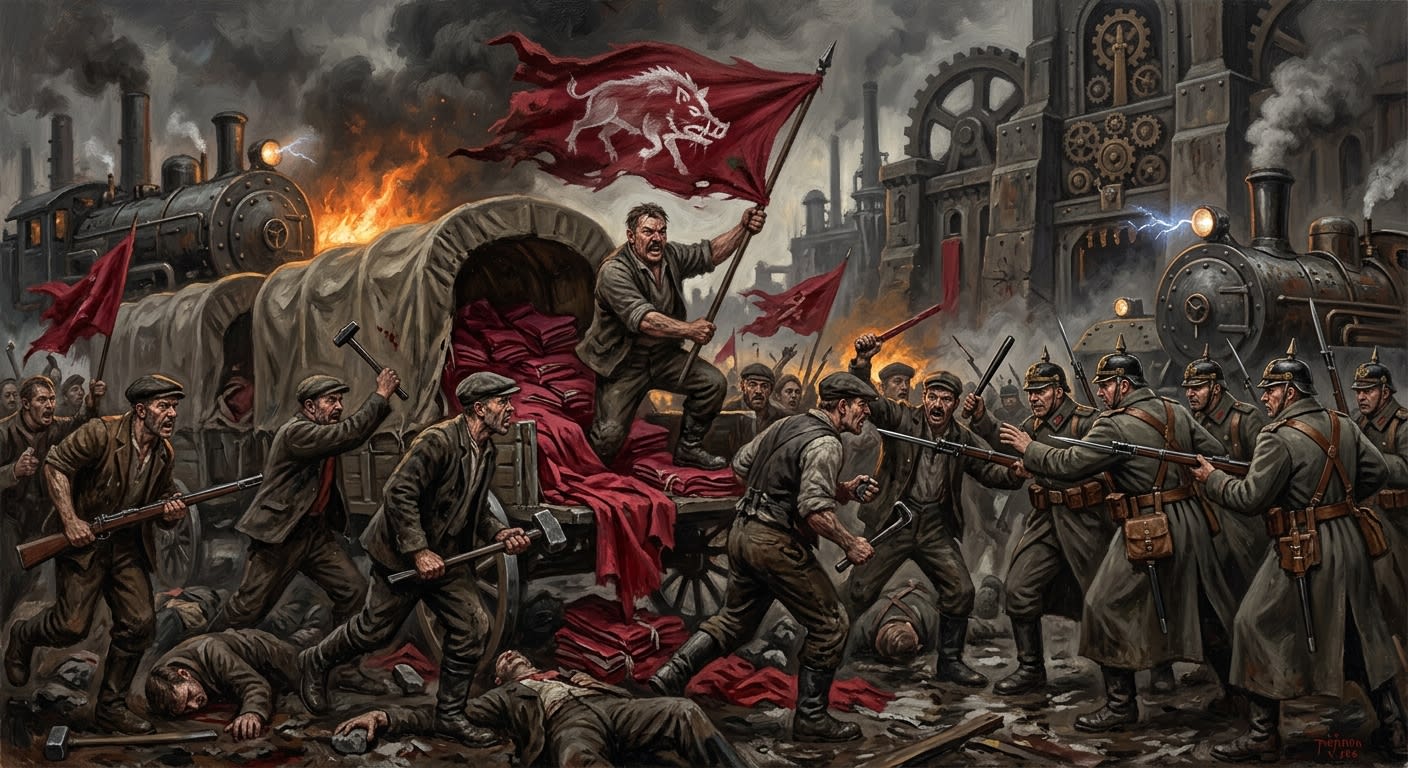
The Crimson Gate Riot of A.S. 106 began at Essen-of-Hymnsteel before the city had learned to sing steel in the approved manner, before the Tri-Bureau Compact fastened its three hands around furnace, ledger, and throat, before Orison renamed the place and pretended the old name had been a clerical error. It was still Essen then: river-fork, forge-smoke, guild pride, rear garrison, soot on every saint, and enough old Saxon memory lodged in the beams to make the Bureau of Heraldry itch.
The gate in question was a supply gate on the western foundry road, later renamed Gate Seven of Measured Entry, then Gate Seven of Corrected Entry, then Gate Seven of No Memorial Plaques. The first name was better. Names usually decline after committees touch them.
The riot is often called the birth-cry of the Beast Proscription. This flatters babies. Birth-cries are innocent. The Riot was an audit in blood.
#On the Quartermaster and His Dead Guild
The quartermaster’s name is not printed in public manuals. I know it. I shall not give it to you, because the common reader makes pets of culprits and then wonders why history bites the furniture.
He served a rear supply office handling flour, lamp-oil, nail kegs, boot leather, and hymn-bronze fasteners bound eastward. His family papers contained convoy rolls from the old Saxon supply guild, defunct since A.S. 30, whose wagons had carried a crimson boar: shoulder lowered, tusk forward, bristles rendered with that hairy vanity peculiar to men who want courage to be visible at a distance. The mark had been legal under the old charter. The old charter was dead. The quartermaster, infected with tradition, revived both on wagon-banners for a shipment due through the foundry gate.
He claimed continuity. Continuity is a respectable word for smuggling yesterday past today’s guards.
The banners were good cloth. That worsened everything. Cheap paint would have flaked. Bad stitching would have made the mark comic. The boar was clean, large, crimson, and proud enough to make any sensible Inspector reach for a scraper blade two years before the Inspectorate existed. It came down the road on fourteen wagons under morning soot, the sort of red that looks darker when the furnaces breathe.
#On the Rumour That Found Teeth
The rear garrison at Essen had been ill-prepared for imagination. This is common among soldiers. They can strip rifles, march in cadence, dig without complaint until their hands split, and still stand helpless before a rumour with a familiar outline.
Reports from Thrace had arrived the previous week: Maldrake’s advance, burning detachments, old militias broken under wrath-heat, and the usual clerical effort to convert terror into morale by stamping it confidential. Confidential news travels faster than public news because everyone entrusted with it becomes briefly important. By the time the convoy approached the gate, half the yard knew that something in the east had put old names on new fires.
Then came the boar.
Some saw Saxony returned. Some saw a dead guild restored by secret warrant. Some saw a wrath-mark, because any red beast with lowered head will become Maldrake’s cousin in a frightened mind. Some saw proof that the Synod had lied about the old houses, the old oaths, the old bargains. The wagon-master shouted for clearance. A corporal ordered the banners lowered. The quartermaster refused, citing archived privilege. Someone laughed. Someone crossed himself. Someone threw a coal hook.
GATE SEVEN WITNESS PACKET — EXCERPT, THIRD HAND “...the boar moved when the first hook struck the pole. I am aware of the penalties for false visual testimony. I repeat: the boar moved. Not as cloth moves. As an animal deciding whether to charge. The man beside me began saying his grandfather’s oath. I had never heard him speak Saxon before.”
The Bureau later attributed the moving to wind. Wind is the old whore of after-action reports. She services every explanation.
#On the Four Hours
Riot anatomy is a clerk’s fantasy. A clerk wants stages: provocation, escalation, breach, correction. The Crimson Gate gave us bodies, ash, hoof-panic, and four hours of men proving that a symbol can command faster than an officer.
The first deaths came at the wagon rail. Two teamsters crushed under their own wheel when the lead oxen bolted. A garrison boy stabbed a banner-pole as if killing the cloth would kill the alarm. The pole snapped; the boar fell across flour sacks; men surged to seize it, tear it, kiss it, burn it, carry it, hide it, or use it as a charge standard. Every verb was treasonous by noon.
Wagons burned in the second hour. Flour burst into white clouds that stuck to blood and made the dead look dusted for storage. Two oxen were bayoneted because their yokes bore the same small boar-stamp as the banners. A chapel bell began tolling without license, probably pulled by a frightened sacristan, and the sound drew workers from the forge lanes. Once the bell joined the shouting, the event became civic. Bells do that. Ask the Bureau of Bells, preferably after securing a chair.
By the third hour, men who had never cared for Saxony were yelling Saxon claims, men who hated dynasties were defending the boar as ancestral right, and men loyal to Strasbourg were striking other loyal men for failing to strike the correct disloyal man. The old guild device did not create these loyalties. It gave them a mouth.
The fourth hour ended under Purity cordon and War batons. The surviving banners were seized. The quartermaster was extracted alive, an administrative insult still discussed in respectable side rooms. Eighty-seven deaths entered the confirmed column. The missing, trampled, smoke-sick, later condemned, and quietly transferred were assigned to other ledgers where grief becomes harder to add.
#On the Bureau’s Conclusion
The obvious culprit was the quartermaster. Obvious culprits are vulgar. The Bureau of Heraldry examined the banner, the gate scrape marks, the yoke stamps, the witness packets, the bell schedule, the surviving flour sacks, and the charred pole ends, then reached a finer conclusion: the boar had done it.
This was nonsense of a high order, which places it close to theology. The boar had no hand on the coal hook. The boar rang no bell. The boar issued no order to charge. Yet the boar gathered fear, pride, rumour, lineage, wrath, and municipal boredom into a single visible command. Men obeyed what they thought it meant. Meaning killed them.
The Armorial received the incident first as a cautionary note, then as a restricted plate, then as precedent. In A.S. 108, the Beast Proscription arrived with its sorted zoo of permissions and anathemas: lions shaved into geometry, eagles broken into chevrons, stags reduced to angles, wolves and serpents banned, bears suspended into that blessed swamp called review. The crimson boar received the phrase that made the Riot immortal: heraldic heresy.
Early street summaries claimed the Riot proved Saxon loyalism remained militarily organised inside Essen.
Corrected. Saxon loyalism did not organise the Riot. It benefitted from being suspected of organising it, which is the cheaper half of politics.
#On What Was Founded There
Two years after the Proscription, the Inspectorate of Visual Compliance was constituted in A.S. 110. Forty-three licensed Heraldic Examiners received grey coats, brass eye-badges, swatch sets, Codices of Permitted Symbols, and scraper blades. The first Codex contained eleven errors. Three guilds paid for them. That, too, is founding.
The Riot gave Heraldry its favourite doctrine: if it rallies, it is dangerous. A beast on a banner, a chalk horse on a school wall, a wolf stitched in a sleeve lining, a serpent carved beneath a widow’s lintel — each became a possible Gate Seven in miniature. The Inspectorate learned to scrape early because Essen taught what late correction costs.
Saint Verral of the Clean Field was painted into Inspectorate shrines with his hot blade and his suspiciously blank wall. Casselius of Mainz, born later into a world already improved by other men’s catastrophes, would make such suspicion elegant enough to frighten brass bells.
#On the Gate Now
Gate Seven still stands. Essen-of-Hymnsteel has since grown furnaces around it, renamed it twice, measured its hinges, replaced its stones, audited its bell-line, and installed a plaque that does not mention the boar. The blank space on the plaque is the most honest object in the district.
On certain mornings, when furnace soot turns red at the edge and the shift-bells arrive a breath late, workers say the gate smells of flour. Inspectors assigned there check wagon cloth twice. No animal device passes. No crimson cloth enters without swatch comparison. No quartermaster is permitted to cite ancestral privilege inside thirty paces of the rail.
Public guide-sheets describe the Crimson Gate Riot as “a regrettable misunderstanding arising from obsolete convoy insignia.”
Clarified. It was not a misunderstanding. The sign was understood too quickly.