
#On the Chancellery's Charge
"The eye is a mouth. Feed it only law."
Every house that ever hung a shield over its door believed the animal on it belonged to the family. The lion was a grandfather's courage. The eagle was the guild's long sight. The stag was some drowned forester's claim to a wood that has not stood since before the Sundering. The Bureau of Heraldry disagrees. The animal belongs to the Armorial of the Faithful, which licenses every insignia under the Concordat's authority, and the family borrows it on terms.
The Chancellery of Permitted Animals is the office within Heraldry that keeps those terms. Its clerks decide which beasts may survive on lawful insignia, in what shape they may survive, and what becomes of the ones that may not. My definition comes from the work I have watched the office do, because its charter has never crossed my desk, and I have asked for it. The Bureau's own account places Chancellery clerks in the Chapter Hall of Worms in A.S. 108 with their blades out. A department's founding papers may be mislaid in any vault in Strasbourg. Its scrapings are harder to lose.
The beast is one compartment of the Armorial among several, and the Chancellery's writ runs only as far as the beast runs. A lawful lion in an unlawful crimson still earns a citation. It is simply someone else's citation. The hue belongs to the Chancellery of Colors, the registration belongs to the ordinary clerks of the Armorial, and the fee belongs, as ever, to the Bureau of Tithes. Permission for the creature has never been permission for the crest.
#On the Proscription
"Scrape it now or bleed later."
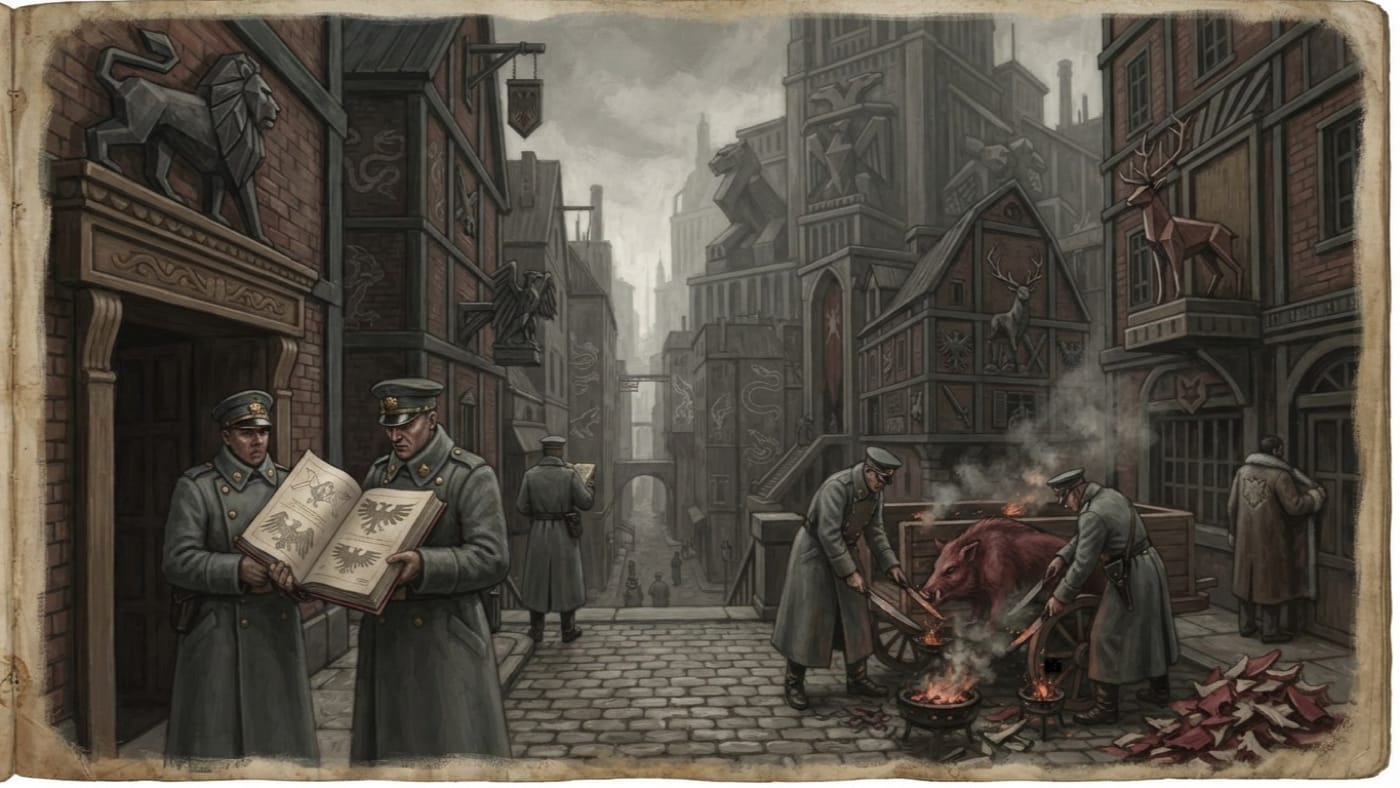
The office took its present form because of a riot. In A.S. 106 a supply convoy entered the gate at Essen-of-Hymnsteel under wagon-banners bearing a crimson boar. These were the arms of the old Saxon supply guild, defunct since A.S. 30. A quartermaster with a fondness for tradition and no ear whatsoever for politics had revived them. The rear garrison was already frightened. It looked at the boar and saw an old dynasty come back, or something wearing that dynasty's face. I record the garrison's reading. I do not endorse it. The Crimson Gate Riot lasted four hours. Eighty-seven people died. The wagons burned with the supplies still in them.
Two years later the Bureau issued the Beast Proscription. Heraldry's own account of its execution at Worms records fourteen hundred crests defaced in the Chapter Hall, the lions first and the eagles last. I did not count them. I observe only that the lions and eagles went under the blade in their old dress, all mane and feather and glaring eye, and that both species are lawful today in a cut the Chancellery approves. The scraping at Worms was the first clause of the sentence. The geometry was the second.
#On the Animals That Remain
"Beasts bite from paper."
Before the Proscription, the arms of the faithful carried every animal that European vanity could afford to paint. The Proscription banned the beasts.
ERRATUM — A.S. 201 — This Survey
The preceding sentence states that the Proscription banned the beasts. It banned two outright: the wolf and the serpent. Lions, eagles and stags remain lawful in stylised canonical form. Bears are suspended pending review. The crimson boar of Saxony is condemned by name. The Warden regrets his economy of phrasing and has submitted the sentence to the Chancellery for correction to approved geometry.
The lawful arrangement, then, in four ledgers.
Permitted in canonical form: the lion, the eagle, the stag. The decree's phrase is "stylised canonical form." The Chancellery reads it as angular, geometric and stripped of naturalism until the creature resembles a diagram of itself. A canonical lion has a mane of straight strokes and no expression at all. The clerks who wanted it that way understood the Proscription better than anyone.
Banned outright: the wolf, the serpent. No canonical form exists for either. To the frightened minds of the rear, a wolf on a child's blanket meant recruitment, and a serpent over a counting-house meant a bow to Greed. The Chancellery did not invent those readings, but it ratified them.
Suspended pending review: the bear. The review opened in A.S. 108. As of A.S. 201 it has not closed. The decree does not say what a bear may do while it waits. The houses that carry one have learned to keep it indoors and quiet, like an uncle under indictment.
Condemned by name: the crimson boar of Saxony. The decree calls it "an emblem of wrath, a heraldic heresy, and a provocation against the Faithful." No other formal decree of the Bureau has used the phrase "heraldic heresy." The decree names that boar and no other. Readers who wish to test the distinction on their own doors may do so at their own expense.
#On Examination and Correction
"A crest unsealed is a lie with teeth."
Here is an ordinary case, invented for instruction but much like a thousand true ones. A coopers' guild in some Rhineland town carries a stag. It is carved in oak above the hall door, painted on every cart tailboard and stitched in brown wool on the apprentices' aprons. It is a fine animal. It has eyes. It has a wet nose. It has a haunch an honest man could carve a supper from. It is unlawful in every particular except its species.
The device goes before the reference folio and is compared against the authorized forms. The cord measures it. The swatches judge the brown, and the Colors clerks carry that part of the quarrel off to their own rooms. The examiner asks where it hangs, who stands beneath it, and what gathers there on feast days. A stag over a cooperage is one question, and the same stag on a muster banner is another. The decision is recorded, and from that moment the stag is a legal fact. It may be approved in corrected form, ordered repainted, confiscated or erased.
A corrected stag goes through the Armorial's ordinary registration like any other symbol, with its forms, endorsements, wax impression and fee. The animal earns no shortcut.
Then the work moves from ink to wood. A Gate-Carver recuts the lintel into canonical angles, and however deep the chisel goes, the oak keeps the ghost of the old haunch in its grain. The tailboards are scraped with a heated blade. The apprentices' mothers unpick the aprons and are not paid for it. Everyone's fingers sting of solvent for a week.
#On the Hands That Enforce
The Chancellery decides. Others carry the decision into the street. The Sigil Inspectors wear grey coats and brass badges. They carry folios, wax stamps, swatches, measuring cord, citation tags, scrapers and portable braziers to the gates, markets, guild districts and muster yards, and they scrape what the register condemns. The dies that press the wax belong to the Bureau of Masks and Seals, while Heraldry governs what those dies may depict. Both Bureaus answer to Casselius of Mainz, who holds them in personal union while their charters stay separate. The Bureau of Records files this arrangement as irregular. Nobody has filed it as a complaint. When guilds rioted over the Proscription, the Bureau of Purity handled the riots and Heraldry handled the paperwork.
The poorest pay the most. A guild that carried a wolf for six generations must choose a new device, pay to register it, and explain to its funeral banners why the grandfathers marched under something that now draws a citation. Convoys once knew one another at a distance by the beasts on their tailboards. After the Proscription, recognition passed to the register, and the dawn gate inspection learned to read geometry where teamsters had read animals. A cobbler with a painted lion over his door loses a day's trade to the repainting and a week's wage to the fee. He keeps the lion, in a manner of speaking.
#On the Present Register
"A clean field is a quiet field."
The Armorial records obedience, and the alleys record something else. Wolves are embroidered inside coat linings where only the wearer and the laundress see them. Children wear beast pins. The Inspectors confiscate them and older brothers replace them. Chalk serpents appear on tenement walls overnight and are scraped off by noon, which teaches the hand with the chalk nothing except the hour of the Inspectors' rounds. A stag can be cut with such scrupulous geometry that it gains an extra point of antler. A certain sort of person in a certain sort of tavern reads that point as a tooth.
The Chancellery's register knows none of this. It records the corrected lintel and not the apron that went into a cedar chest still stitched. Inspectors who sell clearances widen the gap from the other side. They approve near-forbidden devices for guilds and gangs who pay in dye, fuel and wax, and every such clearance enters the record as compliance.
The bear waits. The boar is scraped wherever it is found. The wolf lives under the coat. The lion, angular and expressionless, hangs over the doors of the faithful exactly as the Chancellery intends, and few now living can remember what it was meant to look like.