
Consulted the continuity file, the style guides, and the related Heraldry, Hall of Seals, and Chancellery articles. Now writing the article.
#On the Room Where Symbols Are Chained
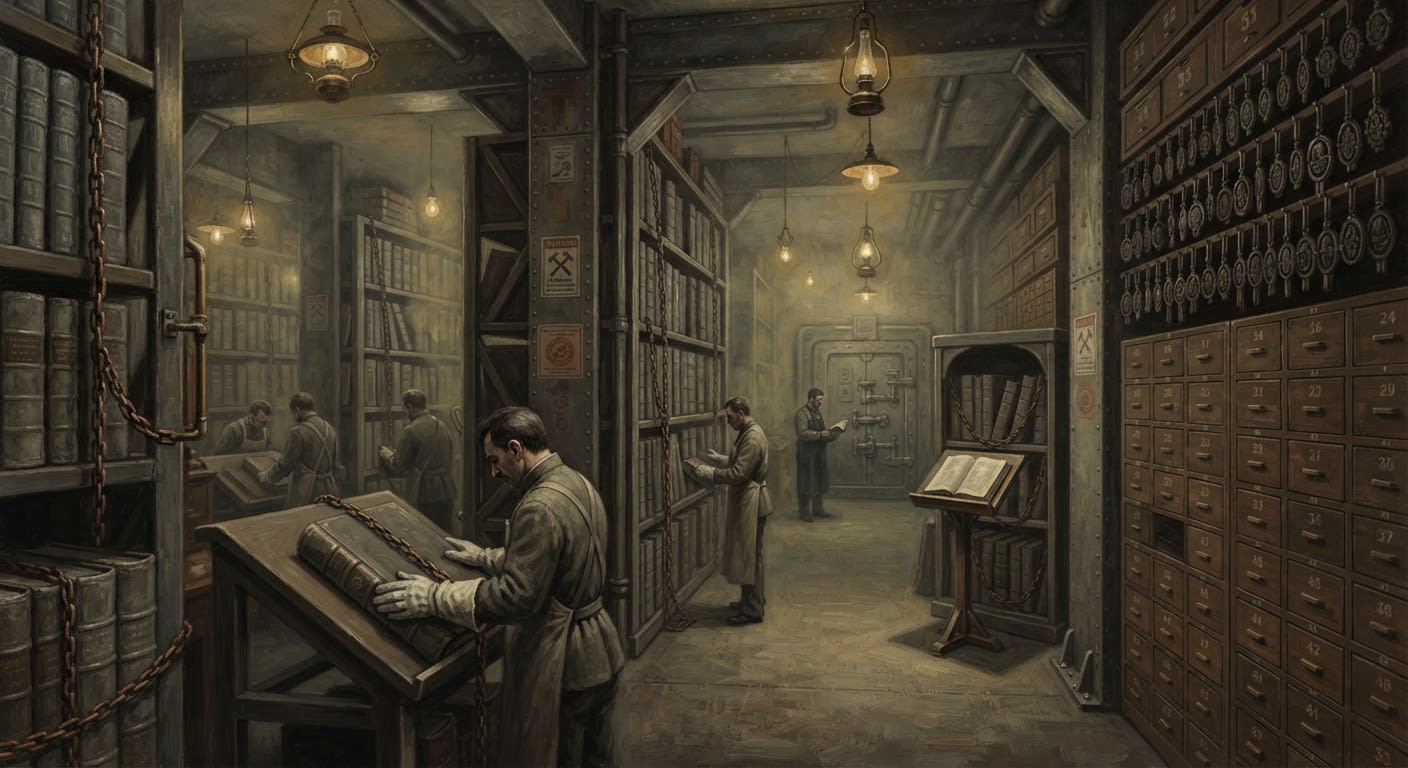
The Armorial Vault lies under Strasbourg, beneath the precinct of the Bureau of Heraldry, down stairs that the clerks count aloud because the Bureau has never trusted a staircase to keep its own tally. The Armorial of the Faithful exists in many forms: quarterly codices, provincial abstracts, and extracts copied by Sigil Inspectors onto oilcloth. Its body lies here. Upstairs a symbol is something a citizen paints. Down here it becomes a legal fact, carrying a number and a chain.
The shelves groan. I have heard them. They sound like old choir-stalls taking weight after a long vigil. The folios on them stand taller than choirboys and weigh more than most deacons. Each one is bound in grey calf and riveted to an iron chain, and the chains run by district. Every banner of a single diocese, guild, and ferry company answers to the same length of iron, so a clerk who wants the mourning chevrons of Speyer can't wander off with the ration marks of Trier. Order is kept by chain. The Bureau finds this more reliable than honesty and cheaper than guards.
The colour plates are stored flat in cedar drawers, because rolled pigment cracks and cracked pigment breeds appeals. The wax impressions hang in numbered cabinets, one after another, like reliquaries for small, hard, faithless saints. The air smells of cedar, tallow, iron, and the vinegar the clerks use on their fingers. Nothing down here is beautiful by accident. Anything beautiful has been licensed.
#On the Descent Beneath Strasbourg
The Vault began as an ambition before it had any walls. The Armorial itself dates from A.S. 58, when a desk in the back of the Records chancery was told to catalogue six hundred and eleven banners, and those fitted in a cupboard. By A.S. 72 the desk had grown into a division and the cupboard had grown into a grievance. Then came the Concordat of Strasbourg in A.S. 90, where Heraldry received its charter, its seal, and Theobald of Worms. Theobald did what every new Archon does with a new seal. He demanded that everyone else surrender theirs.
Every diocese, guild, chapter, ferry company, infirmary, conscription depot, orphan house, cemetery, ration mill, bridge toll, bell foundry, and charitable kitchen was ordered to submit impressions of its marks. Wax came by the cartload, painted boards came by mule, and banners came folded in oilcloth, stinking of rain and pedigree. The first vault filled within eleven months of the order. Heraldry treated this as a proof of zeal. Records treated it as a proof that Heraldry had been given too little space, and argued the point for a generation, and lost.
A Strasbourg pilgrim's guide describes the Armorial Vault as "the crypt beneath the Cathedral where the seals of the Faithful are forged."
Withdrawn. The guide has confused the Vault with the Sigillary, which lies three levels under the cloister stones on the eastern descent of Strasbourg Cathedral, under Masks and Seals. The Sigillary makes dies. The Vault keeps what the dies may lawfully say. No pilgrim is admitted to either, which makes the error harmless and the guide's printer liable.
Today the approach runs from the Hall of Seals, where citizens queue at the colour windows under forty-three lawful Triune Knots. Behind the hearing bays is a door with no knocker. A warden stands before it holding a register instead of a halberd. His authority is greater than a halberd's, and it chafes less. Beyond the door the stairs turn three times, and at every landing the visitor's lamp is examined for an approved flame-colour. The clerks call the lowest working floor Sub-Level Three. Records disputes whether sub-levels may be numbered from a floor that has no registered name, and the dispute is on file there too.
The Chancellery of Colors keeps its palette rooms east of the Vaults, downwind of the dye-works. On boiling days the madder fumes come down the ventilation shafts and turn every lamp on Sub-Level Three faintly penitential. The Chancellery has been asked to stop, and it has asked to see the shade in question.
#On Folios, Wax, Colour, and Counterfeit
The Vault holds four kinds of material.
The district folios are the Armorial as it is written: province, district, function, colour, geometry, motto, sanctioning office, permitted material, permitted scale, approved occasions, and the penalty for enthusiasm. They are corrected with scrapers so fine that the vellum under an old entry turns thin as a scar. Withdrawn marks stay on the page with a ruled line through them and a date beside the line. The Vault never forgets a symbol. It files the symbol's death certificate.
The colour plates in the cedar drawers are the master proofs from which every quarterly swatch is checked. The clerk who opens a drawer has to wear cotton gloves and hold his breath over the plate. Moist breath dulls sanctioned crimson toward tolerated vermillion, and nobody wants to be the clerk who changed the law by exhaling.
The wax impressions hang in the cabinets by number, each one the original seal a house, guild, or parish surrendered under Theobald's order or since. When a seal is disputed at a tribunal, it's the wax in the Vault that testifies. It tends to make a better witness than the person who owns the seal.
Then there are the entries that fit no category and trouble every clerk who touches them. The A.S. 200 audit counted 2,814 duplicates. Some are true duplicates. Others are two guilds that each insist the other copied, and Heraldry registers both until one of them goes bankrupt. It counted 411 impossible entries: marks that can be described exactly and can't be drawn, as if their makers had been working to a different geometry. And there is one entry pending clarification since A.S. 93. Its folio sits on a lectern of its own, under a lamp that stays lit. The clerks go past it quietly.
Vault-Keeper's Night Register, Sub-Level Three. Entry pending clarification since A.S. 93 found open at dawn. Lectern undisturbed. Chain intact. Entry text unchanged, except that the sanctioning office now reads ████████████. No clerk admits to the correction. Lamp oil unconsumed. Folio closed and re-sealed. Duty rota amended so that no clerk walks the lectern row alone.
The counterfeit annex is sealed behind a second door, and its warden answers to Casselius personally. It holds false seals, forged muster badges, bootleg Knots cut at the withdrawn angles, dye-cheat swatches aged in chapel smoke, and a lead-lined rack of confiscated banners rolled tight as bandages. Among them is the crimson boar the Crimson Gate Riot made famous: the flag taken from a burned wagon at Essen-of-Hymnsteel in A.S. 106, which is spoken of with more respect than the eighty-seven dead. The Bureau keeps false symbols so that they can be destroyed correctly. A forgery nobody can compare against is a forgery nobody can prosecute. Apprentice Sigil Inspectors are brought here to learn the lie before they learn the law, and some of them learn to admire it. Those are sent to the Purity liaison for a talk.
#On Supplements and the Violence of Being Current
Every quarter the Vault issues its supplements. Clerks copy the season's additions, withdrawals, corrections, and reclassifications out of the chained folios, and they are bound into the chromarch codex and sent to provincial inspectorates by coach, barge, and courier. On the day they are copied, every supplement is accurate. By the time it reaches the Line, none of them is.
The Bureau calls this the interval of transmission. Inspectors call it the grace that doesn't exist. Somewhere between Sub-Level Three and a gate at Metz, a lawful mark becomes an unlawful one, and the shopkeeper who painted it in good faith is liable from the moment the folio changed, whether or not word has arrived. The Vault is always current and the rest of the Synod never is. The distance between the two is where the fines come from.
Standing Order 14-C, revised in A.S. 187, put this principle to the test when forty-seven Knot variants were cut to forty-three. The four withdrawn geometries were struck through in every district folio in one week. They took most of a year to disappear from the provinces. Every lintel carved in the meantime is recorded in the Vault as an administrative inconvenience, and the Vault holds the list of carvers so that the inconvenience can be revisited.
#On Casselius's Present Vault
Under Casselius of Mainz, who holds Heraldry and Masks and Seals in personal union, the Vault has grown teeth. In A.S. 200 his audit counted 347,211 registered entries. Heraldry's own estimate puts about forty thousand unregistered symbols in circulation. Casselius does not treat that figure as a gap in the Armorial. He treats it as a backlog. He has had empty folios bound and chained ready for them, pre-ruled, district by district, waiting for the chalk marks of Cologne and the cellar crests of refugee houses to be scraped, sketched, and pinned to the page.
He comes down unannounced. The clerks can tell because the chains stop swaying. He is said to compare wax against wax with his ear to the cabinet door, as though the impressions could confess. The chevron dispute on Sub-Level Three has been open since A.S. 193, and he has refused to rule on it. He says an unresolved dispute trains the clerks better than a settled one.
Earlier Heraldry circulars called the Armorial Vault "a repository of the Synod's heraldic heritage."
Corrected. "Heritage" suggests the marks belong to the people who made them. The Vault holds them in custody. Nothing it holds may be inherited without a fee, a form, and a surviving witness.
Go down to Sub-Level Three if a summons takes you, and look along the chained rows. Each entry records a mark that somebody once drew freely. Each cabinet holds a seal that somebody once pressed without asking. Each drawer holds a colour that has since been told how bright it may be. The Vault does not preserve symbols. It preserves the right to punish anything that resembles them.