
#On the Corridor
The Danubian forward corridor is the stretch of river, bank and approach along which the Synod sends what it needs from Budapest to Bastion-Irongate, and along which it sometimes fails to. It starts where Budapest's western-bank yards release their freight and ends where the cannon on Irongate's two cliffs take responsibility for it. Between those two certainties lies a great deal of water and remarkably little paper.
No charter founded it, and no decree set its limits. The Bureau of War treats the corridor as a fact of supply rather than of geography: a run of reaches, fords, ruined piers and approaches that happen to lie along the documented axis between the staging hub and the gorge. No folio I have been permitted to read records its length. Quartermasters argue over its intermediate stations and name them after the wagon-ruts, chapel stumps and drowned works they last saw standing. Its three most famous passages have names only because enough men died at them to need headings.
The word forward is meant literally. Budapest is a Zone 3 city. Irongate is a Zone 4 strongpoint on the middle-southern Sagittal Line, at the Iron Gates near Orsova, where the river has cut a gorge narrow enough to be governed by chain-booms. The Line runs north to south. The Danube was consulted by no council and keeps to its own course. The corridor is what you get when an army asks a river to serve as a road, and the river declines without quite refusing.
#On Passage and Provision
The Central Corridor carries men and matériel east to Budapest. There the divisions part: some go toward Bastion-Sibiu and the Transylvanian wall, and some go south along the river toward Irongate. Quartermasters say "the Sibiu–Irongate corridor" when they mean the grain and "the Danubian forward corridor" when they mean the danger. I have found no difference between the two in the manifests.
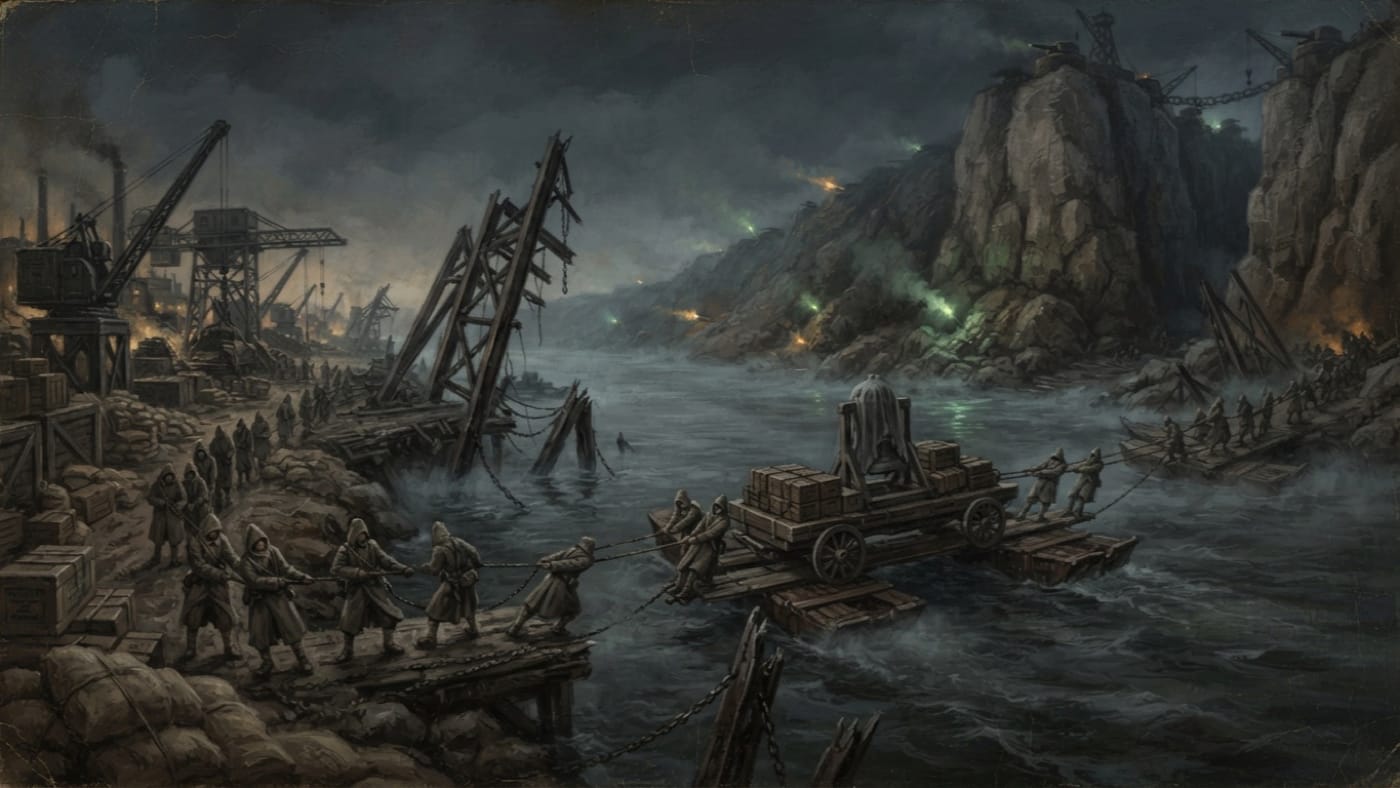
The cargo can be listed, and the Bureau prefers it listed. Rifle cartridges travel in waxed crates. Grain travels in sacks that rot when the cloth gets wet, and the cloth always gets wet. Consecrated bridge-chain is blessed by the link and paid for by the pound. Portable bell-frames go because a bastion that cannot ring can neither count its dead nor warn its living. Sealed reliquaries go too; their contents are classified and their weight is not. Every item has a purpose at Irongate. Irongate's purpose is to hold the river, and the river is the only road that can feed Irongate in the quantity it eats.
That is the corridor's whole difficulty. A road can be paved, walled and patrolled. Water has to be crossed, and at the places where the Synod's route crosses it, most of the Synod's bridges no longer exist. The forward reaches are an ossuary of former works: piers without spans, pontoons without decks, and fords that a tribunal of engineers would call theoretical. Every wagon that reaches the gorge has been hauled, floated, chained or carried across at least one of them.
The Litany-Engineers keep up whatever can be kept up. They drive iron, string cord, recite the right verses over the right rivets and sign for the rope. The Bureau of Records counts wagons out of Budapest and counts them in again at the southern works. The gap between the two numbers is the corridor's annual sermon.
#On the Hostile Bank
In the daily reports, the far bank belongs to whichever adjective the reporting Bureau prefers. It is contested in the morning, hostile by noon and administratively inconvenient in the evening dispatch.
Its principal tenant is Morwen, whose sin is Envy and whose front runs along the western Balkans and the Danube approaches opposite Irongate. She does not want the river. She wants what the river carries, and if she cannot have it she wants nobody to have it. Her influence works on the tools of passage themselves. Guide-posts point against their own directions, and reflections on the water disagree with the bank that casts them. A column that trusts its eyes will eventually march somewhere it was never ordered to go.
She has company, though there is no evidence of partnership. Velmora's assessors belong properly to Sibiu and the gold-veins, yet some have been found near the crossings carrying the private accounts of soldiers who never signed a commercial paper in their lives. Maldrake, whose main business lies at Constantinople, lent the corridor his forward batteries for at least one memorable night. Farther east, the Blightmarsh spreads in Kargath's name, and staff rooms speak of Debrecen the way surgeons speak of a limb they have not yet taken off.
Counted by the hour, the worst enemy is the river. The current pulls sideways. In a forward winter the water is cold enough to stop a hand on the cord. Visibility fails in smoke, in fog and in the dark that every serious crossing prefers. Every broken pier gives the enemy cover and threatens the hull. The Sin-Generals claim credit for a great deal along this reach. The Danube claims nothing and does most of the work.
#On the Night That Kept the Route
The corridor earned its file in A.S. 172, in the operation the Bureau of War has since gilded as the Night of the Three Bridges.
A sudden enemy advance pinned a supply column bound for Irongate's southern works against the western bank. It had forty-seven wagons carrying rifle cartridges, consecrated bridge-chain, three portable bell-frames, two sealed ossuary reliquaries, and enough grain to carry the Sibiu–Irongate corridor through its next rotation. The enemy held the opposite bank. The river was high. The bridges were gone.
Warden-Submarshal Calev Rohn ordered the Vexillators of Strasbourg forward under Bureau of War authority. Three passages were assaulted at once: Saint Hadrien's Ford, the Chain-Pier Ruin and the drowned pontoon at Mark Seven. None of them was a bridge. Each was a place where the corridor's damaged works offered something to stand on, cling to or drown against. At the ford, Litany-Engineers drove pegs into the mud and ran guide-cords across the current. At the ruin and the pontoon, men climbed whatever remained and stepped on things they could not see. The standards went in with them, because a soldier with the river in his mouth follows cloth once he can no longer hear orders.
The official account is exact about its minutes, and I respect exactness when it is not aimed at me. The assault columns crossed in less than seven minutes. The Vexillators had formed on the eastern bank by the ninth minute. The first wagon-chains were hauling by the fourteenth. The supply column finished crossing by dawn. The seven minutes belong to the assault, and the wagons took the whole night. Recitations at levy musters tend to merge the two figures, so Continental Levy recruits picture forty-seven wagons rolling over the Danube in the time it takes to sing a psalm.
The cargo reached Irongate. The southern works held through the winter. The enemy advance stalled long enough for reinforcements to come up through the Central Corridor. The route was kept.
#On the Revised Account
The Bureau of War ratified the operation as a miracle of locomotion and martial obedience. In War's reading, the Creator carried the men across. In the veterans' reading, they swam in full equipment through freezing water, hauled themselves along the cord, steered by banners through the smoke and shoved the man in front. Both readings are on file. Only War's is recited.
The original roll listed 4,200 men dead, drowned, missing, frozen or otherwise removed from formation. On review the figure was split into 1,800 casualties and 2,400 martyrdom-translations. Both categories cover the whole operation. No Bureau has divided them among the three passages, and I decline to do it for them.
A Rhineland digest in circulation places the Night of the Three Bridges at Mainz, Worms and Cologne, dates it to A.S. 207, and describes mass refugee drownings and a lost Processional Band.
Corrected. Strasbourg's Vexillators fought the Night in A.S. 172 on the Danubian forward corridor between Budapest and Bastion-Irongate. The Bureau of War's own entry on the Danubian charge has always said so. A.S. 207 has not yet occurred.
The reclassification has a price, which is to say it produced a saving. A casualty entitles the family to a pension, formal notice, the man's effects and a burial allocation. A translation entitles them to a certificate and a commemorative ribbon. The corridor's dead are accounted for in whatever form the treasury finds easiest to bear.
One more document belongs to the river rather than the battle. A Bureau of Shadows memorandum of A.S. 173 records patrol reports of voices under moving water near Mark Seven, one of them giving tactical instructions. The memorandum certifies nothing, and neither do I.
#On the Reach in the Present Record
As of A.S. 201 the registry describes both ends of the corridor and leaves the middle to the quartermasters. Budapest is still the forward staging hub. Its western bank is Synod-held, and its eastern districts, abandoned since A.S. 120, are entered as contested. Divisions still leave the west-bank yards for the south. Irongate still holds the gorge, with batteries on both cliffs and chain across the water, and Morwen still sits opposite it.
The record says nothing about the present state of the three passages. I can find no survey of Saint Hadrien's Ford since the Night. No certificate says whether the Chain-Pier Ruin was rebuilt, cleared or abandoned, and no engineer has stated whether the pontoon at Mark Seven still lies where it sank. I cannot say whether the cords are still pegged. War has not asked, and Records has not been told.
The corridor is what it was before the Night made it famous: a requirement written in water and met with rope, cartridge-crates and men willing to wade. Its supplies arrive, mostly. Its losses are classified, eventually.