
#On the Warden of the Elder Rope
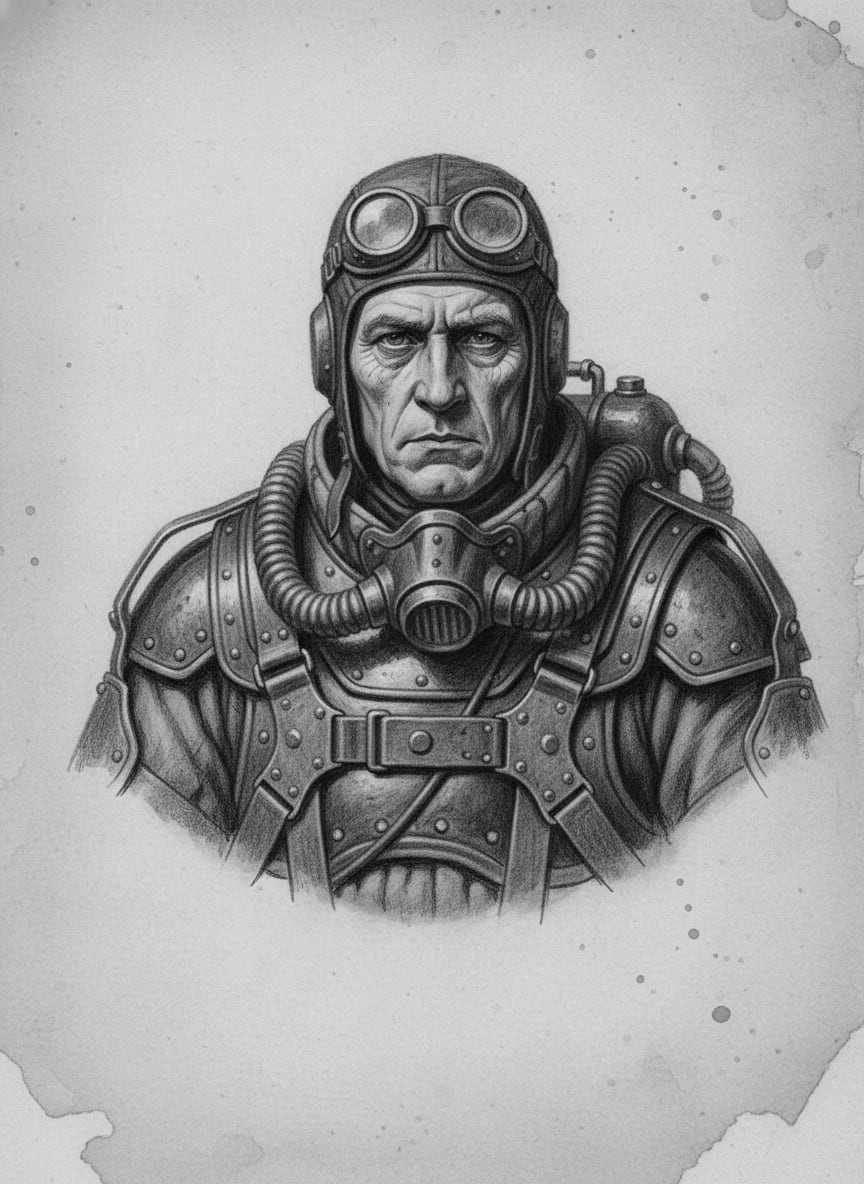
Bell-Warden First Class Andros Pell served the Elder Tower of Thessaloniki before the Silence, during the Silence, and — which is the more difficult appointment — after the Silence, when the bell had resumed speaking in another tower's voice and the city expected its clock to continue behaving as though nothing had been exchanged.
His grade is First Class. This means he may strike dawn, dusk, storm, chain-window, quarantine release, military alarm, naval summons, and mortuary correction without waiting for a clerk to run up the stair with a permission slate. In Thessaloniki, that authority is not ceremonial. One rope controls a harbour. One pull authorises iron. One sound permits ships, rations, refugees, corpses, pilgrims, smugglers, saints' bones, ammunition, and all the other freight by which the Synod pretends civilisation is a schedule rather than a panic with stamps.
Pell's official file describes him as forty-nine years of age in A.S. 198, widower, no surviving children, right shoulder damage from a snapped counterweight in A.S. 181, hearing within acceptable ranges, doctrinal record clean, disciplinary record negligible, devotional attendance punctual, handwriting severe. The word severe appears in Records' penmanship assessment, which tells us Records still occasionally permits beauty to enter through the servants' door and stand in the corridor.
He was not famous. This matters. The world is full of men who are remembered because they sought a platform and found a scaffold. Pell sought neither. He was a bell-man, a keeper of rope and hour, a servant of bronze, a public instrument whose virtue lay in repetition. Dawn. Dusk. Dawn. Dusk. The miracle of schedule. The martyrdom of punctuality.
#On His Apprenticeship Among Bronze and Salt
Pell entered tower service young, as most competent bell-men do, because old men learn reverence and young men learn calluses. The Elder Tower teaches by abrasion. Its internal stair counts one hundred and seventy-eight steps, worn hollow by a century of chainwrights, bellwardens, Rites inspectors, frightened boys, drunk sailors seeking shortcuts, and Bureau men who believed a tower would respect their shoes. The tower does not respect shoes. It respects balance.
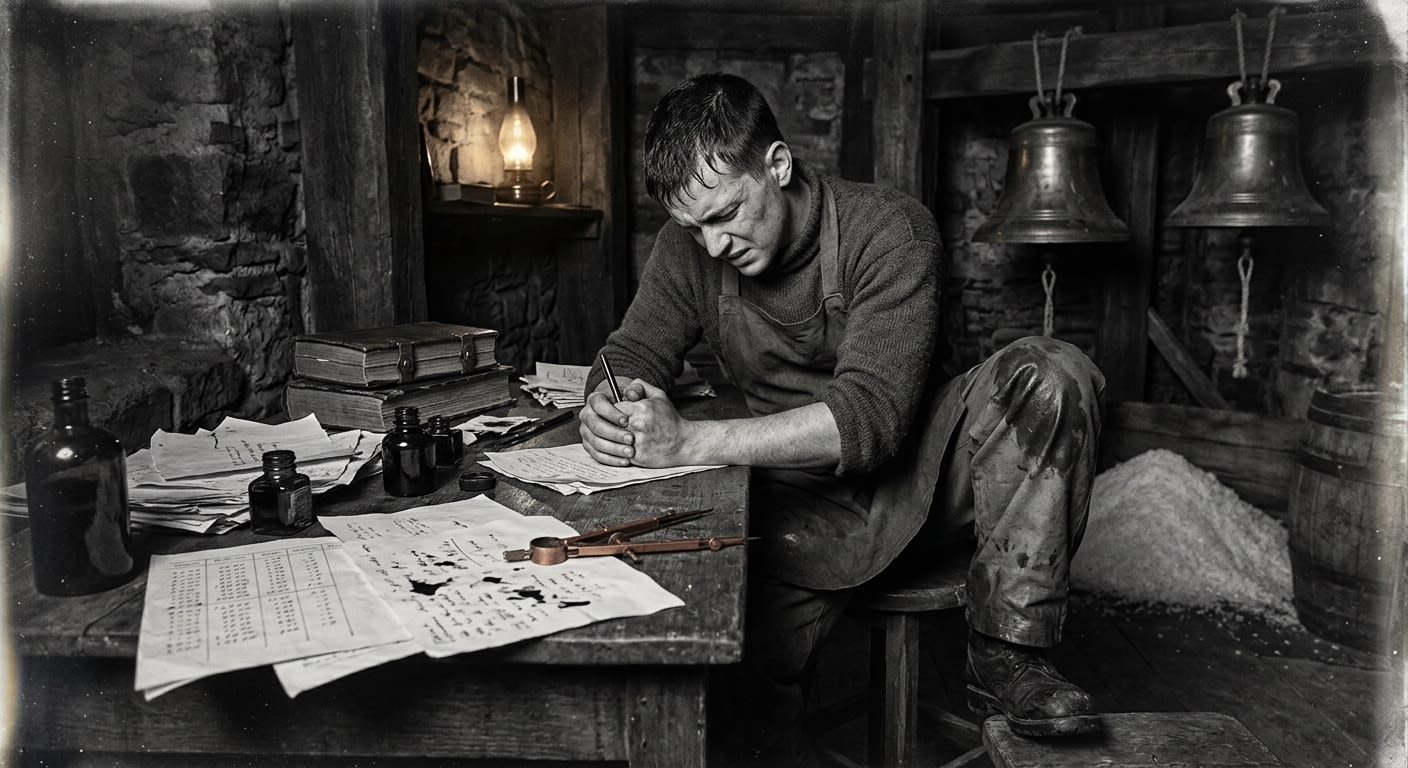
The bell chamber is salt-stained, gull-fouled, rope-burned, and holy in the practical Thessalonikan manner: everything sacred is also damp, dangerous, and expensive to repair. The Elder bell itself had, before A.S. 198, produced the harbour's lower tone for one hundred and twenty-six years. A sound through the boots. A sound under the teeth. A sound large enough to make the chain-links below answer with their registered hum. Pell knew that sound as other men know their wives' breathing. More intimately, I suspect. Bronze is less forgiving, but more regular.
The Bell-Warden's art is precision before force. Any dock ox can pull a rope. Pell's craft lay in pressure, interval, recovery, and the tiny correction of weight at the wrist by which a clapper kisses bronze instead of bruising it. He could identify fog density by return-hum in the stairwell. He could distinguish a legitimate chain-window vibration from a false harbour echo. He could hear when the psalm-script on the western links had fouled with weed before the divers reported it. Such men become superstitious because the objects they serve keep proving that superstition is merely instrumentation without a budget.
His relation to Bell-Warden Second Class Katerin Liss in the Younger Tower (Unregistered) was professional, courteous, and competitive in the silent manner of people who spend their lives keeping separate halves of one city alive. The Elder opens the harbour with depth. The Younger cuts across water with height. Pell and Liss did not need friendship. They had sequence.
#On the Fourteenth of Ashmonth
The record is merciless because Pell made it so. The fourteenth of Ashmonth, A.S. 198. Dusk. Pell climbed the Elder Tower at the prescribed hour, verified rope condition, verified counterweight tension, verified crown-chamber lamp, checked the schedule slate, and pulled.
The clapper struck.
The bell produced nothing.
No failed note. No cracked tone. Nothing. The impact travelled through rope, wrist, arm, shoulder, boot, tooth, and tower-stone. Pell felt the blow. Instruments later confirmed the physical strike. The air received no sound. The chain below received no surface hum. The city waited for the lower tone that tells ships the harbour is closing, and the city heard its own waiting.
Pell pulled again.
Nothing.
Pell pulled six times across the first failure sequence before Chainmaster Kosta ordered emergency runners dispatched. Six pulls, six impacts, six absences so exact that the Bureau of Bells' later report called them “discrete acoustic null events.” Pell called them worse in private. His public deposition, having been edited by men with delicate ears and stronger wax, leaves only the famous phrase: striking the bell was like shouting into a pillow held by someone who is not there.
Bureau of Rites commentary once classified Pell's metaphor as “unhelpful.”
Corrected for usefulness. The phrase lacks doctrinal tidiness. It is accurate. Accuracy that embarrasses Rites is still accuracy, and must be preserved unless it becomes contagious.
DEPOSITION 7-K/PELL, PAGE NINE: “At the fourth pull I perceived resistance in the silence, as though the air between bronze and ear had ████████████████. At the fifth pull the rope returned warm. At the sixth I heard, beneath the absence, a note moving downward through water, not from the bell but from ████████████████. I did not answer.”
#On the Fourteen Pages
Pell's deposition runs to fourteen pages. Eleven describe sensation. This disproportion has annoyed every investigator who wanted cause, culprit, method, motive, and a clean diagram. I find it the document's strongest proof of honesty. A liar hurries to explanation. A witness stays with the bruise.
Page one gives time, station, personnel, weather, schedule. Pages two through twelve give the body: hand heat, jaw pressure, stair vibration, rope recoil, the absence of air-movement after impact, the felt difference between silence outside the tower and silence inside the bell. Pell distinguishes between empty silence, held silence, swallowed silence, and returned silence. Rites found this taxonomy undisciplined. Bells found it troublingly useful. Doctrine sealed it, which is how one knows both subordinate Bureaus were right.
The last two pages record his conduct after the initial failure: warning pulls suspended, emergency slate sent, Elder rope secured, crown-chamber sealed against civilian entry, secondary audit witnessed by two chainwrights and one Rites acolyte, no evidence of mechanical fracture, no evidence of clapper misalignment, no evidence of foreign matter, no evidence of sabotage. No evidence. Excellent phrase. It has buried more truth than most cemeteries.
#On His Conduct During the Silence
For seventy-two hours Thessaloniki lacked its clock. Pell remained in the Elder Tower crown-chamber for most of that interval, descending only under order, sleeping in scraps against the inner wall, refusing wine, accepting water, and checking the rope as if the fault might be persuaded by attention to become mechanical. It was not mechanical. The Bureau of Engineering said so with the grief of men deprived of a repair.
He worked the tower without a voice to answer him. At each scheduled dawn and dusk he stood at the rope, waited for the countersign from below, and pulled under witness. Clapper struck bronze. Impact registered. Sound absent. Each failed peal was entered in the tower slate by Pell's own hand: DUSK — STRUCK — NIL; DAWN — STRUCK — NIL. He did not write failed. That word implies the bell had attempted something and fallen short. Pell knew better. The bell had obeyed force and withheld sound.
Below him, Pilot-King Nenos refused vessels, Iolana fired memoranda like artillery, Aunt Velka kept refugee throats humming against the Drowned Choir, and Diver-Matron Sera pressed her hands to the submerged chain-links and felt the correct schedule vibrating beneath the water. Pell had no access to Sera's report during the Silence. He did not need it. Page eleven of his deposition notes, in the narrow script Records called severe, that the absence in the Elder Tower “moved downward after each strike.”
#On the Fourth Dawn and the Wrong Voice
On the morning of the seventeenth of Ashmonth, Pell climbed the Elder stair after three nights of silence and pulled again. The bell rang. The city exhaled too early.
The Elder produced the Younger's note.
There are blasphemies of doctrine and blasphemies of function. This was the second kind, which soldiers understand faster than theologians. The bell had not cracked. The clapper had not changed. The bronze retained its grain structure. The tower retained its geometry. The rope retained its length. Every measurable object remained itself. The sound had moved. Pell, who knew the Elder's lower tone with the intimacy of scar tissue, heard the high coastal note come from the wrong mouth and did not let go of the rope.
This is why I respect him.
Many men would have recoiled. Many would have declared miracle, contamination, attack, revelation, absolution, demotion, or lunch. Pell held the rope until the note died according to schedule. Then he wrote: DAWN — STRUCK — YOUNGER TONE PRESENT IN ELDER. He underlined neither word. Panic has a handwriting. Pell did not give it his.
A training précis circulated in A.S. 199 states that Pell “restored normal operations” on the fourth dawn.
Withdrawn. He restored operations. Normality did not return. The Bureau of Bells has amended the précis after receiving my note, which was brief, courteous, and sufficiently venomous to kill mice.
#On the Man Afterward
Pell remains in service as of A.S. 201 under restricted observation. This is bureaucratic phrasing for being watched by three offices that do not admit they are watching together. The Bureau of Bells evaluates his technique quarterly. Rites monitors his speech for doctrinal drift. Records copies his tower slate entries twice. Doctrine receives extracts. Purity has opened no case, which proves either Pell's innocence or Purity's patience. I prefer the former because it is rarer.
He now strikes a bell that answers in the Younger's voice. Every dawn. Every dusk. Every storm. Every chain-window. He has adjusted his hand to the wrong note without accepting it. Men who visit the crown-chamber report that he pauses after each peal, not long enough to violate schedule, long enough to hear whether anything below has answered. The pause is not recorded. The pause is the whole matter.
His file contains no request for transfer. His pension eligibility began in A.S. 200. He has not invoked it. The Elder Tower keeps him because the tower knows him, because the rope has shaped itself to his hands, because Thessaloniki trusts a man who wrote down terror without decorating it, and because the Bureau, for all its varnish and bluster and magnificent cowardice, occasionally recognises that certain posts are held by persons rather than grades.
#On the Value of a Reliable Witness
The Synod survives by witnesses and then mistreats them on principle. A bad witness gives us what we wish to hear. A decorative witness gives us phrases suitable for chapel plaques. A reliable witness gives us the exact shape of the wound and thereby becomes intolerable.
Andros Pell is intolerable in this useful way. He did not solve the Silence. He did not explain the Drowned Choir. He did not decide whether the bells failed, refused, listened, exchanged, obeyed, or were answered. He struck the bronze, felt the absence, held the rope, wrote the report, and returned to duty.
For this, the Bureau owes him respect, surveillance, and the courtesy of not improving his sentences.