
#On the Instrument
Synod Directive 88-F, issued through the Bureau of Festivals in A.S. 138 (1848 CE), did two things and admitted to one. Publicly, it made wrist-ribbon stamps mandatory at every Bureau-sanctioned procession. Administratively, it constituted the Receipt-Procession Pageant Captain corps as a licensed profession, with permits, ranks, tools, and a convenient party to blame. The first provision gave the crowd a credential. The second gave the credential a staff.
The common name for the whole settlement is the Receipt Reform. Clerks prefer the number. A reform can be admired; a directive can be enforced, and enforcement is what Festivals pays its people to want.
The scope was drawn narrowly, and on purpose. The directive governs the processions the Bureau itself sanctions: the routes it permits, the feasts it schedules, the gratitude marches it stages. A guild's private parade, a funeral cortège, a wedding party spilling drunk out of a tavern door all sit outside its letter, though seldom outside its interest. In short, Directive 88-F abolished paper.
In short, Directive 88-F abolished paper.
Corrected: Directive 88-F removed the paper slip from the Bureau-sanctioned procession and put a stamped ribbon on the wrist in its place. Permits, route plans, parish rolls, ledger boards and the reconciliation sheets that follow every feast remain paper, and Festivals still consumes them by the ream. The shorthand flattered the ribbon at the mill's expense.
#On the Necessity
The directive was the Synod's answer to Gray Week. Under starvation, open grain audits went into the streets of Strasbourg, Marseille and Munich. A fourth city is still argued over by Bureaus that would rather not own it. Clerks knocked with ledgers and crowds answered with stones. Receipts burned. As a method, the open audit failed in public, and public failure is the only kind an office cannot reclassify.
What followed changed the Synod's posture while leaving its purpose intact. The Synod still required to know who lived where, who ate what, and whose cellar held more grain than its return admitted. It stopped asking at doors and began inviting people out. By the profession's own account, the first gratitude march was used to locate hidden grain: households came out to give thanks, and the curb learned whose thanks did not match their returns.
The Bureau of Records wanted its rolls corrected. The Bureau of Tithes wanted the concealed grain recovered. Festivals possessed the one thing neither of them had, which was a lawful reason to gather a whole district into one street at one hour and make it glad to come.
Directive 88-F turned that reason into standing procedure. Paper slips had served the early marches badly. A slip could be dropped, traded, burned in a font, or tucked into the wrong coat. A ribbon on the wrist could be read from a float.
#On the Wrist and the Register
The mechanism is simple enough to chalk on a slate, which is how Pageant Captains teach it.
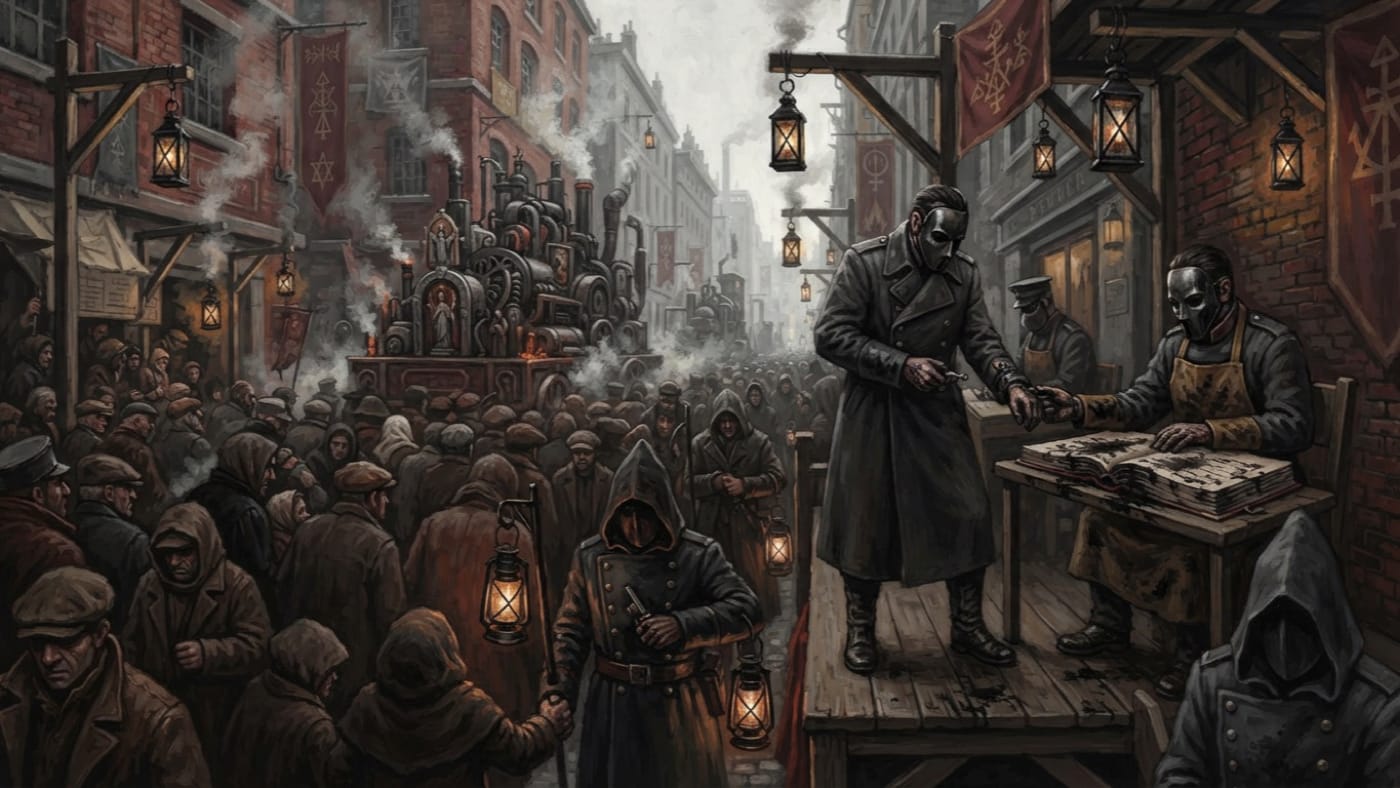
Ribbon stock is issued under count. Before the procession, Ribbon Runners pre-stamp a portion of it and hold the rest back for the curb. On the day, the citizen presents a wrist and the runner fixes the ribbon and drives the punch. The stamp block then marks the feast, the district and the station. The ink stains, and within a season every Captain's fingertips are as black as a coal-heaver's in the Church's employ.
Route Marshals design the path to narrow where the tally stations stand. Drum-Coders set a tempo that makes the crowd pause at those narrows long enough to be read. At each curbside station a team works the ledger board, checking wrist against roll, face against name, and punch pattern against station. A matched wrist passes. A wrong stamp, a missing stamp, or a ribbon worn by someone the roll insists is dead becomes an anomaly. Anomalies are led aside to a tent with a cheerful awning and a single chair.
Reconciliation night comes after the last float. The Captain sets attendance against the rolls, writes the anomaly list, seals it in red wax and sends the totals upward. The street experienced a feast. Records receives a corrected district.
The public language of all this is gratitude. The catechisms say that joy leaves a trace, that all gifts require witness, and that receipt is remembrance. Priests bless the punch-tools. The directive's provisions, as this Codex records them, make no mention of census, concealment, deserters or hidden grain. The profession's surveillance mandate has never been written down, and any Pageant Captain will assure you from behind a lacquered mask that it does not exist. On the matter of the writing, he is correct.
Saint Caldrin the Jubilant Scribe presides over the corps as its recognised patron. He is painted smiling, with ink-black hands, a ribbon-punch in one and a receipt-scroll in the other. The saint lends the ritual its holiness. This file does not say whether he lent the directive anything further, and the reader who asks has mistaken a devotional print for a minute book.
#On Custody and Evasion
A credential is worth exactly as much as the hands that hold its tools. Once Directive 88-F made the ribbon compulsory, everything that produces one became valuable: stock, dye, punches, stamp blocks, route seals and the drum-code slate. Inventory descriptions of the Reform mention district punch codes and custody over ribbon dies. The specifications are Festivals' business and stay in Festivals' drawers.
From the start, the profession lived on permits. A Captain without a sealed permit is a man with a drum. Permit fees paid the stipends. Paper allotments fixed how many ribbons a Captain could stamp. A Ledger patron decided whether he kept his route at all. The licence that 88-F created was also a leash, and the Bureau held the other end.
Evasion arrived with the first feast and never left. Blank ribbons, pilfered from stock or kept back "as spares," pass for clean ones in poor light. Counterfeit seals copy the stamp block with fair accuracy and cheap ink. Quiet ink lasts through the procession and fades by morning, so the wearer is stamped at the curb and blank at the inquiry. Shopkeepers buy places in the front row, and forged exemptions excuse whole households from appearing.
Captains themselves adjust counts to meet quotas. The profession has a phrase for the remedy, "confetti fixes everything," which means the incriminating forms go through the shredder and come down on the crowd as celebration.
A required credential opens a market in counterfeits on the afternoon it becomes required. Festivals treats a steady rate of forgery as a cost of procession, entered beside cider, drum-skins and broken float axles. The Bureau does not mourn it. The Bureau budgets for it.
#On the Following Year's Accord
The directive's weakness was in the legs beneath the wrists. A ribbon identifies a body but cannot hold it still. A counted crowd can still surge, scatter at a rumour, crush itself against a float, or decide at the narrow where the tally station waits that it would rather be somewhere else. Pageant Captains had drums, masks and ledgers. What they lacked were men who knew the alleys.
The Lantern Brotherhood knew them. For decades its watches had walked the streets under the locally revocable toleration of the Curfew Ordinance of Quiet Hours. They knew which corners emptied into which courts.
In A.S. 139 the Lantern Accord brought recognised Brotherhood watches into sanctioned procession command as official crowd escorts. Escorts gained the right to move along the route, inspect ribbons, and hold anomalies temporarily under Festival authority until a Captain or clerk decided what to do with them. The Accord withheld everything else. It gave the Brotherhood no Bureau commission and no independent charter.
The division of labour between the two instruments is the cleanest thing either achieved. Directive 88-F created the credential and the licensed corps that issues and reads it. A year later, the Accord supplied the men who enforce it at the edge of the route. Neither instrument grants what the other grants. No Lantern sergeant may cite 88-F to claim a licence, and no Pageant Captain may cite the Accord to claim a lantern.
Festivals bought the wrist in A.S. 138 and the elbow in A.S. 139. The crowd was never consulted about either purchase, and there is no line in any ledger for its opinion.