

I've finished reading the continuity rules, the style guides and the Windscript sources. The prose follows.
#On the Gate and Its Queue
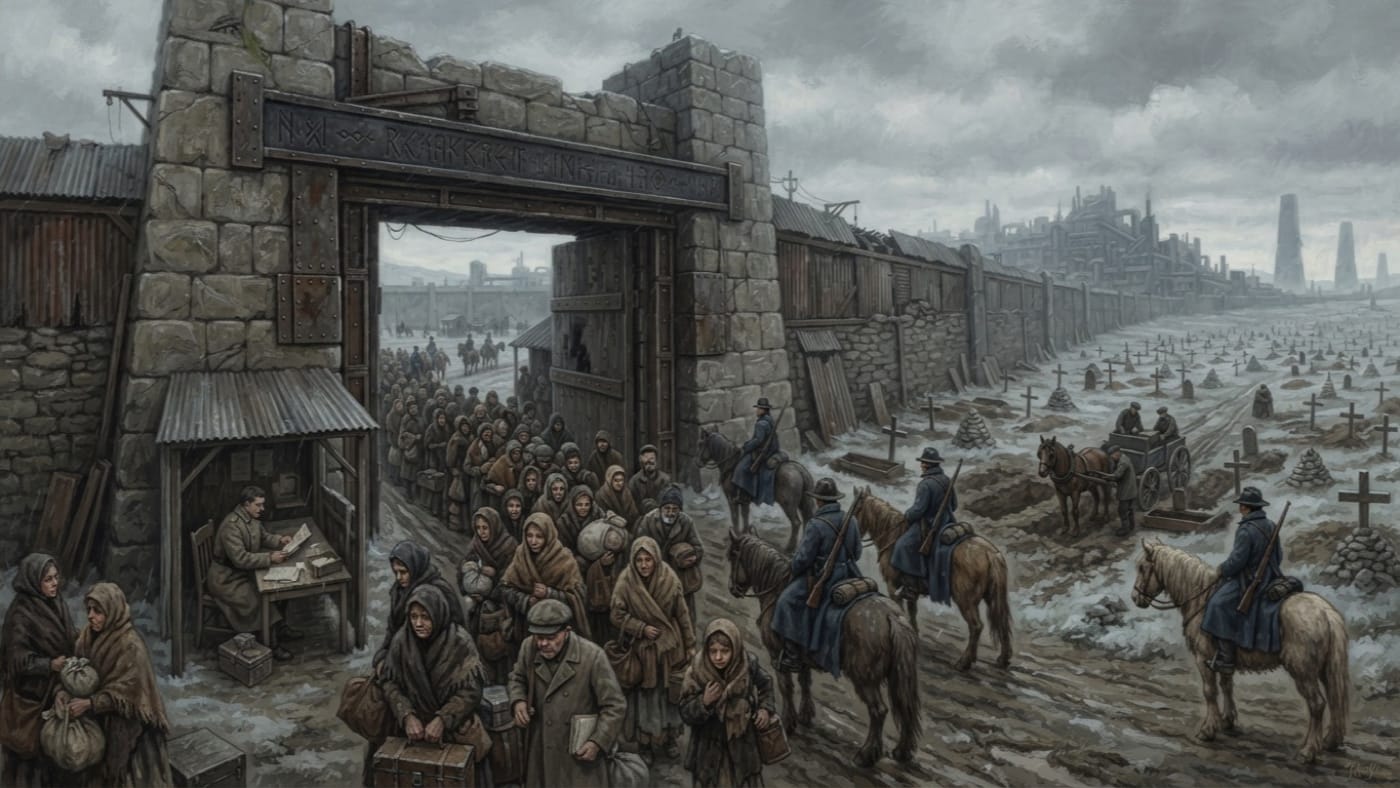
This entry was compiled in A.S. 201, which the heathen calendars call 1911. It is drawn from what the Treaty Office and the Caravan Court have let pass across my desk. None of it is a walk I took myself. The Ditch Gate is the place where refugees queue for entry to the Steppe Gate of Windscript Treaty-Stones. It is also the place outside which certain candidates of the Nine Weights are buried. The town gives it those two functions and no others that I can attest.
The Gate stands in the limestone gap of the Steppe Divides. The crosswind there never stops, and the town's boundary runs along ditch-walls and patrol cordons. The record does not say which way the Gate faces, how wide it is, what it is built of, or how far a refugee must walk from it to the Treaty Ring. I have found no survey of it, no founder and no date of construction. Anyone who offers you one is selling it.
The lintel carries the town's warning: Say it clean, or pay it red. Nobody has recorded who cut it or when. It is directed at people who cannot yet read it.
#On Papers at the Approach
Caravans and refugees reach the Gate by different roads, and the roads lead to different kinds of waiting. A loaded column goes to the entry ledgers and the Caravan Corrals. There its beasts stand under hold while passage writs, escort contracts, manifests, dialect attestations and pronunciation certificates are checked against each other and against the register. The drover pays for each day in fodder, and he pays it because he can.
A refugee goes to the Ditch Gate and joins the other queue. The charter article calls it longer and poorer than the caravan queue. I have no count of the people in it and no average wait to offer. The registers have never thought either worth recording, and I decline to make the omission respectable by supplying figures of my own.
The Treaty clerk checks two things: the papers, and the mouth that will have to speak for them. A refugee usually has too few papers. The mouth is the harder problem. The dialect attestation that would make his speech recognisable comes from the translator-scribes of the Scribe Bazaar, and it costs money. A witness costs money too, since witnesses at the Gate are hired. A dialect is the very thing the attestation exists to certify, and the refugee's dialect is the cause of his trouble.
The Office has no single sequence of desks, and its clerks laugh at visiting jurists who describe one. Each case is handled according to what it brings, and the refugee brings little. So the Office uses the one instrument it never runs short of. It postpones. Recognition at the Gate is the right to be entered in a register as a person and not as a problem. It reaches the queue slowly, and it reaches the fluent first.
#On the Clause Behind the Patrol
The approach roads belong to Captain Rho Balesh and his Blue Cords, the riders of Patrol Command. They count beasts, inspect writs and send the caravans on to the Corrals. Their routes change with the curfew, so a lane that is lawful at noon can be an offence at dusk. Escort priority is sold. Cargo is confiscated and moves under escort, and some of it is never seen again.
None of this is recorded as Ditch Gate practice in particular. I have found no garrison roster for the Gate, no gate tariff and no beating in the record that I could fix to that lintel. I set down the regional arrangement because the refugee walks through it to reach the queue. A family that does not know the evening route has no money to buy it either.
There is one restraint, and it is a legal one. The Court requires a clause authorising force before force becomes lawful. A rider can break a man's arm. Only the bench can make the break lawful. Only Korr's Seal-House Consortium can authenticate the ruling, and only the Office can file the bundle as administration. The clerk recognises the refugee, the arbiter rules on him, the seal authenticates the ruling and the rider handles him, and each answers to a different master. A refugee in the queue meets all four and has standing with none of them.
#On the Price of a Correct Mouth
The lintel's warning is no figure of speech. Within treaty jurisdiction the clause-spirits punish binding terms spoken corruptly, and the punishment travels by hearing and repetition. What they leave behind is recorded: throats that tighten, ink from the ears, cuts opened by paper edges, documents corrected overnight in a hand no clerk will own. Their anatomy, number and nature are not recorded. Ordinary speech does not call them. A refugee who begs for bread in the queue is in no danger from the stones for that. His danger begins when he is asked, or presumes, to speak a term that binds.
The case on which the town has built its fear is the Red Pronunciation of A.S. 94, the 1804 of the heathen reckoning. Licensed Arbiter J. Sarn, Second Class, damaged a binding term on the Third Stone during a salt-convoy dispute. By dawn about one thousand people were dead. The dead were litigants, witnesses, scribes, guards and people in the inns who had repeated what they heard. I will not reconstruct the word. Sarn held a licence, and the licence did not save him.
The first Registry notice gave the Red Pronunciation's dead as approximately one hundred.
Corrected by Bureau of Doctrine erratum, A.S. 95: approximately one thousand. The first figure counted only the bodies classified before removal. This figure belongs to the Ring and to that one night. Nobody should read it as a count of graves at the Ditch Gate.
The town turned survival into a trade. Phoneme cards, licensed pronouncers, certified witnesses and red caution glyphs are all for sale, and none comes with proof that it works. The caravan lord buys a scribe and the wrangler buys a card. The refugee buys nothing. I have seen no record that the spirits choose their victims by purse or by origin. They punish a corrupted term in any mouth that speaks it. Who gets to rehearse first is decided by the town.
#On the Dead Outside
The second function of the Ditch Gate concerns the Nine Weights, the inner bench of the Court and the doctrine of burdens it administers: Passage, Cargo, Witness, Blood, Delay, Oath, Seal, Road and Silence. Before an arbiter is sworn to that bench, he sits the Weighting. It takes place at dawn inside the Ring, with no crowd. The candidate is given a dead case from the Archive with its ruling removed. He must identify which burdens bind, put them in order, and pronounce a settlement into the wind.
The record sorts the candidates by result. Those who come through with no blood above the collar go on to seal instruction. Those who bleed and keep going are called promising. The bench's account says that those who correct the stones are buried outside the Ditch Gate with small stones in their mouths. The Bureau of Rites has filed the practice as local devotion pending extinction.
That is the whole of the attested custom, and I give it exactly as the record words it. The account does not say how those candidates die, who orders the burial, how the graves are laid out, how often it has happened or since when. It names none of the buried. It gives no reason for the stones in the mouth. I have heard the obvious interpretation and so have you. I will not enter it in the Ledger as if the Court had written it. The custom does not cover every candidate who fails, and it has never been recorded as covering refugees.
Some readers will want this space filled with a procession through the queue, a bell, or a mother who watches. No such account exists. ██████████████ The Bureau leaves the line blank because the record leaves it blank.
An editorial observation is permitted, and I make it with my own seal and no other. The town measures mouths at the front of the Gate and buries some of them outside it. It does both under the same lintel, which tells everyone below it to say the word clean.
#On the Present Compilation
As of A.S. 201 the refugee queue at the Ditch Gate is still longer and poorer than the caravan queue. The Blue Cords have swept the approach roads continuously since A.S. 199. High Arbiter Senn Vark's Ruling 201-Blue/17 makes procedurally valid Living Addenda binding. I have found no Addendum that alters intake at the Ditch Gate, and I will not imagine one into existence for the sake of a better ending.
The record does not establish the Gate's plan, its founder, its first burial or the meaning of the stones placed in the mouths. The lintel's words are attested. So are the queue and the custom outside the walls. This compilation enters those three and nothing more.