

#On the Present Station
This survey was compiled in A.S. 201, 1911 by the common reckoning, and the year belongs to the compilation. It dates the paper in the reader's hand. It dates nothing the Open Palms have done.
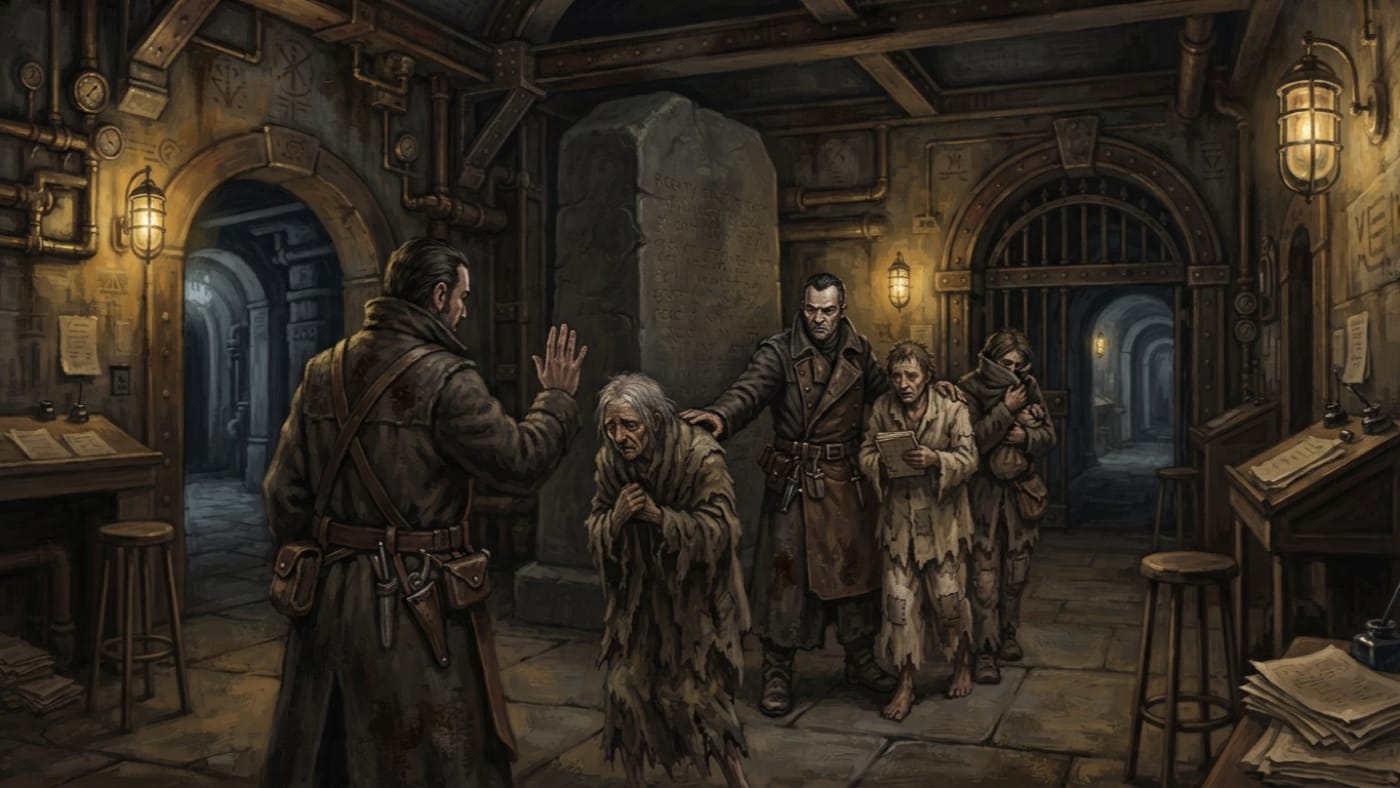
The Open Palms are the mercy arm of the Null Tongue Brotherhood at the Steppe Gate of Windscript Treaty-Stones. They move refugees, debtors and failed witnesses through rooms where a word would cost more than a winter's bread. That is the whole of the published evidence. It is one sentence in the Brotherhood's watch file, and this office has now read it more often than any sentence deserves. The Bureau holds no founder, charter, officer or roll for the arm. It holds a function, and the function is enough to explain why the Gate keeps the arm alive and why nobody at the Gate will say so in writing.
Open Palms: see entry under Null Tongue Brotherhood.
Corrected. The referral sent clerks to an entry that did not exist. What stood under the Brotherhood was a single sentence. This survey replaces the pointer and declines to inflate the sentence into an institution.
#On the Three Kinds of Passenger
The Gate sorts people by what they can say and by what can be proved against them. Each of the three classes the Open Palms carry has failed that sorting in a different organ.
The refugee fails at the mouth. He comes in through the Ditch Gate queue. A refugee intake ledger waits for him, and so do treaty clerks who check tongues as well as papers. He does not know the clause, and he cannot afford a translator-scribe who does. The local proverb tells him never to try a word he does not know. The Gate then requires him to answer.
The debtor fails at the ledger. At the Steppe Gate, owed clauses compound. Default turns into labour conscription or tongue service, which means forced scribing for whoever holds the paper. A debtor who speaks may add to what he owes, and a debtor who refuses may be charged for refusing. The Caravan Corrals east of the Treaty Ring keep their debt wards beside their refugee shelters. Nobody who has stood in either has needed the difference explained.
The failed witness fails at memory, at nerve or at price. The Gate runs on sworn recollection. Witness seals pass as currency, the Oath Inns license benches and rooms for swearing, and the town's own survey credits the Caravan Court with witness control alongside its trade in precedent. A witness who falters has already spoken, and spoken wrongly, in a town where confessions are recorded as addenda and kept in the Burnless Archive, which does not burn. The file does not say how any particular witness failed. It says only that some are moved.
#On the Room
A speech-danger room is any room at the Gate where someone will demand an answer that can kill, bind or bankrupt the person giving it. The watch file names no such room, and this office will not furnish one. Readers who require a floor plan may visit the Gully Market, where floor plans are sold with the same confidence as safe words and come with the same warranty.
The Gate's own records do establish what makes a room dangerous. They list tongue inspections before court, confession fines, pronunciation certificates and dialect attestations at the window, and Quiet Tongue zones near the stones. Since A.S. 194 the Living Addenda have given every clerk reason to fear that a recorded word may grow a clause after the speaker has left the building. In rooms like these the frightened body's reflex is to answer. Getting a person through means, at the least, stopping that reflex and putting something else where the answer would have gone.
The file does not say what the Open Palms put there. The wider Brotherhood teaches gesture-cant and literacy, and its Quiet Hands favour written petitions. I suppose, and label the supposition as mine, that the mercy arm draws on the same tools. Which tools, in which room and for whom are not on record.
#On Hands and Their Limits
The Brotherhood's cant is ugly, limited and quick, and its own teachers refuse to romanticise it. A hand cannot always bind cargo or absolve a debt. Nullists still need paper, witnesses, route marks and the occasional paid scribe. The Open Palms inherit those limits along with the name.
Passage through one room gets a person through one room. A debtor led quietly past a demand for a statement still owes the debt. A refugee who escaped answering one clerk still has no stamp from Seal-House Row, and at this Gate no stamp means no passage. A witness who avoided repeating his failed testimony has not unsaid it, because the Archive keeps what was said. What the arm gives is time and an answer left unspoken. Both are worth a great deal at the Steppe Gate. Neither amounts to clearance.
The Brotherhood has three branches and denies the division with identical gestures. The Quiet Hands teach survival silence: no spoken answers near the Ring, no repeating unfamiliar clauses, gestures for children, written petitions where possible and paid translators when there is no other way. The Stone-Mutes refuse to speak in court, sit through arbitration in silence until it stalls, and teach null-walking. They hold that every spoken contract feeds the treaty. That is their doctrine, and the stones have not answered it. The Open Palms are set apart by their passengers. The Quiet Hands teach a person to survive the Gate, and the Stone-Mutes make the Gate wait. The Open Palms take people who have already failed at the Gate and get them into the next room.
The Brotherhood's Quiet Hands are not to be filed beside the Quiet Hands of the Ritual Bone-Stampers, the senior hands who quiet corridors when ordinary seals fail. The two share a name and nothing else, and clerks who cross-index by name alone deserve their afternoons.
#On the Wound and the Watch
The Brotherhood dates itself from the Red Pronunciation of A.S. 94, when one mispronounced binding term on the Third Stone closed some thousand throats before dawn. That is the parent body's origin wound, as the parent body tells it, and it does not date the arm. No record says whether the Open Palms formed that night, a generation later, or gradually as the Corrals filled. I decline to choose, and I warn the antiquarians against choosing for me.
The watch on the Brotherhood is better documented. The Bureau of Purity monitors it, tolerates it, and records it as operational in A.S. 201. One of Purity's standing instructions is never to force a chorus near the Ring. It was written after A.S. 196, when a junior Lictor ordered nine suspected Nullists to answer together near the Third Stone. Seven complied, and all seven developed throat bruising in the shape of witness marks. The two who stayed silent were released by the Caravan Court for lack of an admissible statement. The case belongs to the Brotherhood, and no record places an Open Palm in it. I cite it for what it shows about the Gate's rooms: the two who said nothing left court with less on file than the seven who spoke.
The Fourth Stone null-walk of A.S. 187 argues against any happier conclusion. An adherent crossed in silence with his palms turned outward, and he fell. The Brotherhood blamed inward speech. Purity found the case inconclusive. Silence at the Gate remains a wager, and the Open Palms place it on behalf of people who could not afford any other bet.
#On Palms That Are Merely Open
The name invites a mistake. Open palms are ordinary at the Church's rails and the Synod's windows. At the Chapel of the Second String, the rubric requires the corrected pilgrim cord to be laid across open palms, and the published survey of that doctrine already warns inspectors that the Quiet Thread's posture is identical to plain obedience. On the Queue Road, open palms at the window are part of what makes a local credible, and the Witness Rental Houses sell that credibility by the hour. Neither practice has any recorded connection to the Steppe Gate arm. The Queue Road's rented witnesses are also a different class from the Gate's failed ones, and should not be confused with them.
At the Gate the Brotherhood's cant uses the palm constantly. A flat palm means wait. An open hand held low means child. The walker of A.S. 187 held both palms outward, the sign for breath kept whole, and no record calls him an Open Palm. A hand posture identifies a hand.
#On the Present Holding
As of A.S. 201 the Corrals' queues are under severe pressure, the Addenda keep arriving, and the missing Third Stone rubbing of A.S. 199 has already changed what the Stone-Mutes teach. The Open Palms' part in any of this is unrecorded. High Arbiter Senn Vark has not ruled on whether silence falls within treaty jurisdiction, and every room the arm crosses sits under that unanswered question.