
#On the Twelve Bodies
Hamburg keeps twelve dock labour bodies, and the Synod would much prefer one. One body would have one hall, one seal, one senior man to summon before a tribunal, and one neck for the Bureaus to measure for a collar. Twelve bodies have twelve halls, twelve grievance books, and a bad habit of remembering, whenever danger comes, that they share a harbour.
The title of this entry is the Registry's own classification. It is convenient for filing and useless for summoning anyone. The twelve answer to separate halls under separate customs. Records holds nothing that binds them together and no year in which they might have been bound. They share a river, a set of hazards, and one demonstrated ability to stop the port at the same moment.
A published personnel survey counts roughly forty thousand workers in Hamburg's dock labour pool. The figure covers everyone who loads, carries, stows, shovels or tallies for wages on the Elbe. It belongs to no single association, and no hall can call it out by itself.
#On Quay, Hold and Black Yard
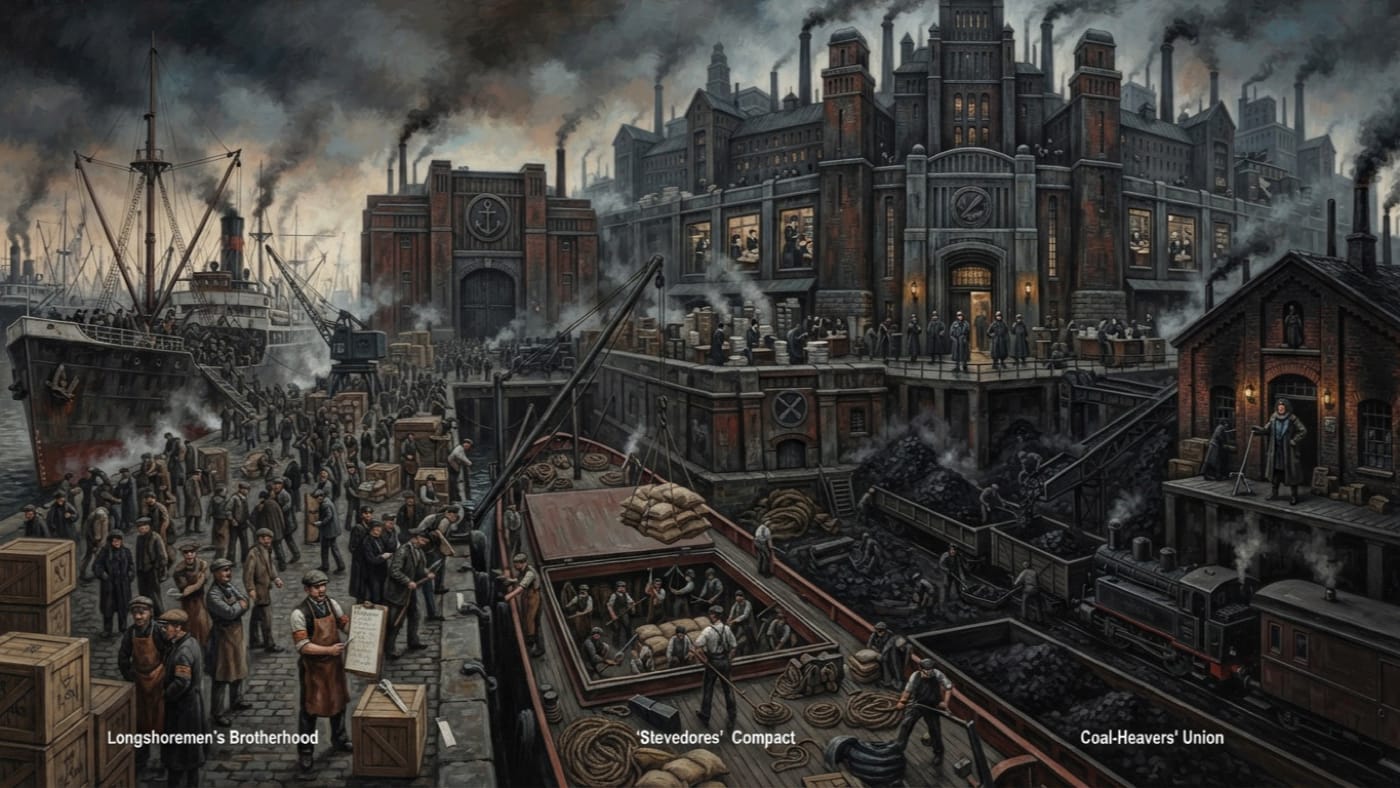
The Longshoremen's Brotherhood is the oldest and strongest of the named bodies. It holds the western and central Elbe quays: the loading schedules, the crane crews, the sling gangs and the grain call-books. It works through chalk marks, hiring records, injury funds and widow tins. A Brotherhood foreman with a stub of chalk can put a gang onto a ship before a Records clerk has located that ship's file. The clerk calls this irregular. The ship calls it Tuesday.
The forty thousand of Hamburg's docks march to Brotherhood chalk.
Corrected. Forty thousand is the aggregate pool of twelve bodies. The Brotherhood's own account claims the quays, the cranes and the call-books. It does not claim the holds or the coal yards, and it does not claim every man who owns a hook. Strasbourg prefers the larger sentence because it has fewer halls in it.
The Stevedores' Compact governs the inside of the ship: holds, hatches, deep-draught crews, grain compression, and the bracing of loads that would otherwise kill someone. Its tools are wedges, tally cords, lantern discipline and the hold-order token. Its senior badge is a bent hatch nail worn on a cord. The Compact claims descent from the old Hanseatic loading houses. Records can neither confirm nor refute the claim, so it survives the way most ancestry survives, on confidence.
The quarrel between these two bodies is the plainest example of how the waterfront is divided. The Brotherhood holds that grain belongs to the quay once the sling takes its weight. The Compact holds that grain belongs to the hold until the hold-order token is released. For the interval between those two moments, a sack of rye hangs above the deck with two owners and nobody's blessing. Records files the matter as an unresolved jurisdiction. The sling gangs file it as a reason to stand well clear.
East of the Dock Quarter lie the black yards of the Coal-Heavers' Union: heaps, chutes, tender loading, barge transfer, night bunker crews and damp-cover inspection. Blackcaps carry and shovel. Chute-men control the flow. Ashwardens inspect heat, covers and sparks, and their judgement carries the weight of men who have watched a damp heap warm itself. The yards answer to Black Marta Pell and to her whistle. They feed the tenders of the Hamburg–Kanzleiburg line, which is where coal stops being cargo and becomes logistics. These grades belong to the Union alone. An Ashwarden who tried giving orders on the west quay would be shown the river.
Beyond these three the Registry's knowledge thins. Chandlers handle rope and lamp oil. Smaller fraternities attach themselves to hides, to livestock and to quarantine freight. I know their trades better than their names, and I decline to number them. A list of twelve with five blank lines invites forgery, and I know the forgers personally.
#On Labour's Own Accounts
Each body keeps its own books, and they do not merge. The Brotherhood maintains injury funds and widow tins. The Coal-Heavers keep injury tins against crushed feet and against the slow wet cough of coal-dust lung. The Compact keeps receipt tins and pays out injury shares. A Blackcap who presents himself at a Brotherhood tin is told precisely where his own hall is, and is given directions.
Certification is the most valuable thing these bodies possess. A senior man's mark saying a load is sound means more, to the man going under it, than any customs seal in the Church. Hamburg's labourers learned long ago that the Bureau's stamp proves only that a clerk was present, and that the clerk was dry.
The guilds are not gentle with their own. In the Compact, a man who falsifies a hold token loses his berth for a season, and a man who cuts a brace early pays into the injury tin of whoever bleeds from his impatience. The halls keep their dead on name boards, sorted by cause: crushed, drowned, suffocated, burned. That is practical memory, and it is crueller and more accurate than mine.
#On the Eleven Days
In A.S. 189, Storage Facility 17-E, which the docks call Warehouse 17-E, held chrismole in wooden crates stacked six high against a condemned wall. The money to repair that wall had been refused. When the wall gave way, the fire took four city blocks and three hundred and twelve lives. The dead included dock workers, tally clerks, cart boys, surgeons, observers, and others whose occupations burned along with their tokens.
The refusals came in the forms each body knew best. The Brotherhood withheld its west-quay labour. The Compact withheld its deep-draught grain crews. The Coal-Heavers stopped night unloading first, then stopped day unloading as well. Twelve bodies stood still for eleven days. Grain sat in the holds, coal sat in the barges, and the northern front waited on a harbour that had been taught, at its own expense, what a wall is for.
Dispatches of the Bureau of War called it mutiny. The conduct itself was coordinated refusal by men who would not enter a burning arithmetic without being paid for it. The Registry records both terms, attributes the first, and leaves the reader to weigh them against three hundred and twelve.
On the twelfth day War offered a seven-per-cent hazard supplement on dock wages. The Bureau of Tithes agreed to exempt that supplement from taxation, and it was an agreement Tithes made the way a man has a tooth drawn. The Compact separately secured a narrower concession for its own senior holdmen. They could refuse to certify unstable chrismole, damp ordnance or overheated grain without immediate arrest for obstruction. The concession applies to holds and to senior men. It gives no general immunity, and nobody granted it to the other eleven bodies.
#On the Bureaus at the Waterfront
War needs the cargo discharged on time and in good order, and it has never forgiven the bodies for proving it cannot get either without them. Tithes keeps quarrelling over declared weight against actual weight, and over whether the supplement's exemption covers what clerks call adjacent payments. The quarrel has outlived several of the clerks. The Bureau of Purity wants access to the halls, the holds and the yards, where men sing, swear, trade and step out of clean sight. It is granted that access when a ship has finished unloading. The Bureau of Records meets chalk, tally cords, whistles and receipt tins, none of which accept a standard form. Records responds by filing complaints that are themselves on standard forms.
Admiral-Prefect Gerta Halske arrived in A.S. 194, five years after the fire. Her office manages harbour routing and war-cargo priority, and it settles the endless collisions between civil traffic and military need. She arbitrates among the twelve on the terms of the present port. The settlement of 189 was made by others and handed down to her, much as one inherits a cracked bell.
The arithmetic behind her is simple. Hamburg sits at the mouth of the Elbe and feeds the northern front through Kanzleiburg and Warsaw toward Bastion-Königsberg and Bastion-Brest. The North Sea survey recorded 4.2 million metric tons of Hamburg throughput in A.S. 200, while the north's grain requirement still exceeded ordinary deliveries. Every ton of it passed through someone's jurisdiction.
#On the Present Application
As of A.S. 201, the supply of the northern bastions depends on twelve bodies that Strasbourg did not design, cannot fully list and has never succeeded in merging. Grain crosses from hold to sling to quay to rail under three customs and at least two disputes. Coal leaves the black yards when an Ashwarden is satisfied and a whistle allows it. The Great Deceiver has never needed to set foot in Hamburg to cost the Church a winter. One rotten wall and one refused repair account did it once, and the port has not forgotten the price.
The Registry keeps the twelve under one heading because the Registry has to file them somewhere. The docks keep them apart because that is how the docks know who will hold the other end of the load.