
#On the Origin
No Deathbed Confession Harvester may take a dying person's last words alone. The whole rule fits on the inside of a white cuff. A second official sits at the bedside, watches the exchange, countersigns the witness ribbon and enters the bell-time in a hand that is not the Harvester's. The packet then leaves the ward under two seals. Everything else in this tract is commentary, and commentary is where the Bureau keeps its tongs.
The Protocol came out of A.S. 134 and out of embarrassment, the Synod's most reliable legislator. The Mercy Ward Purge convicted seventeen Harvesters across the Rhineland wards for selling, suppressing, altering or misplacing terminal statements. The hearings, the weeping and the sentencing belong to that file. The remedy belongs to this one.
The order of events deserves one sentence of respect. After the Lull of Names in A.S. 78 let the dead go unfiled, Standing Order 22-C made terminal confession compulsory in A.S. 80. It was issued by Mercy and Records offices still growing into their titles, ten years before the Synod's constitutional settlement gave them proper letterhead. The Confession Reform of A.S. 104 then fixed the method in its six stations: access, stabilisation, framing, extraction, authentication, packaging. A.S. 134 added a stool. First the Church required the dying to speak. Then it required them to speak in order. At last it required somebody to watch the man holding the quill.
Witness Clerks haunted the wards long before the Purge. The Mainz widow who paid one twice for the same silence could vouch for their industry. What A.S. 134 abolished was the Harvester's option of doing without one.
#On the Two Hands
The first hand belongs to the Harvester: seal-ring, minuteglass, standard forms, and the low voice the profession wears like an apron. The second belongs to a Witness Clerk or a ward officer. The parent file specifies no more than this, and I will not dress the office in qualifications the record never sewed for it. A Confessor-Booth Clerk who can hold a quill and recite his rubric card has processed the living, nothing more. The booth does not seat him at a deathbed.
The Protocol takes little interest in access and stabilisation. Those remain the province of permissions, pillows and the Ward-Sister who props the patient upright so that breath and accusation can both get out. The framing belongs to the Harvester, who is paid to offer the dying a clean story to die inside.
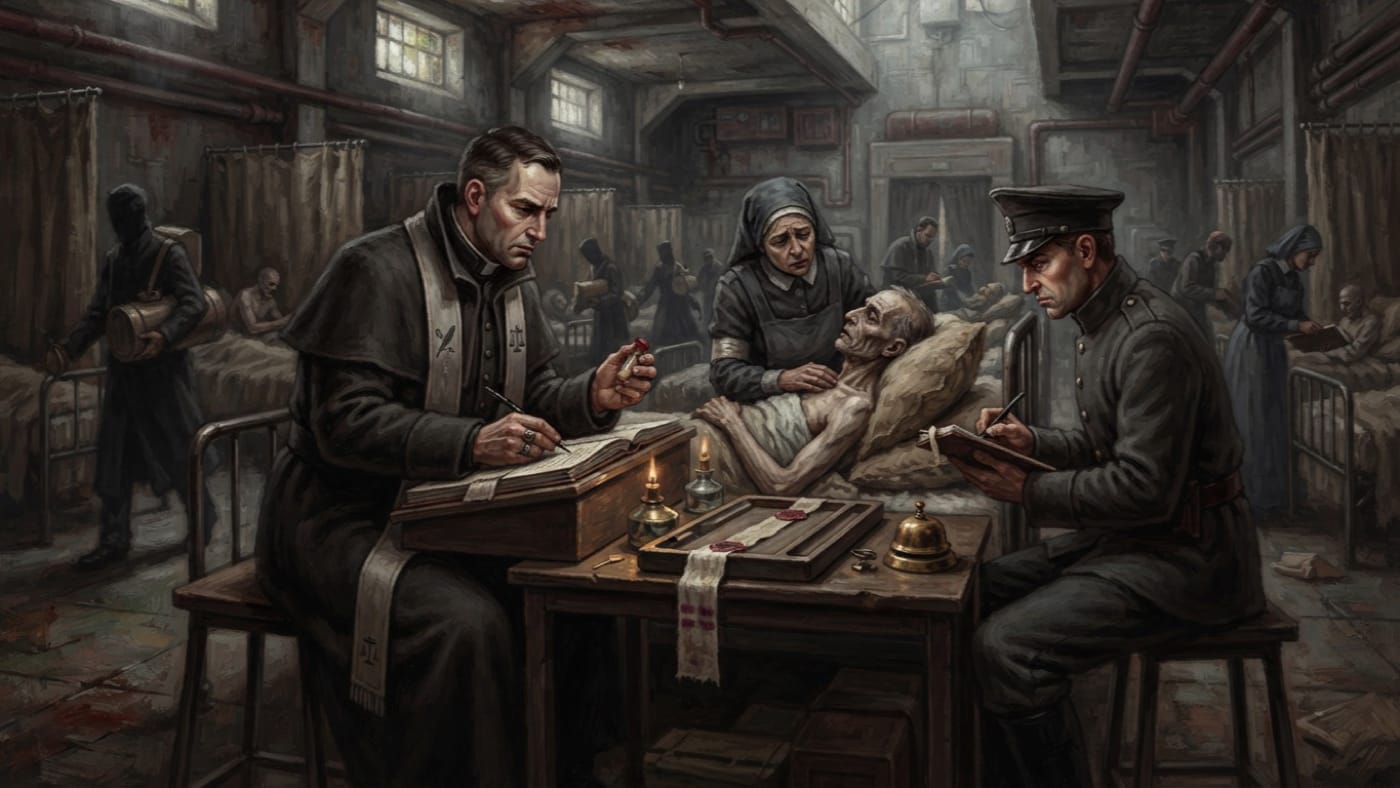
The second official takes his place at extraction. He sits on the paired stool, inside a curtain widened for his knees, close enough to see the mouth and the page in one look. The questions remain the Harvester's. The observer's duty is to watch them asked and to watch the answers go into ink. He sees where the quill hesitates. He sees which names the Harvester repeats twice, once softly and once as ink, and which he lets fall to the floor among the broth spills.
At authentication the furniture does the theology. The witness ribbon, now dyed with paired bars, takes the Harvester's mark and the observer's countersignature. The countersignature slip rests in the second groove of the confession tray, which before 134 had no reason to exist. The ward bell sounds, and the observer writes its time in his own entry, in his own hand, from his own ears. At packaging the packet closes under two impressions of wax, one for each person who will afterwards be asked what happened behind the curtain.
The staffing burden is plain arithmetic, and the wards resent it. A dying soldier does not wait for a second clerk to finish his broth. Black-zone doors were cut with observation slits so that a ward officer could witness without stepping fully into quarantine, and patients learned to fear the slit more than the fever. Bedside Runners became fixtures. They carry ribbons and spare wax and the countersignature slips, and they collect all the small knowledge that gathers around a person paid to stand still near the dying. In a casualty city like Marrowgate, where the wounded arrive by the cartload and die by the bell, the second stool is the most contested chair in the building.
#On the Packet and Its Destinations
Two seals do not make two identical transcripts. Novices confuse the two, and families never learn the difference. One last breath becomes three documents, and each travels to a different desk with a different appetite.
The clean transcript goes to parish comfort. It tells a widow that her husband departed in contrition and peace, and sometimes he did. The internal copy goes to the Bureau of Records, phrased with the precision of a man who knows auditors will read it. The sealed addendum goes to the Bureau of Purity whenever the dying named an accomplice, a hidden book, a hoard of illicit coin or a son with an unfortunate opinion. The family can kneel over the clean copy while Purity is already saddling a horse for the addendum. Both documents are true, and both carry the observer's countersign.
The Protocol gave each Bureau its own scripture. The Bureau of Mercy proclaimed transparency, a word it pronounces as if washing its hands. Records spoke of custody, chains, impressions and the ledger's dignity. Purity spoke little and obtained audit access to every ribbon in every ward. All three were satisfied. The dying were not consulted.
The holding of A.S. 134 fits inside an addendum: last words become mercy only after custody is secured.
An auditor opening a packet still asks first who witnessed. Then he examines the two impressions for shallow wax and chipped rings. He compares the ribbons for bolts too similar across wards days apart by wagon. He lays the Harvester's account of the hour beside the observer's entry and beside the ward bell kept to the standard of the Bureau of Bells. Times that disagree mark the packet as ghost time. Phrases that recur across unrelated deaths mark a script. The Trier Harvester who gave three dying men the same contrition in the same words would today be caught by his own second stool, provided the man on it could read.
#On the Witness Who Can Be Bought
The Protocol works. I endorse it with my own seal and my own vanity. It ends the solitary fraud, the lone Harvester rewriting a fever confession by candlelight with nobody to contradict him. It catches crooked bell-times. It makes a fabricated confession expensive to dress, because a forger now needs a second forger, matching wax and an hour both men will swear to.
Read the countersign for exactly what it certifies. Two officials were present. The ribbon bears two marks. Two hands agree on the hour. The signatures cannot certify that the dying spoke freely, that the questions were honest, or that either witness was clean. Doctrine further holds that some voices at the deathbed are unclean sound and belong to no patient at all. A countersignature has no power over that either. Two corroborating clerks prove agreement between clerks, and Records files the agreement as truth because it lacks a second drawer.
The guild knows this. Its own manuals name the practice of witness laundering: a pliable ward witness chosen for his debts, his habits or his cousin in the quartermaster's office. A Harvester working for a patron can steer the questions toward the name the patron wants, while the observer watches the steering and countersigns. A family pays both men for a softened clean copy. An internal copy acquires gentler wording between the ward and the Records desk. A sealed addendum still vanishes, only now it does so through four hands, which makes prosecution slow enough to be abandoned.
Bribery, blackmail and fear all work on the second stool as well as on the first. A Witness Clerk who refuses a coin may accept a threat. One who refuses the threat may still accept the Harvester's quiet reminder that a junior clerk is the first offering when audit pressure rises. The penalties already on the books remain: seal revocation, reassignment to trenchline harvest, ritual penance, and erasure for a confession proven false under audit. The Protocol added no fresh scaffold. It added a second neck.
Public circulars in the wards declared that the second witness "guarantees the purity of every last word."
Corrected for internal circulation. The second witness guarantees a second name on the ribbon. When a packet fails audit, the Bureau now has two officials to examine in place of one, and it can choose which to keep.
#On the Present Application
As of A.S. 201, no licensed Mercy Ward may accept a terminal confession under solitary seal. The second stool stands beside every sanctioned deathbed in the Church, and a novice who asks why a grieving wife cannot have the last hour alone with her husband is shown that stool and given no other answer.
The Purge file counts some two thousand four hundred Harvesters in active service. It also records forty-three wards that have sent no returns for years and are presumed compliant. Presumption is the cheapest audit there is. It needs no wax, no ribbon and no second hand. Somewhere behind those forty-three silences a Harvester may be working alone with a dying mouth, a sound ring and an empty stool he rents out by the night to whoever will sign for it.
The Bureau is aware. The Bureau has filed its awareness.