
#On the House Above the Vltava
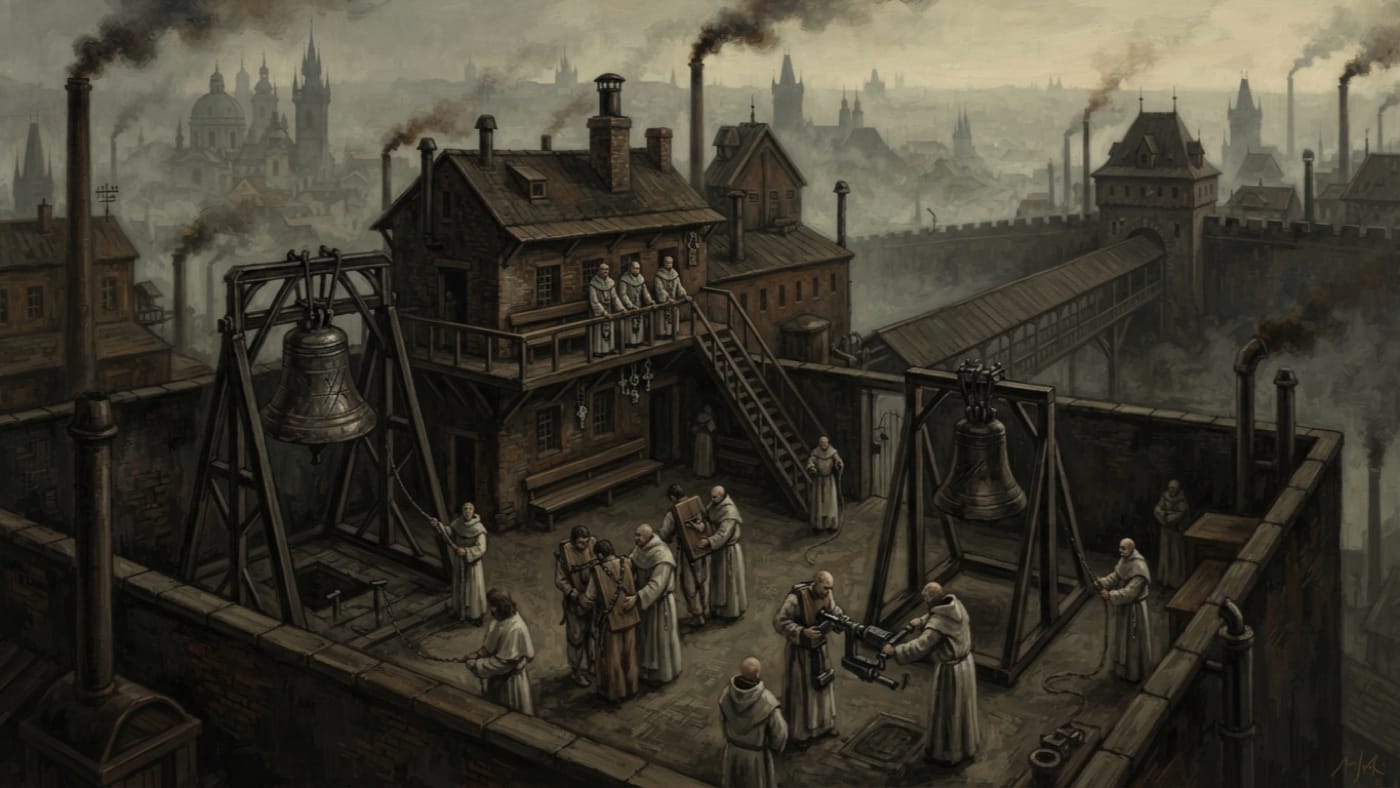
The Ephrath Chapterhouse stands on its hill above the Vltava and looks down on Prague the way a confessor looks at a penitent who has not yet begun to talk. It is the principal seat of the Order of Saint Ephrath. Here a Purity sentence stops being paper and becomes something the condemned must carry.
Provincial visitors arrive expecting a fortress and are disappointed. Prague is Synod-held, a Zone 3 city of the Forward Heartlands well behind the Sagittal Line, and it has no use for battlements. What the Chapterhouse keeps is a courtyard, a gallery overlooking it, a training yard, and beneath them the tablet stores. Those are the rooms I can swear to. The cells, kitchens and chapter room, and whatever the brothers do after Compline, I leave to the brothers. They have never offered me a plan of the house, and I have never been foolish enough to ask for one.
The courtyard wall separates private preparation from public correction. The Procession of Tongues is what Prague sees. The Chapterhouse is the reason Prague sees it on schedule.
#On Its Entry in the Ledger
The house first appears in the Ledger under A.S. 92 as disciplinary theatre annex, Bohemian severity district. I have seen that line passed off as a foundation date by clerks who ought to know better. A Ledger entry proves that a thing existed and was worth a line of ink. It does not name who laid the first stone, in what year, or with whose money. I have found the answer nowhere else, and I decline to invent an architect for readers who like their buildings to come with fathers.
The entry belongs to the years after the Concordat of Strasbourg settled the formal Synod in A.S. 90. Those were years of consolidation, when offices that had long been at work acquired procedure, seals and lettered headings. Records had been remade in A.S. 78, and Purity's Index work had grown from A.S. 80. An annex for disciplinary theatre fits that season exactly. It was an instrument waiting for a licence.
The licence came in A.S. 94. The brothers' forty-one-page petition to the Bureau of Purity leaned heavily on the Second Appendix of Grand Inquisitor Severian, and Purity approved it in an afternoon. Severian never kept house on this hill. He supplied the reason the tongue should be fastened to the Creed. The Chapterhouse supplied the courtyard, the oak and the hands. It was working by the morning of the first departure, and its own intake ledgers later settled how many people it had sent down the hill.
The inaugural Procession numbered approximately one hundred and fifty condemned.
Corrected. The figure is two hundred, by the Seventh Revision of the Bureau of Records, drawn from recovered Chapterhouse intake ledgers: captured Republican Guard officers, Rationalist academics and three Prefectural clerks. Purity's A.S. 95 annual report had entered fifty of them as furniture. The Chapterhouse counted the condemned. Purity, that year, counted chairs.
#On Custody Before the Second Bell
By the time a sentence reaches the hill it has been settled. A quorum of Purity officers ratifies it, the Bureau of Oaths counterseals it, and the crimes are read aloud the evening before. Every question has been answered except the practical ones, and the practical ones belong to Ephrath.
At dawn the condemned assemble in the courtyard, where the walls keep the city out. What follows is done by ordained brothers, out of public view, with tablets brought up from the stores and square iron nails blessed by the Chapterhouse Confessor. I have watched it from the gallery. I will not set it down as a procedure; the Order has manuals, and the reader has no licence to need one. I will record that the courtyard values speed the way a scriptorium values dry ink.
At the second bell after dawn the gate opens, and from that moment the Chapterhouse shares its sentence with other offices. The Bureau of Bells takes the cadence. The Bureau of Orison and Song breathes fog through the street vents. Records keeps the count and audits everyone afterwards. The route, fixed by charter in A.S. 96, descends the hill, crosses Charles Bridge, passes through the university quarter and ends at the final silence station, where the tablets come off and begin their journey home. Ephrath prepares and conducts. Purity signs. Nobody in Prague confuses which of those is the higher office, least of all Ephrath.
#On the Oak and Its Archive
The condemned leave the Chapterhouse once. The tablets leave every year and come back.
Each board is dense oak, seasoned seven years and engraved on both faces with authorised Articles of the Creed. They are extracts, cut from copies held by the Bureau of Doctrine; which Articles go on which face is Doctrine's business, and a codex is a poor place to publish a carving template. Standing Order 14-F, as revised in A.S. 187, requires the Triune Knot on the obverse and Purity's seal on the reverse. Each missing mark costs the responsible Prior three Crowns of Grace. The Order's own device, a tongue transfixed above an open book, appears on its robes, banners and letters and never on the oak. The board answers to Purity, and its marks say so.
During its season of use a tablet belongs to one condemned person, whose name is branded small along the lower edge. Afterwards it goes back to the stores beneath the house, where the boards stand on edge in ranks and are filed by year, route, offence, nail diameter and a column the registers head final silence weight.
The older boards give the stores their character. Their nail-holes have been worn smooth by long service, the grain around each opening polished like the lip of an old font. The younger boards still splinter. Between uses the brothers sand every tablet, taking off the raggedness and keeping the hole, which they regard as the board's service record and have no intention of erasing. A brother at the sanding bench works with the care a sacristan gives a chalice, and with the same certainty that it will be used again.
That certainty is the house's real doctrine. Every condemned person believes the sentence is personal. The shelves say otherwise: the board was cut before the arrest, it has held other tongues, and it will be filed again under a later year. The Chapterhouse does not make a tablet for each sinner. It issues whichever board is ready.
#On the Hands Trained for Public Work
Ephrath recruits from choir lofts and theatres, where young people learn breath, timing and the management of an audience. The Order prizes those skills above muscle, because any parish can find muscle. The training yard turns them into Attachment, the second of the Order's three grades of humiliation, in which the body is bound to the doctrine the mind refused.
The yard teaches it slowly. Novices spend a year carrying empty boards until their shoulders accept oak. The next year the boards are weighted with wet sand. In the third year come handling and timing, the work that will later be done in the courtyard on mornings when the gate is shut. By then a brother knows exactly how a tablet pulls on a body over the length of the route, because his own arms have learned it. When he puts a board into a condemned person's hands he knows to the pace what it will do.
The theatre never quite leaves them. They block the courtyard the way a stage manager blocks a scene, and they speak of the route the way actors speak of a run.
#On the Present Stores and the Unanswered Report
In A.S. 201 the Chapterhouse is in service. The stores are stocked, the sanding benches are occupied, novices are carrying sand in the yard, and when Purity sends down a list, the brothers go to the shelves before they go to the courtyard. The Procession has been held annually since A.S. 94.
The Procession has been conducted without interruption since A.S. 94.
Corrected. The rite has been held every year since A.S. 94. Individual marches have been interrupted thirteen times and paused forty-seven times, and each failure went back into the files along with the boards. The annual observance stands. The phrase "without interruption" does not, and its author has been invited to count.
The house has requests outstanding. Ephrath has asked for better drainage. Records wants a tablet archive annex beneath the old tower of Charles Bridge, which would put part of the Chapterhouse's memory across the river and under another office's key. None of these requests had been granted when I sealed this survey. The Chapterhouse has no new wing. It has a stack of petitions, and in that it resembles every other house in the Synod.
One file in the Chapterhouse's keeping has no request attached. In A.S. 199 a Bells delegation recorded the Procession's acoustic profile, and that same year a Judge was reported at the foot of the bridge. The accounts disagree about whether a march was under way. The Ephrath Prior's report contains a single word on the matter, vidit. Purity asked in the margin what had been seen. The Prior did not answer, and the file has been returned to its shelf with the same care as the oak.