
#On the Faces That Changed
The Face Theft crisis began in Sable Court in A.S. 199. Like most bad business in Cologne, it began small, with a woman at a bread counter turning a coin over twice.
The coins had changed. Citizens of Cologne's outer districts reported that the faces they carried every day, their own and their households', had gone subtly wrong. A wife's coin bore her husband's jaw and a stranger's eyes. A merchant's coin bore a face he had never seen and could not stop remembering. Mouths shifted. Griefs shifted too, and no engraver can cut a grief, though every widow can read one. At the counters, merchants forgot customers in the middle of a sale and stood there holding the change.
The quarter's own account records more than four hundred complaints filed with the Mint Tribunal within three months. Within six months the complaints stopped. By then the complainants could no longer remember what their own faces were supposed to look like, and nobody can dispute a likeness they have lost the means to describe.
The Tribunal received the silence gratefully. Silence files itself.
#On Recognition and Its Withdrawal
The machinery that failed had run for a century. The A.S. 94 arrangements recorded under the Face Registry Compact bound coin to face, face to name, and name to the soul's account in the Great Ledger. They also placed the Crownwright Guild beneath the Mint-Chapter. Since its mandate in A.S. 102, the Face Archive has held a retained master plate behind every working die, and each working die strikes circulating coin in batches. A citizen who loses a coin has lost a coin. Nobody's purse needs to carry its owner's face to buy salt. Recognition rests on the agreement of coin, face, name and account, and the Bureau of Records keeps that concordance.
In Sable Court, circulating faces also anchor memory. You know your neighbour because you have held him in your palm. When a face is recalled, recognition comes loose. Witnesses hesitate, and families argue about whether a brother existed. The Bureau of Doctrine classified the effect in A.S. 194 as a Category Two Localized Identity-Scribal Anomaly, "theologically adjacent to the reliquary effect." Adjacent is a Doctrine word. It means the office has measured the distance and does not intend to walk it.
The warning was already on file. In A.S. 187 an audit by the Bureau of Alchemical Standards found three Archive plates altered overnight: a jawline softened, an iris darkened. The Bureau of Engineering's sealed survey of vaultwork beneath the Black Canal, made the same year, is a separate file, and I keep it separate. Two sealed files from one year remain a coincidence until someone with clearance says otherwise.
#On the Seventeen-Denomination Recall
The Mint-Chapter answered with an emergency face recall across seventeen denominations. Seventeen is the scope of the order. It does not count all the denominations in circulation, or the stolen faces, or the dead. Pilgrims who have tied the number to Saint Aldebrand's femurs may take the matter up with Purity, which forbids unlicensed numerology.
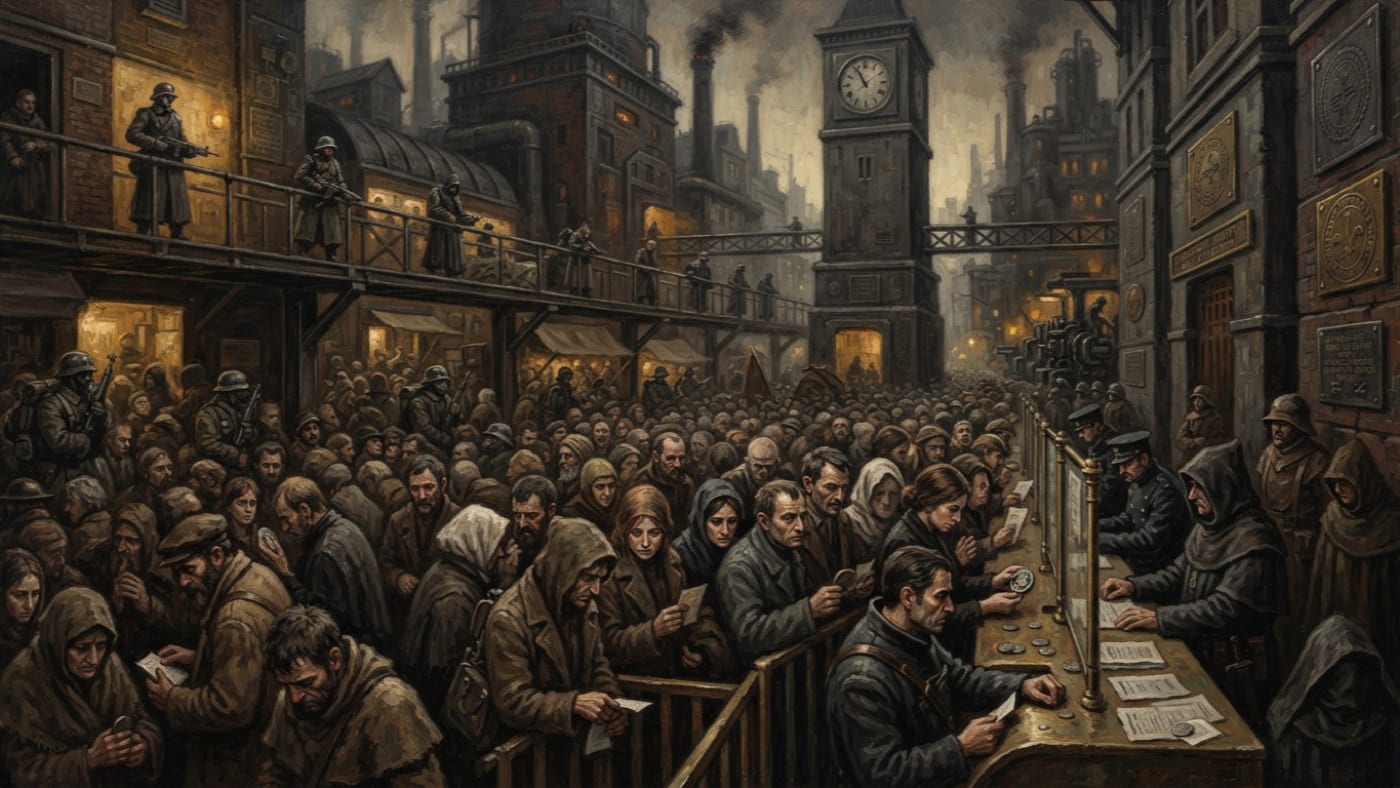
Recall is the heavier instrument. A facehold freezes recognition pending review and gathers nothing. A recall gathers the disputed coin and re-strikes it blank or with a replacement face, and the withdrawal of recognition that follows is called unfacing. Citizens whose faces had already drifted had their coins confiscated and their identities suspended. Citizens whose faces were intact stood in the same queues and began to wonder whether the queue was catching.
Die Row worked triple shifts, and the Strike Floors ran through the night. The hymn-timing slipped twice. Two official batches came off the presses bearing faces the shift choir could not identify and the Assay Cloisters could not account for. These were the Chapter's own coins, lawfully struck.
At Clipper's Market, the wardens shut the gates to prevent a riot. The crowd took the closure as a riot already declared and obliged. No supported count of the dead exists for the Face Theft riots. I will not borrow the nineteen dead of the A.S. 196 Copper Saint Crush to make the page look finished.
What was left went to the Widow Gate. Pensions stalled because a dead husband's face sat under recall. Marriage claims written in a disputed face froze. Bread required an assay slip, and the slip required a coin the clerk would pass. Reports from A.S. 201 describe children made legally unbuyable by erroneous recall spillover: shut out of lawful purchase and exchange, unable to buy a loaf or be paid for an errand. Three committees have proposed temporarily exchange-ineligible minor. The children go hungry under both titles.
#On the Accused and the Unproved
Official suspicion settled on the Clipped Choir, because a state prefers an enemy with a price list.
The Choir did some of it. Its brokers distributed washed coin to three outer districts. Its assayers certified two counterfeit batches that passed outer-gate inspection. These are not the Chapter's two unidentified batches, though enough Warden reports have mixed up the pairs to suggest that someone enjoys the confusion. Lise Three-Eyes, born Lise Marquart, showed that a recalled face could be worn by a living debtor for six bells. The debtor kept the coin under the tongue and spoke no name containing the letter r. That was one attributed demonstration on one debtor. The debtors now queuing for the same service have no way to learn that it may not work for them.
The Choir sells what the Chapter withholds. In the Market, portable innocence and a one-day face-touch will get a widow her bread for an afternoon, for a fee. The Market's memory rinse is weak stock. Deep memory wash belongs to the canal basements and is priced to match. Neither restores a face that recall has taken. Both make the Choir rich, and its crimes stay on the ledger whichever widow ate.
The Choir is also afraid. It lives in the cracks of a working registry, and a registry that collapses leaves no cracks to live in. The Candle Tribunal has banned traffic in the master die and punishes undeclared faceless blank metal with cold coin. Those punishments show the Tribunal's fear. They show nothing about where the die is, or whether there is a die.
The Unface Society, a cell in the furnace tunnels beneath the Anneal Courts, claims responsibility. It demands the destruction of every Archive plate and the circulation of faceless money. The Bureau of Purity doubts that six engravers and a disgraced archive scribe could run a campaign this sophisticated. So the file holds a claim, a suspicion and a demonstration. It still lacks a proof.
This office previously advised that the Clipped Choir could be dismantled through market arrests and seizure of clipping instruments.
Corrected. The arrests reduced clipping. Meanwhile the faces kept changing in the purses of citizens who had never met a clipper.
#On the Reference Under Suspicion
Warden-Captain Joss Kline keeps a pouch of coins he calls impossible. Each bears a face that matches no living person known to the Ledger and no plate in the Archive. They prove that discrepancies exist. They do not name a maker. Street talk calls them the faces of the unborn, or of the Great Deceiver's servants, but street talk has never been asked to sign anything. Kline holds the coins up to the mirrored glass on the Warden Walks during the late watches and reports nothing.
Mint-Prelate Varo Sable controls the recall orders and Archive clearance. Master Engraver Irena Coilhand answers for the fidelity of the craft, and she has taken to wrapping her prayer-scarves around the dies themselves. Neither has explained the plates.
The plates are the real trouble. The Assay Cloisters now test fidelity by hymn-frequency: blind clerks compare each struck coin with its archived plate without ever seeing either face. The method is elegant, and it has a hole in it the width of a jawline, because the retained reference plates have themselves changed. A coin that rings true against its plate proves only that it agrees with the plate, and the plate is under investigation.
Then there is the master die. Rumour describes a steel cylinder bearing no face and every face, able to overwrite the concordance through circulation alone. Strike a coin from it, the story goes, and the coin carries no identity. Handle that coin and your own face starts to drift. An earlier entry in this Codex asserted the die as fact, then wondered whether it was myth or hardware. The Mint-Chapter has denied its existence in four separate depositions, each more emphatic than the last. I record the rumour, and I record the denials. I certify neither. I certify no owner, no maker, and no hand that used it in this crisis.
#On the Continuing Investigation
At A.S. 201, the Mint-Chapter reports that its emergency measures have stabilised the outer districts. In Sable Court, stabilised means fewer new complaints. The first six months also produced fewer complaints.
File 1104-SC remains open under Amber restriction. Purity has dispatched an Inquisitor-Assayer, a specialist in currency heresy whose name has not been made public. Wardens have doubled their rooftop circuits, and every gate holds doubt inspections. Archive access is barred below Mint-Prelate clearance. The Crownwright Guild has closed its apprentice rolls. Clipper's Market may shut all five gates without warning and confiscate disputed coin for fidelity testing. No citizen may count more than nine coins aloud inside it, and no mother may show her child his own face-coin while standing in a recall line.
Each control adds to the official coercion. Each one also raises the price at the back basin, where the soap is grey, the brass trays are dented, and the brokers have hired extra runners.