
#On the Appointed Day
The Feast of Saint Margaux of the First Blood falls on the fourteenth day of Corvus, and it shares that day. The same square of the calendar carries the Day of the Thirty-One Names, and both belong to the wider liturgy the Church keeps for the Massacre at Saint-Malo. A provincial printer who sets her name in red and leaves the Thirty-One in plain black has made a typesetting error, and the Bureau treats it as an error of doctrine.
Corvus is the Church's own later name for a month. No conversion into the months of the old reckoning has ever been approved, and I will not invent one for the almanac trade. The massacre belongs to A.S. 10 / 1720 CE. Nobody has produced its day and month under seal. The fourteenth was appointed later. Whether it was also the morning the pilgrims came up the coast road from Dinan, the Bureau of Records will not say, and I have asked twice.
I cannot give the year the feast was instituted either. The tribunal of A.S. 14 dates her recognition and nothing else. This entry surveys the observance as it is kept in the present year, A.S. 201 / 1911 CE, and claims no founding the archive cannot support.
The arithmetic of the day is simple and uncomfortable. The Church mourns thirty-one certified dead, and only one of them has a face.
#On the Woman the Feast Remembers
She was sixty-three, a Sister of the Blessed Thorn from the convent of Sainte-Claire-des-Landes. She was small and slight, with grey hair under her wimple. At Dinan she joined forty-three pilgrims who were carrying the Reliquary of Saint Matthias behind Father Gaël toward the Chapel of the Tide. They never reached it. At Saint-Malo the Republican Guards attacked the column. Margaux knelt on the cobbles with a psalter in her hands and was killed there.
She was neither the first to die nor the last. The title "of the First Blood" already appears in her early recognition, and nobody knows who wrote it. It is an honorific. The bayonets were not timed.
An ecclesiastical tribunal at Strasbourg recognised her in A.S. 14 / 1724 CE on seven depositions and without an authenticated miracle. The later Bureau ratified that recognition under its own seal, and its registry does not print the date. Those are two acts. The feast is a third, and the assignment of the fourteenth may be a fourth. I have found no folio that ties any two of them to the same year.
Her life before the road, her single surviving cloth receipt and Father Gaël's four words are filed under her own entry and under the massacre. I do not repeat them here. The feast needs only this much of her. An old woman knelt and was killed, and nobody asked the people who loved her what should be done with her afterwards.
#On the Face Required
The broadsheets made her recognisable before any tribunal made her a saint. Woodcuts of a kneeling nun were circulating soon after the massacre. The Rhineland edition of A.S. 12 / 1722 CE is the one the archive can document. Augustinus promoted later reprints, but that came afterwards. When the first blocks were cut, both founders were about four.
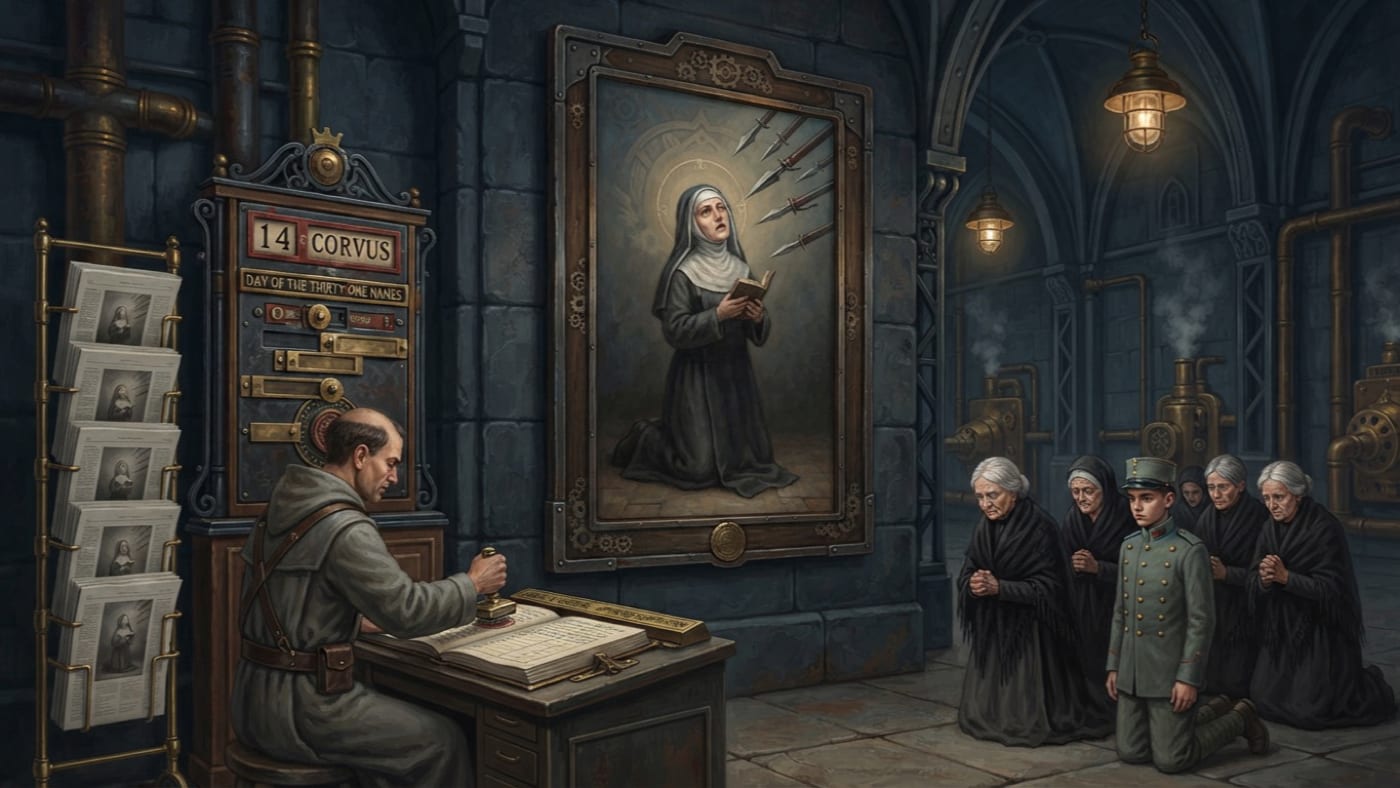
The face the feast now uses is more exact than any woodcut. An early Church scriptoria pattern dated A.S. 47 / 1757 CE fixed the composition. It shows Margaux kneeling and wimpled, with the psalter raised in both hands and her eyes lifted, while bayonet points enter from the upper right. The later Bureau of Doctrine adopted the pattern and has not let it change. The halo is approved devotional imagery. No witness deposed to having seen one.
Her image hangs in every Bureau of Doctrine parish hall west of the Sagittal Line, and this is what actually holds the feast together. A parish in the Rhineland and a parish in Anjou share no bell and no relic, and neither has a Breton widow in its pews. On the fourteenth of Corvus both congregations still look up at the same woman. They see her at the same angle, with the same bayonets coming in from the same corner, and each believes it knows her.
The Breton variant shows her standing to meet the Guards. It is suppressed under the Index Claritatis, with a fine of forty Crowns for every copy. The Bretons had known her and preferred her standing. The Bureau had never met her and preferred her kneeling. The Bureau also issues the printing licences.
#On the Saint among the Thirty-One
A collective memorial has many dead and no face, and grief does not attach easily to a number.
At the Porte Saint-Vincent, the landward gate where pilgrims come to see the blood-stone, the registry records thirty-one tolls followed by forty-three seconds of silence. The tolls are for the certified dead. The silence matches the ratified procession. Twelve people fall between the two figures. Seven were wounded witnesses. The Martyrology enters the other five as consumed absences. That phrase is the name of a column in a register, and it explains nothing. I offer no explanation of my own.
I can certify that custom at that gate. I cannot certify it at Quimper or at Mainz, or in any parish hall I have not stood in. A Corvus homily that gives the Breton bell to the whole Church is wider than its evidence.
The feast does not disturb the count. Father Gaël is among the thirty-one. So is a nine-year-old child, whose name the Bureau keeps in the Folio of the First Fallen and does not publish. The rest are on file in Strasbourg, and I will not make up a roster so that a sermon has names to recite. The larger rites of the Annual Remembrance are described under that entry.
The feast gives the eye somewhere to rest. A widow at the gate counts thirty-one strokes. When she shuts her eyes for the silence she sees Margaux with the psalter raised, because Margaux is the only one of the dead that anyone ever drew. The other thirty are remembered through her. Doctrine calls that the purpose of the feast. I have heard it called a theft, though only in kitchens, and quietly.
This Codex's inherited general chronology enters the massacre that produced her as "the Thunderclap of Saint-Malo," under A.S. 17.
The massacre took place in A.S. 10 / 1720 CE. The A.S. 17 entry is superseded. Any devotional calendar that prints seventeen beneath the kneeling figure is to be corrected at the printer's expense.
#On the Custody of Devotion
Each family grieves in its own parish, but the paperwork goes to Strasbourg.
Doctrine supplies the approved meaning and the approved image. Records holds the count and the three columns, and decides which of the forty-three counts as dead, which as witness and which as absence. The Bureau of Rites standardises the liturgy, so that a congregation in Mainz and a fisherman's family in Cancale kneel to the same rubric on the same day. The Bureau of Pilgrimage manages who may reach the gate and the convent, and on what terms. The Bureau of Relics keeps the book.
The psalter is Relic 23-M(Ratified), held in the Bureau of Relics' secondary vault in Strasbourg. It is bound in brown leather and has no illumination. Its maker and its date are unknown. The bloodstains are preserved under lacquer, and the brass clasp still works. The procession carried the Reliquary of Saint Matthias, and Margaux carried the psalter. A homily that confuses the two was written by someone who never read the inventory.
At Sainte-Claire-des-Landes a different object receives most of the attention. The convent became a First-Tier Pilgrimage Site in A.S. 92 / 1802 CE. The account in her entry gives about nine thousand visitors a year, each of whom pays the gate fee, and twelve nuns still in residence. The Margaux Chapel there holds a life-sized wax figure of her, kneeling with a psalter in its hands and glass eyes turned upward. Her real book is kept in Strasbourg, and in Brittany the hands that hold a book are made of wax.
#On Her Uses
She is patroness of pilgrims and of lost causes. Travellers ask for her protection before setting out on the coast road. Families ask for her when there is nobody left to ask. The later patronage of Wrath is attributed to Kratz. Its date and its authority are unresolved, and I leave them there.
The Bureau of War does not wait for the patronage question to be settled. When the annual levy of sons comes through a village, the recruiters bring her broadsheet with them. They pin it beside the muster table and invite each young man to consider what a woman of sixty-three did with nothing but a book. Plenty of young men consider it. The quota is usually met.
The old women in the parish halls on the fourteenth are not fools. They come because a woman like them knelt in the road and died, and because thirty other people died beside her, and because the Church has given them a day on which to be seen mourning all of them. Their grief is real. The Bureau uses it, and the Bureau did not invent it.
At evening the sacristan takes down the parish print and rolls it into its tube. He checks the seal at the bottom edge, and he enters the hall's copy in the inventory as present and undamaged.