
#On the Table
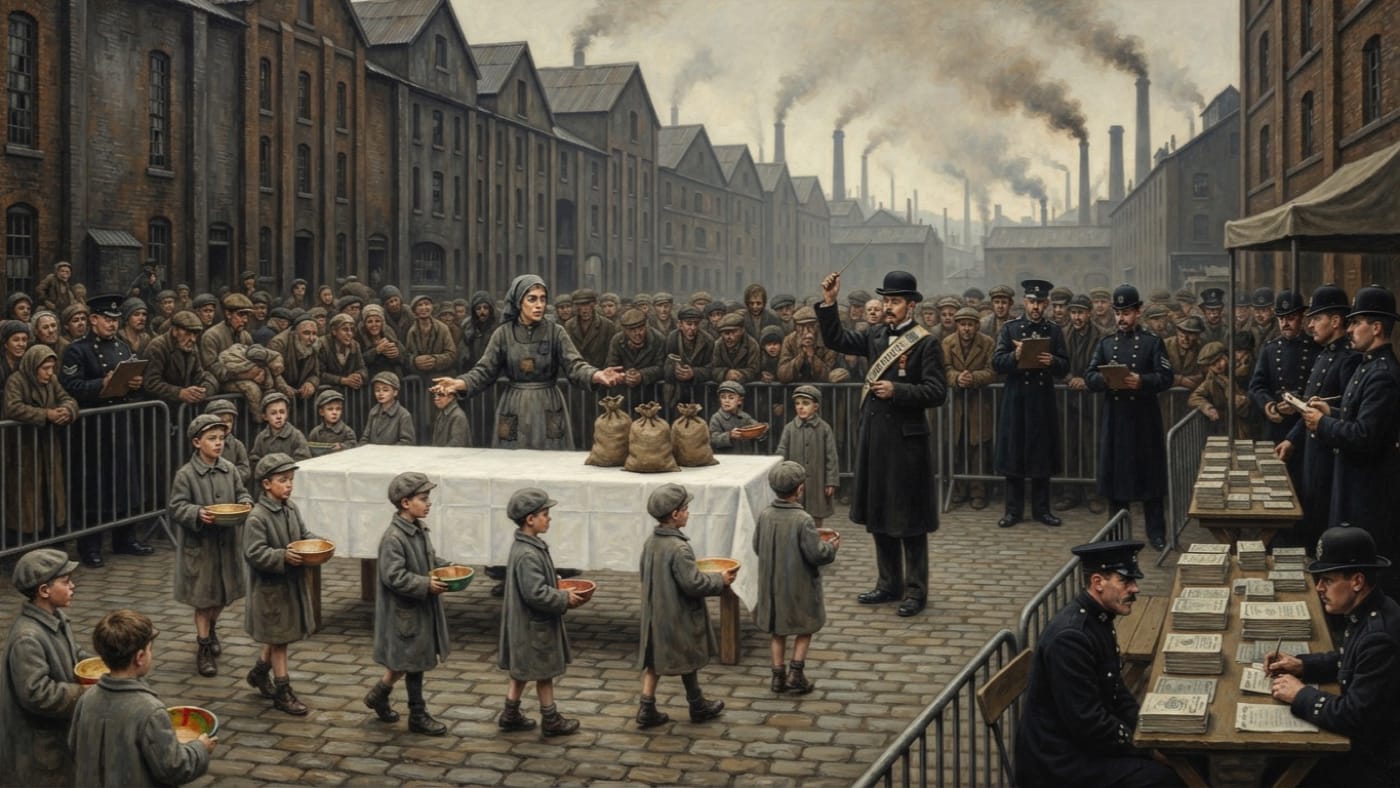
The cloth is the first prop issued and the last returned. It is white and pressed. A clerk of the Bureau of Festivals inspects it before the table goes out, because a stain on the cloth of the Feast of the Empty Table would suggest that somebody had once eaten from it. The table is set in the square or the parish yard with nothing on it. The crowd gathers in front and looks at the bare linen for some minutes. It is the only part of the rite the audience performs without rehearsal.
The feast is annual and licensed, and it is staged in selected wards of the western provinces. The Bureau makes the selection. The published accounts list no wards, and I will not supply a list for the convenience of pilgrims and inspectors, who are often the same people in different hats. The first performance, the year of adoption, and the feast's day and season appear in no file I have been permitted to open. Festivals keeps an exact inventory of its props. As far as I can find, it keeps no record of its own birthday.
The children come next. They process around the table carrying painted bowls, the paint bright and the bowls empty, while a Festival Chorus-Master sings the Hunger Antiphon in a key chosen for thin voices. The key spares the singers. It also describes them accurately.
#On Agnes Under Licence
When the procession has gone round enough times to make its point, Agnes enters. More precisely, a performer enters in the licensed role of Agnes of the Empty Table. The role consists of a costume, a sheaf of cues and a permit. It shares a first name and a number of sacks with the historical woman. She carries three. She sets them beside the bare table, opens them and, in the staged account, hands out bread.
Everyone sees the trick and nobody objects. False millet dresses the mouths of the sacks, and bread comes out of them. The substitution is stagecraft. The Bureau claims no miracle from it. Any Keeper who reports one in my hearing will be asked to name the baker.
The approved story runs as follows. In a hungry season the script declines to date, a parish storewoman of exemplary meekness opens the last provisions of the granary to starving children. She refuses payment. She blesses the queue. She dies smiling before the altar while the bell of Mercy tolls without a human hand, and costumed children scatter painted millet around her bier. The table started empty. By the end of the evening it has bowls and a corpse around it.
The licence lists what it excludes as carefully as what it requires.
#On the Rehearsal and the Count
"Rejoice by permission." — Chorus-Masters' maxim
The Chorus-Master arrives with a sealed script, a conducting rod, a cue bell and a permit sash. With those four things the Master turns a ward's grief into a schedule. The audience learns its part before the table is set: when to kneel, when to hush, and when the last phrase of the Antiphon permits a sob. In wards where the crowd is slow, the profession's habit of planting trained respondents on the benches does the rest. A sob two rows back spreads, and the Bureau pays for any spread it can steer.
The script measures out its mercy. At the close the audience is allowed a licensed ovation, and for this feast the ovation is limited to fourteen seconds. The limit belongs to the Empty Table alone. I have sat through Synodal celebrations that allow more, and some that allow none. The Chorus-Master raises the rod, the hands come together, and the rod falls before a fifteenth second can introduce an opinion.
Attendance Auditors stand at the edges and count the weeping. They count it the way chits are counted at a ration-station: in columns, by ward, against the expected figure. The tally goes into the same report as the length of the ovation and the conduct of the children. Grief that arrives on cue is entered as compliance. Grief that comes late, too loudly or at the wrong line is entered as something else.
The Bureau's risk entry deserves a second reading. It calls the danger identification with the defendant. Tribunal language is banned from the stage. It is evidently allowed in the paperwork, where the clerks who drew up the schedule remembered exactly what Agnes was.
#On the Receipts
"Count sacks like sins." — Bureau of Tithes, Granary Inspection Manual
The table is empty. The stalls are not. The Bureau of Tithes attends in force, because a crowd gathered to mourn a generous woman already has its purse in hand. Seats are ticketed. Programmes are sold. Stall-holders pay their fees. Tithes sells commemorative ration cards in three grades, and I note without comment that there are as many grades as sacks.
The published account gives no price for any of this, no attendance total and no revenue figure. I will not fill the gap with numbers of my own. It is enough to stand at the edge of the square, as I have, and watch the order of events. On the boards, a woman gives away bread and refuses payment. At the gate, a clerk collects it.
The production record does not say whether the children with the painted bowls eat the bread afterwards, or whether any spectator goes home with a loaf. It records three sacks, one clean cloth and grief held to fourteen seconds. Tithes records receipts.
#On the Wall Left Out
"To hoard food is theft against Heaven." — Bureau of Doctrine, Ration Catechism, Third Revision
The restricted file on Agnes is shorter than the staging schedule. Records has proved no surname, family, parish or sentence year. What survives is the offence and the punishment. She hid three sacks of millet meant for unlawful distribution, and the Bureau of Purity had her immured in a wall next to a parish store. Keeper tradition places her after the First Ration Reforms of A.S. 104. That tradition dates neither her sentence nor the feast.
The pageant keeps the sacks and removes what they cost her. It keeps the storewoman and removes the wall of the store. It keeps her death and supplies a better one: death through generosity before an altar instead of the mason's slower work. Anyone who knows the file will read the forbidden-staging list as a description of the original scene.
The Grain Keepers kept what the Bureau removed. The name Silo-Agnes grew up in their cellars long after the sentence, and they use it for an unofficial patron. Some Cellar Wardens press an ear to the storage wall before they open a cache. If they hear scratching, they say Agnes is counting. The Mercy Keepers wear three chalk dots inside the left sleeve and leave a crust on the highest shelf. Kitchens keep millet charms and small wall tokens, which Purity and Tithes agreed in A.S. 199 to ignore until they affect revenue. The Keepers assign her three sacks to Mercy, Prudence and Sin. That is their reading of her. The tribunal inventory records three sacks and no theology.
None of this appears at the feast, and I have no evidence that the cellars hold a rival observance on the same night. They have no need of one. A Mercy Keeper who watches the actress open the sacks sees a woman hiding grain and keeping quiet about it. The Chorus-Master has no cue for recognition.
A.S. 192 Festival circular: "No evidence connects Agnes of the Empty Table to Grain Keeper superstition."
Corrected internally. Purity raid reports, sleeve chalk and kitchen prayer all document the connection. The public denial stays in force, the correction stays unpublished, and the feast carries on under a circular the Bureau itself no longer believes.
#On the Present Observance
As of A.S. 201, the pageant of Agnes of the Empty Table is still licensed and her private cult is still watched. Both conditions are deliberate. The feast gives the wards a woman who fed children, and the watch-lists record which spectators wept for the wrong one.
The Bureau of Doctrine counts the feast among its instruments of supervised charity. Bread may pass from hand to mouth once a script, a permit and a receipt have passed first. Visitors sometimes confuse the Empty Table with the Triumph of the Gaunt, since both put hunger on a stage. The Triumph crowns those who have gone without. The Empty Table applauds, for fourteen seconds, a woman who gave away grain she had no licence to keep. Doctrine files them on separate pages, and so do I.
After each performance the table goes back into storage, its cloth folded and inspected. Nothing was eaten from it, and the ledger confirms this.