

#On the Saint Who Was Walled with Millet
Saint Silo-Agnes is the unofficial patron of the Grain Keepers, the official charity martyr of three Bureau of Festivals pageants, and the only woman in the western provinces known to have been condemned for hoarding three sacks of millet and then praised, in song, for giving them away. This contradiction troubles no licensed authority. The Synod has never feared contradiction when contradiction comes with ticketed seating.
Her public life is brief. The approved pageant calls her Agnes of the Empty Table: a parish storewoman of exemplary meekness who, during an unspecified hunger season, opened the last granary sacks to starving children, refused payment, blessed the queue, and died smiling before the altar as the bell of Mercy tolled without human hand. Children in festival costume scatter painted millet around her bier. Mothers weep on cue. Attendance Auditors count the weeping. The Bureau of Tithes sells commemorative ration cards in three grades.
The restricted file is smaller and heavier. Agnes, surname absent, parish uncertain, was convicted under an early Purity ration discipline proceeding for concealing three sacks of millet in a cellar assigned to candle storage. She did not confess to theft. She confessed to counting wrongly in favour of the living. The sacks were found behind a false wainscot, wrapped in altar linen, marked with chalk crosses by household: widow, fever boy, twins, old mason, no teeth, no kin. The tribunal classified the marks as distribution intent. Distribution intent converted hoarding into spiritual sabotage.
She was immured.
#On the Silo Before the Saint
The name Silo-Agnes is not contemporary to the sentence. It grows later, in cellar speech, where names lengthen around use the way handles polish beneath hands. The Grain Keepers needed a patron who knew storage, not a palace saint with clean fingers and a painted loaf. They needed a woman who understood key-rings, damp corners, weevil jars, false spoilage reports, and the particular silence of a mother who has stopped asking because asking costs dignity she has already spent.
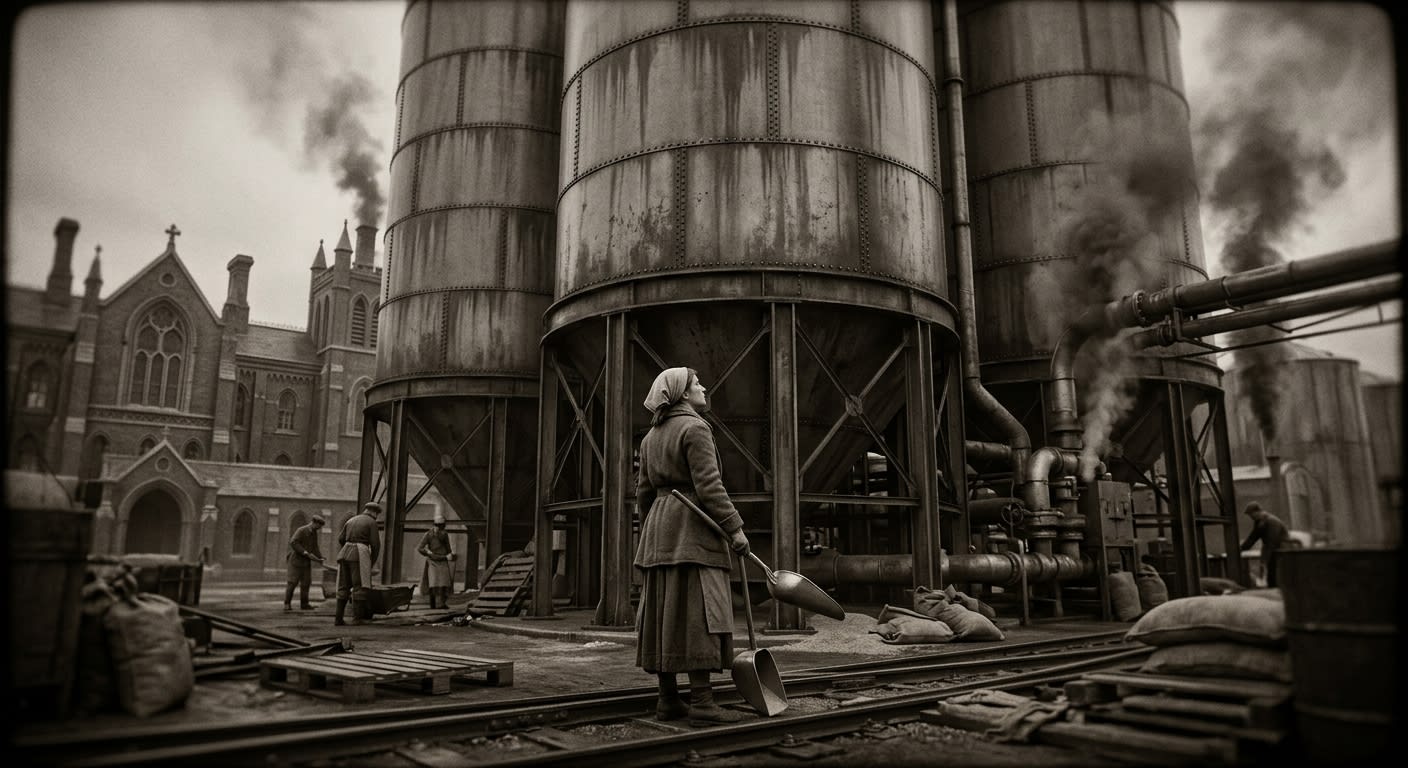
Keeper tradition places Agnes in a Rhine parish after the First Ration Reforms of A.S. 104 (Unregistered), when standardised chits turned hunger into transferable paper and transferable paper into fraud. The date is plausible. It is also convenient. A.S. 104 gives every later ration abuse an origin cupboard into which Doctrine may place blame and shut the latch. The Grain Keepers prefer a rougher memory: Agnes served in a parish storehouse during a winter when official allotment counted registered mouths and ignored the mouths not yet returned by Records after convoy loss, plague confusion, or clerical laziness. A ledger can make a child disappear before hunger has the courtesy to do the same.
She began by shaving measures. A scoop levelled low for the official bin. A scoop rounded high for the widow. A little dust swept into a pouch. A spoiled sack condemned with excessive grief, then recovered by lamplight. No banners. No doctrine. No glorious conspiracy. Just millet, wrists, and a woman who knew the difference between a regulation and a corpse.
The cellar accounts name no husband, no child, no family. This absence has become devotional. Mercy Keepers claim Agnes fed other children because she had none. Quota Men claim she had children and erased them from the story to protect their descendants. Hunger Brokers claim she had no attachments and so could afford virtue. All three readings are self-portraits holding candles.
Festival scripts prior to A.S. 188 identified Silo-Agnes as “daughter of a licensed granary prefect.”
Withdrawn after Records failed to authenticate the prefect, the daughter, the licence, or the granary. Current public phrasing calls her “a humble servant of the ration chapel,” which has the advantage of being vague enough to survive inspection.
#On the Three Sacks
The three sacks have become relics without relic custody. This is dangerous, which is why the Bureau of Relics pretends not to hear the prayers spoken over kitchen bins in her name. Grain Keepers divide the sacks by doctrine. The first sack belongs to Mercy: bread for children, fever patients, nursing mothers, men too old to work and too stubborn to die. The second belongs to Prudence: seed grain, emergency reserve, proof against the official tomorrow failing in precisely the same way as the official today. The third belongs to Sin: bargaining grain, bribery grain, silence grain, the sack that keeps the patrol sergeant's eyes elsewhere.
Keeper prayers ask Agnes to keep all three sacks full and to make the third unnecessary. The second clause receives less confidence.
The tribunal inventory gives prosaic quantities: three sacks, each under full tithe weight, mixed millet with husk contamination, no seal twine, altar-linen wrapping, chalk household marks. The Purity assessor wrote that the accused had “substituted private pity for public allocation.” A better indictment of the Synod has never been filed by one of its servants, and I resent him for achieving it accidentally.
Agnes answered with arithmetic. Sixteen households had received short issue. Four infants had no registered supplemental ration because baptismal confirmations lagged behind ward transfer. Two widowers were classified as able-bodied despite fever sores. One soldier's mother was denied dependent bread after the son's unit stopped appearing on public casualty lists, which meant he was dead, missing, reassigned, or administratively inconvenient. Agnes had counted these persons, then counted the parish sacks, then committed the crime of making numbers meet flesh.
TRIBUNAL EXTRACT — GRAIN SABOTAGE HEARING, FILE PARTIAL Question: By whose authority did you reserve the sacks? Answer: ███████████████████████████ Question repeated: By whose authority? Answer: The hungry came before the stamp. Disposition note: subject removed from open hearing; further response sealed as incitement Sentence: immurement; ration warning to be read at market bell
The sentence was carried out in a wall adjoining the parish store. This detail survives in no Festival script. It survives in Keeper practice. On the night before a cache is opened, some Cellar Wardens press an ear to the storage wall and listen for mice. If they hear scratching, they say Agnes is counting.
#On the Festival's Useful Lie
The Bureau of Festivals found Agnes late and improved her immediately. A wall is poor theatre. A cellar lacks sight-lines. Millet is visually inferior to wheat. Immurement provides a strong final image, yes, but it leaves the audience angry in the wrong direction. Festivals required Agnes to die giving, not being punished for having kept enough to give.
The Feast of the Empty Table supplied the frame. Every year, in selected wards, a table is laid with clean cloth and no food. Children process around it carrying painted bowls. A Chorus-Master sings the Hunger Antiphon in a key chosen to flatter thin voices. Agnes enters with the three sacks, opens them, and distributes bread no actual millet could have produced. The crowd learns that charity is holy when performed under supervision, rationed through script, and followed by a licensed ovation no longer than fourteen seconds.
The pageant is popular because everyone understands it incorrectly. Mothers see the woman who fed children when the ration line failed. Grain Keepers see the woman who hid grain and held silence. Festival officers see controlled grief. Tithes sees receipts. Purity sees a useful reminder that generosity outside authority ends safely inside theatre.
This is the Bureau's wager: dramatise the saint loudly enough and the criminal disappears behind her halo. It works on children. It works on visiting officials. It has never worked in a cellar.
A.S. 192 Festival circular: “No evidence connects Agnes of the Empty Table to Grain Keeper superstition.”
Corrected internally. Evidence is abundant, recurrent, flour-dusted, and sung in kitchens after curfew. Public denial remains authorised because admitting the connection would require explaining why a convicted hoarder has better devotional reach than three ratified ration saints and one Bureau-approved ladle martyr.
#On the Grain Keepers' Agnes
Among Mercy Keepers, Silo-Agnes receives a crust before distribution. The crust is placed on the highest shelf, where children cannot reach and mice can, which is either bad storage or excellent theology. The Mercy Keepers say Agnes feeds the small first. They carry three chalk dots on the inside of the left sleeve: one for the hungry, one for the hidden, one for the denied.
Quota Men honour her differently. They write AG. in ledgers beside tolerated discrepancies, never enough to convict, always enough for a trained eye to know that the grain has been diverted under saintly excuse. They dislike sentiment and adore a useful mark. Their Agnes is not a martyr but a method: three sacks, three books, three denials before confession.
Hunger Brokers invoke her rarely and falsely. A Broker who claims Agnes while charging famine interest deserves a wall without air, and I write this as a man employed by a state that has an entire department for walling people without air. Even hypocrisy has standards.
The Bureau of Purity tracks Agnes marks in raid reports: chalk three-dot clusters, millet grains in reliquary lockets, little clay wall charms, prayers beginning “Lady of the Last Sack.” It classifies them as subsistence superstition unless attached to an active cache. This leniency is tactical. Arresting every grandmother with a millet charm would empty half the west into tribunals and leave the other half to cook for them.
#On the Wall and the Present Use
The location of Agnes's wall is disputed in the approved way: too many places claim it for any one claim to be actionable. A parish near Mainz keeps a bricked alcove behind its store chapel and charges pilgrims to touch the mortar. A Rheinscarp ration mill has a sealed cellar wall that sweats grain dust in wet months. Strasbourg's poorer intake streets whisper of a pantry where scratching can be heard before shortages. The Bureau has authenticated none of these. Authentication would create a shrine, a shrine would create offerings, offerings would create revenue, and revenue would require deciding which Bureau gets it. Better to let holiness remain unprofitable until jurisdiction matures.
Silo-Agnes endures because she solves a problem the Synod created and then criminalised. Official hunger requires approved saints of restraint: ribs crowned in iron wire, bowls held empty, fasts dressed in doctrine; see the Triumph of the Gaunt and try not to vomit into the programme. Actual hunger prays to the woman with the hidden sack. A mother does not ask whether Agnes had a licence. She asks whether there will be bread before the child stops asking.
As of A.S. 201, her public pageant remains licensed. Her private cult remains watched. Grain Keepers continue to mark caches with three dots, to name their emergency sacks after her, and to whisper that the wall never finished closing because Agnes kept counting on the other side. Purity denies this. Festivals sells the programme. Tithes counts the stall fees. The children eat when somebody has been brave enough to sin.