
#On the Counter
"Rejoice by permission."
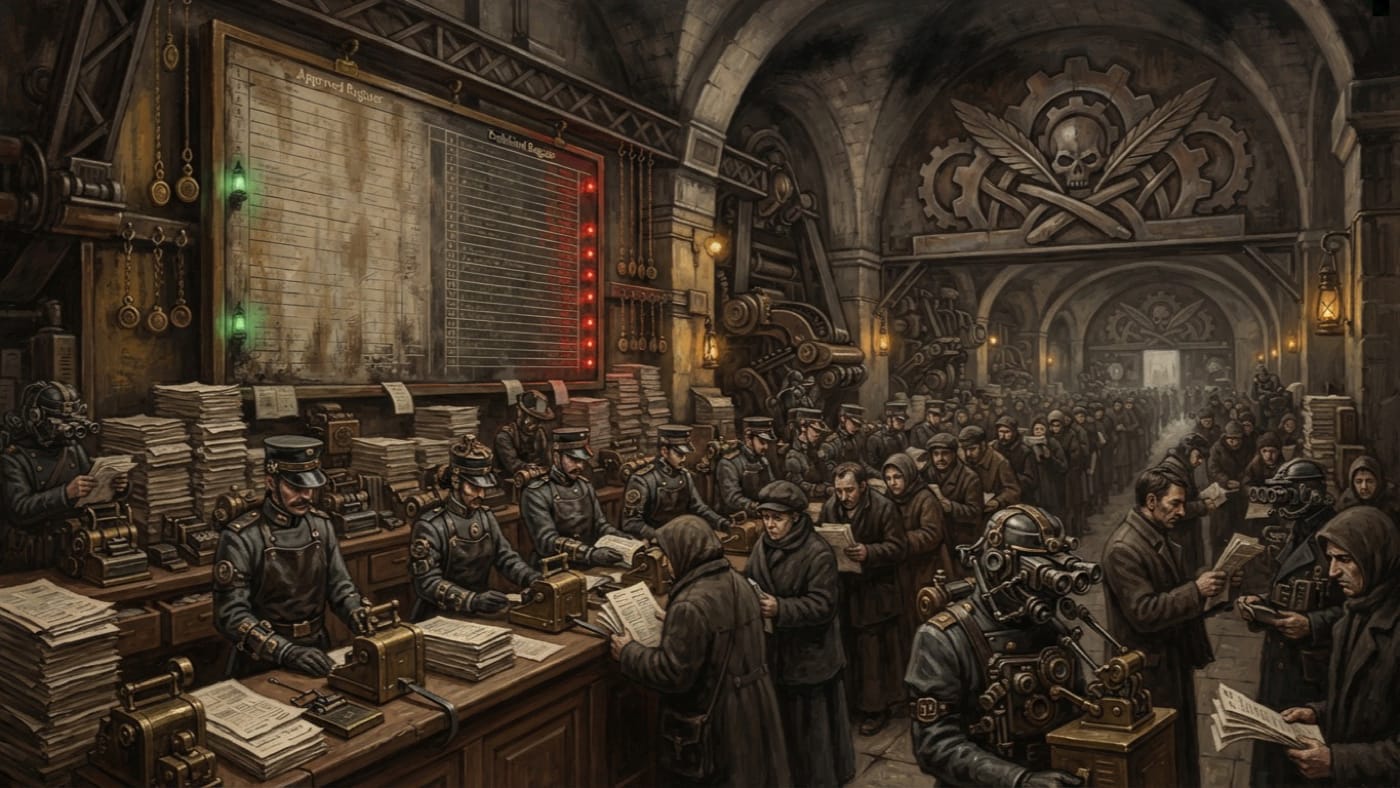
In Lyon, joy starts in a queue. The Lyon branch of the Festival Permit Office, maintained by the Bureau of Festivals, appears in the account of A.S. 200 as a counter staffed by Bureau clerks, with citizens queuing before it, forms on every surface, and a board on which celebrations are sorted into the approved and the prohibited. The citizens hold their papers in both hands, as a pilgrim holds a relic that cost too much and may yet prove to be a pig's knuckle.
The account gives two figures, and I set them down exactly as the Bureau supplied them. Average processing time: eleven weeks. Average celebration duration upon approval: four hours.
Some impertinent reader will picture the citizens of Lyon standing at the counter for eleven weeks, growing beards and confessing to one another. They stand there for a morning. The weeks belong to the paper, which leaves the counter, is read, is considered, is answered and comes back. A petition has more shrines to visit than any pilgrim. The four hours are an average of what was granted. No statute fixes them, and the number does not describe opening hours or the patience of any clerk.
#On the Permission to Rejoice
"Joy is a sacrament. Unsanctioned joy is an insurgency."
The Bureau of Festivals governs the dates of celebration, the costumes worn at it, the plays performed for it, and the grief and observance that go with it. It licenses joy for four reasons, and the Bureau will name only the first two in public: morale, doctrinal instruction, crowd control and surveillance. A festival teaches with bunting. It also takes a census to music. A clerk who stamps a feast-day permit is approving an afternoon of singing and, with the same stamp, a register of everyone who turned up for it.
The board in the Lyon office shows two columns. The Bureau's calendar has three registers, and the clerks are expected to know all of them.
The Sanctioned Register holds the great feasts ratified by the Bureau of Doctrine. Nobody asks permission to keep them. Citizens are counted at them, and absence goes into the books.
The Prescribed Register holds the regional observances, the parish and city rites too local for Strasbourg's direct attention and too useful to abolish. These run under licence, and licences are the counter's whole trade. A citizen who reaches the front of the queue is generally asking whether a local custom may be practised on a given date, in a given place, by a given crowd, using a script that someone with a seal has already read.
The Prohibited Register lists what may not be done. Its rule is simple, and every year some Lyonnais is surprised by it: a request does not make a prohibited thing lawful. A citizen who applies for a forbidden celebration has filed a confession on the Bureau's own stationery.
Scripts deserve particular reverence. A licensed performance is a performance of approved text. The citizen who wants a play at a saint's day is asking to stage words Doctrine has already vetted, in a form Festivals has already measured, for an audience the Bureau intends to count. Spontaneity is welcome so long as it was submitted in advance.
#On the Other Seals
The clerks at the Lyon counter hold the pen. They do not hold every seal.
A celebration in the Synod's dominion touches nearly every Bureau that can tell time, take a meal or count a coin. The Bureau of Bells keeps the bell schedule, and a festival that rings against it is a disorder however pious the music. The Bureau of Rites keeps the fasts, and a feast that falls on one becomes a gathering at which the celebrants may not eat. The Bureau of Tithes watches cost and provisioning, because a crowd needs bread, lamp oil and a road, and whatever a crowd consumes was owed to someone. The Bureau of Orison and Song licenses the music. The Bureau of Records keeps the attendance and the observance in its ledgers. Whatever deviation the festival produces goes to the Bureau of Purity, which receives it with the appetite of a creditor.
These are relationships between institutions. They are no floor plan. I do not say that the Lyon branch keeps a Bells clerk in a back room or a Tithes auditor under the stairs. I say that the bells, the fasts and the purse sit over the Lyon counter whether or not anyone from those Bureaus sits behind it.
The account does not say where the eleven weeks are spent, and I will not guess on the record. Off the record, I have met the Holy Bureaus.
#On Lyon's Masks
"Unsanctioned mirth is the first syllable of sedition."
Lyon is a city of the Rhône, of the western heartland, and of close supervision, and that last condition has a date: A.S. 170.
That year, during the Tumults of Lyon, masked celebrants used the anonymity of a licensed festival to hand out seditious pamphlets. They assaulted two Attendance Auditors. They also staged an unlicensed puppet show in which the Hierarch of the Third Seal appeared as a dancing bear, which Doctrine later classified as creative blasphemy. The masks were confiscated and the puppeteers immured. Carnival masks were outlawed in three provinces. Since then the Bureau of Festivals has stationed additional Auditors in Lyon for every major observance, a deployment the Lyonnais call "the second occupation."
Initial Bureau reports described the Tumults of Lyon as a spontaneous disorder caused by excessive drink and insufficient supervision.
Withdrawn. The distribution of the pamphlets, the sugar packed into Auditors' whistles, the altered procession banners and the false permit stamps all show planning. Excessive drink remains probable. Insufficient supervision is admitted only in sealed rooms.
Look again at the last item before the full stop: false permit stamps. The rioters of A.S. 170 had studied the Bureau's paperwork closely enough to forge it. Every clerk who has worked the Lyon counter since inherits that lesson, whether or not it was ever taught aloud. A Lyonnais application is a request, and it is also a document of the kind that once helped a crowd hide its faces and walk a bear in a mitre through a licensed square.
The two things Lyon taught the Bureau to fear are anonymity and theatre without a licence, and the board's prohibited column is where they now sit. The suspicion outlived the riot. It will outlive the clerks too, because it lives in the forms, and forms do not retire.
#On the Licensed Hours
"No unscheduled encore."
The stamp comes down and the paper leaves the counter for the last time. At that point the celebration exists in law and has yet to happen in the street.
It reaches the street through officers whom the counter clerks never become. A Festival Chorus-Master directs the licensed performance, with the approved script, the permit sash, the cue bell that starts a refrain and stops one, and the knowledge that any departure from the text can cost the licence. Pageant Captains handle the bodies, which means routes, barricades and the movement of a crowd that has waited eleven weeks to be allowed to move. Attendance Auditors count the participants and record how enthusiastic they visibly are. In Lyon there are more Auditors than elsewhere, for reasons already entered in the books.
Lyon's own regulated observances show what a licensed performance asks of the body. In the Procession of Tongues, citizens recite the Creed over and over until their voices crack, and those who falter are gagged. The streets fill with hoarse devotion. I cite it as an example of a performance governed down to the throat, and I draw no conclusion from it about the four-hour figure. The account does not connect the two, and neither do I.
Then the permitted hour ends. The Bureau's real instrument has always been the stopping point. The script runs out, the cue bell sounds, the Pageant Captains open the barricades in the other direction, and the Auditors close their frames. A crowd that wants more has, by wanting it, reached the exact limit of its licence.
Nobody forces the citizens to stand in that queue. A sanctioned feast takes them whether they apply or not. The counter is for what they choose: a parish saint's day, a guild procession, a song their grandmothers sang under licence. For these they wait eleven weeks. For these they accept the board, the clerks, the seals of six Bureaus, the second occupation at the alley mouths and the bell that will end it. They come back the following year with fresh forms.
Doctrine calls this devotion and Records calls it compliance. I call it the most reliable demand the Synod has ever met. The Bureau of Festivals has rationed it for generations and has yet to find its bottom.
The queue resumes at the opening bell. Bring the correct form.