
#The Oldest Wall at the Hinge
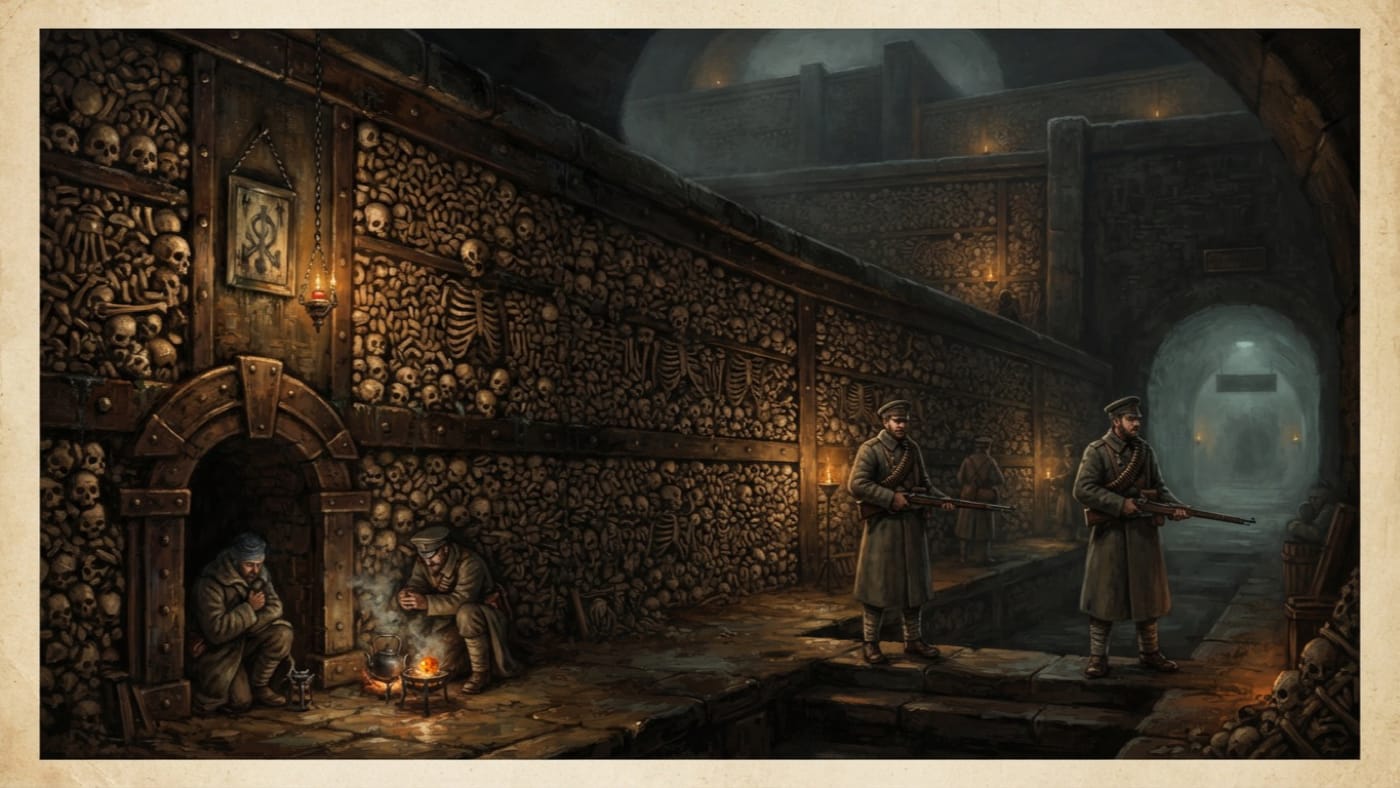
The First Ossuary Ring is the oldest masonry at Bastion-Constantinople that is still expected to do a day's work. It lies within the innermost defensive shell of the southern anchor, sunk into the older Byzantine fabric of the city. It is black where the newer works are pale. It is built, and I state this plainly because the Bureau prefers it stated grandly, of soldiers. Their bones lie between its courses. Their names lie elsewhere, in ledgers, where bones are not permitted.
It is the earliest part of what are now called the Ossuary Rings. It is also a grave, a rampart and a parcel of Church property, and it has never been required to choose among them.
#On the Retreat and the Dead
The annal of the Bastion fixes the arrival in the winter of A.S. 47, two years after the Sundering. What remained of the Continental Levy came down to the Bosphorus at the end of the retreat, with Maldrake's furnace-legions descending from the Thracian Plain behind it, and there it halted. The annal calls the halt a stand. The margin of an older copy calls it exhaustion. Both are in the Bureau's hand, and both are correct.
An army that stops will dig. Ditches became walls. Men kept dying while the digging went on, from wounds carried out of the Danube country, from cold and from fire. An army holding ground has nowhere to put its dead except the ground it holds. So the mass graves were dug where the earthworks were dug: in the same trench, with the same spades, sometimes in the same morning. What began as burial became footing. What became footing became the First Ossuary Ring.
The records do not say who first laid a course of stone over a course of the fallen. They say only that it was done many times. They also say that the surviving clergy of the march declared the works consecrated by virtue of the bones mortared into them. Records now styles those clergy Hieromnemons. The office credited to them had not yet been constituted. The title was hung on them afterward, like a medal pinned to a coffin, and nobody in the coffin has objected.
The annal also keeps the oath. By its count the First Continental Levy numbered twelve nations, eight languages and six incompatible liturgies, and it swore on the bones of its dead: "The Line is carved into earth. We retreat no further." Nearly two more decades would pass before the Sagittal Line could be called a defensible work. The men swore by a Line that did not yet exist, upon dead men who could not leave, and the oath outlived both conditions.
The formal Synod, constituted at the Concordat of Strasbourg in A.S. 90, later ruled that retreat from Bastion-Constantinople is heresy. In A.S. 47 there was no Synod to rule on anything. There was mud, and a decision the mud had already made.
#On the Bone-Built Works
Walk inward from the outer rings and the stone darkens as you go. The newest works are pale, and their edges are still sharp. The oldest inner works are black: black stone, old mortar, joints that weep in every season, and in the sub-chambers a humidity that tastes of iron. The First Ring belongs to that black.
It was dug into the Byzantine city rather than raised on open ground. Its builders took what the ancient fabric gave them, the footings and cellars and buried foundations of the old capital, and filled the cavities with what the retreat gave them. The dead of the stand lie between the courses. In places the bone shows at the face of the joint. Elsewhere later hands have pointed over it, and only the record says it is there. The record is sufficient. The Bureau of Records has never required a man to see a thing it has already filed.
I decline to print dimensions. Nobody designed the Ring. It accrued, one trench at a time, under a pressure that did not wait for drawings. Later works of the complex were laid against it and outward from it, until six concentric walls of catacomb-fortification stood where one desperate shell had been. The masonry shows where the First Ring ends and its successors begin far less cleanly than the Bureau of Engineering would like.
It was a defensive work from its first day and a funerary work from its first night. The two functions have never been separated. The Bureau of Rites calls this sacred geometry. Anyone who has held a trowel calls it structural necessity. I have read both files, and they describe the same wall from opposite ends.
Older compilations of the Codex describe the bone-built works of the first stand as the oldest fortifications of the western anchor of the Line, at Bastion-Lorraine.
The Line runs north to south, from the Baltic to the Bosphorus. The First Ossuary Ring lies at its southern anchor, Bastion-Constantinople, and always has. "Lorraine" survives as a refugee name in songs and on pre-correction brass. The brass will be corrected when the Bureau of Tithes locates the funds for brass.
#On Custody and Those Who Live Nearby
The Ring is garrisoned. Its dead keep their posts in the joints, and the living keep theirs on the walks above and in the galleries between. A soldier on the inner watch stands on his predecessors and is expected, in due course, to be stood upon.
Mother-Cryptor Sabine administers the Ossuary Rings as a whole for the Bureau of Records and carries the catalogue of the complex in her memory. Her urns number in the tens of thousands. The dead of the First Ring were never urned. They were built in, and a man built into a wall makes a curious entry: he is at once a casualty, a relic and a structural member. Each of those states has its own office, and each office has its own form.
The Warrens lie beneath and between the Rings. Their people are veterans too broken to return to garrison, the families of soldiers killed before pension age, and craftspeople who came to supply an army and could not afford to leave. The Warrens are not counted as part of the First Ring, and the First Ring is not counted as part of the Warrens. They share walls, damp and a smell. Wherever the living lodge beside consecrated remains, the allocators want a permit for the sleeping and the mortuary clerks want a classification for whatever is slept beside. In the oldest passages a child may sleep against a course that holds someone's great-grandfather. No one has drafted the form that records this arrangement, and no one has asked for it.
#On Consecration and Service
The Church holds that the dead of the First Ring remain on duty. They took their oath on bones, became bones and were laid into the line of the oath. Doctrine reads this as continuous service, unbroken by death, which is the only kind of service the treasury has ever been able to afford. No one draws a pension on a wall, and no widow can petition on behalf of a course of masonry.
The Bureau of Doctrine assigns their memory to Records, their sanctity to Rites and their upkeep to whoever happens to be standing nearest with mortar. The arrangement satisfies everyone who was consulted. The dead were not consulted, on the reasonable ground that they had already consented in A.S. 47, in writing, upon themselves.
The parish clergy teach that any soldier who dies within earshot of the Constantinople carillon passes into the Book of Departures without a clerk's hand. The parishes cherish the doctrine, and the Bureau of Bells rings it. For the First Ring it is inconvenient. Its dead were in the walls some two decades before any carillon hung over them. I have referred upward the question of how they were entered. It has not come back down. In the Bureau of Doctrine, a question that does not come back down has been answered.
#On the Present Condition
The First Ring persists. It has never been demolished, replaced or retired, and none of those things could be done without first settling whom one would be demolishing. Every later wave of dead has gone into the complex that grew outward from it. In the Year of Ash Rain, A.S. 143, Maldrake burned the Thracian forests and the Ninth Bell Famine took what his shells had missed. That year the Ossuary Rings as a whole expanded by a quarter of a mile, and Records logged sixty-eight thousand casualties. The expansion belongs to the complex and to the famine. The First Ring supplied only the precedent.
Kargath starves the convoys from across the marshes. Maldrake burns the walls from across the Plain. Between them, the Rings never lack building material. I say so with exactly as much levity as the ledger allows, which is none, recorded in red.
Near the inner works, sealed and uncatalogued, lies the Third Ossuary. It has been under seal since the year of the stand. The garrison reports bells near it that match no schedule, and dogs that lie down facing it. Those reports concern the surrounding complex, and I have filed them there. Nothing in the First Ring's record attributes any sound to the First Ring. Its dead are silent, as dead men in good order should be.
#Disposition
The First Ossuary Ring is entered in the Ledger as standing, garrisoned and consecrated by attestation. The garrison of its first winter remains inside it. The wall remains on duty.