
#On the City That Does Not Appear on the Map
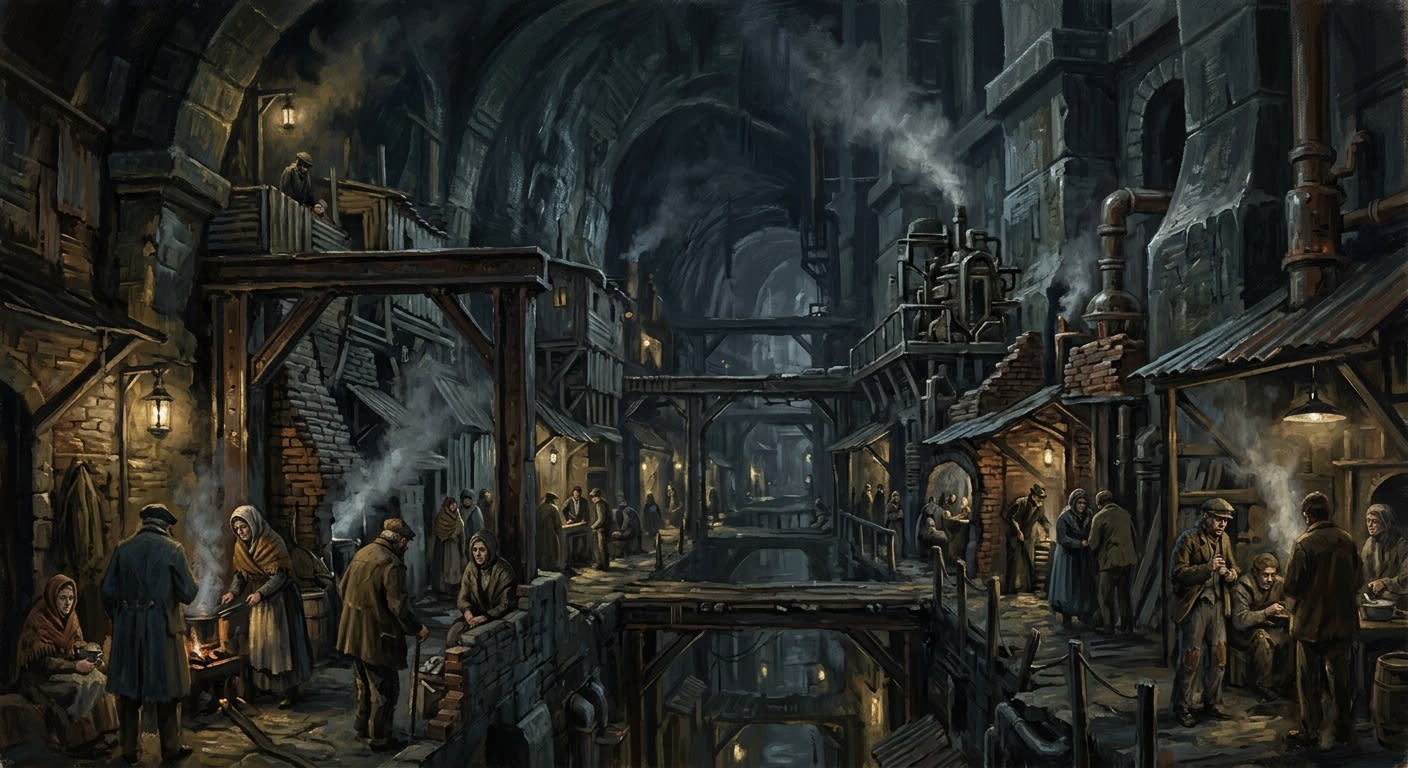
The Constantinople Warrens lie beneath and between the Ossuary Rings of Bastion-Constantinople, in the sub-ossuary corridors, drainage galleries, abandoned work cuts, half-sealed crypt roads, and air shafts that the Bureau of Settlement marks as solid stone. The Bureau's maps are not wrong in the ordinary sense. They are wrong in the imperial sense: confidently, repeatedly, with stamps.
Some forty thousand people live there. Veterans too damaged for garrison return. Soldier-widows whose pensions froze in a Records dispute. Children born under arches the map insists are load-bearing masonry. Craftsmen who came to repair the fortress and discovered that leaving required a valid outbound permit. Permit-expired wanderers, oath-poor pilgrims, furnace-scarred labourers from the Foundry Quarter, rope-market families displaced by harbour revisions, and the patient human sediment that every great fortress accumulates beneath its proclamations.
The official population of Bastion-Constantinople is a tidy number by Bureau standards, arranged into ledger colours, sub-Archonate districts, and civic categories whose elegance makes them immediately suspect. White for sanctum offices, Crimson for foundries, Black for the Ossuary garrison, Grey for barracks, Blue for the Harbor of Chains, Ochre for terraces, Green for Pilgrim's Coast approach. The Warrens have no colour. Colour would imply classification. Classification would imply responsibility.
The recommendation is a masterpiece. One cannot monitor what one refuses to see. The Bureau does it daily.
#On How Stone Became Shelter
The Warrens began as refusal, then became habit. After the Sundering, Constantinople received armies, dead, refugees, relics, siege engines, and all the panicked architecture of a continent discovering that eastward movement had become a sacrament of suicide. The First Ring rose in A.S. 47 from frozen ground and stacked dead. The Second Ring, ordered by Governor-Praelate Hugo in A.S. 68, gave the fortress its deliberate bone-course. The rings expanded, and with expansion came service cuts, lime rooms, cooling niches, unused galleries, rejected corridors, and all the gaps left by men building faster than they could account for what they had built.
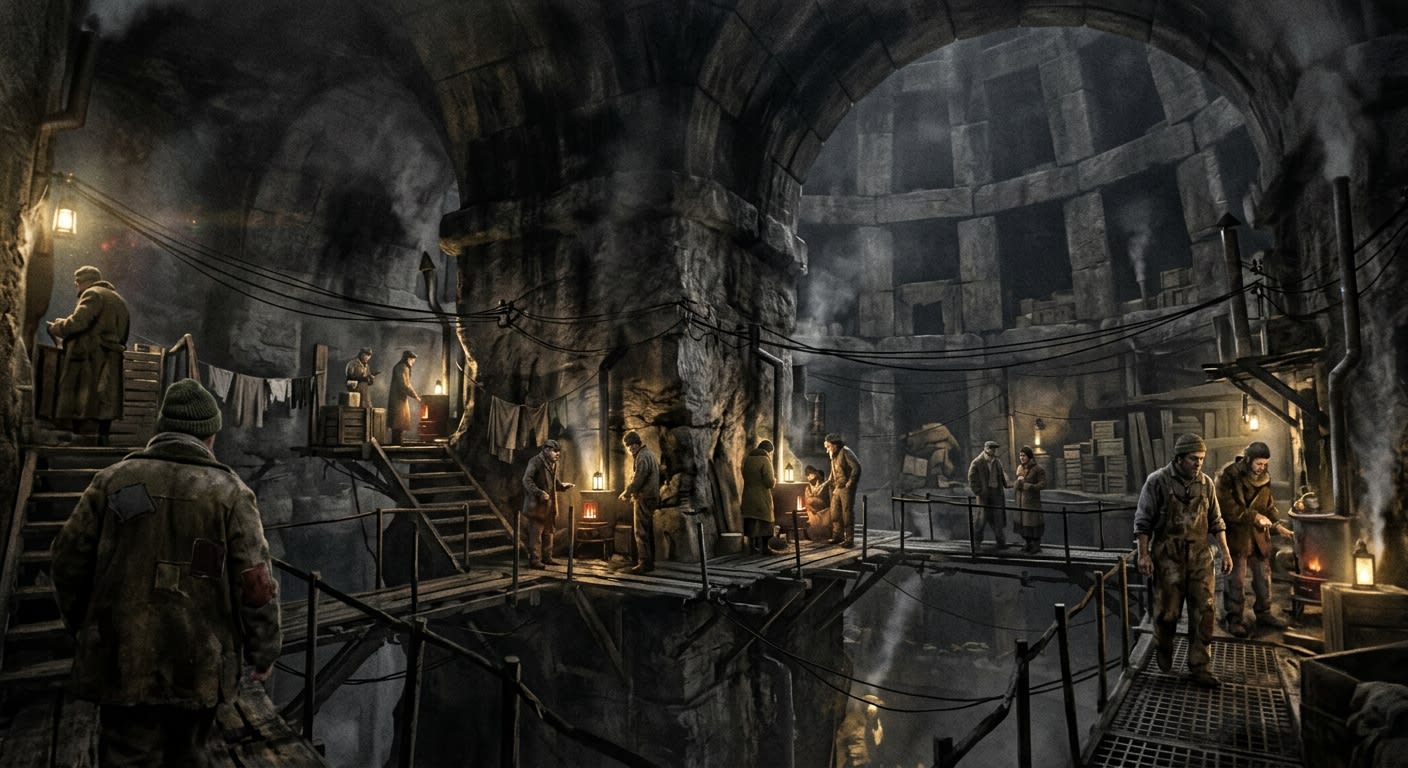
A work crew sleeps in a lime alcove for three nights. A widow waits there during a bombardment. A child is born where the corridor bends away from the inspection route. A quartermaster stores spoiled grain in the next chamber and forgets the key. A veteran hangs a curtain, then a second curtain, then a saint-card, then a kettle-hook. By the time the Bureau asks who authorised residence, residence has already acquired neighbours.
An A.S. 130 survey described the sub-ossuary passages as “uninhabited maintenance access.”
Corrected. They were inhabited. The survey party entered by the wrong gate, counted three empty tool rooms, heard singing through the wall, and concluded that acoustics were misleading. The people on the other side of the wall were less misleading than the surveyors.
The Ninth Bell Famine of A.S. 143 gave the Warrens their present shape. Ash fell for nine months. Sixty-eight thousand dead entered the Rings. The Sixth Ring expanded by a quarter-mile in five months, and the tunnelling crews cut temporary passages through old drainage to move bone, lime, water, and bodies. Temporary passages are the Synod's preferred method of creating permanent embarrassments. Families moved into the cuts because the streets above were hungry, the air outside was ash, and the dead below were at least quiet after the Sub-Carillon (Unregistered).
By A.S. 170, when the Vigil of the Hollowed cracked the Sixth Ravelin and forty-seven volunteers were sealed into Chamber 7, the lower corridors already contained a population large enough to be useful and invisible enough to be deniable. The last confirmed Settlement inspection occurred that year. The inspector's report uses the phrase “temporary sub-civil presence.” The presence stayed. The inspector did not.
#On the Layers Below the Rings
The upper Warrens press against the Fifth Ring, where the Ossuary Housing Allocators issue tagged alcoves, corridor bunks, and permission to breathe dry air near bones. These upper lanes have names, though no official map bears them: Candle-Tongue Row, Widow's Elbow, Nailmarket, Saint Barachiel's Drip, the Bread Stair, the Nine Hooks, Varnish Chapel, Grey Rope Cut. Names are jurisdiction in miniature. The people name what the Bureau will not number.
Below the upper lanes are the sub-ossuary galleries where air thins, lantern smoke stains the ceiling black, and water runs along channels old enough to predate every Bureau that claims authority over them. Here the Warrens cease being crowded and become deep. Families sleep in chain hammocks bolted between pilings. Shops occupy niches meant for bone carts. A barber works beside a sealed door whose wax layers have been repainted so often that the stamp is now a lump of authority without readable text. Bread is baked in clay ovens fed by waste heat from the Foundry Quarter. The loaves taste of iron. The locals call this flavour protection.
Below that are the forbidden passages. No sensible resident names them for outsiders. They lead toward the Third Ossuary, toward the lower faces of the Ring walls, toward dry chambers where dogs lie facing inward, toward gaps in the stone through which bells may be heard at hours no bell schedule admits. The Lantern Brotherhood patrols some of those routes. The Brotherhood claims its clockwise circuits prevent return. Return of what, it declines to specify. Good. Precision would only make the matter less comforting.
Extract from an A.S. 198 Purity intake, seized from a Lantern patrolman: Question: What did you see beyond the lower hinge? Answer: A street. Question: Describe the street. Answer: It had windows. Question: There are no windows beneath the Fifth Ring. Answer: They looked out. Question: Upon what? Answer: ███████████████████████████████████████ Disposition: witness transferred; route sealed; seal found broken at Matins; route not found.
#On Food, Law, and the Courtesy of Being Forgotten
The Warrens eat by barter, salvage, favour, and theft so old it has become etiquette. Foundry workers bring heat-cracked tools, slag-brass, stripped screws, boiler soot, and meal flour skimmed from official rations. Harbour families bring salt fish, rope fibres, broken lantern glass, and rumours of chain luminosity. Ossuary workers bring tallow, bone dust, permit tags, and the kind of silence that can be sold only once. Surface traders descend for repairs, cheap mending, smuggled fuel, unlicensed confession, counterfeit address slips, and the peculiar comfort of conducting business where the Bureau cannot efficiently overhear.
There is law. Of course there is law. Human beings deprived of official law manufacture it from habit and fear, like candles made from grave tallow. Theft from a neighbour's stove brings public repayment. Theft from a Bureau crate brings applause if performed competently and exile if performed stupidly. Violence in the upper lanes is punished by the lane elders. Violence near sealed doors is punished by the Lantern Brotherhood. Violence against children is punished without minutes.
The Bureau interprets such arrangements as disorder. This is natural. Bureaucrats see no law unless it arrives wearing their seal. The Warrens endure precisely because their order is too local, too oral, too knotted into person and place to be extracted into a form. A Settlement clerk can confiscate a tag. He cannot confiscate the fact that Aunt Mirel knows who borrowed the kettle during the Ash Week sickness and who never returned it.
#On Regularisation Attempts
Between A.S. 180 and A.S. 200 the Bureau of Settlement proposed twelve programmes to regularise the Warrens. Twelve proposals. Twelve little processions of ink marched bravely into committee and died there without last rites.
The first called for a census. The second called for forced relocation to Grey barracks. The third invented “provisional residents, pending zone assignment,” a phrase that sounds merciful until one remembers that pending is where people go to become furniture. The fourth through eleventh refined intake routes, permit classes, health inspections, escort loads, and tithe categories with decreasing contact with stone. The twelfth, in A.S. 200, admitted defeat with the sentence: “The sub-civil population remains irregular. This Bureau recommends continued monitoring.”
The official documentation previously implied that Settlement's failure to regularise the Warrens resulted from ignorance alone.
Corrected. Ignorance is only the liturgical vestment. War will not spare escorts, Tithes cannot decide how to tax unacknowledged dwellings without admitting they are dwellings, Records fears amendment cascades, and Purity distrusts any population that has survived without its supervision. The ignorance is maintained because every alternative costs authority.
Sub-Archon Provisional Yvette Langres has requested authority for an independent Warrens census without War escort. War objected. Records objected to direct Ledger amendment access. Tithes objected to field budgets. Doctrine objected to the tone. I object to Doctrine's objection, which will be filed under Insolence, Internal, Warden-Class.
The Warrens have learned to receive these threats as weather. Regularisation rumours arrive; men hide permit-expired cousins; women move children to deeper lanes; lantern patrols mark dry doors with chalk; surface brokers raise prices; then the rumour dies in committee and everyone exhales through cloth.
#On the Present Condition
As of A.S. 201, the Warrens remain inhabited, unregistered, taxed indirectly, policed unevenly, defended accidentally, and known to everyone who profits from pretending otherwise. They are a pressure valve under the southern anchor. Remove them and forty thousand people appear somewhere less convenient. Recognise them and the Bureau must explain how a city beneath the city survived thirty-one years after the last inspection. Destroy them and one risks discovering what the lower passages connect to when the people are no longer making noise above it.
The fortress uses them. The Warrens repair boots, mend uniforms, hide deserters, store contraband, carry water, bury inconvenient dead, feed rumours upward, absorb widows, shelter uncounted children, and provide the city with that obscure civic function no Bureau has yet successfully monopolised: endurance without permission.
Do not mistake this for safety. Kargath's hunger presses from the marshes. Maldrake's shells remember the upper walls. The Sub-Carillon keeps ringing because no official with a soul left intact wishes to test the silence. The Third Ossuary waits beneath its seals. The dogs face inward. The children of Widow's Elbow know which vents breathe warm on Tuesdays and which murmur names after rain.
Above them, the official city tolls its bells. Below, the unofficial city counts by echoes.