

#On the Term and This Survey
Compiled for the Northern Office of the Bureau of Doctrine in A.S. 201 / 1911 CE. That year belongs to this compilation. It is not the year lamp-aid began, and nobody in the fjord has offered me one.
In Hrafnvik, lamp-aid is the oil and lamp-time a household draws from the communal stock to get through the long dark. In practice it is a wick in a longhouse in the sixth week of winter: lit for so many hours, cut shorter when the barrels run thin, and cut again when the narrows close. Nothing more lies behind the word. It is a custom of one fjord's longhouses, kept by the Clan Moot of Hrafnvik, and it extends no further than the Moot's barrels.
The Bureau's forms want to file it under charity, entitlement or ration. Each of those categories assumes a promise that someone wrote down. In Hrafnvik the promise is renewed or withdrawn each winter by elders who have counted the barrels, and they do not write it down.
This survey draws on my nine-day inspection of A.S. 197 / 1907 CE, on the published accounts of the Moot, the Chapter and the dark-houses, and on the Chapter's ledgers, which I read at length and trust in their proper place.
#On the Count Behind the Allowance
Lamp-aid begins in the Render Yards. Nothing reaches a household lamp without passing through them.
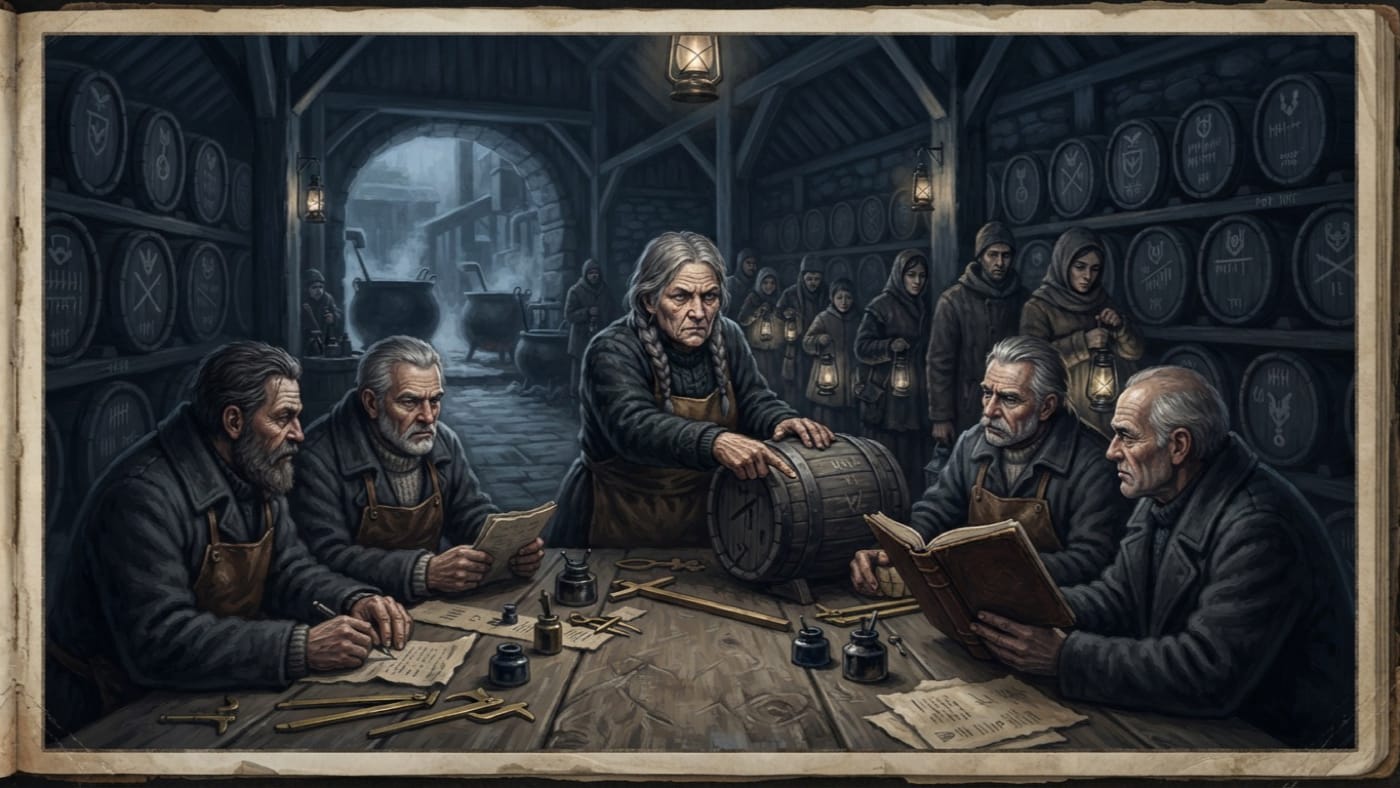
The Moot holds the communal oil and the render schedule. Elder Sigrun Half-Wick is its senior voice and one elder among several, and the others would correct any clerk who forgot it. Her standing rests on her household's survival, on her reputation and on the Moot's assent. The reputation dates from the Seal-Death Winter of A.S. 188 / 1898 CE. By her published account, she cut every wick in her longhouse by half, then cut them again, and three weeks of household oil lasted seven. I have the account. I do not have the arithmetic, and I will not invent a hidden barrel or a miracle to supply it.
Her schedule assigns the work: which households skin, which boil, which tend and cool the vats through the night, which carry to the Shrine Rings, which store in the Frost Pits, and which load the shipments south toward Bastion-Königsberg. The catch sets the count, and so does the winter. A household's labour and its lamp-aid come out of the same barrels, so a place on the schedule pays wages and assigns guilt in one entry. A household left off the schedule entirely has no share in the economy that pays for light.
Every barrel carries notch-codes cut into the stave, because ink runs in the first sleet. Oil-chits and bone tokens settle smaller debts between households. When the count is disputed it goes to the lamp audit, where the elders reconcile the notches against the wicks burned and the oil remembered. Where memory and wood disagree, published accounts record an oath vote and, on occasion, a reading of flame colour. I enter both as local practice. I certify neither, and the Bureau of Rites has not asked me to.
Oil goes south while local lamps run short. Sigrun has sent barrels toward Königsberg in the same season she refused extra lamp-time to her own nephew's house. The Northern Office reads this as compliance. The nephew presumably read it otherwise.
#On What a Household Owes
A household owes oil-tithes in notched barrels, watch-hours on the cliffs, wick dues, and the fast days that the Chapter sets and clan honour enforces. The longhouses call a shortfall lamp-debt, an obligation measured in nights of light, and it is owed to the Moot and the Creator on the same page. The Moot collects its share before any confessor reaches the Creator's.
Lamp-time can be owed, traded and withdrawn, which makes it the nearest thing Hrafnvik has to coin that keeps a child warm. Arrears that cannot be paid in fat may be turned into watch duty, so a house short of oil pays in nights on the ridge. Published testimony describes a darkened household sending its eldest daughter to ask whether a debt could be paid in watch-hours, wick-spinning or seal-hide rope. Sigrun refused some of these requests and accepted others.
None of this follows a tariff. The elders weigh the offence, the household, the season and what the barrels will bear, and on another night the same arrears may receive a different answer. I found no automatic route back into aid. A household that has paid its debt has paid it, and it then waits to learn whether the Moot agrees.
#On Withdrawal
The Moot uses one allowance both to keep the fjord alive and to discipline it. In January the frost treats the two uses alike.
The published accounts associate loss of lamp-aid, and with it dark-house status, with missed quota, repeated refusal of obligations, unsanctioned fast-breaking, selling tainted oil, and putting out a shrine lamp in spite. The general register of the Clan Moot states the rule broadly. The Hrafnvik account treats each case on its own facts. I record both and do not merge them into a statute the elders never swore to.
A fast-breaker may be made uncounted. The house loses its place on the tally and its passage priority when the ice opens, as well as its aid. What follows depends on the house. One with a private barrel, a cousin with a full lamp and a purse of bone tokens has a hard month. One without them burns whatever it owns that will burn, and then has nothing left to burn.
Sigrun has ordered doors left unlit for three nights. She has also sent wicks to dark-houses by routes that no Watch report records. Both entries stand. They show that the elders exercise discretion. They do not show an appeal court, a written exemption, or a rescue that a darkened house can rely on.
#On the Chapter's Paper
The Shrine Chapter of the Blessed Wick blesses each batch, keeps the confession record, sets the fast calendar, issues exemptions and passage papers, and reports compliance south. Prior Malthus has held its stamp since A.S. 192 / 1902 CE. His ledgers record lamp-aid in a fair hand and with great dignity. They do not allocate a drop of it.
A Northern Office abstract of A.S. 195 described Hrafnvik's oil allocation as "managed jointly by Shrine Chapter and Clan Moot under Synodal advisory order."
Corrected after the A.S. 197 inspection. The Chapter blesses, records, exempts and reports. The Moot allocates. The advisory order appears in the abstract and in no ledger I was shown at Hrafnvik.
The paper still carries weight. Malthus cannot restore a darkened house's oil, but he can excuse it from the fast that darkened it, issue a son his passage south, or leave a name off a roster. The split-barrel dispute in the published accounts shows how the two authorities meet. After a thin-seal week Malthus moved to deny fast exemptions to three households. Sigrun produced a tally showing they had met quota by weight, since one barrel had split and been re-bound. Malthus objected to the form. The Moot's count prevailed, and the exemptions issued.
The Winter Watch under Rauk One-Eye keeps the routes, the escorts and the decision about who is fetched back from the ice. The captain answers to the Moot. A household cut from lamp-aid that sends someone out for fuel is asking the Watch for a rescue it has no claim to. Rauk knows which houses can survive two nights without aid, and Sigrun knows which houses can spare a body for the ridge.
The Warm Paper Brokers sell exemptions and passage writs for oil. Their customers buy a chance at survival with the fuel that would have kept them alive, and the Render Yards must make up every barrel. One prohibition holds above the trade: no one may take a child's lamp or lamp-pin as payment. The rule protects the lamp. It does not promise that the lamp will be lit.
#On Unlogged Warmth
Beneath the count runs what the longhouses call unlogged warmth: oil under false tags and wicks passed from hand to hand. It keeps some of the excluded alive, and it turns every audit into a negotiation with oil nobody admits to.
The Dark-House Circle is a separate matter and must stay separate in the file. It is an unregistered mutual-aid network, attested in published testimony: hidden oil, false inventory tags, stolen shrine wicks, quiet deliveries to some excluded households. It is not another name for lamp-aid, and it neither governs nor founded it. Its members, its leadership, its beginning and its routes remain unreported, and I will not supply them. Sigrun's unrecorded wicks do not make her its leader or its member. They show only that she has sometimes sent wicks to houses she darkened herself.
#On the Present Count
This closes the A.S. 201 / 1911 CE compilation.
Seal returns have thinned, and the south wants tighter quotas because Königsberg burns northern oil. The longhouses want fewer fast days, since a lean fast in a lean year empties houses the Render Yards will need when the seals return. Brokers multiply at the Slipways. Hrafnvik's compliance has been renewed on conditions and remains under review. Lamp-aid continues as it did before this survey: the elders count the barrels and decide which lamps stay lit, and how long each one burns.