
#On the District
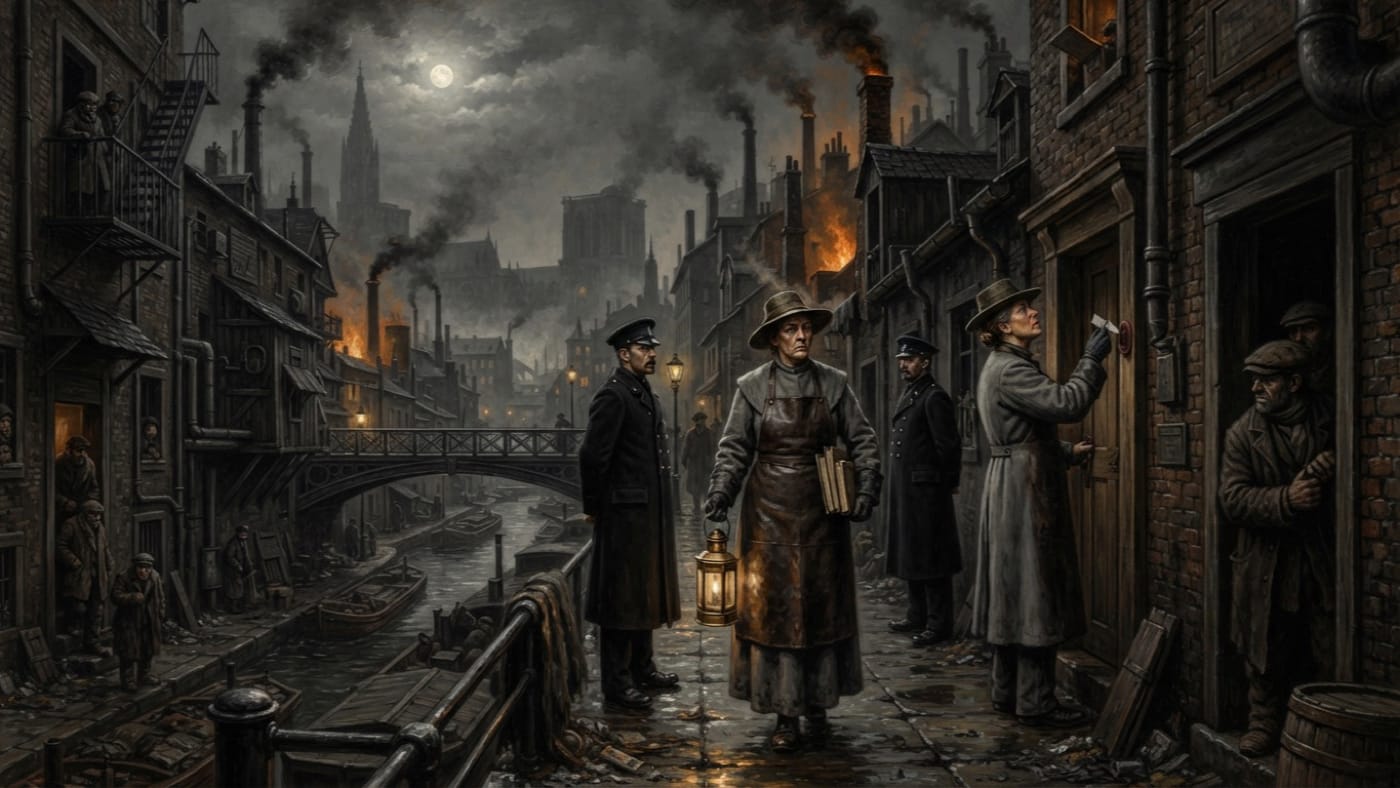
The Furnace District of Strasbourg is named for what it does. The capital rarely extends that much honesty to its quarters. Chimneys rise above workshop and tenement alike, and the soot comes down on both without consulting the property register. River air, quench-troughs and whatever the gutters are asked to carry keep the paving stones wet, and the wet stone holds the soot. A doorstep scrubbed in spring is black again by autumn. Few householders bother scrubbing a second time.
The Synod's capital is a city of ledgers, barges, garrison roads and cathedral bells, and the Bureau of Records would prefer it remembered that way. Ledgers do not keep themselves warm. Iron must be heated, kettles boiled, and old men's kitchens kept above the temperature at which old men stop. Somewhere the city must burn things. The Furnace District is where Strasbourg agreed to do it, though no one ever said so aloud.
I will not give its boundaries, its population or its founding year. They have not been supplied to me, and the Hieromnemon does not invent a surveyor's chain because a reader expects one. Anyone who needs those particulars may apply to Records, which will tell them quite truthfully that the matter is under review.
#On Fuel and Labour
The Church issues fuel the way it issues absolution: by allocation and seal, and never quite enough. Consecrated lamp-oil, blessed tallow and rationed coal arrive in the quantities the Bureaus have calculated, and the calculation always assumes a warmer winter than the one that comes. The ration is honest. The cold does not read it.
Black diesel fills the gap. It burns hotter than any Bureau allocation, drives a furnace harder and keeps a lamp lit longer. It leaves an acrid stink in the throat and an oily soot on the sill that no cleric has yet agreed to bless. General Bureau lore connects the black-diesel distillers and the hidden pipe-runners to the furnace districts of the Synod's cities, and the connection needs no great imagination: men who sell heat go where heat is bought. I make no claim about any particular still, pipe or route beneath this quarter. The Bureau of Purity would thank me to keep making none, and I am a grateful man.
Legal labour has its own smells. Bitter inspection incense hangs in the air, and wax smokes where the seals are pressed. Coughing runs from doorway to doorway like an antiphon nobody licensed. Every furnace of any size needs a man to keep its joints from screaming, and the Synod has trades for that. The resonance plumbers and gasket-hymn mechanics keep the iron lungs of the industrial cities breathing. Wherever the Bureau of Engineering has its way, the furnace catechists explain to the labourers that the fire roars because Heaven wills it. The Bureau of Doctrine holds that the fire roars because Heaven wills it, and because Doctrine says so. The two Bureaus have argued about causality for longer than the district's soot has had time to settle. The furnace has kept roaring through the whole quarrel.
#On Air Made Evidence
A Purity Fume-Inspector enters this quarter as a walking court of first instance. The grey half-priest robe, the filtered nose-mask, the ash cuffs and the brass badge of the Ninth Mark announce her before she speaks. The ledger-lantern is the true warrant. A woman holding a lantern stamped with the Bureau's seal is no longer simply looking. She is witnessing, and what she witnesses becomes evidence once it enters her logbook.
The procedure has three steps, and each makes the air more actionable than the last. She smells first, with a nose trained over months on controlled burns until it can tell black diesel from blessed lamp-oil at forty paces. She samples second. She holds the reactive fume paper to a chimney's breath, fills an ash vial from the flue, and lights a measure of sanctioned incense in the comparison censer, checking by colour and texture whether the district's smoke is doctrinally sound. She writes third, and only the third step matters. A smell is a sensation, a bloom on paper is a chemical event, and an affidavit is law. The Ninth Mark authorises her to enter any premises in her district, open any flue and inspect any cooking fire. With that authority the inspection passes from the chimney-pot into the kitchen.
Detecting a substance is one act. Recording it is another, and the Bureau keeps the two apart with great care. Under the Twenty-Percent Tolerance, an unwritten custom of the senior Air Auditors that the Bureau has never committed to any paper it acknowledges, roughly a fifth of the estimated contraband is tolerated. It goes unseen and unsmelled. Officially it never burned. The other four-fifths are documented, cited and taxed, and the Bureau of Tithes collects the assessments with the serenity of a creditor who has never lost a case.
The Furnace District has learned the arithmetic. Eighty percent is a figure on a ledger, and no Inspector carts away eighty barrels in every hundred. A kitchen may be cited, assessed and fined, and its stove may still be lit the next night. The household pays for its warmth twice, once to the man who sold the fuel and once to the Bureau that discovered it.
An earlier training memorandum described the Fume-Inspector's role as "the impartial detection and documentation of all prohibited emissions within the assigned district."
The word "all" has been revised to "selected." The word "impartial" has been struck out. The Furnace District was never consulted on the revision and has felt its effects every winter since.
#On the Nocturnal Citation
"The raid is the sermon. The confiscation is the amen." — Bureau of Purity, Operational Directive: Visible Enforcement (Nocturnal)
The night raid is the district's liturgy, and like any liturgy it is rehearsed. The Bureau chooses its targets for their instructive value. They must be visible from the street and inhabited by someone whose punishment will teach a lesson without provoking anyone powerful. One does not raid a Guild-Master's furnace. One raids the journeyman's, because the lesson is the same and the paperwork is smaller.
The form never varies. The Inspector arrives after dark with two witnesses, because one witness can recant and three would suggest doubt. She carries fume paper already tested that day against the target's emissions. She knocks. If the door stays shut, three strikes of the lantern's brass casing carry the legal weight of a summons. The seizure follows, then the sealed vial, then the wax citation on the premises. Last comes the three-line formula naming the sin, the statute and the date, which ends "as witnessed and sealed."
I attended one such raid in the Furnace District in A.S. 194. The Inspector was a woman of middle years. She seized three ounces of unconsecrated lamp-oil from an elderly man's kitchen. The man wept. She catalogued the oil, sealed the vial, pronounced the citation and left. At the corner she stopped, took off her mask and vomited into the gutter. Then she put the mask back on and walked to the next address.
Three ounces is enough to light a lamp for a few evenings. It cost him a citation and an assessment, and the Bureau entered the whole affair in its ledger as a demonstration.
#On Smoke That Writes
On some days the fume paper in Strasbourg's industrial wards does something its manufacturers did not mean it to do. The paper normally blooms in dark rings for petroleum distillates and ruddy spirals for animal fat. On these days the bloom settles into letters.
The Fume-Inspector's competence ends there. She seals the block, reports it and withdraws. The Bureau's entire operational guidance on the matter is three words long: Seal. Report. Forget. She is forbidden to read what the smoke writes. Only the Script-Interpreters, eleven in the whole Synod, may approach without immediate withdrawal. Some of the eleven are stationed in Strasbourg. By the testimony of their own profession they are the most frightened people in it.
The Fume-Inspectors' guild newsletter is an unofficial sheet that the Bureau tolerates because suppressing it would confirm what it prints. It reports that script-smoke events in Strasbourg's industrial wards have tripled since A.S. 195. The Bureau calls the figure unverified. The newsletter does not say whether any of those wards is this one, and neither shall I. Doctrine has not ruled on what the smoke is or who is writing it, and I will not rule ahead of Doctrine.
#On Continued Operation
The district goes on burning. Records counts it, and Purity patrols it. Tithes collects the assessments on what it burns, and Engineering keeps the iron working. The households keep their stoves alight with whatever fuel the allocation, the black market and the night's luck provide. Every party to this arrangement needs the others. The Bureau needs contraband to cite, and the households need the fuel the citations let them keep. The capital needs the heat and has no wish to learn where it comes from.
The Inspector walks her rounds, and her cuffs darken. A chimney is chosen and a doorframe takes the wax. The street watches, and the next chimney goes on smoking.