
#On the Veins Beneath the Warrens
"Contraband does not exist unless confiscated. Until then, it is loyalty-in-waiting." — Bureau Resolution, filed and dated, classification pending indefinitely
The Distiller produces. The Smuggler transports. The Hidden Pipe-Runner — Pipe-Ghost, Warren-Rat, Soot-Mole, Heat-Runner, Contraband Vein, and a dozen other names the Bureau of Records does not carry — delivers. He is the capillary between the Anatolian crude and the lamp on the widow's table, the joint between the cellar furnace and the orphanage kitchen, the hand-pump in the dark that means the difference between a warm district and a dead one. The Bureau of Engineering has surveyed the pipe network beneath the Warrens of Constantinople on three separate occasions and failed to locate it three times, the failure being compensated at the standard rate. The Bureau of Purity has condemned the network on eleven occasions and raided it on none. The pipes remain. The pipes have always remained. The Bureau's inability to find them is, I am given to understand, a matter of considerable professional pride on both sides.
Let us be precise about what the Pipe-Runner maintains. Beneath the Warrens — beneath the market courts, the ration kitchens, the ossuary housing blocks, the confession booths, the grave-field suburbs, and the twelve other classifications of human misery the Bureau of Settlement has devised to describe the same condition of desperation — runs a secondary arterial system. Clay pipes, lead joints, salvaged bell-duct segments, hand-pumps fashioned from Chrismole castoffs, pressure valves machined by men who learned their trade in the Bureau's own workshops before deserting to more honest employment. The system carries black diesel from the distillation pits to the lamps, stoves, furnaces, and field-kitchens of every garrison district that has experienced a winter, which is every garrison district, because the Sagittal Line does not run through the tropics and Providence has not seen fit to warm it.
The system is invisible. The system has been invisible since the first crude was pumped through a stolen sewer pipe in the years following the Great Retreat, when the Bureau's sanctified fuel allocations covered approximately one-third of the Line's thermal requirements and the remaining two-thirds were covered by ingenuity, larceny, and the brute arithmetic of frostbite. A hundred and forty years later, the system is larger, more efficient, and more thoroughly invisible than anything the Bureau has built on purpose.
#On Those Who Crawl
"Don't make it exist." — operational maxim, every Pipe-Runner who has survived a winter
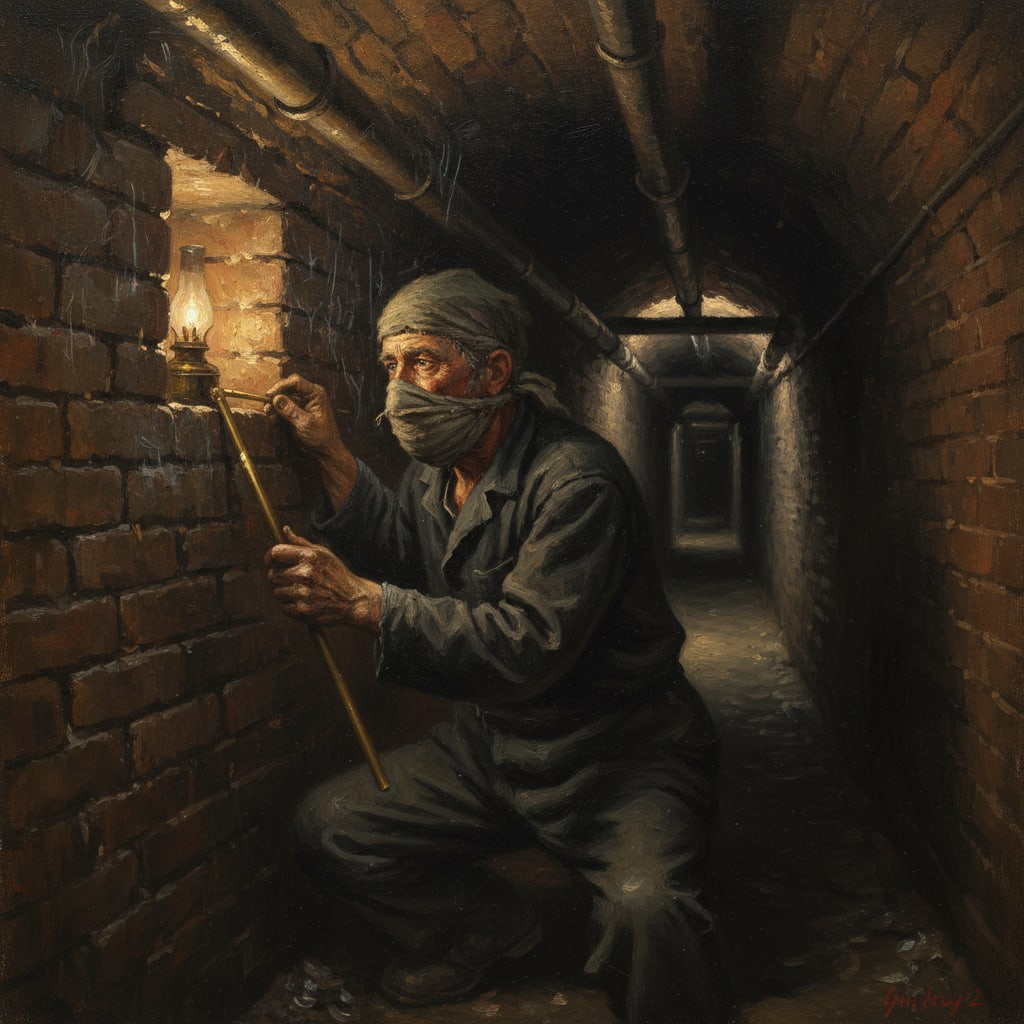
A Soot-Boy — or Soot-Girl, the trade being admirably egalitarian in its exploitation of children — begins at eight or nine. He carries bone-clamps, wax-seal strips, and a vinegar-rag mask that does nothing for the fumes and everything for the illusion that his lungs are being protected. He learns silence before he learns the pipes, because a Soot-Boy who speaks in the crawlspaces attracts two things: rats, which are manageable, and Purity Fume-Inspectors, which are not. His education consists of following a Joint-Mender through brick galleries narrower than a confessional and hotter than a Catechist's opinion, memorising the sound of a healthy joint (a steady hiss, low-pitched, like a sleeping cat) and the sound of a dying one (a wet cough, rising, like a man who knows). By the age of twelve, he can identify a leak by ear in total darkness, seal it with wax and bone-clamp in under a minute, and navigate three districts of crawlspace without reference to any map, because maps do not exist, because maps are the first thing the Bureau confiscates, because a map of the pipe network is a death warrant written in the Pipe-Runner's own hand.
A Joint-Mender patches, reroutes, and pressure-balances. He carries the tap key — the tool that opens, closes, and redirects flow at junction points — and the listening rod, a length of brass that, pressed to a pipe wall, transmits vibrations the ear can parse into a grammar of pressure, flow rate, blockage, and imminent catastrophe. The Joint-Mender's hands are a cartography of burns: knuckle-dots from splashing diesel, palm-crescents from hot clamp-work, wrist-scars from the particular variety of pipe failure that sends a jet of superheated fuel across whatever flesh happens to be nearest. His forearms are speckled in constellations his children could chart. His nails are permanently black. His cough is permanent.
A Route-Keeper holds the entire network in his skull. He draws no diagram. He writes no schedule. He maintains what the Pipe-Runners call the "omission map" — a mental catalogue of every place he does not go, which, by negative inference, describes every place the pipes run. If a Route-Keeper is captured, the Bureau obtains a man who knows nothing about any pipe in any location, because the Route-Keeper can truthfully say he has never drawn a map, never written a route, and never kept a record. The fact that his memory constitutes the most accurate survey of the Warren's subsurface infrastructure ever assembled is, doctrinally speaking, an inconvenience the Bureau has chosen not to examine.
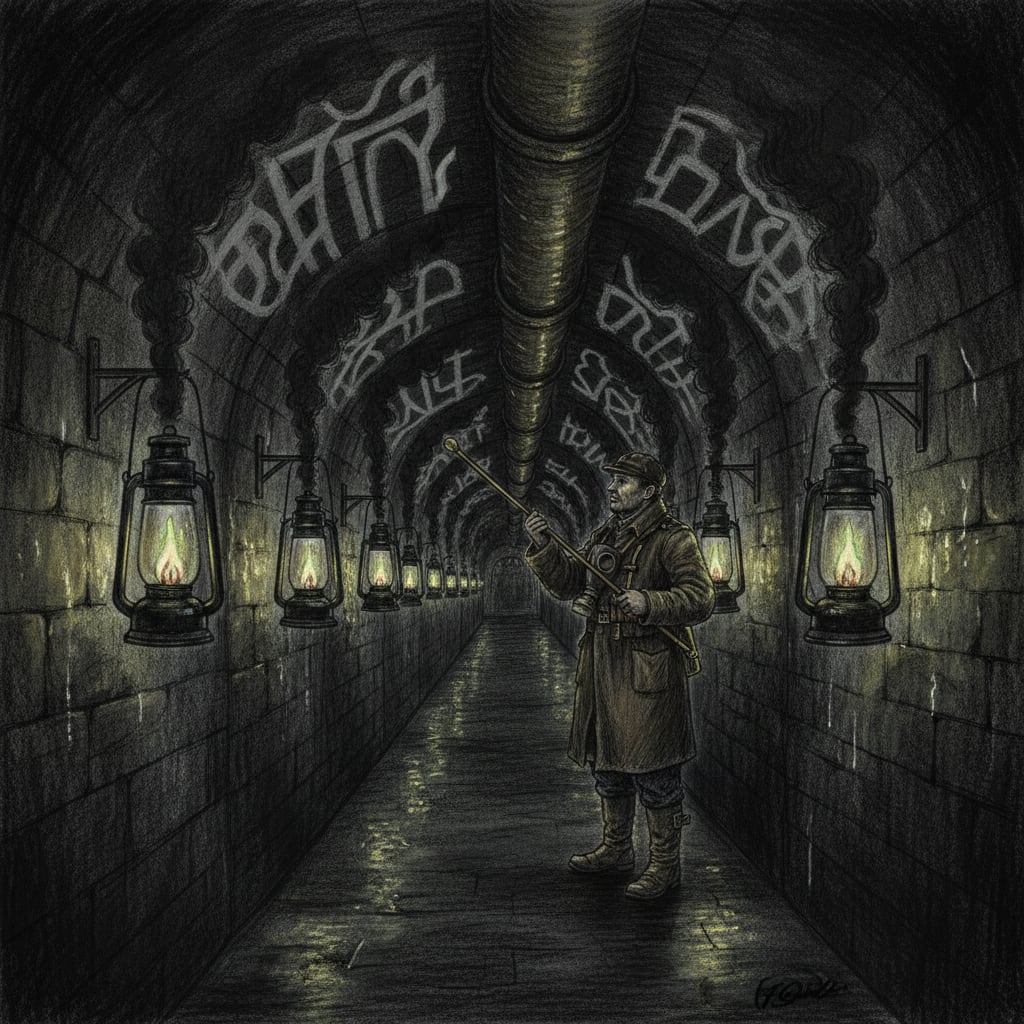
At the summit — a word I use loosely, for the summit of this profession is a crawlspace — sits the Bell-Duct Ghost. This is the Pipe-Runner who dares thread lines near the resonant infrastructure: the bell-ducts, the gasket corridors, the resonance manifolds where the official fuel system hums at frequencies the Bureau of Doctrine insists are sacred and the Bureau of Engineering insists are structural and the Bell-Duct Ghost insists are profitable. Running pipe near resonant infrastructure is the most lucrative work in the trade, because the vibration masks the hiss of flow and the bell-schedule provides a predictable window of acoustic cover. It is also the most lethal, because the vibration does things to black diesel that the Distillers' shorthand summarises as "the sound makes the fuel remember," and fuel that remembers produces scripture-smoke, and scripture-smoke in a bell-duct is the kind of doctrinal emergency that brings the Bureau of Purity at a run.
#On the Twenty Per Cent and the Theatre of Confiscation
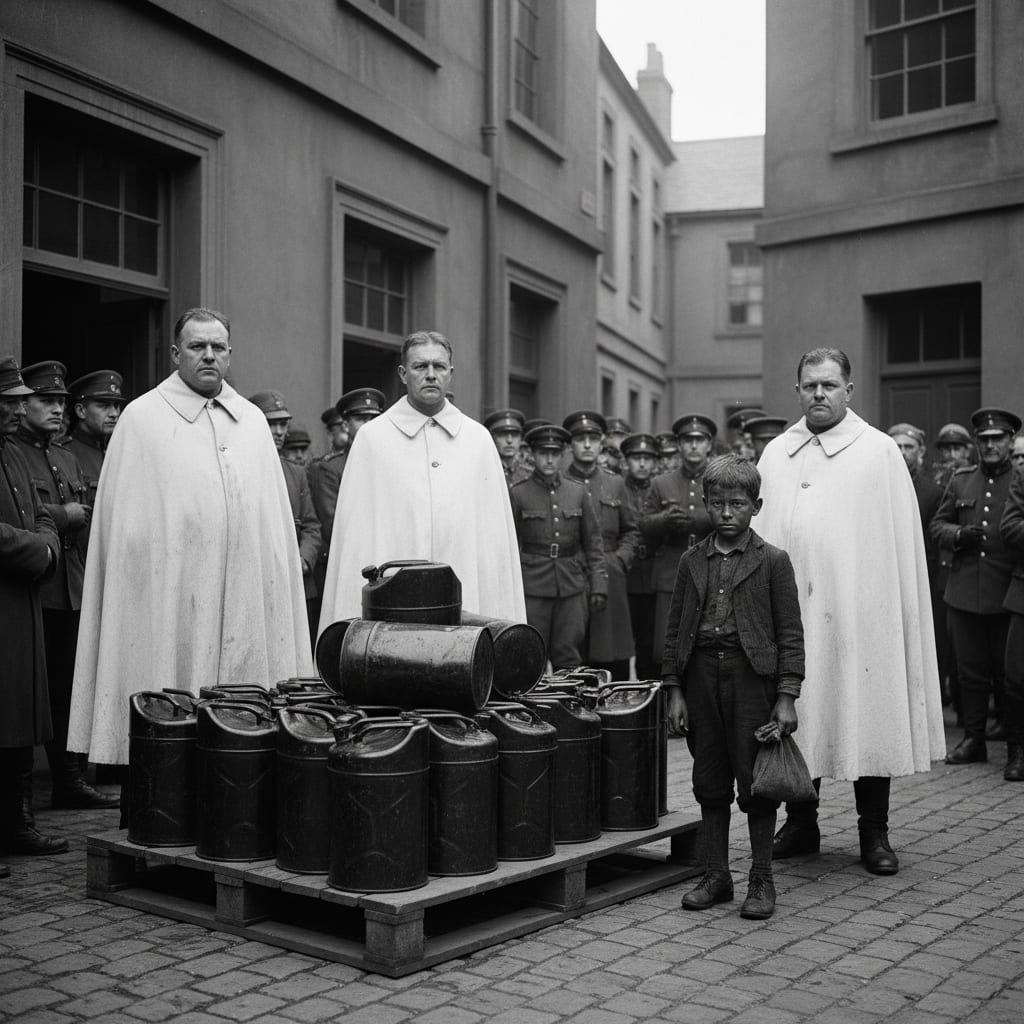
The Pipe-Runner's economy mirrors the Distiller's, because the Pipe-Runner's economy is the Distiller's — the downstream half of a single organism the Bureau has bisected on paper and left intact in practice. Twenty per cent of flow through any given pipe network is designated "confiscatable." This twenty per cent travels through spur lines deliberately routed past Purity patrol corridors, sealed with conspicuously poor wax, and stocked with canisters bearing the distinctive soot-crusting the Inspectors have been trained to identify. The Pipe-Runner calls these "surrender cans." The Bureau calls them evidence. The transaction is consummated with a theatricality that would embarrass a Festival Chorus-Master: the Inspector "discovers" the spur, the Pipe-Runner "flees" through a pre-arranged escape route, the canisters are paraded through the market square, and a Soot-Boy whose name was drawn from the expendable end of the roster is publicly immured.
The remaining eighty per cent flows through the main arteries, unmolested, untaxed in any formal sense, and invisible to every Bureau survey that has ever been conducted, because the surveyors are paid — in black diesel — to be thorough in the wrong direction.
The system's elegance is its circularity. The Bureau needs confiscations to demonstrate enforcement. The Pipe-Runner needs the Bureau to confiscate the designated twenty per cent so the remaining eighty per cent can flow undisturbed. The Warden needs black diesel to heat his quarters. The Soot-Boy needs employment. The orphanage needs warmth. The tavern needs lamp oil. The trench captain needs engine fuel. Each participant in the arrangement understands precisely what he is doing and precisely why he cannot say so, and the silence that binds them is tighter than any gasket the Bureau of Engineering has ever machined.
#On the Hazards of the Crawl
The work kills in four ways, and the four ways are patient.
Fume-sickness first. Black diesel vapour accumulates in crawlspaces with the persistence of doctrine and the subtlety of a Codex Auditor. A Pipe-Runner's lungs are coated black by the third year of service. By the fifth year, the cough is chronic. By the tenth, the cough produces soot-flecked blood that the Bureau of Mercy classifies as "occupational expiration, non-Bureau" and declines to treat, since treating a Pipe-Runner would require acknowledging that Pipe-Runners exist, and acknowledging that Pipe-Runners exist would require acknowledging the pipes, and acknowledging the pipes would require acknowledging that the Bureau's fuel system is inadequate, and the Bureau's fuel system is a matter of doctrinal certainty.
Burns second. A pipe under pressure that fails at a joint delivers a spray of diesel heated to temperatures the profession measures not in degrees but in scars: a "one-mark" is a wrist burn, a "three-mark" is a face burn, a "Cathedral" is a burn that covers enough of the body to make identification impossible, which is, in the trade's grim accounting, a favour to the victim's family, since the Bureau cannot prosecute a corpse it cannot name.
Collapse third. The crawlspaces are not engineered. They are scavenged: bricked-up tariff tunnels, abandoned ossuary drains, sewer galleries the Bureau of Settlement sealed and forgot, bell-duct maintenance corridors that predate the current acoustic infrastructure by decades. The Pipe-Runner crawls through architecture that was never designed to be occupied and is maintained by men who learned masonry from watching it fail.
Confiscation fourth. The staged variety is survivable — a Soot-Boy is immured, the papers are filed, the theatre concludes. The unstaged variety is catastrophic. When the Bureau of Purity decides to make a confiscation real — when a clerk converts a theatrical arrest into an actual prosecution — the entire network downstream of the compromised junction goes dark. Families freeze. Kitchens close. The dark along the Line acquires the particular quality that soldiers describe with a single word, which is "teeth."
Bureau of Purity Enforcement Digest (A.S. 199): "Zero pipe infrastructure of any description exists beneath Warren sectors designated Alpha through Kappa." This claim is endorsed by the Bureau of Settlement. The Bureau of Tithes has filed a dissenting annotation observing that "thermal output within the designated sectors exceeds sanctified fuel allocation by four hundred and twelve per cent" and requesting clarification regarding the heat source. Clarification is pending.
#On the Pipe That Hums
The Distillers know that fuel remembers. The Pipe-Runners know that pipes sing.
It happens in the bell-ducts first — the places where the unofficial conduit network runs parallel to the official resonant infrastructure, where black diesel flows through clay within a hand's breadth of the consecrated iron through which the Bureau's sanctified chrismole sustains the vibrations that keep the bastions standing. The vibration bleeds across. The diesel absorbs it. And the pipe begins to hum — a low, insistent tone that is neither the bell's frequency nor the diesel's combustion harmonic but something between, something that the Counter-Toll Operators have classified, on the three occasions they have been asked, as "unattributed, substructural, under advisement."
The Pipe-Runners have their own classification. They call it "Skopje weather (Unregistered)." In the Lantern Warrens of Skopje (Unregistered), black diesel lamps hum hymns when lit — hymns that no living chorister has composed, in modes that the Bureau of Bells' acoustic analysis identifies as pre-dating the Bell Codex by at least a century. The phenomenon has been purged by fire four times. It returns each spring, like doctrine.
When the hum starts, the experienced Pipe-Runner reduces flow and walks away. He does not investigate. He does not listen. He tells himself the pipe is cooling, the pressure is dropping, the vibration is structural. He tells himself this because the alternative — that the fuel is alive, that the fuel is remembering, that the pipe is carrying something besides diesel — is the kind of thought that leads to the Forbidden Stacks of the Bureau of Silence, and nobody returns from the Forbidden Stacks with their curiosity intact.
#On the Factions and the Silence
Three factions split the trade, and the split follows the fuel.
The Lamp-Mercers prioritise homes and lantern blocks. They are the closest thing the profession produces to saints: men and women who risk immurement so that children can read by lamplight and grandmothers can cook after curfew. Their slogans are charitable. Their margins are thin. Their funerals are attended by whole districts who know better than to say why.
The Furnace-Hardliners prioritise kitchens, industry, and the forward trenchline. They are the closest thing the profession produces to soldiers: pragmatists who supply engine-grade diesel to the war effort through channels the Bureau of War cannot acknowledge and the Bureau of Purity cannot interrupt. Their clients are trench captains and Litany-Engineers and the particular species of bastion quartermaster who has learned that requisition forms and hymn-blessed fuel do not, in combination, keep a furnace lit through January.
The Bell-Tappers run lines near resonant infrastructure for profit and for power. They are the closest thing the profession produces to heretics, which is saying something given that the entire profession is classified as heresy. The Bell-Tappers exploit the acoustic cover of the bellway corridors to run pipe that would be detected anywhere else, and they charge accordingly, and they die accordingly, and the scripture-smoke that rises from their lines is thicker, darker, and more legible than anything the Lamp-Mercers or the Furnace-Hardliners produce.
All three factions observe a single rule: no written records. The omission map lives in skulls. The route schedule lives in muscle memory. The bribe ledger lives in handshakes. When a Route-Keeper dies, the network he carried dies with him, and his successor must re-learn it by crawling every inch of pipe in darkness, by ear, by burn, by the particular smell of diesel that tells a trained nose whether a joint was sealed last week or last decade.