
#On the Eighteenth Platform
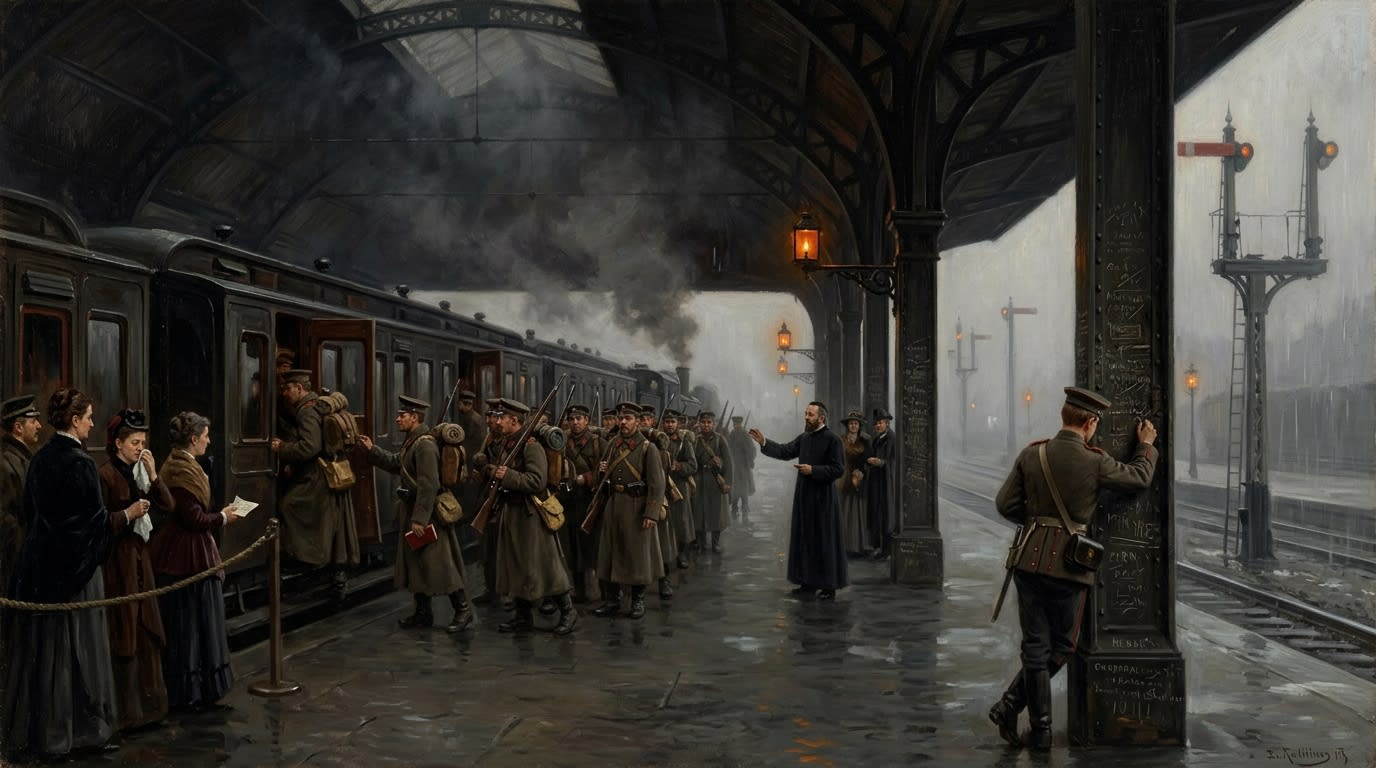
Gleis Achtzehn, Platform Eighteen of the Münchner Kreuzbahnhof, is the eastern departure tongue where Munich stops being a city and becomes a sentence of transport. It is called a platform by clerks, a spur by engineers, a farewell by mothers, a nuisance by the Bureau of Records, and a shrine by soldiers who have learned that shrines are made by damage when priests arrive late.
It is outside the fourteen public platforms. This has delighted pedants and endangered them.
The platform is long, iron-ribbed, soot-furred, and permanently damp from locomotive breath. Its canopy does not cover the last thirty paces, which means rain falls on the final loading files as if Heaven itself wished to confirm the paperwork. The eastern track curves away under semaphore arms and signal lamps toward Vienna, Budapest, Bastion-Przemyśl, Bastion-Sibiu, and all those forward destinations that sound merely geographic until a man receives orders.
#On the Loading of Men
The Durchgangskaserne delivers roughly forty thousand soldiers each month to the Kreuzbahnhof's eastern throat. They arrive fed, counted, inspected, briefed, re-equipped, deprived of sentimental luggage, and marked with that exhausted obedience common to men who have stood in queues long enough to begin doubting the kindness of chairs. They carry rifles, kit rolls, hymn-plates, cartridge rosaries, letters folded too often, and family instructions already impossible to obey.
At Platform Eighteen, the categories thin. Infantry, artillerymen, rail guards, stretcher detachments, replacement clerks, penal drafts, choir escorts, mule handlers, and chaplain assistants wait under the same soot. War distinguishes them by manifest. The platform does not. A boot is a boot. A breath is a breath. A name scratched into iron is harder to misfile.
A Bureau of War visitor's guide described Platform Eighteen as “a morale-controlled departure environment.”
Corrected by lived fact. Morale is not controlled there. Morale is negotiated between whistle, rain, tobacco, fear, and the minute before the carriage door closes.
The loading rite has no official rite. Orders are read. Names answer. Officers count aloud; clerks count silently; sergeants count by the crude animal instinct that detects absence before arithmetic can wake. Chaplains from the transit barracks stand near the lamps, offering blessings whose doctrinal standing remains pleasantly inadequate. Some men kneel. Some do not. Some spit for luck, which Purity dislikes and War tolerates because spit is cheaper than desertion.
#On the Pillars
The iron pillars of Platform Eighteen carry names, dates, unit marks, saints, lovers, curses, farm maps, parish initials, failed jokes, regiment numbers, fragments of the Triune Creed (Unregistered), and prayers carved with bayonet-points, pen-knives, buckle tongues, broken spoon handles, and once, in a case preserved for its idiocy, a dental hook stolen from a medical crate. The first carvings are older than the surviving maintenance rolls. The deepest have gathered rust at the edges like dried blood.
Records ordered the pillars cleaned four times. The names returned within a week. Records has stopped ordering.
A name carved into iron before departure is neither memorial nor boast. It is a claim against disappearance. The Synod counts its soldiers with ledgers, roll calls, death attestations, ration tallies, transfer orders, hospital tags, and casualty appendices. Those instruments are holy, naturally; I supervise holiness in ink and know its smell. The pillar-name performs a ruder office. It says: I was here before the train made me useful.
#On Cleaning, Return, and Unapproved Witness
The first cleaning was ordinary maintenance. The second was discipline. The third was alarm. The fourth was theology pretending to be property care. After the fourth, a Records supervisor filed the phrase “inscriptional recurrence, morale-adjacent, non-hostile.” This is one of those bureaucratic phrases that enters a file wearing little slippers and then sits there for decades, impossible to evict without admitting the house has been listening.
No formal anomaly classification has been issued. Munich has no classified anomaly; the city's pride depends on that sentence, and several Bureaus have invested too much ink in preserving it. The pillars are explainable. Soldiers carve them. Cleaners remove the marks. Soldiers carve again. The cycle offends Records because it contains no villain, no demon, no heretical cell, no negligent contractor, merely men behaving as men do when the future has become an eastbound timetable.
A Cross-Station memorandum proposed installing sacrilege-resistant enamel sheathing over the pillars.
Rejected after trial. The enamel cracked under temperature shifts, reflected signal lamps into drivers' eyes, and gave soldiers a smoother surface for carving. The memorandum author was reassigned to ticket-window doctrine, where optimism can harm fewer trains.
Some names appear twice. Some appear upside down. Some are carved too high for the recruit said to have cut them. One pillar bears the same date under seven different hands. Another bears no names at all, because men refuse to touch it. Station workers call it the Widow Post. Official diagrams call it Support Column E-4. Both names are cowardly in different directions.
CROSS-STATION NIGHT LOG, A.S. 199 — EXCERPT SEALED 02:13 after final eastbound departure: scraping heard on Platform Eighteen after closure. Inspection party observed fresh letters forming on Pillar Four without visible tool. Text: █████████████████████████. Senior porter requested priest. Duty officer requested paint. Disposition: ordinary vandalism, suspect unidentified.
#On Mothers, Clerks, and the Last Safe Ground
Families are not supposed to reach Platform Eighteen. This rule is sensible, necessary, repeatedly posted, and useless. Mothers bribe porters. Fathers arrive carrying parcels wrapped in newspaper and shame. Wives stand beyond the chain barrier with faces arranged into civic obedience. Children wave until the smoke takes the carriage windows. The station guards look away in strict rotation, a practice never written because written mercy becomes a liability by noon.
The last safe ground is not dramatic. It smells of coal, wet wool, sausage grease, lamp oil, fear-sweat, and beer smuggled from the Bräuviertel in canteens labelled water. Men laugh too loudly. Officers become busy with nothing. A chaplain misplaces his gloves every morning and finds them in the same pocket after the train leaves. On the pillars, under names already old, new hands scratch one more line.
The train doors shut. The whistle speaks. The platform empties with a violence quieter than artillery. Sweepers come out. Porters collect dropped buttons, paper twists, half-cigarettes, a rosary bead, once a wedding ring tied to a length of bootlace and labelled “return if alive.” The ring was forwarded east in an envelope. The receipt came back unsigned.
#On Present Condition
As of A.S. 201, Platform Eighteen remains operational, uncleaned, unsanctioned in its shrine-function, indispensable in its transport-function, and quietly defended by every office that pretends to disapprove of it. War needs the trains. Records wants the names legible if it must tolerate them. Doctrine prefers a soldier who carves a prayer to one who vanishes before muster. Purity listens and finds grief, which it cannot prosecute efficiently.
The pillars stand. The trains depart. The names return.