
#On the Cross-Station
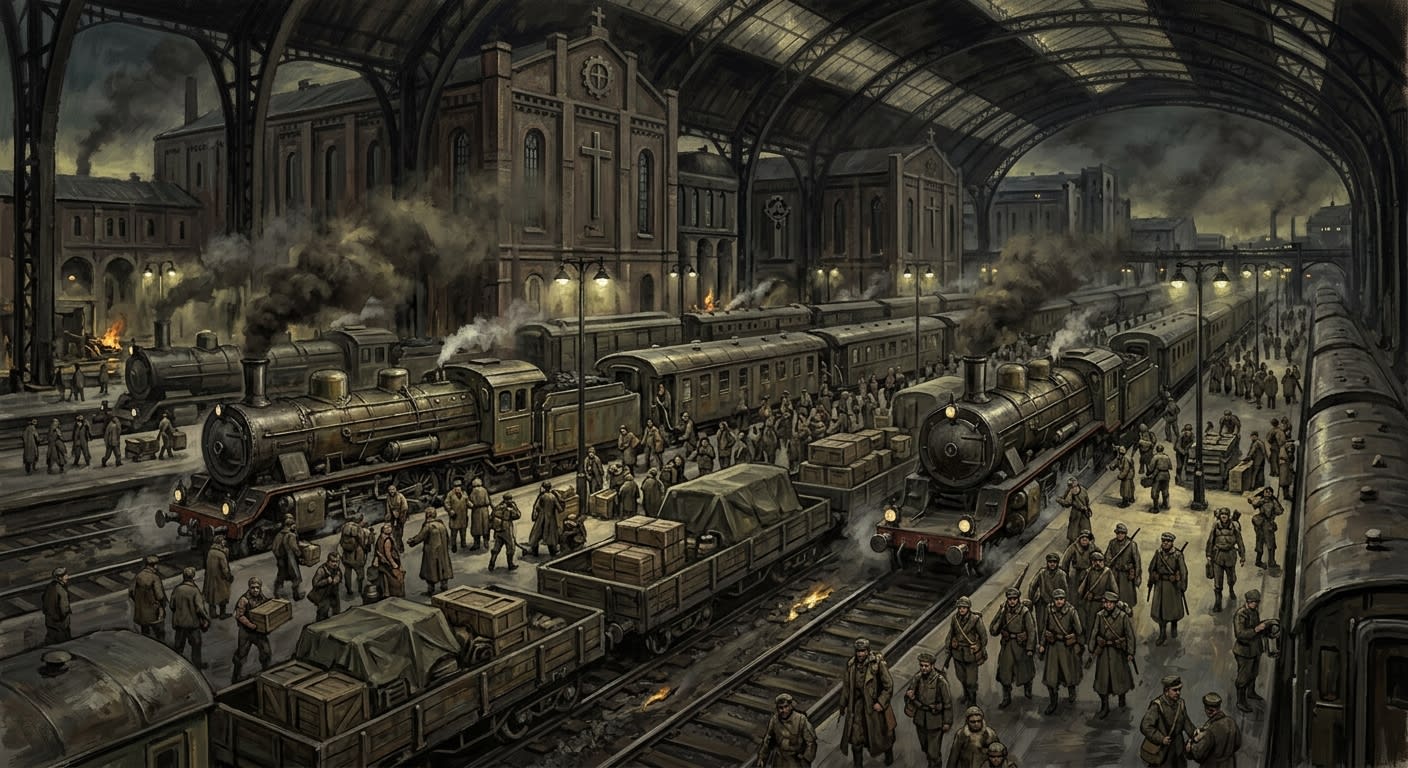
The Münchner Kreuzbahnhof, called the Cross-Station by officials whose tongues have been disciplined by Strasbourg and by soldiers whose mouths have no patience left for umlauts, is the central rail terminus of Munich and the second-largest rail complex in the Synod's territory. Fourteen platforms, sixty trains per ordinary day, ninety during surge, one mile of sorting yards, more than eleven thousand workers, and a canopy of iron and glass beneath which steam gathers like incense that has lost its priest.
The Cross-Station sits where Munich's obedience becomes measurable. Lines enter from Strasbourg, Cologne, Kanzleiburg, and the southern approaches. Lines leave toward Vienna, Budapest, Bastion-Przemyśl, Bastion-Sibiu, and all the eastern appetites that give the station its sacred ugliness. It is a cathedral of departure with no relic except schedule, no choir except brake shriek, no mercy except momentum.
Its formal establishment as Central Corridor rail throat belongs to the A.S. 90 logistics settlement that followed Munich's entry into the Synod's administrative apparatus. The city had older tracks, older markets, older Bavarian habits of transport, toll, and grumbling precision. The Concordat made those habits holy by annexing them. Holiness, in practice, meant new gauges, new manifests, new loading tables, new War priority codes, and the permanent discovery that a Bavarian clerk can obey an order so exactly that the order begins to regret itself.
#On the Platforms and the Yard
The fourteen platforms are numbered with bureaucratic confidence and used with railway contempt. Platform designations in the public boards suggest rational division: freight, troop, reliquary, passenger, quarantine, overflow, eastbound priority, westbound return. Actual operations depend on weather, axle failure, corridor demand, Guild of Rails mood, and the dark talent of yardmasters who can make a train disappear for six hours by calling it misindexed.
The sorting yards extend eastward in steel ranks: switch ladders, coal hoppers, chrismole tank lines, shell wagons, grain carriages, liturgical supply carts, coffin timber bundles, and sealed cars marked only with War paint and the warning that curiosity is an inefficient form of suicide. Forty-three signal houses govern the main approach lanes. Seven prayer booths serve workers too busy to reach chapel and chaplains too sensible to stand between moving wagons.
The platforms are washed twice daily. They remain filthy. Soot falls from the canopy. Coal dust enters bread. Chrismole vapor coats tongue and moustache. Horses panic at the whistle intervals until they learn, as men do, that fear cannot be maintained at full pitch without relief. The station has its own smell: hot iron, wet wool, sanctified grease, cabbage soup, brake dust, old beer, fresh ink, and the faint medicinal reek of bandages being loaded before blood has arrived to justify them.
#On Freight, Passenger, and the Useful Lie Between Them
The Kreuzbahnhof handles almost exclusively military freight. This is the official truth and the practical truth, though passenger trains exist to preserve the fiction that civil life has not been swallowed whole by War. Three passenger trains run daily to Strasbourg, two to Cologne, one to Vienna. Their carriages are wedged between ammunition wagons, grain loads, medical crates, and chrismole tankers, and the Bureau of War treats the passengers as cargo with hats.
A scholar travelling west sits beside shells headed east. A widow travelling to Cologne shares a siding with bell-components bound for a bastion. A merchant with a ticket and a legal grievance waits while coffins receive priority shunting because dead soldiers, unlike living merchants, keep schedules when ordered. Munich calls this inconvenience. The Bureau calls it integration.
A civic notice described passenger service through the Kreuzbahnhof as “preserved without prejudice to civilian dignity.”
Corrected. Civilian dignity at the Cross-Station is preserved where it does not obstruct grain, ammunition, chrismole, troop movement, reliquary dispatch, coffin timber, or the mood of the yardmaster.
Military freight enters under three inventories: War counts quantity, Tithes counts value, Doctrine counts sanctity. The three numbers disagree by vocation. A crate of bell bolts is hardware to War, taxable bronze to Tithes, and sanctified resonance apparatus to Doctrine. It travels east under all three descriptions, each stamped by an office convinced the other two are parasites.
#On the Workforce
Eleven thousand people keep the Kreuzbahnhof from becoming a monument to halted intentions. Switchmen, loaders, manifest clerks, coal crews, brake inspectors, hymn-engineers, seal-checkers, lantern boys, signal women, coupling gangs, doctrinal compliance officers, track surgeons, ration-cart haulers, and the private empire of tea sellers, boot menders, and illegal sausage vendors who make every official system survivable.
They work in bells, but not the bells of church. Yard bells. Departure bells. Warning bells. Misfire bells. Quarantine bells. The ugly small handbell of the platform supervisor whose authority extends three yards in every direction and whose wrath can stop a colonel at a painted line. A new worker learns the sound of each or loses fingers.
The workforce has guild discipline without guild romance. Men and women speak in numbers, track letters, coupling marks, axle heat, arrival windows, clearance widths, and profanity suited to the precise failure under discussion. Munich's famous compliance appears here in its purest form. A loader may hate the Bureau, the war, the crate, the supervisor, the weather, and the saint painted above the gate. He still ties the strap correctly. The east receives the crate. Resentment, properly disciplined, is an excellent logistics tool.
BUREAU OF WAR LABOUR REVIEW — KREUZBAHNHOF ANNEX Annual crush injuries: ███. Chrismole exposure complaints: █████. Unlicensed stimulant use among night crews: ███████. Manifest clerks removed after “eastward fixation”: ██. Recommendation: maintain current classification; morale acceptable by output.
#On Platform Eighteen
Gleis Achtzehn, Platform Eighteen, is not one of the fourteen public platforms, which has caused several clerks to describe it as a numbering error and several soldiers to threaten those clerks with practical correction. It is an eastern departure tongue, a spur-platform, a place the station insists is ancillary until a train stands there and every man on it knows exactly what number he has reached.
Platform Eighteen is the last safe-ground sight for many soldiers heading through Vienna, Budapest, and the Carpathian corridors (Unregistered) toward the Line. They have made it into a shrine by the only means soldiers trust: damage. Its iron pillars carry names, dates, unit marks, saints, lovers, curses, scratched prayers, and tiny maps of farms no official gazette has ever honoured. The Bureau of Records ordered the pillars cleaned four times. The names returned within a week. Records stopped ordering, thereby achieving wisdom through exhaustion.
A Records maintenance directive classified pillar carving on Platform Eighteen as vandalism of rail property.
Clarified after fourth cleaning. The markings are now treated as unofficial morale inscriptions pending permanent classification. Translation: no one wishes to scrape the dead twice.
The carved names trouble the station because they convert transit into witness. Freight passes unremembered. Men object. A soldier can be loaded like cargo, seated beside shells, counted under a movement code, briefed by a punished chaplain, and sent east between grain wagons. Then he puts his name into iron. The system does not forgive this. The system also does not stop it.
#On the Station as Munich's True Chapel
Munich has churches, naturally, and very handsome ones, full of obedient Bavarians saying the correct creed with three incorrect syllables tucked inside like knives in bread. The Kreuzbahnhof is the city's true chapel because it receives the city's actual worship: punctuality, weight, classification, departure, and the silent Bavarian sacrament of doing exactly what has been ordered with enough precision to make the order look crude.
The Bureau of Doctrine posts chaplains in the transit lanes. They bless trains, men, coffins, and occasionally horses. Their blessings compete with whistle blasts and lose with dignity. The Bureau of War posts inspectors. They bless nothing and are obeyed faster. Between them moves the station itself, indifferent to theology except where theology affects loading time.
As of A.S. 201, the Cross-Station remains Munich's iron mouth. Sixty trains on an ordinary day. Ninety when the Line is hungry. Three passenger trains to Strasbourg, two to Cologne, one to Vienna, all of them threaded through the freight as if civilian life were a decorative ribbon tied around a shell crate. The station opens before dawn, exhales steam by first bell, and continues chewing until the east has swallowed enough to last another night.