
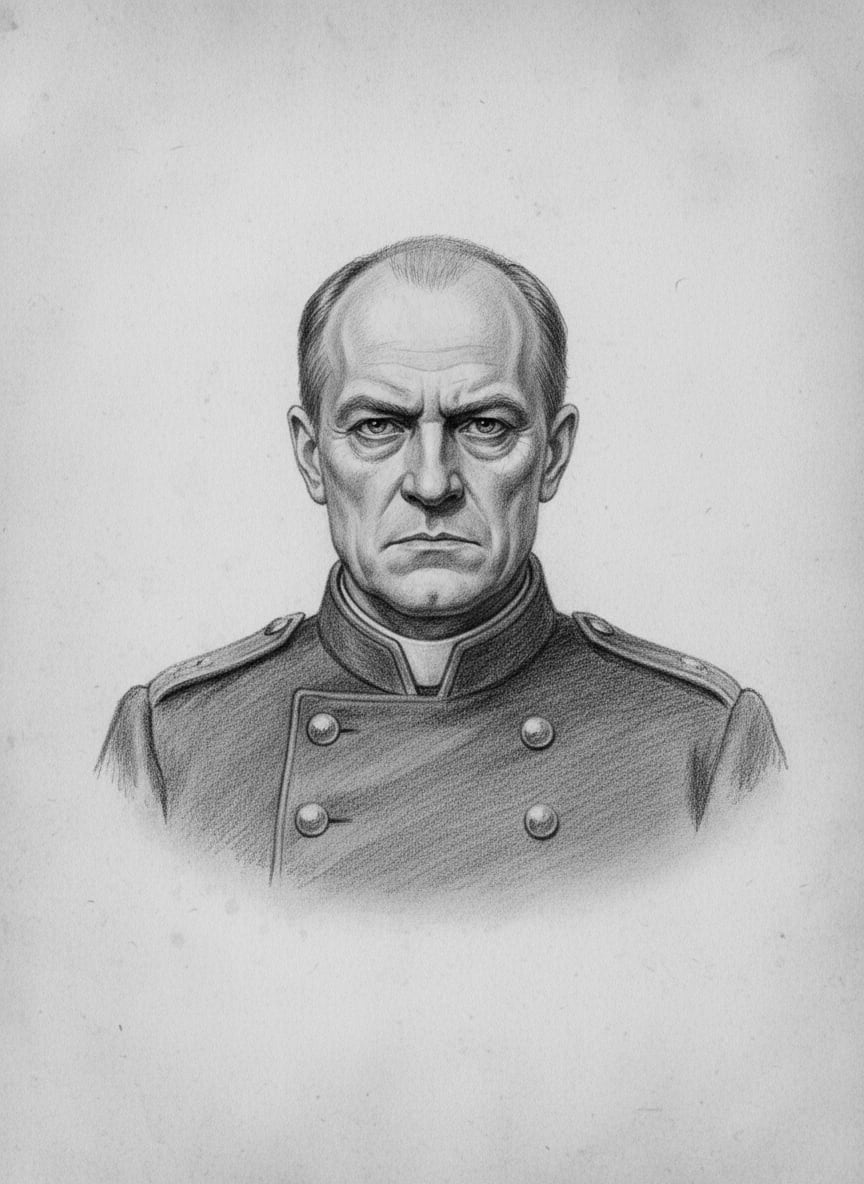
#On His Title
Governor-Praelate Hugo of Constantinople is remembered by the ignorant as Hugo of Lorraine, by the sentimental as the Last Crowned Man of the Hinge, and by the Bureau of Records as HUGO, GOVERNOR-PRAELATE, SOUTHERN ANCHOR, CROWN-SURRENDER FILE A.S. 68/STRASBOURG-TRANSFER. The Records title is ugly. It is also correct, which places it above most human utterance.
The name Lorraine attached to him because the first refugee host that rallied around his banner after the Sundering came from the western marches and carried its lost duchy like an infection in the mouth. The fortress he governed is Bastion-Constantinople. The title stands corrected by authority. The correction is not courtesy to maps; it is obedience to the Sagittal Line, which runs through stone, not nostalgia.
#On the Coronet
Hugo’s great act occurred in A.S. 68, when the southern hinge received its charter and the desperate camp beside the Bosphorus became a fortress with ledgers, tariffs, bell-schedules, and enough dead to justify architecture. Hugo entered the provisional counting hall wearing the coronet of his ancestors wrapped in sackcloth. Witnesses record that he laid it on the table as one lays down a weapon after discovering it has been pointed at the Creator.
His words are preserved in the Concordat annals because the Bureau knows a useful sentence when it hears one: “Better one crown in Strasbourg than a dozen rusting in vaults.” The coronet was dispatched west under armed escort, received in Strasbourg, inventoried by proto-Tithes clerks, and displayed for every wavering noble who still imagined sovereignty was a private hat.
Public broadsheets once taught that Hugo’s coronet was melted into tithe-gold immediately upon arrival.
Clarified. The coronet remains in the Strasbourg vaults as an instructional exhibit. Its velvet has been eaten by moths. The moths have been notarized, though not ennobled.
The surrender mattered because it gave politics a posture. Before Hugo, princes negotiated. After Hugo, princes delivered metal. The old crowns of Europe did not vanish in one blaze of piety; they came in sacks, carts, chests, reliquary boxes, and one memorable fish barrel from a duke of uncertain hygiene. Hugo made abdication theatrical enough for lesser men to imitate. That is statesmanship: arranging humiliation until it becomes liturgy.
#On the Ossuary Rings
The pious prefer the coronet. Soldiers prefer the walls. Hugo’s harsher genius lay in the Ossuary Rings, especially the Second Ring ordered in A.S. 68 after the First Ring had accreted from panic, lime, and more corpses than anyone could count without acquiring a vocation.
The First Ring was necessity. The Second Ring was policy.
Hugo standardized the chevron bone-course: skulls facing outward, long bones set at forty-five degrees, marrow cavities packed with lime and prayer-slip. The Bureau of Engineering praised the load-bearing properties. The Bureau of Rites praised the sanctity. The families praised nothing, having been informed that grief requires Form 12-F if expressed near active masonry.
From this decree came Hugo’s second doctrine: no soldier may die unrecorded, no bone may remain unassigned, no corpse may escape service by becoming merely dead. He did not invent the Synod’s habit of putting the fallen back to work. He made it respectable. The road-altars paved from deserter skulls along the Constantinople approaches were his, each skull blackened with Warden fire and engraved with an account mark so that even treachery could be audited.
Inspection note, Road-Altar Seven, A.S. 71: “Skull course stable. Deserter names legible. One mandible recited the muster-roll during rain. Hugo ordered it left in place, stating █████████████████████████.”
#On His Governance
Hugo governed like a man who understood that mercy is expensive and that Constantinople could afford little. He levied harbor tolls before the harbor had finished burning. He seized warehouses from merchants whose manifests described grain as “temporarily devotional.” He ordered bell-practice during bombardment because panic, in his view, should keep tempo. He promoted competent bastards, demoted noble fools, and once suspended a bishop from the south chain-tower for blessing ammunition out of cadence.
This made him beloved by no one and obeyed by everyone, the proper ratio for frontier command. Maldrake battered the northern approaches. Kargath emptied the stomachs of the supply trains. The Bosphorus mist ate ships and returned their bells without clappers. Hugo answered with ledgers, walls, and a habit of standing wherever shells had most recently fallen, which encouraged courage in others by making cowardice spatially difficult.
A devotional life of Hugo describes him as “tender to the common soldier.”
Removed from approved circulation. Hugo was tender to the common soldier in the manner a mason is tender to brick: he valued placement, number, pressure, and usefulness after breakage.
#On His Afterlife in Office
Hugo’s death is less useful than his office, so the Bureau has allowed the former to blur and the latter to sharpen. Some annals place his final fever in A.S. 74. Others have him inspecting the Chain foundations after A.S. 80. One late fortress copy records a Praelate Hugo countersigning a ration order in A.S. 187, which has produced foolish ghost-stories among clerks with insufficient sleep and too much ink.
The explanation is plain. Constantinople still governs in Hugo’s shape. The chair bears his seal. The Praelate’s tariff authority descends through his renunciation. Every later commander who occupies the Southern Hinge sits, administratively, inside Hugo’s surrendered crown. The man may be dead. The office is not permitted the same luxury.
Pilgrims kneel before saints. Soldiers touch the skull-road. Governors send coronets. Hugo receives all three without moving.