
#On the Strait That Has Too Many Names
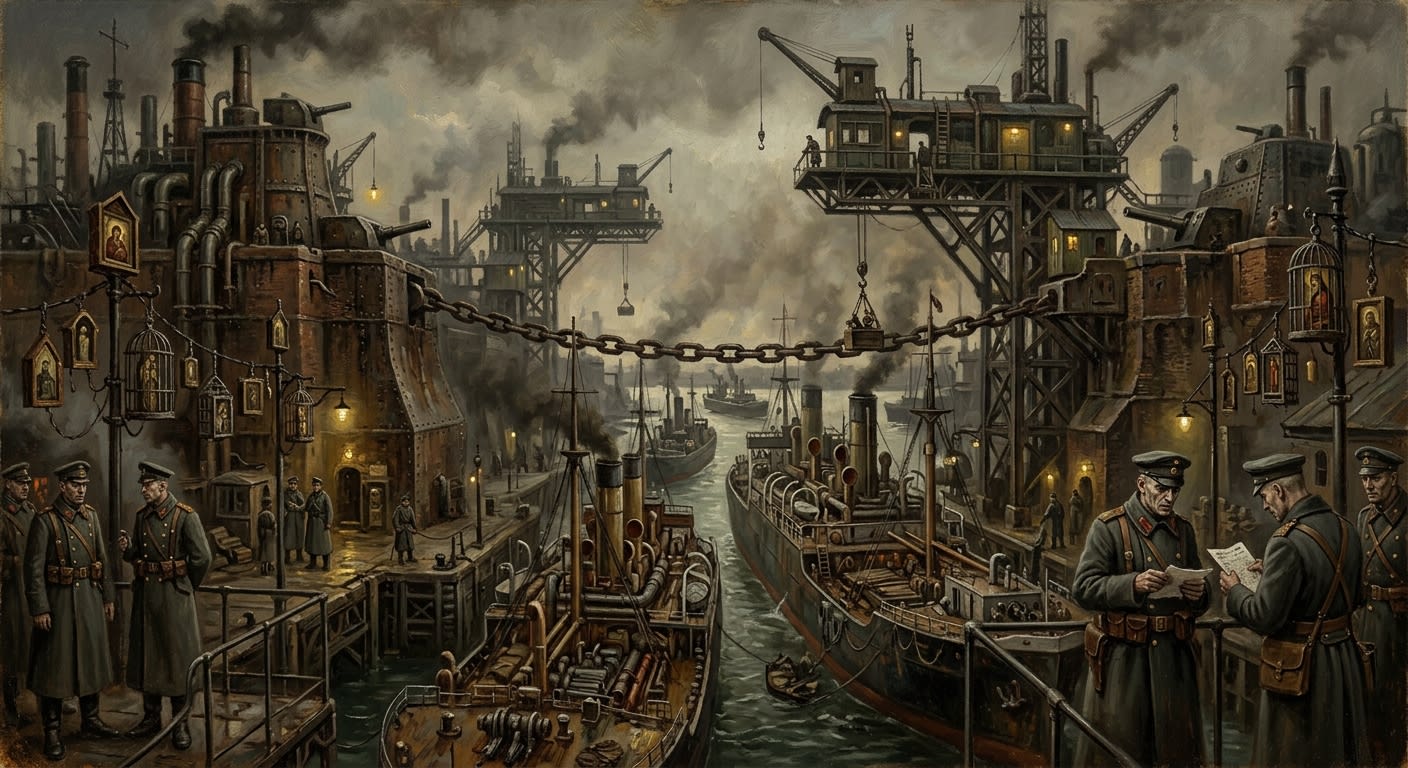
The Bosphorus is the southern hinge of the Sagittal Line, the water-cut between Europe and Anatolia, the wet throat through which Bastion-Constantinople breathes, feeds, lies, taxes, and occasionally remembers that the sea is older than every office pretending to own it. Maps call it a strait. The Bureau of Engineering calls it a maritime corridor. Pilots call it the throat. Customs clerks call it jurisdiction. Fishermen call it whatever will not offend the water before dawn.
All of them are correct enough to be dangerous.
A river descends. A canal obeys. A harbor may be bullied by stone, dredge, chain, tariff, and persistent vulgarity. The Bosphorus accepts these gestures, wears them for a season, and then moves beneath them with the patience of a scribe waiting for a superior to misspell his own title. Its surface runs one way. Its undercurrent runs another. Its fogs choose their witnesses. Its gulls scream over sealed cargo as if they have read the manifest and found the theology wanting.
The Synod holds the Bosphorus because it must. Without it, the southern Line becomes a wall with a drowned hinge. The Black Sea becomes a mouth pressed to Constantinople's ear. Anatolian grain rots beyond reach. Pilgrim traffic stalls in Marseille and Genoa. The Black Sea Reliquary Flotilla loses its inner refuge. Kargath tastes convoy hunger from the north, Maldrake presses Thracian fire from the landward scars, and Syrion smiles in whatever drowsy oubliette receives reports of southern delay.
The Bureau teaches children that the Bosphorus is a barrier. This is a merciful lie, and mercy has its office hours. The Bosphorus is an argument. It separates, joins, hides, reveals, ferries, refuses. It gives the Synod a southern closure and then charges interest in drowned men, late manifests, false saints, bribed pilots, extra links, and reports sealed by officials whose hands smell of vinegar because they have washed them too often.
#On the First Locking of the Water
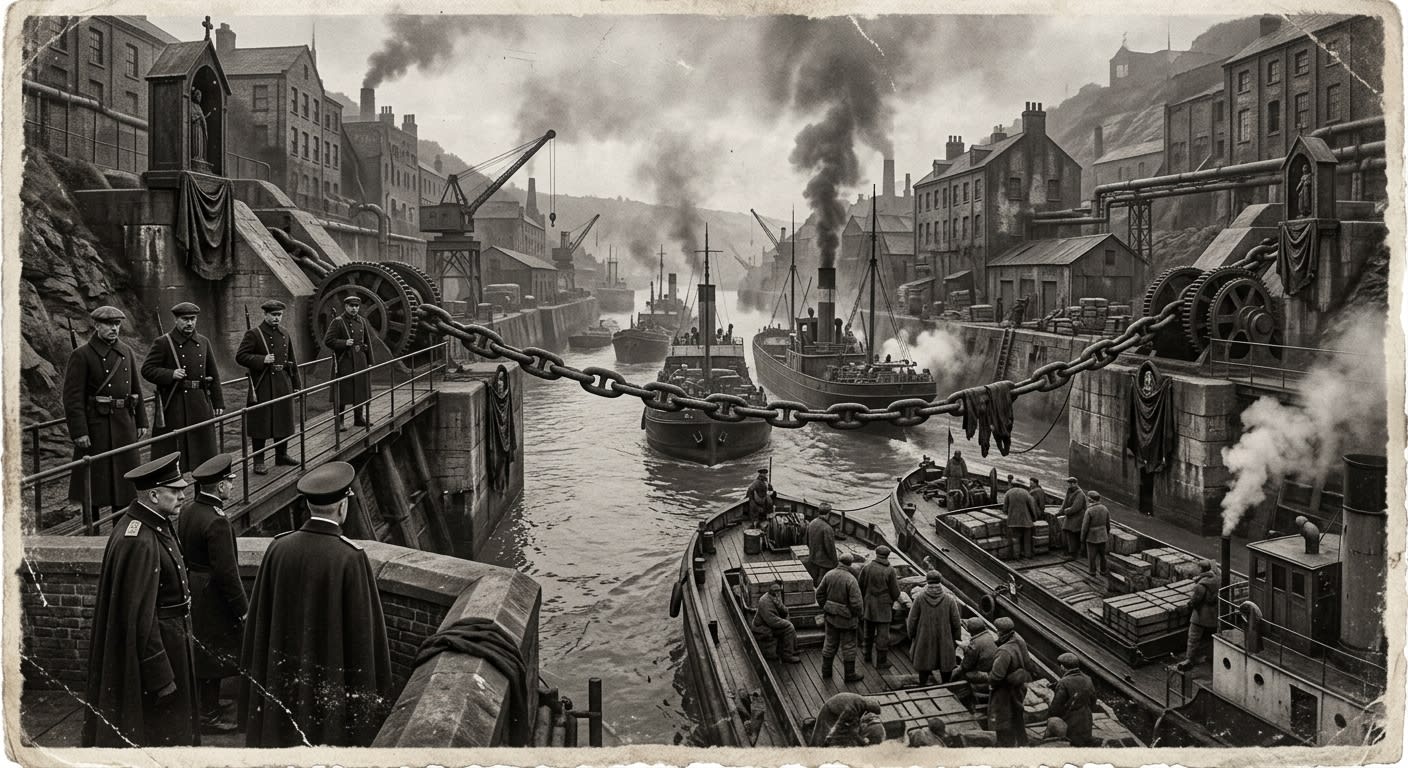
The first post-Sundering soldiers reached the old Byzantine waterfront in A.S. 47, two years after the veil tore and the Balkans became a wound with roads. They arrived with refugees, guns, relic bundles, fever, hungry horses, scraps of command, and the splendid lunacy by which exhausted men mistake geography for Providence when Providence has failed to provide a better map. Behind them lay Thrace in convulsion. Before them lay the strait. Beyond it lay Anatolia, grain, exile, trade, and the old, degrading temptation to retreat.
They did not retreat. They began counting stones.
The old walls were there. The old harbors were there. The old silt, old bones, old cellars, old imperial arrogance, all there, all waiting to be revised under Synod seal. The first works were provisional: rope booms, gun rafts, quay barricades, chapel sheds, triage awnings, and a registration table made from three planks laid over amphora crates. Men died while arguing whether the table belonged to War, Records, Passage, or Rites. This, more than the stones, proves Constantinople was already becoming itself.
By A.S. 68, under Governor-Praelate Hugo, the provisional waterfront received its first ratified form. Granite pins were driven into the quay. Winch houses rose. The southern tower and the Anatolian gunwork were joined by consecrated iron. The Harbor of Chains entered the Ledger as a Shield-Prefecture installation, which is the Bureau's way of saying that the water had become a defendant and would be treated accordingly.
Early primers state that Bastion-Constantinople secured the Bosphorus upon ratification in A.S. 68.
Clarified. The bastion secured the walls. The harbor secured the passage. The Chain secured the Bureau's ability to speak as if both facts had always been a single triumph.
The first chain count was three hundred and forty links. The present count is three hundred and forty-seven. The difference is seven links, no requisition, no forge record, no installation crew, and no acceptable sermon. I record the discrepancy here because arithmetic, like sin, grows bolder when ignored.
The first harbor law was simpler than its descendants: no vessel passes after dusk; no cargo lands without seal; no pilgrim disembarks without name; no relic changes pier without witness; no corpse enters customs unless accompanied by a living responsible party. That last clause lasted three months. Constantinople's dead objected by volume.
#On the Harbor, the Chain, and the Office of Suspicion
The Harbor of Chains is a mile of fortified quay, eleven piers, a chain tower, customs houses, winch sheds, inspection chapels, quarantine pens, under-vault slips, and enough wet paper to pulp a minor heresy. It smells of pitch, salt, lamp oil, bilge rot, old incense, new fear, and the hot metallic odour that follows a gun crew after firing into fog.
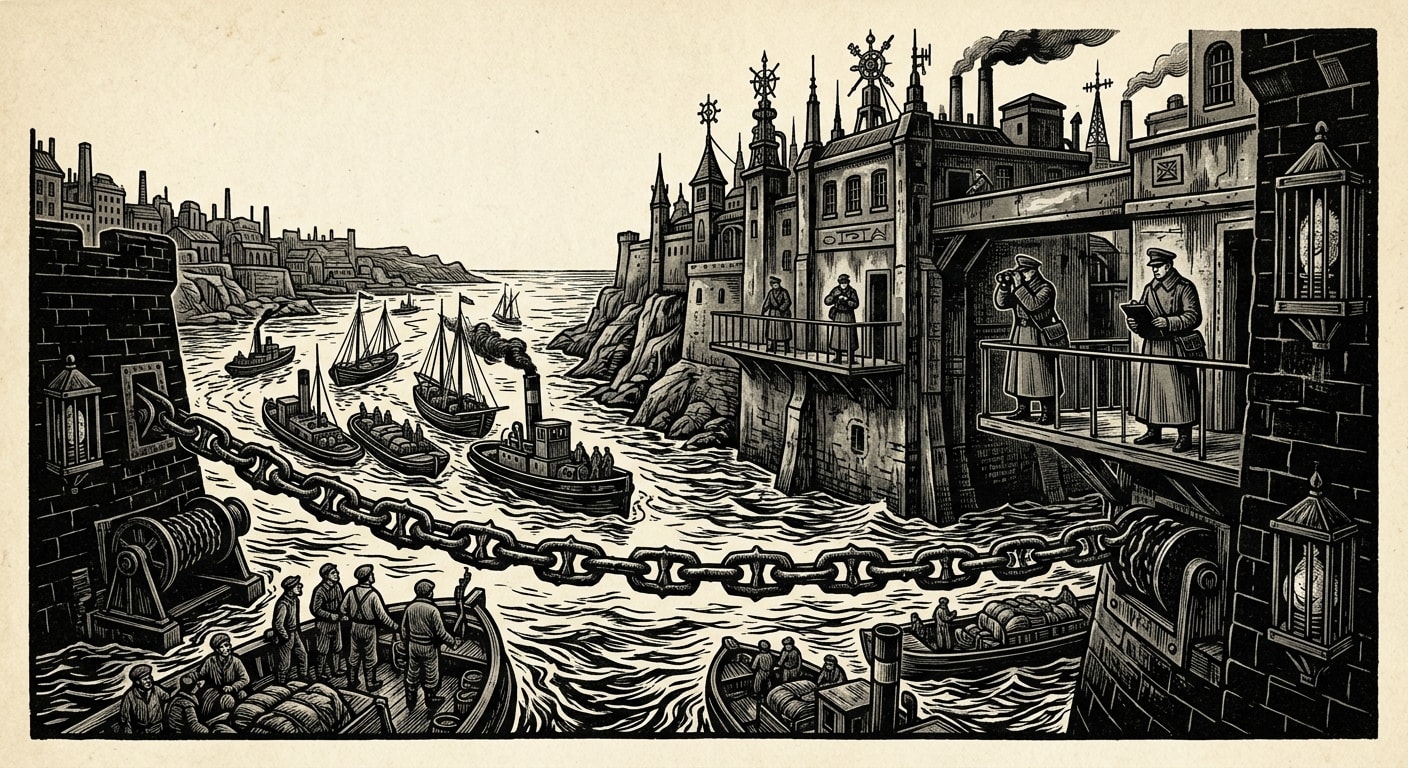
Piers One through Four take military supply: shell, grain, fuel, spare barrels, replacement levies, and sealed crates from the Bureau of Shadows that arrive without manifest and depart without gratitude. Piers Five and Six take pilgrims, whose faces change between gangplank and inspection table when they learn that the holy southern hinge has lice, tariffs, and men with hooks. Pier Seven belongs to the Catacomb-Carrier Threnody, moored for eleven years, crew listed as intact with supplement missing, fees paid quarterly by an account older than the clerks processing it. Piers Eight through Eleven accept commerce, which is what smuggling calls itself while wearing gloves.
The Chain of Saint Anakletos is the harbor's jaw. Raised at dusk, lowered at dawn, watched by men who trust iron less than landmen do because they have seen it rust, it crosses roughly twelve hundred yards from the southern tower to the Anatolian emplacement. Each link stands man-high and horse-heavy. Each bears a reliquary capsule filled with crushed bone, blessed oil, and documentary confidence. The Bureau of Relics can produce catalogues assigning fragments to forty-three saints by link number and capsule position. It can produce a second catalogue if asked about authenticity. Wise men do not ask for the third.
Winch-house crews raise the Chain in shifts of seven, calling commands in a harbor dialect so compressed that the Bureau of Bells once declared it operationally adequate and doctrinally impenetrable. This was meant as criticism. The winch crews took it as praise and continued speaking properly.
Harbormaster Joram Clee has served the Chain with a devotion so blank that Purity lacks the tools to accuse it. His daily entries after A.S. 162 are famous for their starvation: condition satisfactory; temperature ambient; luminosity nil. Nil, nil, nil, across years, storms, audits, riots, convoys, and administrative reorganisations. A lesser man would decorate despair. Clee files it.
The standard morning harbor inspection is starved to four virtues: Chain condition satisfactory, temperature ambient, luminosity nil, link count verified against last sealed survey. Deviations are to be reported before interpretation, a rule written after three priests interpreted rust as grief and delayed a repair crew long enough for a winch tooth to shear.
#On Convoys and the Taxed Breath of Passage
Every hull entering the Bosphorus enters a rite of suspicion. Grain ships from Anatolian coasts. Coal lighters crawling in under soot-coloured canvas. Pilgrim ferries from the west. Relic barges with guards too nervous to be thieves and too armed to be honest. Patrol launches. Funeral craft. Fishing boats whose nets contain more rumours than fish. Black craft no office admits to owning until one founders and three Bureaus arrive to claim the wreck.
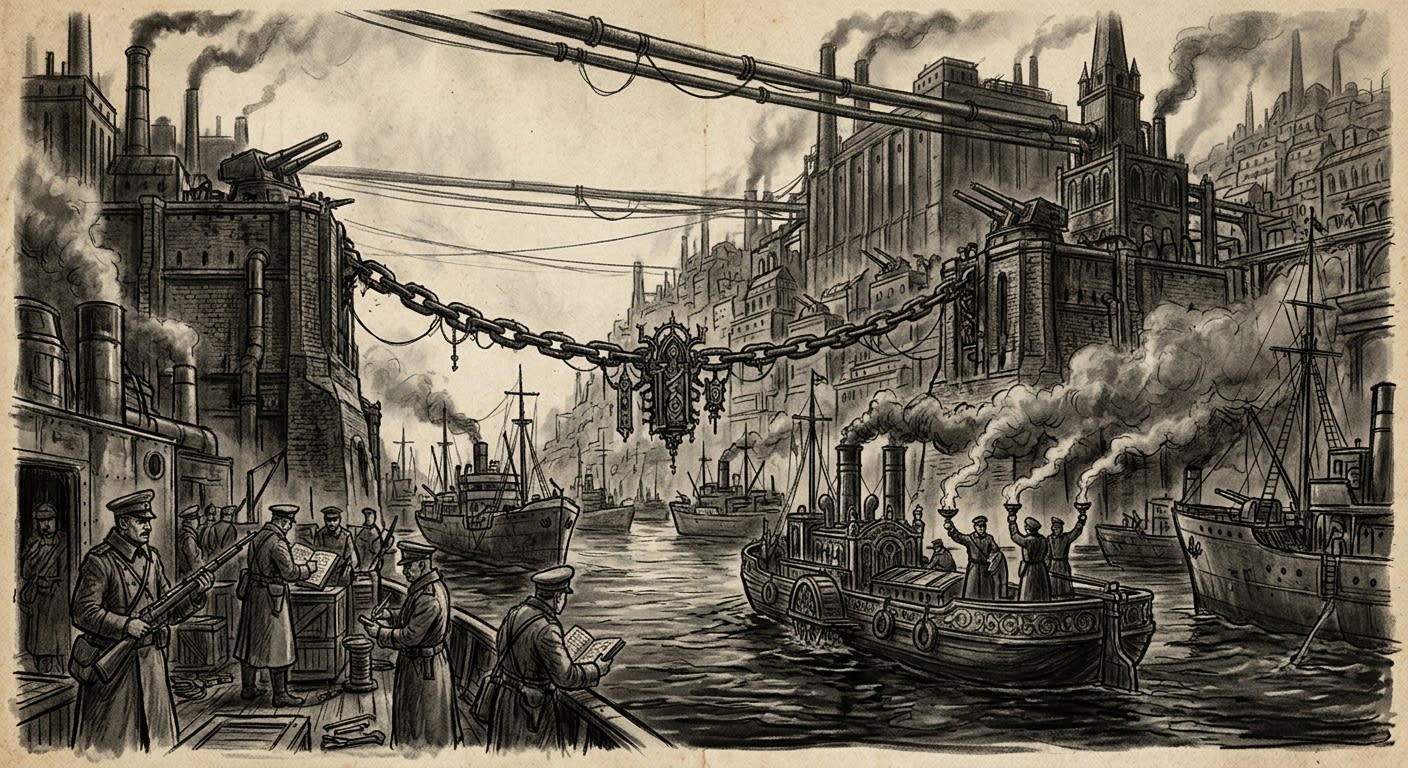
The vessel presents manifest, counter-manifest, origin writ, destination writ, tariff schedule, cargo psalm, contamination declaration, crew confession roster, chain-passage fee, seal, counter-seal, emergency name list, and proof that no one aboard has been dead long enough to require separate tax treatment. The harbor clerk checks the wax first. The experienced clerk checks the crew first. The old clerk watches the waterline.
A misspelled name can hold a grain convoy for six hours. A warm seal can move contraband through three inspections. A pilgrimage licence from Genoa may be genuine, forged, blessed, stolen, revised, and legally valid in that order. The Bosphorus has made entire families wealthy on the difference between a stamp accepted at dawn and the same stamp rejected at vespers.
The Strait-Rats live in that difference. They move demon-glass in reliquary crates, false saints in double-walled icon boxes, ration coupons under fish scales, letters inside candle cores, and occasionally persons under the legal category of ballast, which tells us all we need to know about maritime ethics. Customs displays confiscated goods under placards. The smugglers study the placards for spelling.
The pilgrims suffer most visibly and least profitably. They arrive expecting the southern hinge of the Church and find a quay where a child may be delayed behind a crate of nails because the nails have cleaner papers. They sing while waiting. The harbor tolerates singing during daylight and charges a disorder fee after curfew. A pilgrim who complains is told the Bosphorus has defended the Faith since A.S. 68. This is true. It is also unhelpful when one's shoes have been stolen by a boy with a valid ferry tag.
The convoy captains hate the harbor and depend upon it. This is the commonest kind of loyalty in the Synod. They curse Clee, bribe sub-clerks, petition the Shield-Prefecture, and then cry when the Chain rises behind them at dusk because, whatever else may be said of the Harbor of Chains, it keeps the Black Sea from walking into the ration holds with a knife.
#On the Night the Strait Burned White
The Bosphorus earned its public theology on the 14th of Ferrum, A.S. 162, when the Black Sea Armada entered the approach during harvest convoy season. Forty-seven demon-crewed vessels came under a half-moon while civilian grain ships crowded the channel and the harbor guns faced the polite directions printed on the morning schedule. The Anatolian tower reported sails. Number: all of them.
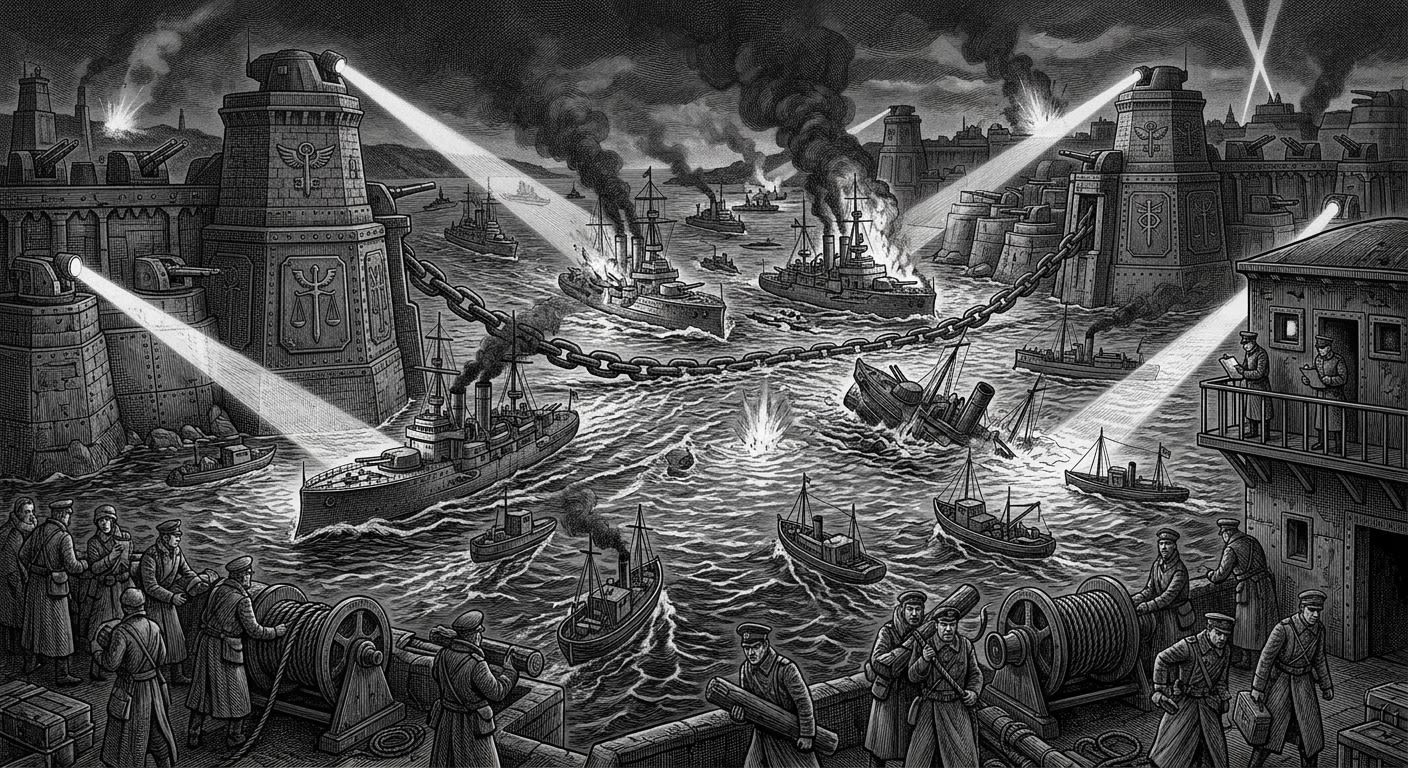
Praefect-Naval Cassius Tern ordered the Chain raised, the ravelins manned, the bells rung, and runners dispatched before rhetoric could put on boots. Good command is usually less beautiful than legends claim. It consists of moving iron quickly and speaking in sentences short enough for frightened men to obey.
The first ram-vessels struck the Chain. The Chain held. Then it burned.
White fire ran link to link across the strait, through reliquary capsules, hinge pins, salt-stiff ropes, wet air, steam, and memory. The prows of hostile vessels ran like wax. Fire-ships detonated and fed the brightness they meant to smother. Fog-carriers dragged grey murk into bell range and silenced the Anatolian choirs for twenty-three minutes. The Flotilla held at the outer approaches under Admiral-Prior Yvenne Salt-Crown's insolent and excellent dispatch: “Withdrawing is dying slowly. Staying is dying usefully. We stay.” War filed it as Insubordination, Productive. The category remains underused, mainly because War prefers insubordination dead.
Telescope operator's addendum, southern tower, A.S. 162: figure aboard forty-third vessel remained upright after deck ignition; observed writing on ███████; wrist articulation reversed; final visible marks resembled harbor numerals; page sealed under Maritime Spiritual Contamination Protocol; ink condition at A.S. 201 review: wet.
Seven hours and fourteen minutes. Forty-three vessels destroyed. Three retreated into fog from which no patrol has charted an exit. One vessel unaccounted, a phrase so clean it should be made to scrub latrines. Defender losses were severe enough for Records to develop elegant handwriting and for Doctrine to develop louder hymns.
At dawn, the Chain stood intact. Its reliquaries were cracked. Its glow had gone out. The harbor survived, which is how victory is defined when enough bodies are unavailable to object.
Public Armada catechisms state that the Bosphorus “repelled the fleet unaided by mortal error.”
Corrected. Mortal error was everywhere: late guns, crowded convoy lanes, misread signals, sealed warnings, proud assurances printed six weeks too early. The Chain held despite us. Doctrine, with impressive taste, has claimed supervision.
#On What Waits Below
The Bosphorus is defended above the surface because surface defenses can be engraved handsomely. The matter below is less cooperative.
The seabed is old masonry, wreck iron, silt pockets, dropped saints, ballast stones, burned timbers, demon scrap, lost anchors, drowned ledgers, and bones sorted by current rather than denomination. Divers from the Harbor Patrol descend on weighted lines and return with broken teeth, sealed jars, bent reliquary caps, Roman coins, hair that grew while submerged, and statements later softened by chaplains. The official phrase is submerged hazard field. The divers call it the lower archive.
Near Phaleron Bay lies the Iron Idol, a ship-shaped absence linked by arithmetic, dread, and fisherman cowardice to the forty-seventh vessel of the Armada. Public charts omit it. Military charts mark obstruction. Fishermen mark nothing and sail elsewhere. Engineering Survey Team Phaleron-12 returned one sentence: The survey is complete. The team did not return its sounding weights. One diver returned with barnacles inside his glove and no cut in the leather.
The under-vaults below the Harbor of Chains descend into Byzantine bedrock: storage levels, patrol slips, winch roots, sealed archival rooms, and spaces assigned to offices whose names vanish from maintenance requisitions. Mother-Cryptor Sabine holds Shadows material in the third level, where temperature drops without reason and salt appears on walls no seawater touches. Purity does not inspect there. Purity has been informed that the contents are of historical interest. The phrase historical interest has excused more living horror than most heresies.
The Widow's Syndicate maintains a surveyed vault near harbor level. Its filed dimensions differ from its actual dimensions by eleven meters along the eastern wall between the A.S. 198 and A.S. 200 surveys. The Widows serve tea to inspectors. The inspectors leave satisfied. Tea is among the great enemies of audit.
Below water, faith grows barnacles. Above water, faith gets stamped.
#On the Air Above the Throat
The Bosphorus is watched from the air because the enemy learned that convoys beneath an empty sky arrived lighter than they departed. Grain vanished without broken locks. Crewmen forgot cargo numbers. Lamp-oil casks sweated sweet rot. Kargath's appetite does not always chew. Sometimes it inventories.
The Vigil-Ark Saint Barachiel patrols the southern hinge above the harbor lanes, an armoured reliquary craft suspended with brass fittings, sealed lift calculations, sermon horns, and proportions that make the eye file complaints. It drops warnings, fire, and catechism upon movement lacking permission. Fish have heard more approved doctrine than several rural bishops.
The Ark works with the Harbor of Chains, the ravelins, the Bellway towers, and the watch posts on the Anatolian shore. Works with is the official phrase. In practice the Ark terrifies pilots, deafens gulls, spooks mules, scatters fog when fog consents, and gives the harbor one more authority to argue with before firing. Southern defense is a choir of jealous throats. The miracle is not harmony. The miracle is that the noise points outward often enough.
After the Ark's A.S. 199 broadcast, Clee made one deviation in the luminosity field of his chain log. The entry was sealed within the hour. The index denies the page. The archive contains it. This distinction is procedural, in the way a knife in the ribs is anatomical.
#On the Eleven Dark Nights
From A.S. 199 to A.S. 201, the Chain of Saint Anakletos went dark on eleven recorded nights. Dormancy had been normal since the Armada. Darkness was another species. Dormant iron reflects lamplight. Dark iron receives it and gives nothing back, like a sealed superior pretending not to hear a good objection.
On the fourth dark night, a single vessel moved through the strait without harbor entry. No log records it. At dawn, three new links were present. By the A.S. 200 survey, seven new links existed. Their metal matched the original A.S. 68 Anatolian stock, from ore no longer mined. Their seals were genuine. Their reliquaries were empty.
The Bureau of Rites produced forty-seven pages explaining why holy iron may withdraw visible testimony as an act of devotion. Rites has always been bold where paper is cheaper than courage. Engineering called the metallurgy impossible with admirable restraint. Records suggested surveyor's variance and was laughed at by the harbor crew so savagely that the laughter had to be classified as morale incident.
The Bosphorus now contains a chain that has added itself, a seabed that edits charts, a harbor log with an absent page, a patrol airship whose broadcasts alter records, and a waterway still described in school primers as secure. I envy schoolchildren. Ignorance sits lightly on the small.
#On the People Who Live by the Water's Refusal
A strait is never ruled by towers alone. It is ruled by men with wet boots, women with tariff knives, children who know which pier guard sleeps after third bell, widows who lend rope at interest, pilots whose hands can read tide-shear through a tiller, and clerks who can smell a warmed seal before the wax admits guilt. Constantinople calls these people harbor population. The harbor calls them necessary vermin. I prefer local expertise, which sounds kinder and costs nothing.
The pilots form the first priesthood. They are licensed by Passage, bullied by War, fined by Commerce, courted by smugglers, distrusted by pilgrims, and obeyed by captains who wish to survive the southern eddies. Their craft is half mathematics, half blasphemy, and half inherited superstition, which makes three halves and a harbor licence. A pilot knows where the surface current lies, where the lower pull begins, where a ship may turn without surrendering its stern to the wrong water, and which prayers must be omitted because the Bosphorus answers them badly.
The pier families serve beneath them: rope-menders, lamp-trimmers, fish-sellers, docket-runners, bilge boys, seal-coolers, plague flag washers, and the little guild of hook-men who retrieve what falls between hull and quay before the water classifies it as property of the dead. They live in rooms above warehouses and under customs stairs, beside hot pipes, behind shrines, inside legal excuses. Their children learn three alphabets: parish letters, tariff marks, and the chalk signs by which a cargo-handler warns that Purity has entered the quay with clean gloves.
The Bureau has tried to regularise them. Of course it has. Regularisation is what Strasbourg calls appetite when appetite has a pen. The A.S. 186 Quay Register attempted to assign every harbor resident a work code, pier district, bunk entitlement, confession parish, ration route, flood duty, and emergency corpse obligation. The register succeeded for nine days. On the tenth, three families traded bunks, two pilots died without surrendering their apprentices, Pier Six flooded, a relic barge arrived early, and a child named Anka Clee's assistant by chalking the title on his back while he slept. The Bureau declared partial success and printed certificates.
Harbor women conduct the true traffic of minor survival. They sell broth at dawn, stitch oilcloth after vespers, warn sailors which inspectors are angry with their wives, hide children during impressment counts, and keep lists of who fell into the water with debts unpaid. The Widows' Syndicate, licensed in one sentence and feared in five offices, lends rope, credit, witnesses, mourning veils, and silence. Its vault dimensions have already offended geometry. Its tea defeats audit. Its ledgers are said to contain names of drowned men who still pay interest through relatives, employers, or dreams. I have not verified this. I have drunk the tea. I retain the suspicion.
A Bureau of Settlement digest described the harbor population as transient maritime labour. Corrected in practice, if not in print. Transient labour does not inherit grudges by pier number, preserve flood heights on chapel beams, identify inspectors by cough, or know which drowned cargo will return before the owner has reported it missing.
The harbor's poor do not hate the Chain. They hate delays, fees, inspections, cold, requisitions, and clerks with dry sleeves. The Chain they respect with the practical piety peasants reserve for wells, knives, midwives, and dangerous saints. It closes the water that would otherwise invite worse things. It also traps them inside the price of its protection. Gratitude and resentment sit well together on the quay. There is room. Everyone is damp.
#On Law Written in Salt
Bosphorus law has two faces: the posted face and the wet face. The posted face hangs in customs houses, admirable and useless, telling captains where to present manifests, where to declare relic exposure, where to discharge ballast, where to stand during inspection, which bells denote quarantine, which flags mean wait, which flags mean fire, and which flags mean the harbor has entered a mood beyond flags.
The wet face is older. It says a pilot may ignore a junior clerk if the current has changed. It says the chain crew may curse a priest during raising so long as the link clears water. It says an inspector who drops a seal into the strait pays for three replacement seals and one drink for the boy who dives after it. It says a corpse found tangled in harbor rope belongs first to Records, second to family, third to creditors, and fourth to the water if the first three cannot agree by dusk. It says no one speaks the Forty-Seventh Ship's name while counting links, though no public document admits the ship has a name.
All functioning law begins as custom and ends as invoice. The Bosphorus has merely shortened the distance between the two.
The most litigated rule concerns night passage. The Chain rises at dusk. That is doctrine, defense, ritual, warning, and employment guarantee. Yet exceptions accumulate like barnacles. Emergency medical ferry. Late relic convoy. War dispatch. Bellway malfunction. Fog closure reversal. Drowned pilot recovery. Governor-Praelate override. Purity chase. Shadows silence-order. Each exception requires a seal. Each seal creates a precedent. Each precedent breeds a fee. By A.S. 201, the night-passage exception manual exceeds the original harbor charter by three hundred pages and has killed, through confusion alone, at least six men and one mule.
The mule received compensation. The men's families remain under review.
Heresy also travels by salt law. A sailor who lies on land lies to a clerk. A sailor who lies on the Bosphorus lies to water, chain, crew, cargo, wind, saint, and whatever listens beneath Phaleron. Harbor courts punish such lying with disproportionate zeal. False depth report: flogging. Concealed fever: quarantine irons. Warmed cargo seal: pier labour. False relic declaration: Purity cell. False calm: burial if the crew is unlucky, promotion if War needed the convoy moved and the report permitted it.
The Bureau of Doctrine pretends to supervise this law. In truth, Doctrine arrives afterward, wipes salt from the document, improves the adjectives, and seals what the harbor has already decided.
#On the Present Passage
As of A.S. 201, the Bosphorus remains held. Held means the Chain rises at dusk. Held means the Harbor collects fees. Held means grain still reaches Constantinople often enough to call shortage mismanagement rather than siege. Held means pilgrims still kiss the quay stones before discovering they have knelt in fish waste. Held means smugglers still hide demon-glass in relic crates, pilots still curse inland maps, Clee still records nil unless compelled otherwise, and the Saint Barachiel still bawls doctrine at clouds that may or may not be listening.
Held does not mean understood.
At evening, the winch crews sing in their clipped harbor tongue. The links rise wet and black from the strait. The Anatolian guns report readiness. The ravelins answer. Inspection chapels close their ledgers. Patrol launches nose through tide-shear. Somewhere below, divers refuse a line assignment near Phaleron. Somewhere above, the Ark turns with a groan like an old bishop rising from an expensive chair. The water passes under everything, taking the reflections with it.
The Bosphorus remains the Synod's southern throat. We clasp it with iron, clog it with law, bless it with bone, frighten it with guns, and tax every breath that passes. At dawn we lower the Chain and call this permission. At dusk we raise the Chain and call this control.
The water has not countersigned.