
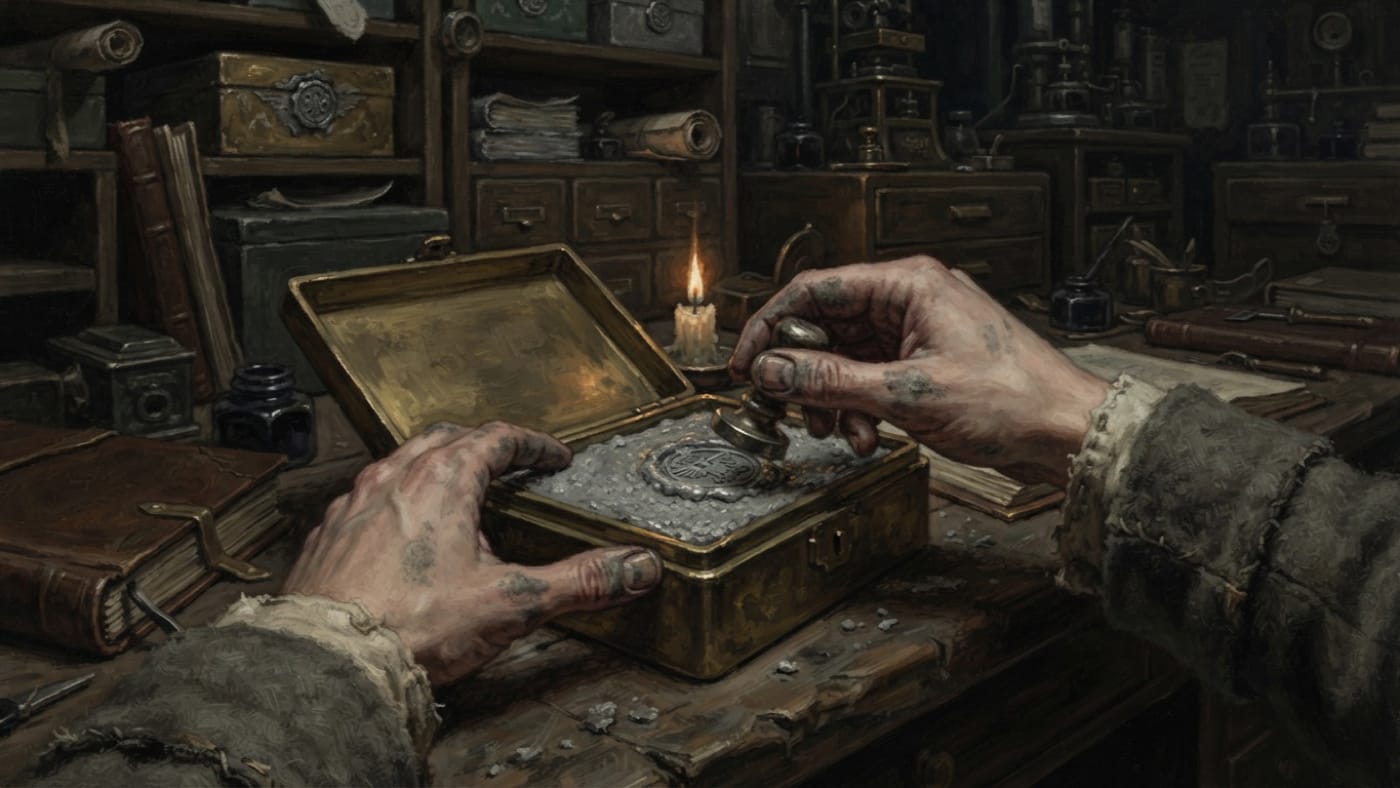
#On the Seal
A Night Paper has three parts: a slip of grey vellum, a sentence that shows only under true flame, and a thumb's width of wax the colour of grave-dust. Commanders remember the sentence. Clerks remember that no record of it exists. The couriers, who handle the thing more than anyone living, remember the wax.
They have a word for it. In courier slang the seal is grave-wax. At the far end of the route, Night Wagon drivers say grey wax and mean the whole Paper: seal, sentence and consequence together. I use the courier's word because it is the narrower one, and on this subject narrowness is the only safe habit.
Three things must be held apart. There is the material, grey and gritty and kept warm in a seal-box. There is the impression, which is what the material becomes once it is pressed onto vellum. And there is the instrument, the authenticated Night Paper, which kills men. The wax does not kill men. It persuades a commander at two in the morning that the slip in his palm is the real thing, and every corpse after that follows from his being persuaded.
#On the Substance and Its Alleged Origin
What can be handled is this. The wax is grey, the grey of a sexton's sleeve after a wet funeral. It is gritty at the edge of the impression, and it leaves grit under the nails of everyone who works with it. It must be warmed before pressing, so couriers begin every shift by warming the seal-box, the way a sacristan in a cold nave warms the cruets before Mass. It smells. Everyone who has met it agrees that it smells. Nobody in a position to testify will say what of.
What cannot be handled is its origin. A grave-dust colour proves only the colour. I have heard ash, chalk, lead and the sweepings of ossuary floors proposed for it, mostly by men who have never stood in a wax-room.
The account that lasts is uglier. It is whispered that the wax is the cooled fat of those who once opposed the Synod. The older chronicles use the word whispered, and so shall I. Frightened soldiers like the symmetry of it: the condemned, rendered down, come back to seal the condemnation of others. I hold no ledger on the question. On this subject, the absence of ledgers is policy. The Creator presumably knows the ingredients and has not filed a correction.
Custodians are known to scent their protective charms with ancestor-fat, and people cite this as corroboration. It corroborates only that Custodians are morbid. A charm in a Custodian's pocket says nothing about the seal on a Night Paper. Anyone who confuses the two should be kept out of evidence rooms.
I will not supply a recipe. I do not have one, and the Bureau has made it clear, through the eloquent method of never having existed, that I am not to get one.
#On Recognition and the Dawn
A Night Paper leaves no record of issue. No clerk has testified to drafting one. The Bureau of Records files the category as "classified" and files nothing under it. So a Paper cannot be checked against a register, because the register is exactly what has been left out. It has to be authenticated in the hand, in the dark, in the time a frightened recipient takes to decide whether to obey.
The courier learns the wax by smell and texture, and the recipient learns to trust the courier's certainty. The start of a shift follows a fixed order. Warm the seal-box. Test the candle, since Papers show their text only under true flame. Rub wax into the glove seams. The glove-wax is issued separately from the seal, and I have not established whether the two share a base. Couriers keep them apart in the kit. I respect a superstition that happens to match good filing practice.
At the handoff, the Paper goes into a palm. The recipient lifts it to a flame and the text appears. The seal sits beneath it, grey and granular, and it smells right. That smell is the entire authentication, and it is enough to burn a sector.
Then comes dawn, announced across the city by the Bureau of Bells with its usual disregard for anyone who is still busy. A Paper's authority normally expires at sunrise. Papers are reported recalled, or found blank by morning, and couriers call the hour after white morning. A Paper countersigned by the Shadows does not expire at all. That is the rarer category and the more frightening one.
These are properties of the instrument. I find nothing to show that the wax itself decays at dawn, that a different mixture makes a Paper permanent, or that the seal grants anything the Bureau's will has not already granted. Couriers will tell you a poor seal makes a Paper die badly: it curls, smears, or lies. That is occupational lore, gathered from men racing the clock, and I record it as such. Expiry, blanking, recall and plain burning in a candle are four different events. People who were busy at the time tend to report them as one.
#On the Hands It Marks
Grave-wax shows on the body before anyone sees it on vellum. Couriers carry it in their nail-beds and glove seams. Drivers pick up grey wax under their fingernails from their wax-seal kits and scrape it out at the end of every shift. Gauze-Masked Custodians seal their own pockets with wax, carry a wax press among their issue, and check the wax first on any paperwork of omission, because the wrong scent means forgery. So one material passes through three trades, delivery, carriage and collection, and stains all three at the fingertips.
Getting it off is a ritual of its own. Couriers end the night washing in ash-water. Drivers scrape. Neither method is reported to work completely, which tells you something about the wax or about the men.
Drivers also do something I admire for its stupidity. At the start of a shift they touch grey wax to the tongue "to taste the order." It is an occupational rite with no chemical standing, and they perform it with the diligence of men who know that perfectly well. I once asked a driver what an order tasted like. He said "Thursday." I have entered this in my private notes as the most theological answer I received that year.
Couriers say the wax listens. They report that it "sticks": a weight in the pouch after the Paper has gone, a smell lodged in the throat. Some wear a smear of grave-wax at the throat as a charm, as if they want to be heard. Custodians have their own phrase, "Wax is watching," by which they mean an audit is coming. I take the Custodians' meaning to be the sober one. The wax has never filed a report, and auditors file nothing else.
#On Imitation and Other Uses
The material has escaped its office. Black-diesel distillers end their shifts by sealing canisters with grave-wax knockoffs, grey wax pressed onto a fuel drum to look like the thing that frightens people. As far as a canister needs anything, it works. A drum wearing the colour of a Night Paper discourages theft by anyone who cannot tell the difference, which is most of the Church.
The Orison engineers have their own record. Their guild lists grave wax among the relic residues, alongside bone ash and sanctified salts, that early broadcast engineers found would reduce parasitic inversion. Whether their grave wax and the courier's come from the same pot, I cannot say, and the engineers are not saying.
Together these settle one practical point. People who are not the Bureau of Shadows can get the colour, the name and the general smell of grave-wax. A seal that looks right identifies no author. A seal that smells right confers no jurisdiction. Every forger in the Church knows that documentary legitimacy is a surface, and a surface can be matched.
A forged Paper and a genuine one stop being equals once they leave the hand. The forger has the wax. The Bureau has the consequence. A commander who obeys a counterfeit has committed his own atrocity. A commander who obeys the real thing has committed the Synod's, which is filed differently and is never punished.
#On the Present Allotment
Since the Year of Smoke, the Records have used the phrase "Shadows activity intensifies" while keeping up the position that no such activity exists. The wax has followed the same grammar. Couriers date the rise in grave-wax allotments to A.S. 199. Drivers report rising purchases and give no figures, which is the only professional thing I have ever seen a driver do with numbers. Wax-room candles burn longer. The Records log routine supply. The Bureau of Shadows has no comment, having no mouth.
I cannot name the supplier, the price, the district or the quantity. Anyone who offers you those figures in a Strasbourg tavern is either a Bureau agent testing your appetite or a fool about to become cargo on a wagon bound for Brest.
This office has previously stated that no grave-wax allotment exists, that no seal-box is issued, and that the grey material seen on certain couriers' hands is chandlery residue.
Corrected: allotments exist and have increased. The material on the couriers' hands is grave-wax. The chandlers' guild has asked to be left out of future denials.