
#On the Bureau That Counted Wheat Until Wheat Became Evidence
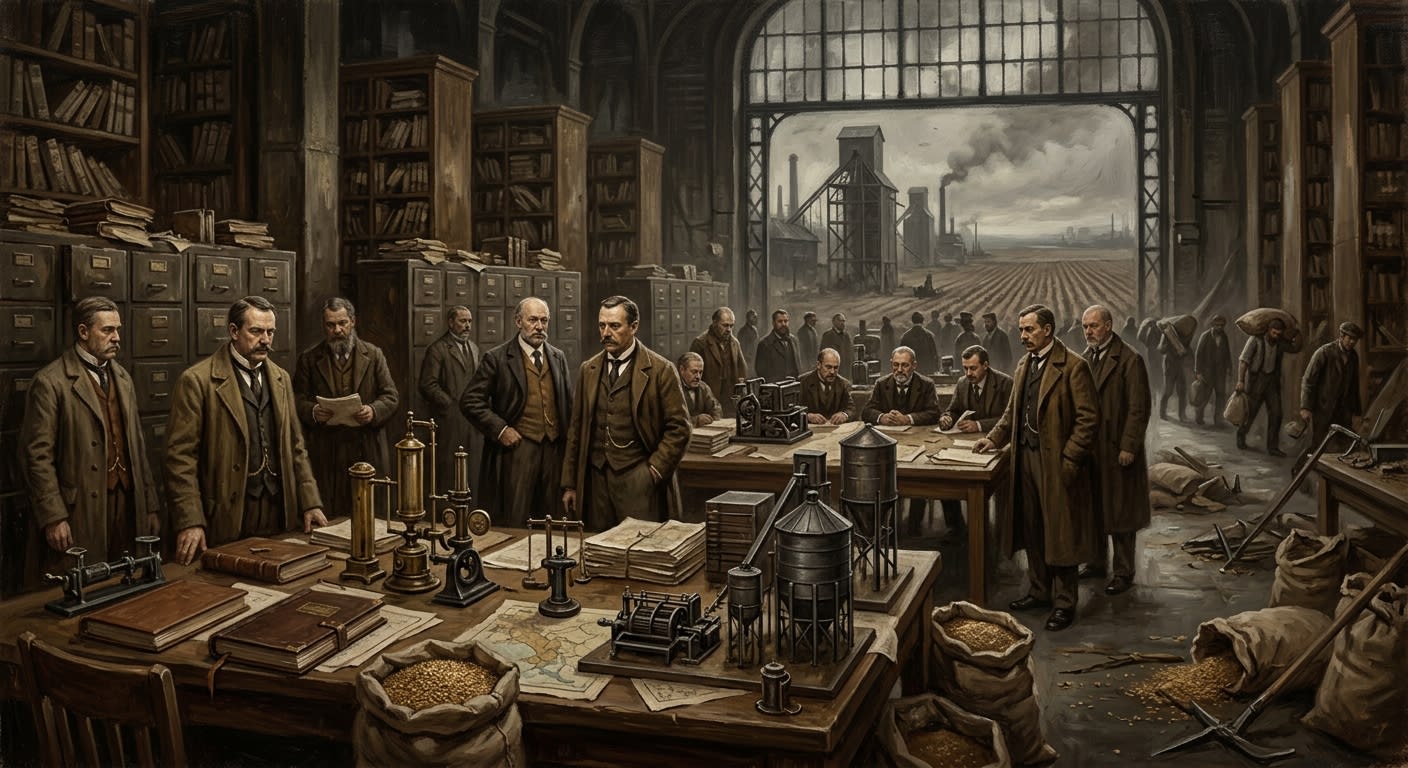
The Bureau of Agriculture was once a respectable organ of the Synod, which is to say it possessed offices, seals, regional assessors, a quarterly journal on soil acidity, and sufficient delusion to believe food might be governed by people who knew how it grew. It kept yield tables for Pannonia, orchard ledgers for the Tisza valley (Unregistered), cattle registers from the Alfold, seed vault inventories, silo plans, crop-rotation folios, pest circulars, and field reports written by men with mud on their boots rather than theology in their cuffs.
Naturally, Strasbourg grew suspicious.
Its public charter placed it under subsistence security, land recovery, seed preservation, and agricultural prognostication. Its real task was narrower and crueller: persuade Europe that the fields would feed the war after the war had eaten the fields. For a century it did this with maps, projections, and that peculiar administrative optimism which survives because no one opens the relevant cabinet.
#On Its Useful Lies
Agriculture inherited older imperial agronomy after the early Synod consolidations, then wrapped it in acceptable language. Crop rotation became “seasonal obedience.” Soil enrichment became “humoral amendment under Providence.” Irrigation ratios became “water discipline.” Seed preservation became “future tithe custody.” The knowledge remained useful because it had been baptised badly enough to pass inspection.
The Bureau's finest early work lay in surveys: Pannonian wheat-country, Rhine barley corridors, Lombard orchards, Baltic rye belts, forward livestock capacity, projected recovery zones around Debrecen, and those heartbreaking Hungarian maps that begin with the sentence “the plains fed three empires.” I have read all eleven Debrecen recovery reports, filed between A.S. 145 and A.S. 155. They are accurate, grieving, and useless. Accuracy without power is a splendid way to manufacture paper.
The Bureau also preserved fragments of forbidden science after Purity's more enthusiastic bonfires. It knew enough to miss what had been burned: crop rotation notes, soil treatments, irrigation ratios, seed lines, pest remedies, and six hundred pages of pre-Sundering agricultural science destroyed with Marrow Vask. Agriculture would have begged for those pages later, had it possessed humility, authority, or access to the ash pile.
Earlier summaries described Agriculture as “obsolete after ration modernisation.”
Corrected. It was obsolete only to offices that preferred counting bread to growing it. The fields did not become obsolete. The farmers did not become obsolete. The Bureau became inconvenient because it kept writing down reasons hunger had causes.
#On Tithes, Theft, and Patience
By A.S. 143, the Bureau of Tithes had begun exercising grain authority without authorisation. This was theft in the pure Bureaucratic sense: no door forced, no seal broken, no confession possible, simply a function lifted one form at a time until the robbed office continued existing only as stationery. Agriculture issued reports. Tithes issued rations. Reports do not fill bowls. Rations do, or pretend to, which is politically preferable.
Then came Seville.
The Iberian campaigns bent western stores toward Bastion-Constantinople, revived famine levies, and left Agriculture with the task of managing what remained. It produced a seventeen-page report recommending patience and prayer. This has been mocked for decades by men whose emergency plans consist of requisitioning someone else's pantry. Prayer deserved better. Patience had already been eaten.
The Weevil Year made the murder tidy. Official grain stores rotted under lawful multi-Bureau custody. Engineering built the silos. Rites blessed them. Records inspected them. Agriculture owned them. No one owned the air. Hidden Grain Keeper caches fed districts while public stores became black mash. Agriculture received the blame, which was procedurally convenient because blame must have a desk.
#On Dissolution
A.S. 158: Strasbourg terminated the Bureau of Agriculture on grounds of “administrative redundancy and doctrinal irrelevance.” All records were transferred to the Bureau of Records sub-registry. All staff were reassigned to the Paper Mines of Ulm. Grain allocation passed to Tithes, which had already stolen the chair and now received permission to sit in it.
No successor Bureau was designated. This was called streamlining. Farmers continued farming. Fields continued failing. Kargath continued eating soil. Reports continued arriving, because the dead Bureau had left behind habits in clerks too stubborn to understand their own extinction.
The dissolution of Agriculture was unrelated to the Weevil Year.
It has always been unrelated. It became unrelated the moment the circular said so. The rotted grain, the ventilation failure, the hidden caches, the famine levies, and the transfer of authority to Tithes are separate matters connected only by chronology, consequence, and every fact the Bureau has declined to bless.
Transfer docket, Agriculture Eastern Recovery Desk, A.S. 158: Personnel listed: 417 Personnel received at Ulm: ███ Personnel retained for remnant technical consultation: 3 Personnel unaccounted after “records consolidation”: ██ Cabinet keys recovered: 0 Disposition: CLOSED BY ABSENCE OF OFFICE
#On the Three Clerks
Three clerks remain in a Strasbourg basement, the remnant office no one admits is an office because an office implies budget. They calculate Abundance Field yields, annotate Blightmarsh boundary reports, compare soil that should be dead with grain that grows too well, and submit annual requests for reinstatement. As of A.S. 201, the eleventh request has been denied.
Their argument is vulgar, powerful, and inadmissible: an enemy who wages war through agriculture might best be opposed by someone who understands agriculture. War calls the Fields military. Doctrine calls them theological. Tithes calls them allocative. The three clerks call them agricultural, which is why the request fails every year with dependable grace.
The Bureau of Agriculture is gone. Its cabinets remain. Its records remain. Its absence governs more than its presence ever did. Every ration line, every failed silo, every Kargathian field whose fruit smells of fresh bread, every Tithes clerk who mistakes a sack for revenue and a stomach for an account, all stand inside the hollow it left.