
#On the Origin and Authority
"Guilt is weight. Weight must be measured." Gate Chapter Catechism, posted at all three arches of Griefgate.
The grief-tax is the price the Church sets on carrying an unresolved spiritual condition through a gate that would rather the traveler had resolved it somewhere else. Its principal house is the Widow's Pennies Exchange, under the central of Griefgate's three black arches. There the Pilgrim Roads narrow into a chalk defile in the western heartlands, and every eastbound soul has to stand still long enough to be priced.
The distinctions come first, because the pilgrims never make them. The Tithe Assessors collect a household levy in doorways and ration halls, and they assess it on a hearth. The grief-tax is assessed on a passage. According to the Exchange's own account, the name "Widow's Pennies" is older than the hall. It belonged to an emergency levy on bereaved women in a famine year, a levy long since abolished, and the title drifted down the roads until it settled on the Exchange the way a debt settles on an heir. In street cant, widow-pennies now means the whole bundle: toll and grief-tax paid at one counter in one breath. The tables do not ask whether the payer is a widow, and widows are a minority of the payers.
Local authority rests on the Joint Charter of A.S. 94 / 1804 CE, renewed in A.S. 187 / 1897 CE. The charter bound the Synod Gate Chapter and the licensed broker compact into a single stewardship four years after the Concordat of Strasbourg made the Synod a formal body. Griefgate's grief-tables were codified under that charter. The records do not say whether any confessor anywhere priced a sorrow before A.S. 94, and I have not asked them. A wise archivist does not pester a ledger about its childhood.
#On the Assessment
"Kneel and name." Instruction painted above the Kneel-Sheds.
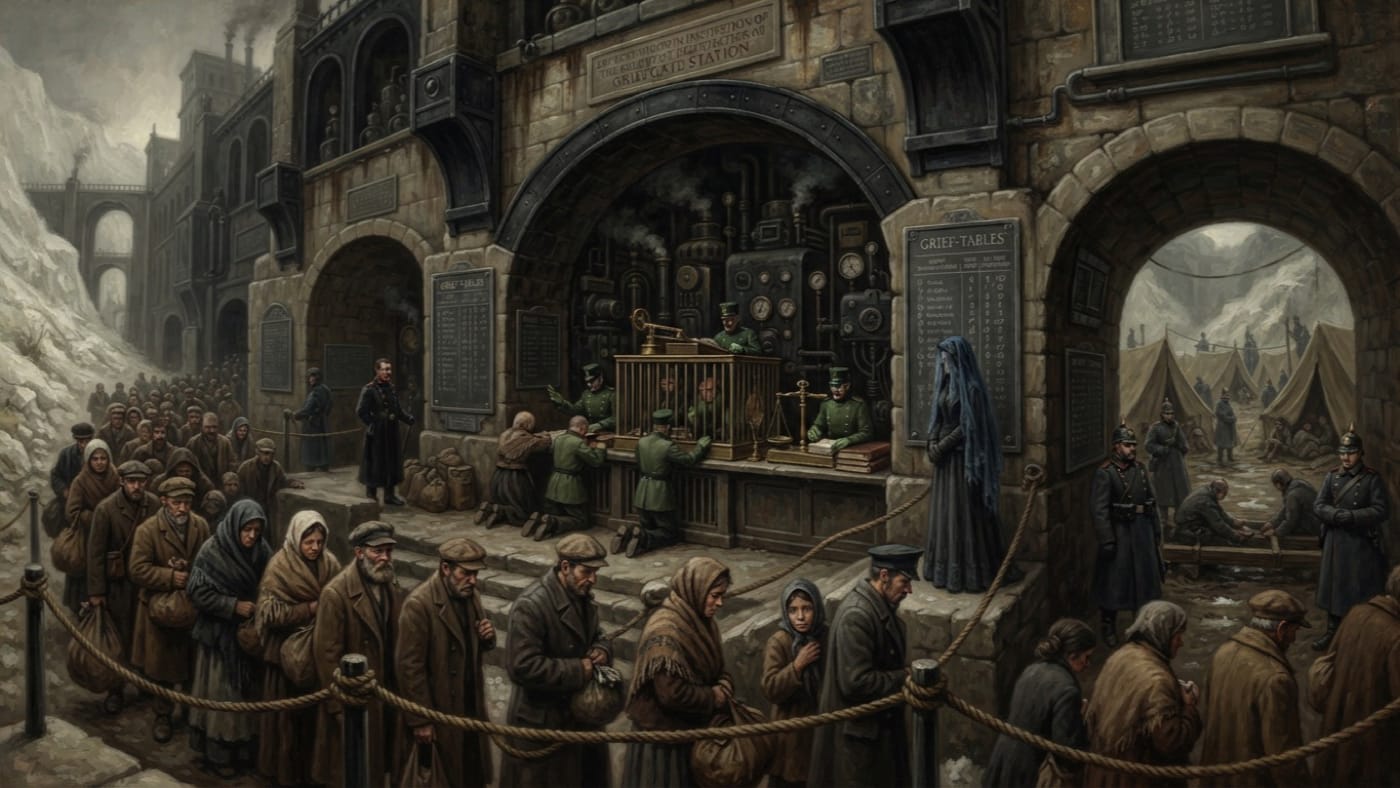
The traveler arrives from the west, usually sung down the road by the brokers of the Choir-Broker Hall of Peregrine Row, who have their own compact and their own fees and whose concern for the traveler ends at Griefgate's rope. Then the traveler queues. The queue smells of wet wool and sour incense, and its ropes are blessed every morning. Eventually the traveler kneels in one of the confession stalls along the right bluff and declares, under confession protocol, whatever spiritual burden they currently carry: a death in the family, a sin unabsolved, a debt unpaid to the Church. A clerk writes it down.
Then the clerk starts comparing. The declaration is held against the traveler's papers, face, companions and stated destination. Most decisively, it is held against every earlier confession the traveler filed at other stations along the road, all of which feed the Great Ledger of Souls. If the story agrees with the record, the clerks call it a story-fit. If it disagrees, the clerk raises a doubt flag.
A doubt flag is a notation. It is not yet a verdict. A widow whose husband's name is spelled one way at one station and another way at the next has produced a mismatch, and the mismatch proves nothing about her soul. It proves something about two clerks. The Gate makes no such distinction in practice: the flag costs her the same hours in the queue whichever of the three was at fault.
A traveler who passes comparison has the declaration entered against the public grief-tables, which hang on the Exchange walls like weather forecasts. Each category of burden carries an assessed value, and the assessed value becomes the toll. I will not reproduce the figures here. They are revised, and a Codex that prints a price invites haggling.
The clerk does not weigh the sorrow, and no instrument in the hall pretends to. The clerk sets the declaration beside the table, and the table was drawn up by men who never met the deceased. A burden the traveler declared is priced. A burden the traveler did not declare but the clerks then find is priced too, at the cost of the traveler's liberty.
#On Payment and Portable Clearance
"Pay clean. Pass clean." Inscribed above the central arch.
Payment is made in standard pennies, in oath-notes, or by signing a labor-conversion contract. Coin goes in open view to the Assayers of the Bitter Scale, who weigh it on brass balances, bite it, and test it with reagents that have dyed their fingers a permanent green. The assayers test the coin and nothing else. Oath-notes and contracts go to the copyists, because paper does not sit well on a scale and a contract bites back only later.
The receipt is the indulgence slip, a rectangle of heavy paper bearing the Gate Chapter's red-wax seal and the confession clerk's black mark. The pilgrims call it portable clean. For thirty days it clears its bearer through checkpoints on the roads, and during those thirty days it serves as spiritual clearance, travel pass and negotiable paper all at once. Since about A.S. 199 the slips have changed hands widely as a secondary currency, and the Bureau of Tithes has watched their circulation with an expression I can only describe as envy.
The slip has limits, and I record them for any bearer who has mistaken wax for armor. An intact slip does not lift a doubt flag already raised against the bearer's name, and it does not exempt the bearer from inspection. A smudged seal buys a conversation with an inquisitor that no traveler wants to have.
#On Arrears and Judgment
A disputed assessment goes to Arbiter-Widow Solenne, called Blue Veil after the mourning gauze she wears for a husband whose death nobody has verified. Neither the veil nor the title proves the bereavement. They prove that she understands her court. I have looked for a published schedule of grounds for appeal, a deadline, or a list of permitted rulings, and I have found none, which at least spares the petitioner the trouble of reading them. She hears the dispute and she rules, and the ruling goes into the record.
The traveler who cannot pay goes to the Holding Pens, which the town calls the Delay Gardens: canvas that leaks, straw that rots, and a clerk at the gate who enters each day of detention as delay debt. The debt can be paid in coin, in labor, or in confession service, and a detainee with coin would not be in the Pens. When the debt outruns the debtor, as it is built to do, the clerks draw up a labor-conversion contract. The contract describes its term as temporary and does not define it anywhere.
The brokers control how fast paperwork moves. Each day a file waits adds another day of delay debt, and the brokers draw their fees from that waiting, so the slowness is how the arrangement turns a profit. Gate-Canon Meral Voss controls the doubt inspections above all of this, and she does not hurry for anyone.
Everyone passes eventually.
The proverb is struck. A detained traveler who cannot pay accrues delay debt every day, and when the debt is converted into a contract of undefined term, passage becomes a matter for the contract and no longer for the traveler. "Eventually" is not a unit the Gate's ledgers recognize.
#On the Commerce of Guilt
Most things at Griefgate are for sale. A bribe will buy speed, a better lane, and a balance that misreads its weights in the payer's favor. It will not buy doubt clearance once a flag has been raised. On that one point the Gate Chapter is incorruptible, and I suspect the reason is that a flag is worth more to the Chapter than any bribe a flagged traveler could offer.
Below the arches, the Culvert Market trades in whatever the surface will not stamp: forged lane tickets, blank indulgences waiting for a forger's seal, and rented witnesses who will vouch for any grief-story for the price of a meal. Some sellers offer smuggled guilt, meaning a confession made for pay on someone else's behalf. A traveler can crawl under the Gate and come out on the far side, but a doubt flag is attached to a name, and the name stays in the Ledger whichever way its owner went.
The culverts also carry an accusation, and I set it down because the Gate cannot stop the culverts saying it. They claim the Exchange seeds false confessions into its own ledgers and assesses grief-tax on losses that never happened, so that detentions and labor seizures will later have a lawful pretext. They say Solenne keeps a ledger of such entries. Nobody has produced it, and an unproduced ledger is only a rumor. I file it under rumor.
The stone complicates the arithmetic. The Bureau of Bells confirmed the grief resonance under the arches in A.S. 143 and in A.S. 187 classed it as Category Two Ambient. When the crowd grows mournful enough, wax refuses to set, bells ring flat, and people lose their own names partway through a sentence. A clerk who hears a half-spoken name writes down a mismatch. None of this shows that the stone detects lies. It shows that the instruments behave worse when the grief is greatest, and the greatest grief arrives at the counter in the largest crowds.
#On the Present Application
The roads are swollen in A.S. 201. Refugees, conscripts and pilgrims bound for the Sagittal Line stand in the same queue, and the Gate operates at Amber, with waits that reach three days at peak.
An auditor will want an average tax per traveler. There isn't one. The receipts are counted in pennies, in notes and in human beings, and no honest ledger can add those three together and divide by a fourth. The figures belong to Griefgate station alone and say nothing about the Church at large. They do show the competing demands on the Gate. The broker compact wants looser clearing, so more travelers pass and more tolls are paid. The Synod wants more detentions, so the eastern labor quotas are filled. One of those columns grows with every slip issued and the other grows with every contract signed, and the Gate has to keep both of them growing.
The receipts are entered and the discrepancy is rounded. The queue moves forward one rope-length, and the next traveler kneels.
Dolor taxatur; via manet.