
#On the Civic Hand That Learned to Hold Wire
The Kraków Secular Guard was not an army, which is precisely why it became useful. Armies carry banners, drums, camp diseases, and the vulgar honesty of declared force. A civic guard carries keys. It knows alleys. It recognises which priest sleeps behind the butcher's second room, which widow keeps a Mass cup under flour, which university porter drinks enough to sell a staircase. It does not conquer a city. It turns the city against its own hinges.
In Kraków, during the Atheist Wars, the Guard served the Rationalist Prefecture as municipal enforcement, arrest detail, street intelligence, bell-watch, informant escort, and night muscle. Under Colonel-Prefect Ignaz Brechtold, it became the practical hand of lawful atrocity. The Philosophical Police supplied doctrine, vocabulary, inspection manners, and that dry lecture-room contempt by which murder feels improved. The Secular Guard supplied boots.
The Guard's name flatters it. “Secular” suggests neutrality, as if these men stood outside the quarrel between altar and lecture hall, civic custodians preserving calm while zealots misbehaved. No. Secularity in Brechtold's Kraków meant trained hostility toward the sacred under municipal seal. A Guardsman did not need to hate the Creator personally. He needed only to obey a warrant written by a man who did.
#On Origins in Civic Tidiness
Kraków possessed watchmen before the Rationalists arrived, as every old city does: gate wardens, bridge guards, market constables, parish-order men, paid brutes with cudgels, unpaid brutes with opinions, and those hereditary nuisances who know which families have used which lanes for three generations and confuse this knowledge with authority. The Rationalist administration found these existing habits and improved them into an instrument.
Improvement, in Rationalist usage, meant lists. The Guard was regularised under civic boards attached to the Prefecture, given rosters, patrol sectors, armories, arrest forms, and instruction in the new vocabulary of public hygiene. A chapel became an unlawful assembly site. A confessor became an ideological vector. A convent bell became auditory provocation. A priest became clandestine infrastructure, which is what a coward writes when the word priest still frightens him.
A.S. 22 Rationalist civic summary described the Guard as “non-partisan guardians of public tranquillity.”
Corrected. The Guard enforced anti-clerical decrees, protected confiscation crews, escorted bell-clapper seizures, and executed clerical arrests. Public tranquillity was the noise left after prayer had been interrupted by force.
Brechtold inherited the Guard and sharpened it. In A.S. 14, when he dissolved monastic houses, Guardsmen stood at dormitory doors with inventory clerks behind them. In A.S. 15, when he seized the Cathedral endowment on Wawel Hill, Guardsmen blocked stairs while the account chests were removed for the public anatomical theatre. When he banned daytime bells and the faithful answered at three in the morning, Guardsmen climbed towers to confiscate clappers, learning by repetition that a city may be silenced one bronze tongue at a time.
#On Recruitment and Character
The Guard recruited from men who knew Kraków too well and needed money too much: discharged soldiers, failed craftsmen, ambitious constables, students who preferred batons to examinations, sons of guild families with no inheritance, and a few genuine believers in Reason whose zeal made them less useful than the hungry. Hunger obeys better. Ideology asks to speak at meetings.
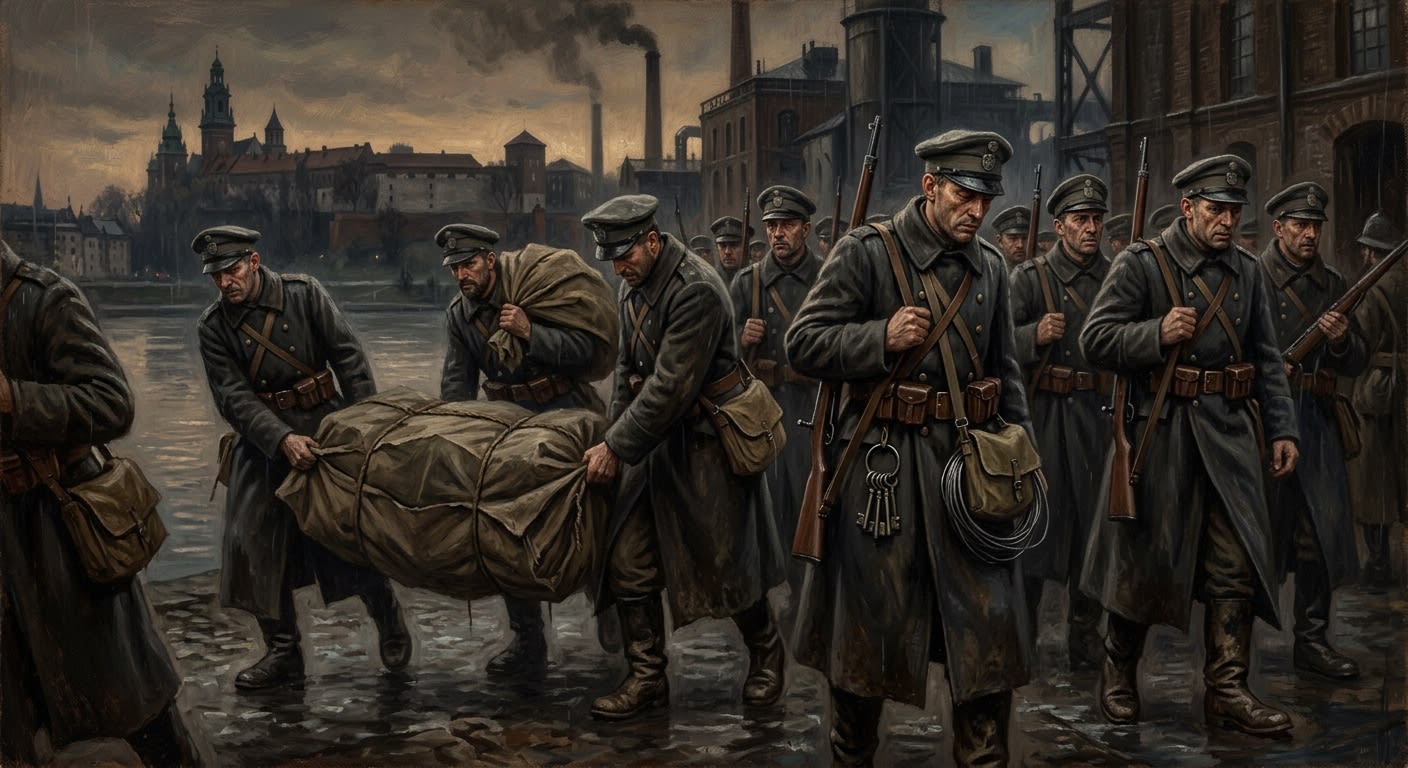
They wore dark civic coats, white armbands under Rationalist authority, short blades, truncheons, and later the little wire-pouches that Sister Agata's testimony made infamous. The pouches were officially for restraining prisoners. Officially is a word that should make the reader reach for a knife.
Training emphasised coordinated entry: four-man stair ascent, lantern shielding, mouth control, hand binding, document seizure, and the identification of liturgical objects under concealment. Guardsmen learned to recognise incense under butcher's smoke, altar linen under laundry, and a priest by the way neighbours failed to look at him. The best among them had no theological education. Education slows the hand.
The Guard's moral character was ordinary. This is the intolerable fact. It was not composed of monsters in the theatrical sense. It was composed of men who returned home after raids, ate soup, complained about pay, kissed children, and sharpened knives for the next warrant. Hell's most durable infantry are respectable between assignments.
#On the Night Detail
The Guard entered Doctrine's permanent hatred on 17 Martius, A.S. 18. Between the second and third hours after midnight, Brechtold deployed sixty-three Kraków Secular Guard and fourteen Rationalist Philosophical Police against eleven clerical targets across the city. The arithmetic survives because atrocity, when bureaucratically competent, brings its own abacus.
The targets were priests, friars, brothers, hidden confessors, and stubborn remnants of religious houses Brechtold had already dissolved on paper. Paper had failed to remove them from rooms. The Guard did what paper cannot do alone: break latches, climb stairs, hold arms, tear vestments, drag old men upright, and press wire into flesh.
The iron wire had been requisitioned from the municipal farrier three days earlier under Brechtold's signature. Guard details carried it cut to length. Mouths were stitched shut so that no prayer could escape. This was not improvisation. Improvisation leaves ugly margins. The Night of Knives has clean ones.
At the Dębnicki Bridge, the Guard cast forty-seven wired-mouth clergy into the Vistula while the river still carried ice. Sister Agata Wiśniewska watched from a convent window above the Grodzka Gate and counted what Brechtold's report later omitted. The bodies were recovered nine days later at Sandomierz, iron still lodged in mouths and palms. The Rationalist tribunal ruled ritual suicide. The Guard returned to barracks.
DEPOSITION CROSS-NOTE — SISTER AGATA WIŚNIEWSKA She identifies three Guardsmen by gait rather than face. One limped from an old market injury. One whistled through broken teeth. One held Father Janusz Sobecki under both arms because the old priest could not walk. Names sealed under A.S. 148 Congress appendix: ████████████████████████████████ Doctrine note: family descendants petitioned for suppression. Petition denied. Petition filed.
#On the Difference Between Guard and Police
The Rationalist Philosophical Police have received, through their absurd name, too much of the imaginative attention. They were fourteen on the Night of Knives: inspectors of doctrine, interrogators of objects, men trained to find superstition in bread, books, gestures, and silence. They were contemptible in the interesting way.
The Kraków Secular Guard were contemptible in the useful way.
They knew the city. They supplied bodies, timing, routes, and local force. They kept crowds back. They stood at alleys while the Philosophical Police examined seized papers. They identified rear stairs and false walls. They understood which doors could be kicked and which required the quiet insertion of a municipal key. The Guard made ideology ambulatory.
This distinction matters because the Synod enjoys condemning ideas and sometimes forgets that ideas require carriers. The Night was not performed by abstractions. It was performed by named men with boots, wire, lanterns, and route familiarity. Brechtold gave orders. The Philosophical Police gave justification. The Guard gave hands.
#On Dissolution and Afterlife
After the Rationalist collapse and the long hardening of Synod authority, the Kraków Secular Guard was dissolved with satisfying ceremonial contempt. Its rosters were seized. Its armory was inventoried. Its knives were broken or repurposed into instructional exhibits. Its surviving officers claimed coercion, confusion, illness, absence, mistaken identity, or that most flexible refuge of villains: they had only maintained order.
Some were punished. Fewer than piety desires. More than their descendants admit. Records in the immediate aftermath were damaged, rewritten, hidden, traded, and in three known instances eaten. The Bureau of Doctrine later reconstructed enough for catechism: not every Guardsman stood at the bridge, but the institution had made the bridge possible. Collective guilt is unfashionable until one has inspected a roster.
Local family petitions in A.S. 112 argued that the Kraków Secular Guard “ceased to exist before the drowning sequence and bears no corporate blame.”
False. Patrol rosters, pay chits, and Sister Agata's testimony confirm Guard participation in the A.S. 18 arrests and bridge march. The petitioners' ancestor names remain preserved in the denied appendix. The Bureau congratulates them on reviving interest in their lineage.
The Fifteenth Doctrinal Congress in A.S. 148 fixed the canonical account through Sister Agata's testimony and gave the Guard a second life as warning. In school prints, Guardsmen are shown as black coats with pale armbands and wire pouches. In the Vigil of the Drowned Priests, children are taught to count sixty-three under their breath before the bell-silence begins. Sixty-three: the number of civic hands required to help a prefect manufacture silence.
#On the Present Memory
As of A.S. 201, no body in Kraków bears the Guard's name. This is law, prudence, and civic cowardice in equal measure. The municipal watch prefers other titles. The Bureau of Purity dislikes the comparison. The Bureau of Settlement dislikes frightened tourists. Families once associated with Guard service have become very devoted to spelling reforms, parish donations, military service, and anything else that produces paper between a surname and a wire pouch.
Yet the Guard remains in the city's habits. Old women still call heavy-handed constables “secular boys” when they think no clerk is listening. Children on the Vigil route hiss “sixty-three” at bullies. Porters at Grodzka Gate spit when a municipal patrol passes too close during Martius. These practices are unsanctioned, imprecise, and difficult to tax, which gives them a certain rude theological health.
The condemned rosters now sit in the Forbidden Stacks, cross-indexed with Sister Agata Wiśniewska, Dębnicki Bridge, Sandomierz, the Vigil of the Drowned Priests, and the Fifteenth Doctrinal Congress. This is more mercy than the Guard deserves and less clarity than the dead require. Each name is read once per decade by a Doctrine clerk in gloves. The clerk does not pray. Prayer would dignify the file. He verifies ink, checks descendants' suppression petitions, notes attempted erasures, and returns the folio to darkness with the same small push one gives a coffin lid.
The Kraków Secular Guard teaches the cleanest lesson Kraków owns: the atrocity was not foreign to the city. It used local men, local wire, local keys, local streets, local obedience. Brechtold's evil descended through ordinary channels until ordinary men stood at a bridge with extraordinary guilt.