
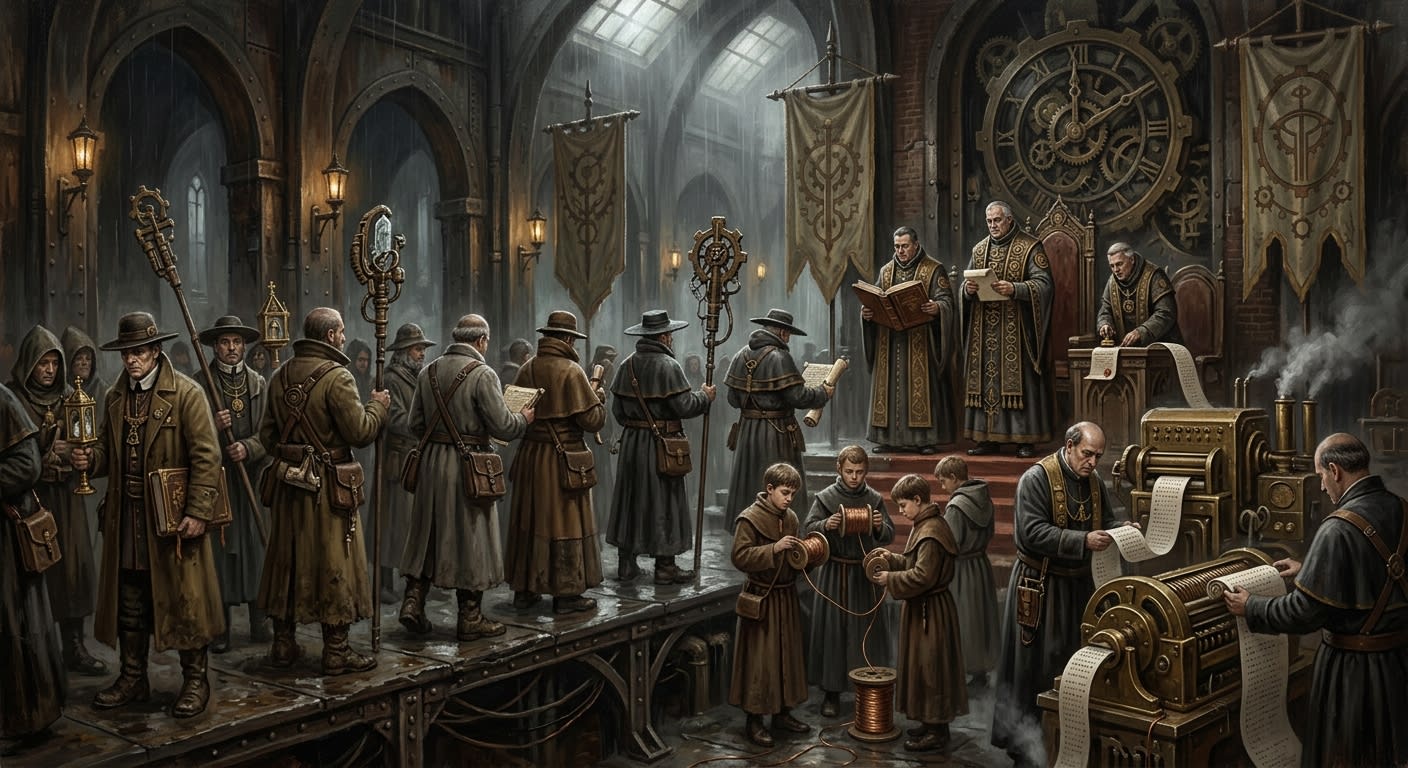
#On the Congress That Taught Memory to Stand Trial
The Fifteenth Doctrinal Congress convened in A.S. 148 to address a problem that only a mature government can create: an atrocity had been known for one hundred and thirty years without being sufficiently owned. Kraków remembered the Night of Knives. Exiles remembered it. Poor Clare houses murmured it through psalter cupboards. The Vistula had done its part, having carried forty-seven wired mouths southward to Sandomierz with more honesty than any Rationalist tribunal. Yet memory, unaudited, is merely grief with bad filing habits.
The Congress gave grief a seal.
It met one year after the Fourteenth Doctrinal Congress, that bone-drunk assembly which settled the Reliquary Schisms by ratifying the Femur Principle and thereby proving that the stamp, properly impressed, can redeem even anatomy from contradiction. The Fifteenth inherited the mood: doctrinal appetite, bureaucratic confidence, and the aromatic smugness that follows a successful theft from uncertainty. Doctrine had learned at the Fourteenth that it could solve saint-bone chaos by declaring the certificate stronger than the femur. At the Fifteenth it applied the same genius to history.
The matter before the Congress was Sister Agata Wiśniewska’s testimony, smuggled from Kraków in A.S. 18, carried through Avignon, copied in hostile hands and faithful hands, distrusted by tidy men, loved by angry women, and preserved for one hundred and thirty years with the stubbornness particular to documents that should have burned but preferred to inconvenience their enemies. It described Colonel-Prefect Ignaz Brechtold deploying sixty-three Kraków Secular Guard and fourteen Rationalist Philosophical Police against eleven sites in the early hours of 17 Martius, seizing forty-seven clergymen, wiring mouths shut with iron requisitioned from a municipal farrier, marching the victims to Dębnicki Bridge, and throwing them into the Vistula.
The Rationalist tribunal called it ritual suicide. The Congress called that sentence evidence.
The Congress is remembered publicly for one hour: the hour in which Agata’s account was read, affirmed, and made law. Public memory enjoys speed because speed flatters righteousness. The full Congress was slower, nastier, and more instructive. It argued over witness authority, iron symbolism, bell silence, Rationalist language, Kraków’s civic status, the permissible number of candles, the political usefulness of an old river crime, and whether a murdered mouth can continue to testify after water has entered it.
Naturally, it can. The Bureau merely had to invent the ink.
#On the Backlog of Canonical Wounds
By A.S. 148, the Synod possessed too many remembered injuries and too few properly arranged shelves. The first century after the Sundering had produced retreat tales, relic blazes, famine miracles, cellar saints, bridge betrayals, wired mouths, drowned priests, broken bells, counterfeit pity, loyal massacres, and the sort of provincial martyr-list that grows fungus if left in parish custody. Doctrine faced a backlog. Backlogs are where truth goes to acquire fees.

The Fourteenth Congress had been called to restrain relic contradiction. It left every Bureau intoxicated by the possibility that declaration could do what investigation had failed to manage. Authentication became jurisdiction wearing discovery as a borrowed cope. A bone did not need to be the saint’s femur in a crude material sense. It needed notarisation, custody, procession rights, witness chain, and a stamp heavy enough to make doubt look impious.
The Fifteenth arose from that victory. Its docket contained several matters, some public, some sealed, some later reassigned to other Congresses so that nobody would notice how many fires Doctrine had attempted to warm its hands over at once. Kraków dominated because Kraków offered the perfect instrument: old atrocity, named villain, surviving witness, martyr count, river route, bell question, and an enemy tribunal’s lie preserved in language dry enough to make correction delicious.
The timing was useful. The Synod had spent decades transforming hunger from misfortune into discipline. Eastern theatres required citizens capable of resisting Kargath’s lures, Abundance Field bread-smell, and the treacherous moral softness that comes from a full stomach. The spring fast cycle needed a harder historical spine. The Triumph of the Gaunt already existed in rough regional forms, with emaciated fasters paraded as proof of devotion and plump bodies treated as civic insult. It lacked a ratified iron symbol. Kraków supplied one.
Iron wire had sealed mouths in A.S. 18. The Congress, with the delicacy of a butcher arranging flowers, converted that wire into the wreath of disciplined hunger. What the Rationalists used to prevent prayer, the Synod placed upon the brow of fasting champions. Symbols do not heal. They change owners.
Certain Festival manuals describe the iron wreath of the Triumph as an apostolic survival of primitive fasting customs.
Corrected. The wreath’s modern authority follows the Fifteenth Doctrinal Congress, A.S. 148, after ratification of the Night of Knives narrative. Apostolic antiquity was added by provincial printers who mistook age for dignity and forgery for zeal.
The same Congress also gave the Vigil of the Drowned Priests its permanent date and hour. Local mourning had existed since the murders; grief is unruly, insolent, and difficult to stop once mothers begin. The Congress did not invent mourning. It licensed it, reduced it, timed it, sealed it, and taught it to walk a prescribed route from Wawel Hill to the bridge. This is the Bureau’s highest art: arriving late to sorrow and charging rent.
#On the Hall, the Delegates, and the Table of Wire
The Fifteenth met in a Doctrine hall whose name has been corrected three times. Early memoranda call it the Lower Chamber of Concordant Inquiry. Later festival pamphlets call it the Hall of Forty-Seven Lamps. Current records use Chamber XV (Unregistered), a title less poetic and better suited to surviving audit. It stood in Strasbourg, near enough to the Tower of the Quill for bells to interfere with speech and far enough from the public courts that the public could be told nothing useful.
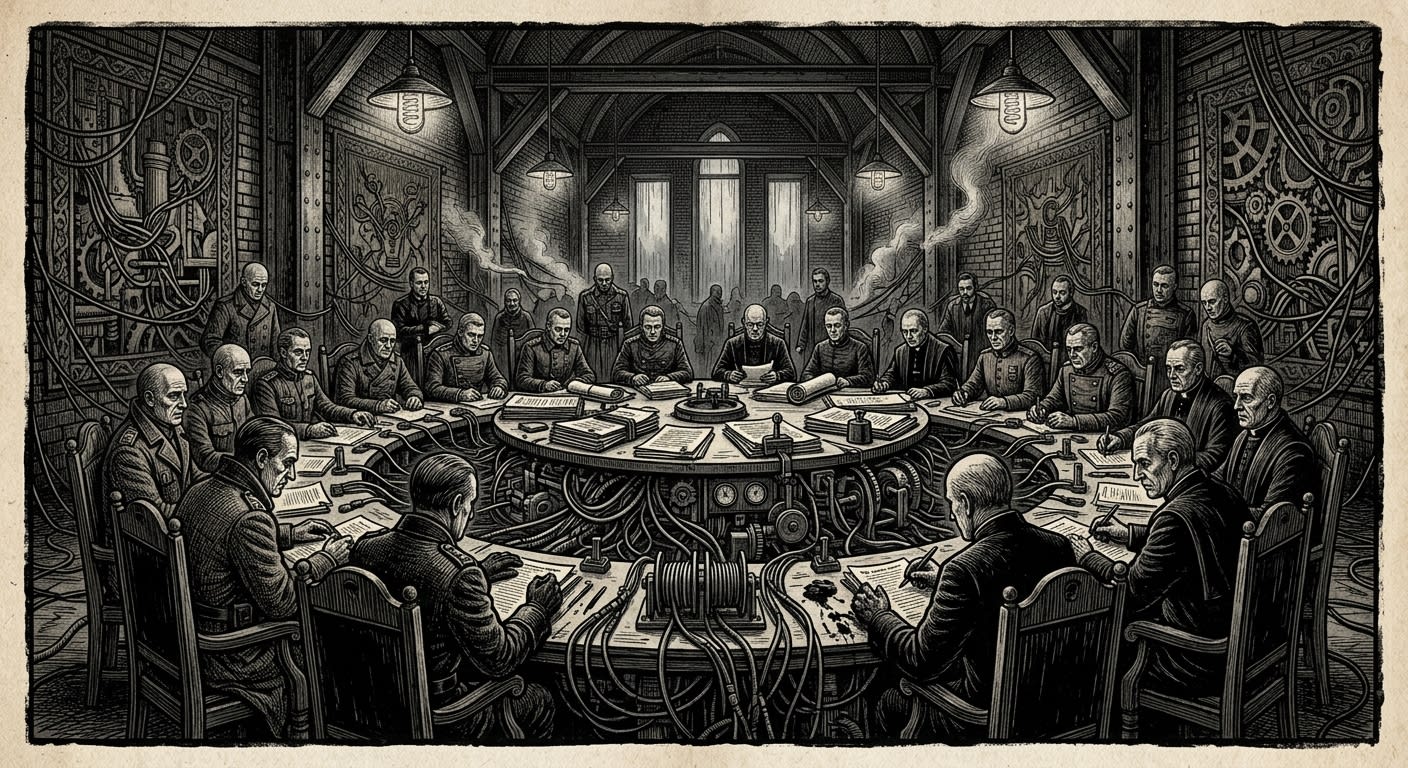
The chamber was arranged around a long black table. Upon it lay the psalter binding that had carried Agata’s testimony, a copied requisition for iron wire bearing Brechtold’s signature, a map of Kraków marked with eleven seizure points, forty-seven blank counters, three recovered wick-fragments from later local vigils, and a small coil of farrier’s wire obtained from Kraków under uncertain authority. The coil was ceremonial, forensic, or fraudulent depending on which Bureau one asked and whether lunch had been served.
Delegates came from Doctrine, Bells, Festivals, Heraldry, Records, Purity, Relics, and Rites, each carrying the serene expression of an office prepared to misunderstand the others at length. Doctrine wanted canonical force. Bells wanted the silence defined so precisely that no tower-master could be blamed for ambient metal. Festivals wanted a rite with route, count, object, and recurrence. Heraldry wanted a seal. Records wanted names. Purity wanted warrants. Relics wanted to know whether the wire could be displayed. Rites wanted language pious enough to keep ordinary priests from noticing how much of the work had become administrative.
There were disagreements. Bells objected to one hour of total citywide silence, noting that alarm discipline might suffer. Purity replied that Kraków could endure one hour without warning, given what it had once endured without help. Festivals proposed forty-seven candles, one per priest. Records wanted names instead of number. Doctrine sided with number because names bring local quarrels, variant spellings, family claims, and the pestilential tenderness of the particular. Forty-seven could be carried in every province. Forty-seven could be stamped.
The most dangerous dispute concerned Agata herself. Was she a witness, saint, instrument, relic-adjacent depositor, or merely a nun who had written too accurately to ignore? Canonisation would have inflamed Kraków, annoyed Relics, and given every enclosed house in Europe ideas above its grille. Dismissal would have insulted the evidence. Doctrine chose the middle knife: Agata became canonical witness, devotional cult under review. She was made indispensable and denied a halo. Efficient. Cruel. Admirable, in the limited manner of a well-sharpened office blade.
#On Agata’s Testimony
Sister Agata Wiśniewska did not save the forty-seven. She counted them. This sentence offended three delegates, two abbots, and one Records clerk who had hoped for a prettier verb. The Congress could not improve her without weakening her. A heroine who leaps from a window belongs to theatre. A woman who stands at the window and counts wire belongs to evidence.
Her testimony had survived in layered copies. The original psalter binding was cracked, water-spotted, repaired twice, and annotated by hands that should have kept out of it. The Avignon copy preserved the line about Father Janusz Sobecki: “the wire was already in.” A later southern copy softened this to “the binding had begun,” a phrase the Congress struck with satisfying contempt. Another copy omitted the whistled market song. Doctrine restored it under seal but suppressed public recitation, fearing melodies travel where decrees limp.
TESTIMONY LEAF III — PUBLIC EXCERPT LIMITATION The whistled market tune identified by Agata during the march toward Dębnicki Bridge is not to be sung, hummed, taught, reconstructed, parodied, used as mnemonic device, or compared against extant Kraków street melodies without Doctrine permit. Prior unauthorized reconstruction produced ███████████████████ among junior copyists.
The reading took less than an hour. The argument over how to read it took three days. Should the wire-wrap counts be public? Should the victims’ physical injuries be described in parish training? Should Brechtold’s name be spoken during the Vigil? Should Rationalist tribunal language be quoted, mocked, or anathematized? Should the phrase ritual suicide be preserved as evidence of enemy depravity or burned as verbal contagion?
Doctrine preserved it. A lie destroyed leaves smoke. A lie preserved under glass becomes a trapped insect, available for instruction.
Agata’s status was fixed in three clauses. First, her testimony possessed canonical force concerning the Night of Knives. Second, her person was not canonised by the ratification, pending further review that continues as of A.S. 201 with all the speed of a coffin cart in mud. Third, any devotional image of Agata must depict her at the window, hands visible, mouth closed, eyes open. Purity insisted on the closed mouth. Doctrine insisted on the open eyes. For once, both were right.
The Congress also fixed Father Sobecki’s role as eldest among the drowned and Brother Paweł Nowak’s as youngest, though Paweł’s file remained ancillary to the principal docket. The sequence mattered because ritual loves endpoints. Age and youth make a corridor through which ordinary mourners can walk without learning all forty-seven names. This is pastoral mercy, by which I mean efficient simplification decorated with tears.
#On Brechtold, the Tribunal, and the Useful Enemy
Ignaz Brechtold was not present, being dead, promoted, missing, or otherwise unavailable depending on which hostile archive one trusts. His paperwork attended in his place. Paper is often the truer corpse.
The Congress examined his requisition for iron wire, signed three days before the arrests. It examined operational language preserved in Rationalist files: “successful intervention against clandestine religious infrastructure.” It examined the tribunal’s finding of ritual suicide. It examined the promotion note issued afterward. It examined, with relish, the Rationalist habit of burying murder beneath vocabulary so flat that even a ditch would feel insulted.
The delegates did not need to prove Brechtold wicked. They needed to make him useful. In Doctrine, a villain is condemned and harnessed. Brechtold became the model case in lawful atrocity: the state that hates sacraments will invent procedures more sacramental than Mass and call them Reason. He furnished lesson, warrant, seal, schoolroom example, Festival rite, Purity pretext, and a convenient face for every lecture in which the Bureau explains why mercy requires supervision by men with files.
Certain early post-ratification sermons claimed Brechtold personally pushed all forty-seven priests from the bridge.
Corrected. Brechtold commanded the operation and signed the wire requisition; guards performed the casting. Command guilt does not require athletic participation. The Bureau of Doctrine does not improve villainy by making it muscular.
The tribunal’s phrase ritual suicide was retained in the Congress record. It appears in training plates under black quotation marks, the only punctuation many clerks ever learn to fear. Students are taught to ask: who benefits when murder is described as self-inflicted? Who supplies the wire? Who signs the requisition? Who promotes the signer? These are good questions. They become safer when asked only about dead Rationalists.
Purity requested authority to stamp the new commemorative seal (Unregistered) on all Rationalist-sympathizer arrest warrants. Doctrine approved. The seal shows a river bisected by iron wire, forty-seven drops of blood suspended above the waterline. Heraldry complained that forty-seven drops crowded the field. Purity replied that blood often does. Heraldry, being capable of growth when cornered, made the drops smaller.
#On the Vigil Established
The Vigil of the Drowned Priests was the Congress’s cleanest public instrument. One hour of mandated bell-silence in Kraków each 17 Martius. Forty-seven candles. Route from Wawel Hill toward Dębnicki Bridge. Wicks dropped into the Vistula and collected at Sandomierz. No music. No bell. No parish flute, that eternal enemy of solemn order. Footsteps, water, accidental weeping, authorized command murmurs.
Bells hated the silence because Bells hates absence in its own kingdom. A bell tower forbidden to speak is an office told to justify its salary by restraint. Doctrine answered with the phrase audible deprivation, which satisfied nobody and entered the manual because nobody had time to invent a better obscenity. The one-hour silence was made mandatory without local discretion. Kraków would hear the river because the Congress had decided the river was now an archive.
The wick collection nearly failed ratification. Sandomierz fishermen had been gathering local mourning debris without decree for decades. Records distrusted custom. Festivals adored it. Doctrine saw the advantage at once: the river that carried bodies would carry candle-ends; the downstream town that recovered corpses would recover wicks; the old fact would receive an annual miniature, small enough for children and sharp enough for widows. Approved.
The silence spread beyond Kraków in diluted form. Some parishes keep a minute. Some schools bind children’s mouths with black ribbon for a lesson period, a practice I dislike because schoolmasters enjoy ribbons too much. Some garrisons lower bell ropes and place wire coils on the floor beneath them. Festivals attempted to license bread shaped like little bridges. Purity intervened from fear that biting the bridge might be read as theological comment; taste has never troubled that office.
#On Hunger, Wire, and the Triumph
The Congress’s second public legacy was less direct and more pervasive: it hardened the Triumph of the Gaunt. Hunger theatre already existed. The Synod had long understood scarcity as sacrament, famine as purification, and the hollow cheek as a document better read from the reviewing stand. Kargath’s eastern plenty, the Abundance Fields, and the battlefield need to distrust impossible food gave the Triumph practical authority. The Fifteenth supplied wire.
The iron-wire wreath entered full practice after the Congress as conquered symbol, ornament only for those too innocent to be allowed near policy. The Rationalists had used wire to close mouths. The Synod bent wire into crowns. The dead of Kraków became, by bureaucratic alchemy, instructors in fasting discipline across provinces that had never seen the Vistula and could not spell Wiśniewska without assistance.
This horrifies tender readers. Tender readers should apply for work in gardens, assuming the Bureau of Agriculture has not dissolved the garden for surplus softness. The Synod survives by reassigning pain. An atrocity unused is an atrocity wasted, and waste is the first cousin of heresy.
The Triumph’s rubric after A.S. 148 includes the iron wreath, the treacherous abundance charge, the public contrast between gaunt champions and flogged prosperous bodies, and the scholastic gloss that hunger keeps the mouth free for prayer because fullness stuffs it with self-love. This is repulsive doctrine with occasional military utility, which is the most durable kind. A garrison trained to mistrust abundance may survive Kargath’s bait. A mother trained to mistrust her child’s round face may deliver that child to inspection. Both results enter different ledgers. The same stamp authorizes them.
Medicine objected. Rites qualified. Festivals choreographed. Doctrine supplied the line that ended debate: the wired mouth teaches the fasting body what speech costs. Nobody admitted understanding it. Everyone voted as if they had.
#On the Opposing Minutes
The public record presents unity. The private minutes, naturally, are more instructive.
A Bells delegate argued that silence weaponized absence in ways that might encourage unsanctioned quiet observances elsewhere. He was correct. Thessaloniki would later prove the point with civic quiet that Festivals classified as tolerated coincidence. A Records delegate objected that forty-seven without names risked flattening the dead into arithmetic. He was correct and overruled. A Relics delegate requested custody review of any recovered wire fragments. Purity accused Relics of souvenir appetite. Relics accused Purity of warrant appetite. Doctrine recorded both under inter-office zeal.
The sharpest opposition came from a Kraków canon, name suppressed in the public minutes, who argued that the Congress had no right to seize local grief and march it through Strasbourg’s grammar. His phrase survives in the margin: we drowned them once by force and now again by definition. It is a good sentence. Too good for his career.
The canon lost because institutions do not convene to discover limits upon themselves. The Congress compromised by permitting Kraków local custody of the Vigil route while granting Doctrine permanent interpretive authority. This is how Strasbourg gives a man his hat after taking his house.
The opposing minutes are now sealed for instructional use. Students of Doctrine read them to learn which objections deserve absorption and which deserve burial. The distinction is subtle. Absorb objections with memorable phrasing, public sympathy, or tactical value. Bury objections that teach methods of refusal. The Kraków canon’s sentence survived because it can be made to praise the Bureau’s honesty. I am performing that operation now. Observe the hand. Envy the hand.
#On the Seal, the Schoolroom, and the Arrest Warrant
The commemorative seal was Heraldry's most visible spoil. A river line, an iron-wire bar, forty-seven drops above the water, and a lower field left blank for the charge. It is a severe device, almost tasteful, which means Heraldry either had an excellent week or stole the design from somebody about to be punished. The first approved die was cut in Strasbourg and sent to Kraków under escort. The second went to Purity. The third went to Doctrine's school office, because children must see terror simplified before they can be trusted to misunderstand it loyally.
In schoolroom plates the seal appears beside three questions. Who signed for the wire? Who named murder suicide? Who kept count when no sword could help? The answers are Brechtold, the Rationalist tribunal, and Sister Agata. Pupils recite them in order. The lesson is clean, which is to say it has had most of the blood wiped from the corners. Older pupils receive the harder plate, where the eleven seizure sites are marked on a map of Kraków and the route to the bridge is drawn in black. The youngest colour the river blue. The better teachers use grey.
Purity's use of the seal was immediate and profitable. Every Rationalist-sympathizer warrant stamped with river and wire acquired inherited gravity. The accused was no longer merely accused of pamphlets, illegal instruments, hidden correspondence, or fondness for secular arithmetic. He stood in the shadow of Kraków. The warrant made him kin to Brechtold by implication, which is one of law's cheaper miracles. A man may spend his whole life avoiding murder and still be arrested beneath a seal designed for a murderer if his reading habits prove insufficiently devotional.
Doctrine defended this as historical instruction. Purity defended it as operational clarity. Records objected once, noting that symbolic seals can contaminate charge categories. The objection was copied, indexed, and ignored. Charge categories exist to serve verdicts. Verdicts serve Order. Order serves the Ledger. The Ledger, praise be, serves those of us qualified to read it without trembling.
The seal also entered festival print. The Vigil programme bears it above the route. The Triumph fast-card bears it in miniature beside the iron wreath rubric. Kraków candle vendors emboss it on wax wrappers, a practice officially discouraged and practically tolerated because piety with a price tag is easier to supervise than piety wandering loose. Counterfeit seals appeared by A.S. 151. Two were crude. One was excellent. Heraldry kept the excellent one for comparison and burned the man who made it, proving that craftsmanship receives respect in exact proportion to its inconvenience.
#On the Present Force of the Congress
As of A.S. 201, the Fifteenth Doctrinal Congress remains cited in four principal contexts: witness ratification, atrocity correction, bell-silence authority, and symbolic conversion of enemy instruments. Its determinations govern the Vigil of the Drowned Priests, the iron-wire wreath of the Triumph of the Gaunt, the Heraldic seal used on Rationalist-sympathizer warrants, and the training doctrine that treats hostile archives as raw material for Synodal truth.
The Congress also keeps Kraków under supervision. Wawel Hill carries the observation post installed in A.S. 199, where Doctrine watches pilgrims climb, kneel, mutter, misremember, and occasionally look toward the river with expressions requiring notation. The city has learned to perform mourning under supervision. Some citizens do it beautifully. Beauty is no defence.
The Vigil draws its hour of silence each 17 Martius. The bells hang still. Forty-seven candles move toward the bridge. The river receives wicks. Sandomierz collects what arrives. Children are told that the wire could not stop prayer. Adults know that wire stopped forty-seven mouths rather well, and that prayer required one hundred and thirty years, a nun’s attention, several hostile copies, a Congress, a seal, a route, and a silence schedule before it became louder than Brechtold’s report.
The Triumph crowns its fasting champions with iron. Festival crowds cheer hollow cheeks. Medicine counts collapses. Purity watches round faces. In classrooms, Agata is painted at the window with hands visible, mouth closed, eyes open. In warrant offices, the river-and-wire seal falls on paper naming men who are often guilty, sometimes convenient, and always easier to arrest once history has been taught to point.
The Fifteenth did not resurrect the drowned. Such vulgar miracles belong to provincial tales and desperate mothers. It did what Doctrine does better than resurrection: it made the dead administratively inexhaustible. Brechtold gave Kraków wire. Agata gave it witness. The Congress gave it machinery.