
#On the Inspectors Who Put Spectacles on the Knife
The Rationalist Philosophical Police were the lecture hall’s answer to the execution squad: inspectors, interrogators, confiscators, evidence readers, object-deniers, and licensed sneer-bearers of the Rationalist Republic, trained to discover superstition in bread, bone, bell, gesture, silence, mourning, and any room where old women lowered their voices when a young man entered with a notebook.
They were never numerous enough to rule by themselves. This fact has misled sentimental historians into calling them marginal. A match is also small until the archive burns. The Philosophical Police supplied vocabulary, doctrine, classifications, cross-examination, property categories, and the chill little sentences by which murder became civic hygiene. The Kraków Secular Guard supplied boots. The Philosophical Police supplied permission for the boots to feel clean.
Their name deserves contempt, and contempt it shall have. Philosophical, because they claimed to act from Reason rather than appetite. Police, because Reason Alone, when denied an altar, soon discovers the pleasures of a baton. In the Age of Reason, this was considered maturity. In the Ledger, it is filed as intellectual vice with arrest powers.
#On Their Origin in the Academy’s Bad Conscience
The Philosophical Police emerged from the academies before the Republic learned to call its appetite governance. In the first years after De Vera Luce, learned societies sent lecturers, pamphleteers, disputants, relic-assayers, and civic advisors into towns that had not requested improvement. They discovered at once that mockery could empty a salon and fail to empty a chapel. A professor can defeat a priest in a debate arranged by professors; he has greater difficulty against a grandmother with a rosary and a closed pantry door.
From this embarrassment came inspection. If argument could not remove devotion, procedure would locate it. The early officers were called Examiners of Public Error, then Inspectors of Civic Clarity, then Philosophical Police once the Philosophical Prefectures made ugliness respectable by giving it a district budget. They carried notebooks before they carried pistols. This, to their shame, was not innocence. It was sequencing.
Their first task was translation. A relic became an osseous claim. A saint day became obstructive calendar residue. A parish network became clandestine religious infrastructure. A kitchen Mass became unauthorized nocturnal assembly. A psalter became portable superstition stock. Translation is conquest at room temperature.
Rationalist memorial fragments describe the Philosophical Police as “scholarly observers assigned to public-order actions.”
Corrected. Observation records. Assignment legitimizes. Public order bleeds. The phrase describes men who stood close enough to atrocity to improve its grammar and far enough from the river to keep their cuffs dry.
The Republic loved them because they made repression feel examined. The Council of Nine required officials who could enter a cloister, identify which objects were economically useful, which were politically dangerous, which were emotionally adhesive, and which should be displayed after seizure to instruct the stupid. The ordinary guard sees a cupboard. The Philosophical Policeman sees concealed ritual logistics. Both open it. Only one writes a monograph afterward.
#On Their Instruments of Clarity
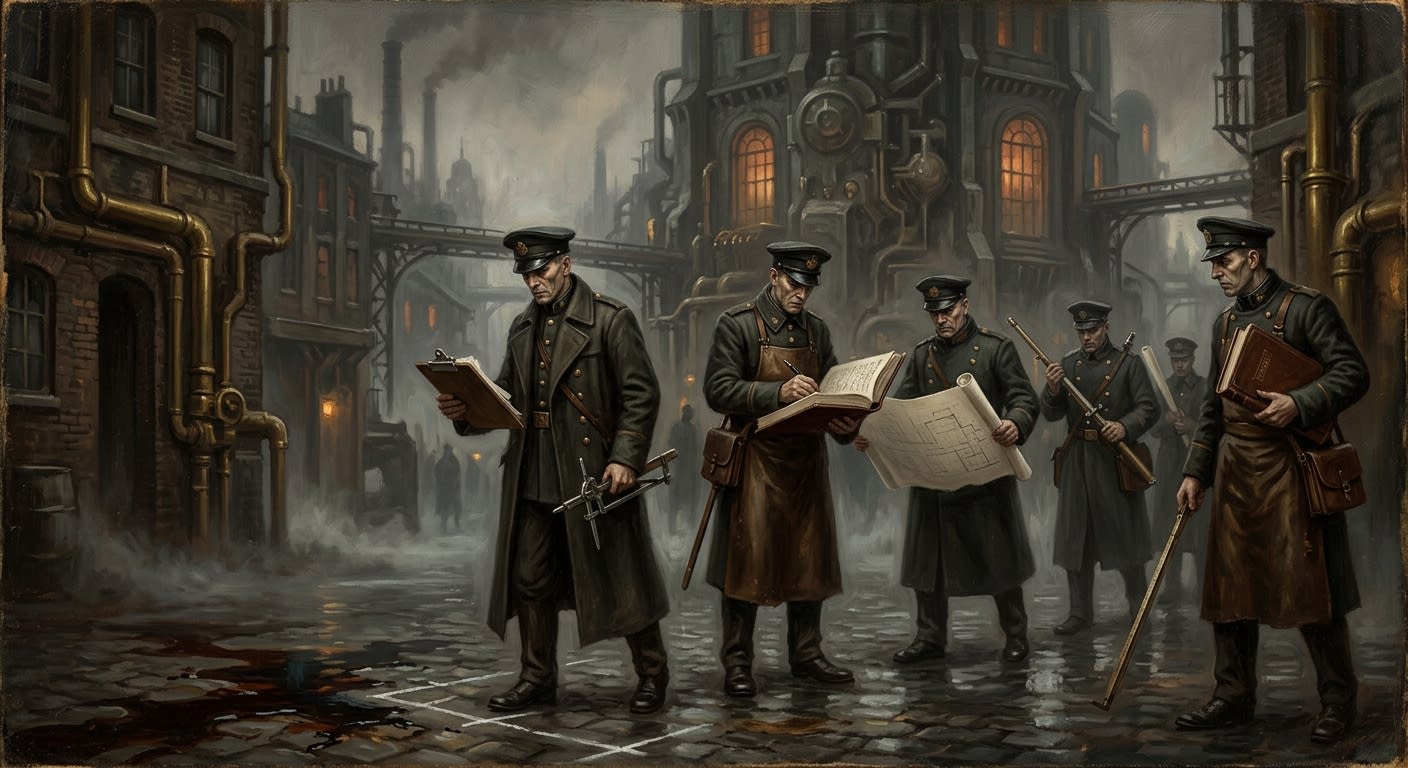
Their uniform varied by prefecture, since Rationalist vanity adored local rational adaptations when central cruelty had already been standardised. Common features recur in surviving plates: grey or blue-grey coat, black collar tabs, narrow cuffs, triangular badge bearing compass and broken vertical, waxed evidence satchel, chalk for marking doors, sealing string, bone calipers, pocket lens, arrest tags, and the thin interrogation folio called the Book of Clarifications.
A Philosophical Policeman did not merely seize. He interpreted the seizure while performing it. He could look upon a chalice and classify metal value, liturgical contamination, community attachment, probable hiding networks, and resale utility in one entry. He could hold a child's primer and note whether alphabet prayers had survived under civic maxims. He could read wear on a floorboard before a cupboard shrine and calculate how many knees had betrayed the Republic.
The Book of Clarifications deserves particular hatred. Each page offered prompts: Object? Use? Witness? Superstitious attachment? Economic value? Recommended disposition? Potential pedagogical display? The format trained cowardice into confidence. A young inspector who might have blushed before a crying nun could instead tick devotional dependency and recommend removal under civic health authority. Forms do not remove cruelty. They give it posture.
The pocket lens became their sacramental parody. They lifted it over relics, wounds, ink, teeth, rosary knots, bread edges, scorch marks, and the tongues of accused prayer-speakers. Through glass, they told themselves, mystery would submit. Through glass, they missed Hell assembling at the edge of their charts. A small comic compensation, though not enough for the dead.
#On Kraków and the Fourteen
The Philosophical Police enter Kraków's canonical wound as a precise number: fourteen. On 17 Martius, A.S. 18, Colonel-Prefect Ignaz Brechtold attached fourteen Rationalist Philosophical Police to sixty-three men of the Kraków Secular Guard and sent them against eleven clerical targets. Their number survives in Brechtold's order, in Guard pay records, in later Congress tables, and in the Instructional Appendix that descendants of the guilty have failed, with admirable persistence and no success, to suppress.
The fourteen did not need to drag every priest. That was the Guard's function. They stood at thresholds, identified papers, verified targets, confirmed which men belonged to which illegal devotional networks, and marked objects for removal while the rooms were still warm from sleep. They distinguished a hidden confessor from a frightened uncle. They named a psalter as evidence. They corrected Guardsmen who called vestments clothing rather than ritual costume. They made the raid legible.
KRAKÓW OPERATIONAL CROSS-SHEET — A.S. 18 Attached Philosophical Police: 14. Target verification phrases: preserved. Instruction on mouth closure: cross-referenced to Guard wire issue. Examiner note beside Father Janusz Sobecki entry: “mobility irrelevant to ideological function.” Names of two examiners later entering Vienna promotion lists: ████████████████████. Doctrine handling: display phrase; seal names pending descendant review denial.
That phrase — mobility irrelevant to ideological function — is the whole office stripped naked and made to stand in the cold. Father Sobecki was seventy-one and unable to walk. The Guard dragged him. A Philosophical Policeman made the dragging rational. The old priest's legs did not matter because the category priest had already replaced the man. This is Reason Alone after midnight.
At the Dębnicki Bridge, their role becomes harder to isolate, which is precisely how auxiliary guilt prefers to survive. Sister Agata Wiśniewska saw coats, wire, guards, movement, the old man, the whistled apple song. Her testimony fixes the Guard more visibly because boots and hands perform better before a window than evidentiary authority. The fourteen were present as the Republic's inspecting mind. A mind can drown men without wet sleeves if enough hands obey it.
#On Methods of Interrogation and Display
The Philosophical Police favoured interrogation by correction. They did not ask whether the accused believed. They asked the accused to clarify his relation to civic truth. They did not ask where Mass had been held. They placed objects on a table and invited the accused to explain why harmless materials had been arranged in illegal hope. The room did much of the work: bare table, clapperless bell, civic maxim on the wall, Guard witness behind the right shoulder, evidence folio opened just far enough for the prisoner to see his own name already inked.
A common sequence survives in Prefecture Nineteen training fragments. Present object. Deny sacred term. Offer civic term. Require agreement. Mark hesitation. Repeat. A rosary becomes bead chain. A reliquary becomes bone box. A chalice becomes silver vessel. A saint becomes historical morale figure. Each forced substitution cut a little nerve. Enough cuts and the tongue begins to protect itself by speaking enemy language.
Later sympathizers claimed the Philosophical Police practiced nonviolent ideological correction.
Corrected. Violence does not cease when the blade waits outside the door. A man compelled to rename his dead under guard has already felt the hand, though the bruise may form in the soul before it reaches the skin.
Public display completed the method. Seized bells were shown beside labels explaining acoustic superstition. Confiscated reliquaries were opened before schoolchildren. Vestments were hung on lecture stands and described as costume technology. The police understood humiliation as pedagogy. In this, at least, they were competent.
#On Their Relation to Guards, Prefects, and Tribunals
The Philosophical Police sat between Prefect and Guard like a hinge made of jargon. The Prefect issued political appetite. The Guard supplied force. The Tribunal of Clarity supplied later cleanliness. The Philosophical Police travelled with the warrant, sharpened the target, certified the object, and ensured the story could survive cross-examination by men who enjoyed pretending cross-examination made a thing just.
Brechtold's Kraków shows the arrangement in miniature. He wanted clerical networks broken. The Guard knew doors, alleys, staircases, families, and which parish servant drank. The Philosophical Police knew how to make eleven raids into a theory of civic hygiene. Afterward, the tribunal called the drownings ritual suicide. Such obscene comedy required prior vocabulary. One does not leap from murder to suicide in a single sentence without trained men preparing the bridge.
Their rivalry with municipal forces was predictable. Guards mocked them as ink-fingers. The Philosophical Police regarded Guards as necessary animals. Both assessments contained evidence. During operations, the Philosophical Police resented blood on papers and Guards resented corrections during arrests. Yet they needed one another. A theory without boots remains a pamphlet. Boots without theory remain assault and attract the wrong kind of inquiry.
#On Dissolution, Survival, and Synodal Use
The Sundering ended the Republic before it finished congratulating itself. The Philosophical Police fared poorly when categories acquired claws. Inspectors trained to identify illicit relics found themselves facing villages that answered in dead voices, roads that returned patrols inside-out, and fogs that refused to clarify their relation to civic truth. Several prefectural houses continued issuing summonses to districts that had ceased being districts in any sane sense. A recovered eastern report bears a Philosophical Police notation against a demonic incursion: unlicensed dramatic congregation. The handwriting stops there. Mercy has moods.
Some officers died with the Republic. Some fled west and burned their notebooks. Some offered their skills to successor authorities under softened titles: records examiner, civic proof assessor, property clerk, school inspector, tribunal reader. The Synod punished enough to satisfy liturgy and employed enough to satisfy necessity. The Bureau does not burn a useful method merely because a damned hand once held it. We purify, rename, supervise, and deny sentiment access to procurement.
As of A.S. 201, their files rest in the Forbidden Stacks, cross-indexed with the Night of Knives, Wawel Hill, Sister Agata, Brechtold, the Vigil of the Drowned Priests, and the Philosophical Prefectures. Advanced Doctrine students read them after breakfast and before lunch, so digestion can assist judgment. The lesson is unpleasant and clear: language can become a weapon before the knife leaves its sheath.
The fourteen at Kraków remain unnamed in public extracts. Their office does not. Names rot, petition, marry, beg suppression, or hide behind descendants with clean collars. Institutions persist more usefully in condemnation. The Philosophical Police were Reason's confessors with warrant books, the Republic's little priests of negation, men who taught Europe that a mouth may be closed by wire after a word has already been murdered on paper.