

#On the River as Filed
Compiled A.S. 201 / 1911 CE. The survey takes its date from this compilation. The river is older, and the file does not say by how much.
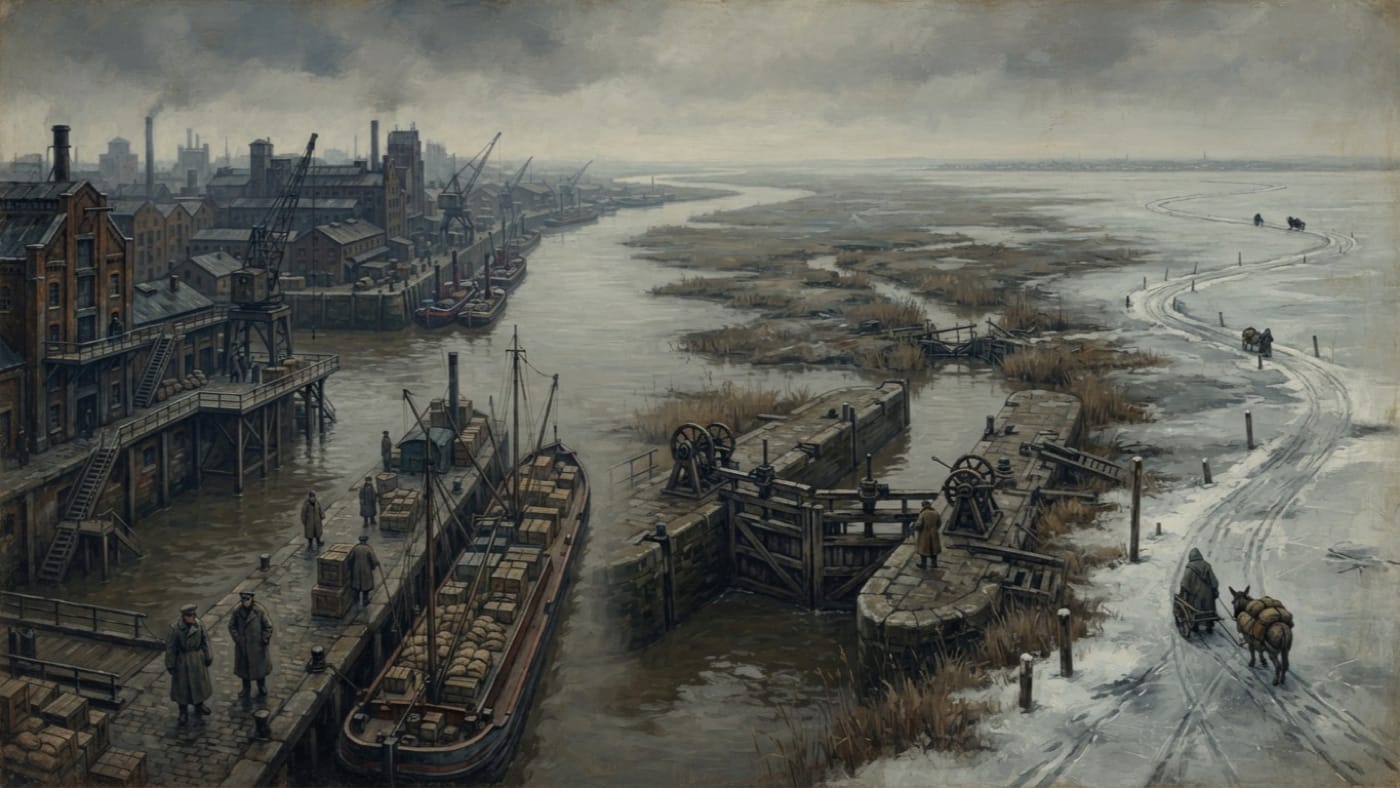
The Scheldt is a working river that ends its life in an argument with the sea, and it loses. The Codex holds it in fragments: one port's manifests, an aside in a lock doctrine, a smuggler's borrowed name, and a frost road six miles long. This compilation, made in A.S. 201, gathers those fragments in one place and does not pretend their edges meet.
The file has no itinerary from source to mouth, so the reader gets none. I could draw one. The Bureau of Engineering would admire the penmanship, and the barge pilots would laugh until they were sick over the side. A river described from what the record actually holds is poorer than a river invented, and it is the only kind I sign.
The record gives an estuary. It gives drowned pastures, tidal flats, marsh locks, a port and the cold. Cargo goes up the Scheldt and excuses come down it. Anything the Church wants to know about the river, it learns where something on the water has to stop, be counted and pay.
#On Cargo and Custody at Antwerp
The Scheldt's best-documented stop is Antwerp. It is a Synodal port in Zone 1, Belgian, and not Dutch, a point its citizens raise with visitors before the visitors have opened their mouths. Its published plate lists the city's work as grain reception, dock accounting, relic transit and diamond-scale finance. From its docks cargo moves inland toward Ghent, Bruges, Candlewick and Cologne. The river delivers, and the city counts what it delivers.
The counting is split between two houses. The Bureau of Records keeps the Scheldt Annex near the old crane, where dock manifests, name rolls and damaged receipt copies sit in raised cabinets. Next door the Bureau of Tithes runs the Salt-Scale House, which handles tariff weight, salt dues, grain levies and bonded cargo. When a barge unloads, Records owns the paper and Tithes owns the weight. A merchant soon learns that he owns neither.
That last line of the stamp is mine, and I stand behind it. Antwerp's arrangements belong to Antwerp. Nothing in the record shows the same two offices, the same cabinets or the same balances at every quay along the river. A clerk who applies an Antwerp tariff schedule to a boat thirty miles off is committing an error, a forgery or an act of ambition, and I will leave it to his confessor to decide which.
The cabinets are raised because of the water. Antwerp's account traces the custom to the flood scares of A.S. 78, when river cities found out what floor-level storage does to a manifest. As of A.S. 201 the Annex has been raised twice against flood. Paper is the most vulnerable cargo the Scheldt has ever carried, and it never even gets wet in the hold.
#On the Lower Marsh Locks
Below the port the ground stops being sure of itself, and the Scheldt runs into marsh. There are locks in that marsh. The record does not say how many, where they stand, who built them or what each one charges. It says one thing, and says it in comparative form. The Seal Locks doctrine, after listing how widely the practice of lock tribunals has spread, admits that the lower marsh locks near the Scheldt still answer to local boatmen more than to Strasbourg.
I keep the wording exactly. "More than" is a measure, and it grants no independence. It does not mean Strasbourg is absent, that the boatmen are a guild, a council or a single named man, or that Synodal pressure stops at the reeds. It means that in this stretch of water, the people who know where the channel shoals have a stronger claim on the gate than the people who have the seal.
That happens wherever the water has a temper. A crank key and a written ordinance carry their authority. So does a boatman's knowledge of which tide floods which sill and which bank moved last spring, and every lockman who wants to keep his chamber dry will defer to that knowledge. The doctrine names similar holdouts elsewhere. Hamburg's northern floodgates set aside Candlewick shade rules in the ice weeks and plead practical necessity. The marsh locks of the Scheldt appear in the same breath and make the same plea without words.
The model sits at Candlewick. There, Records, Passage, Tithes and Purity each claim a part of every lock chamber. Manifests are read aloud, seals are compared under a north lamp, and nothing is lowered until the water ledger is closed. That practice is a comparison. It is not a description of the Scheldt. I have no evidence that any Scheldt lock reads manifests aloud, keeps a north lamp or owns a ledger. The file has no lock map, and I will not draw one in order to look thorough.
#On a Borrowed Name in the Marsh
Talk of locks leads, in any honest file, to talk of the water that runs past them. The Black Canal is properly Candlewick's: an under-dike criminal waterway that became useful after the Great Fire and the wax quotas of A.S. 98, and carries outlaw shade, false seals and worse. The name has travelled. The Black Canal entry records that other cities use it loosely, and among its examples it lists "a marsh sluice near the Scheldt."
That is the entire record of the Scheldt sluice. It is an example of loose usage, attributed to the speech of other cities. The entry does not connect the sluice to Candlewick's canal, place it under the Candlewick Syndicate, name anyone who works it, or say what passes through it. The name came to the marsh the way fashions reach the provinces, poorly fitted and worn with pride.
#On Frost and the Second Causeway
In winter the estuary changes its form, and the Salt-Vigil (Unregistered) collect the toll. The order's published plate lists seven seasonal roads across the western marshes and shallows. It names the Second Causeway, the Scheldt Crossing, and describes it as running six miles across the frozen estuary flats to the southern spur junction. In years when the freeze comes late, the same entry says, the Second Causeway does not exist, and traffic is rerouted through the Queue Road.
That is the route as filed, and I add nothing to it. I give no bearing and no landing, and I do not tie it to any marsh lock, because the source does neither.
The order was born of this sort of crossing. Salt-hermits were guiding refugees over the frozen flats around A.S. 52, and the order received its charter in A.S. 82. Both dates belong to the order and say nothing about the river. The Lore Book (Unregistered) calls them toll-house ascetics who tithe salt and tears and control the winter roads. Their tithe is separate from the crossing fee that the Bureau of Tithes takes at the same toll-houses. A traveller pays both. He gives the order salt or grief, and he gives the Bureau scrip, salt tokens or trade chits, and he swears in a way the toll-booth confessors write down.
Wider context shows how thin a winter link can be. Brielle stands in the same belt of tidal marsh, which runs from the Frisian shallows to the drowned mouths of the Scheldt. It is no Scheldt port. Its only recorded road is the Fourth Causeway, seven miles from Brine Fork, and it ordinarily depends on frost from November to March. In the A.S. 199–200 season that road failed to freeze and was closed. Bureau instruments recorded the expected cold and ordinary salinity. The toll-brothers reported warm water. The Codex holds both accounts and settles neither.
The Salt-Vigil Causeways entry describes the A.S. 199–200 closure of the Fourth Causeway as "the first closure of any causeway in the order's history."
Withdrawn. The same entry records that the Second Causeway, the Scheldt Crossing, does not exist in late-freezing years. A road that fails to exist has been closed. Only the recorded closure of the Fourth stands. The superlative goes to the cabinet of superseded claims.
#On the Present Condition
This survey stands as compiled in A.S. 201 / 1911 CE.
Antwerp remains under ordinary Synodal custody. Its Annex has been raised twice and its manifests are kept above the floor. The marsh locks near the Scheldt answer to local boatmen more than to Strasbourg, and the Codex knows no more about them than that. The marsh sluice remains a Black Canal in name only, attributed and unattached. The Second Causeway exists in hard winters and does not exist in late ones.
For the Brielle Spur, two separate entries must stay separate. In March A.S. 200 a Bureau of Engineering survey found the station operational, and no later inspection of the station is on file. The road was rebuilt, and traffic returned in the A.S. 200–201 season. In A.S. 201 the Fourth Causeway alone is classed Amber and monitored. That class applies to the road. It records nothing new about the pans.
The cabinets in the Scheldt Annex stand two raisings above the old floor. The river has kept its own count.