

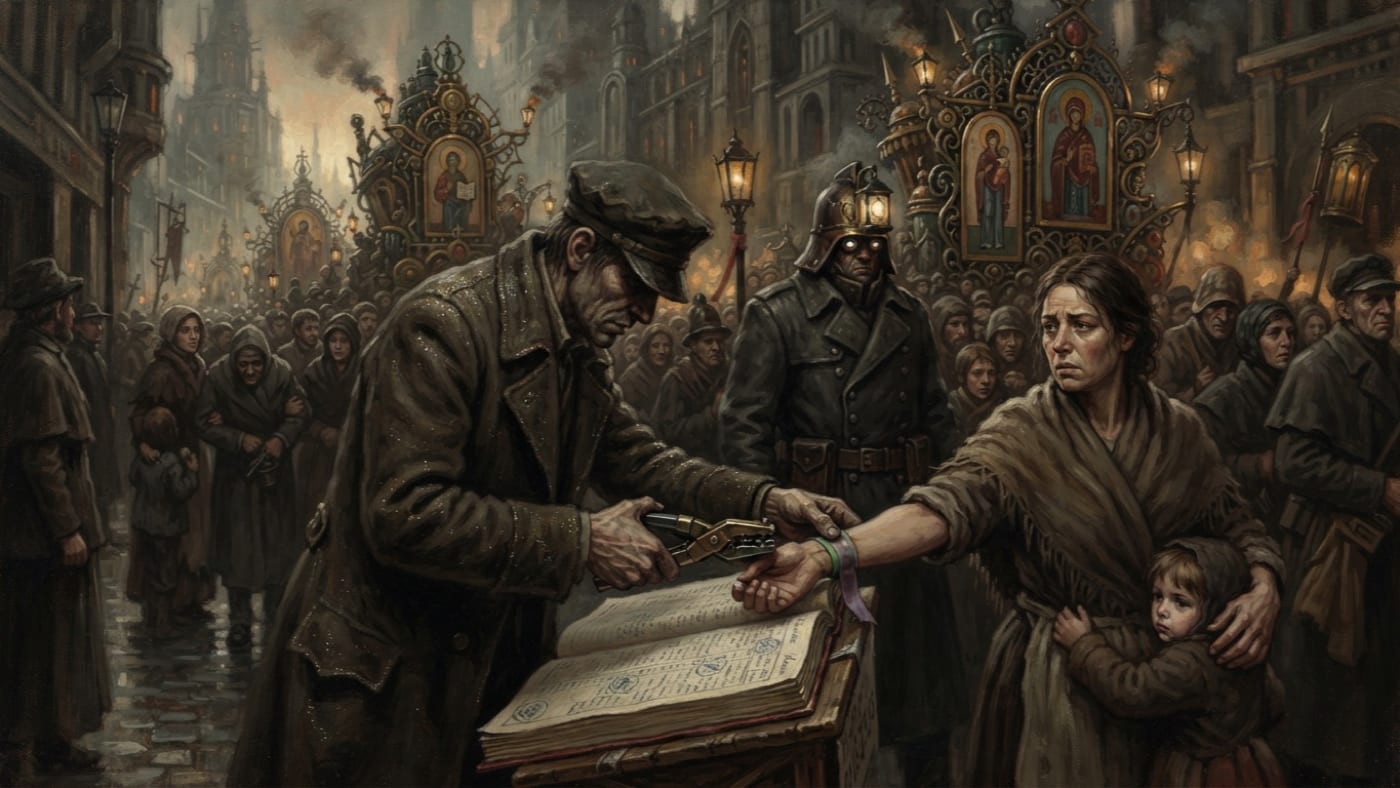
#On the Runner's Station
"Punch it clean."
The Ribbon Runner is the lowest hand the Bureau of Festivals will trust with a citizen's wrist. With the Confetti Cutter, the Runner makes up the entry rank of the Receipt-Procession apparatus. Above them stand the Route Marshals, Drum-Coders and Float Wardens, and far above those the Pageant Captain, who designs the route and owns the count. The Captain walks the middle of the street in a lacquered half-mask. The Runner stands at the curb in an ordinary coat with glitter in the seams, a punch in one hand and a parish roll within reach of the other.
That distance is the whole profession. The Captain sees a crowd. The Runner sees one forearm at a time: the cuff pushed back, the tendons jumping, the faint grey of a wrist that has not been washed since the last ration queue. The Bureau describes the station as a point of welcome. Citizens approach it the way they approach a confessional when the priest is known to gossip: smiling, sleeves up, already composing.
A Runner who performs well may rise. The ladder promises nothing. It exists, and so do the rungs that rot.
#On the Reform That Required Hands
During Gray Week, the Synod sent auditors into hungry cities with ledgers and escorts. The Bureau of Records and the Bureau of Festivals still dispute the year, with the passion of two sextons fighting over one candle stub. The cities answered with cobblestones. An open count, it transpired, makes a starving man feel counted.
Heraldry credits the method that followed to Caldrin of Essen, since honoured as Saint Caldrin the Jubilant Scribe and painted with a ribbon-punch in his fist. Whatever Caldrin actually wrote, the Receipt Reform of A.S. 138 made the wrist-ribbon mandatory for every sanctioned procession. A mandate that size cannot be carried out by one masked officer and a saint on a chapel print. It required hands: cheap ones, many of them, quick at the curb.
No surviving ledger records when the first Runner punched the first wrist. The rank appears in the record already working, which is how the Bureau prefers all its labourers to appear. The Lantern Accord of A.S. 139 then put Brotherhood escorts at the Runner's shoulder, and the station took on its permanent smell of lamp oil.
Older Festival primers state that the Receipt Reform "abolished the paper receipt throughout the Synod."
Corrected: the Reform replaced the paper attendance receipt for sanctioned processions. Parish rolls, permits, manifests and reconciliation ledgers remain paper, and the Runner carries a good deal of it. The Bureau abolished one slip and multiplied every other form.
#On the Wrist and the Roll
"Ribbons don't lie."
What follows is an illustration drawn from the Division's general practice. It describes a station, not any particular person.
A woman reaches the curb with her son on her hip and her arm already out, because she has done this before. The Runner greets her with the formula, joy to the house, gratitude to the Ledger, and takes her wrist in two fingers, lightly, the way a clerk lifts the corner of a page. The ribbon is laid. The punch closes. The pattern for this procession, this district and this feast-day goes through the ribbon and through the skin of her wrist together. The sound is smaller than anyone expects, a wet click under the drums. She does not cry out. Her shoulder rises a finger's width and stays there.
Then the Runner looks up.
This is the only part of the work that matters to anyone above the curb. The face is compared with the roll. The name she gives is there or it is not. The age beside it fits her or it does not. The parish listed is this district, or it is three wards west, where the ration cards are kinder. The fresh punch states one thing only: this wrist attended this procession at this station. It says nothing about whose wrist it is. The roll says that, and the roll is only as honest as the last clerk who copied it.
A clean match earns a smile and a gesture toward the floats. A doubtful one earns the same smile and a mark in the station record, made with the thumb turned so that the citizen sees only the Runner's knuckles. The woman and her son move on into the confetti. Whether she knows what the knuckles were doing depends on how many processions she has survived.
By the end of a feast-day the Runner's nails are ink-black. There is glue in the creases of the knuckles, a ridge of callus where the punch-grip bites the thumb, and ribbon fibre under every fingernail like lint from a shroud. Paper dust in the throat. A headache keyed to the low drum.
#On the Edge and the Tent
Runners work wherever the Captain's route means the crowd to slow: gates, checkpoints, curbside stations, the frayed edge of the crowd at the bends. When the floats pause, the Runners move. A Runner carrying the parish roll at the Captain's side turns pages at the Captain's nod and keeps them dry. A Runner at a curb works wrists while the saints on the float above wobble on their poles.
The drums govern all of it. On three low beats the crowd advances, and the Runner finishes the wrist already in hand and lets the next one go. A syncopated roll tightens the route, which brings more sleeves within reach than the Runner can honestly read. A single sharp crack means inspectors are present: behaviour becomes standard, and the formula is spoken in full. One code appears in no manual, though every Runner knows it before the first shift ends. Four beats, a pause, four beats: a Judge's agent is in the crowd. Smile harder.
The Lantern at the Runner's elbow inspects ribbons too. The Accord lets him check colour, punch pattern, station mark and tearing, and he reads them with a sergeant's eye and a ration-thief's memory. The two keep a working understanding: the Lantern holds the body and the Runner holds the paper. The Captain commands both. Neither enjoys it.
At the lost-child tent the arrangement sits down. A Lantern corporal takes the flap, and a Runner takes the stool with a fresh manifest across the knees. Children separated from their mothers really are found there, wiped of sugar and handed back to the right skirts, and a Runner who has done it once will tell you it is the best hour of the feast. The same stool then receives the man whose ribbon is missing, the girl whose ribbon is forged, the face that does not belong to its name, and the name that belongs to a corpse. There are sweetmeats for all of them.
At the Feast of Saint Merrow's Tally in Strasbourg's Lace District, during the first Accord season, Runners worked the edges while Lanterns held the alley mouths. The tent received nineteen children, six deserters, three dead men under false names, and a widow whose ribbon bore a punch pattern from a feast that had not yet happened. The report called the day serene.
#On the Wrong Punch
"Wrong punch" is the profession's word for failure, and it covers several sins at once. A ribbon torn at the punch-hole. A pattern struck at the wrong station. A die worn so soft that this feast's holes look like the last one's. A ribbon cut by a forger working from a stolen die, or with no die at all, only a good eye and a cobbler's awl. The Reform made the ribbon harder to counterfeit than a paper slip. It made nothing impossible. A ribbon is only as trustworthy as its inspection, and inspection happens at the speed of a parade.
That is the trap. The Runner is judged on ribbon integrity and on keeping the route breathing, and the two quarrel every time the drums roll. Hold a doubtful wrist too long and the curb clots. The people behind start watching the Runner instead of the saints, and a crowd that watches its counters is a crowd that has remembered Gray Week. Wave the wrist through and the anomaly walks unwritten into the reconciliation, where one day it will be found, and found to be the Runner's.
The Bureau keeps the Runner's power over a discrepancy narrow. A Runner notes and compares. Under the Accord, a Runner may join a Captain, a Warden clerk or a Judge's agent in deciding where a detained anomaly goes next, which is to say, to which desk. Sentencing belongs to other offices, and erasure to offices further off still. The Runner writes a line, and the line travels to people who use it.
#On Reconciliation and Blame
The last float is rolled into its yard. The confetti, which was audit forms yesterday, is swept back into sacks to become audit forms again. The station records go to the Captain, who folds them into the totals. The reconciliation ledger reaches the Bureau of Tithes by courier that evening. From Tithes the names run downhill to the ration offices, the conscription boards, the Lantern patrols and the purity inspectors, and each office takes what it needs from a mark some junior made at a curb with a turned thumb. The ribbon itself levies nothing. The ledger it feeds levies plenty.
The Procession Marshal answers for bodies in motion and the Captain answers for the count. The Runner answers for both whenever the count goes wrong in front of a Ledger Prefect. The Division's own working guidance lists what a Captain may sacrifice when pressure rises: a scapegoat troupe, a foreign agitator planted in the crowd, and a Ribbon Runner. The list is not in alphabetical order.
Ask a Runner why they took the work and you will hear about bread, debt, a cousin in the Bureau, the music. Ask what the punch is for and they will say to make it count legally. Ask whose fault the widow was and they will look down at their own black nails.