
The First Council of Cologne — Prose Draft
#On the Assembly Before the Assembly
The First Council of Cologne met in A.S. 27, thirty-one years before the Night of Black Decrees, sixty-three years before the Concordat of Strasbourg, and seventy-three years before the later Council of Cologne perfected what the first one only dared to imagine. This distinction must be made loudly, since provincial schoolmasters, drunken deacons, and three published historians of the Rhineland have confused the two Councils with a persistence that suggests either malice or literacy.
The later Council claimed to bind dioceses. The first one permitted narrower contact.
It gathered in September A.S. 27, during the last hard years before the Treaty of Regensburg, when the Atheist Wars had not yet received their tidy name and the continent still pretended that its convulsions were separate emergencies. Rationalist administrations already governed in some places; the faithful still lacked a common government.
The Council's official title was the Cologne Preliminary Convocation for Ecclesiastical Mutuality, a name so bloodless that one suspects a bishop invented it to avoid frightening merchants. Later Synodal histories called it the first yoking. That verdict reveals what its descendants wanted from the meeting more clearly than it reveals what the delegates adopted.
It produced no Concordat. It founded no Bureau. It issued no binding constitution whose seal can be kissed by schoolchildren and audited by accountants. Its significance lies in a more dangerous register: it produced a habit. Men who had spent years defending diocesan privilege discovered, in a cold Cologne chamber under cracked vaulting, that their enemies were coordinated and their friends were not. The discovery was unpleasant. Useful discoveries usually are.
#On the Chamber and Its Occupants
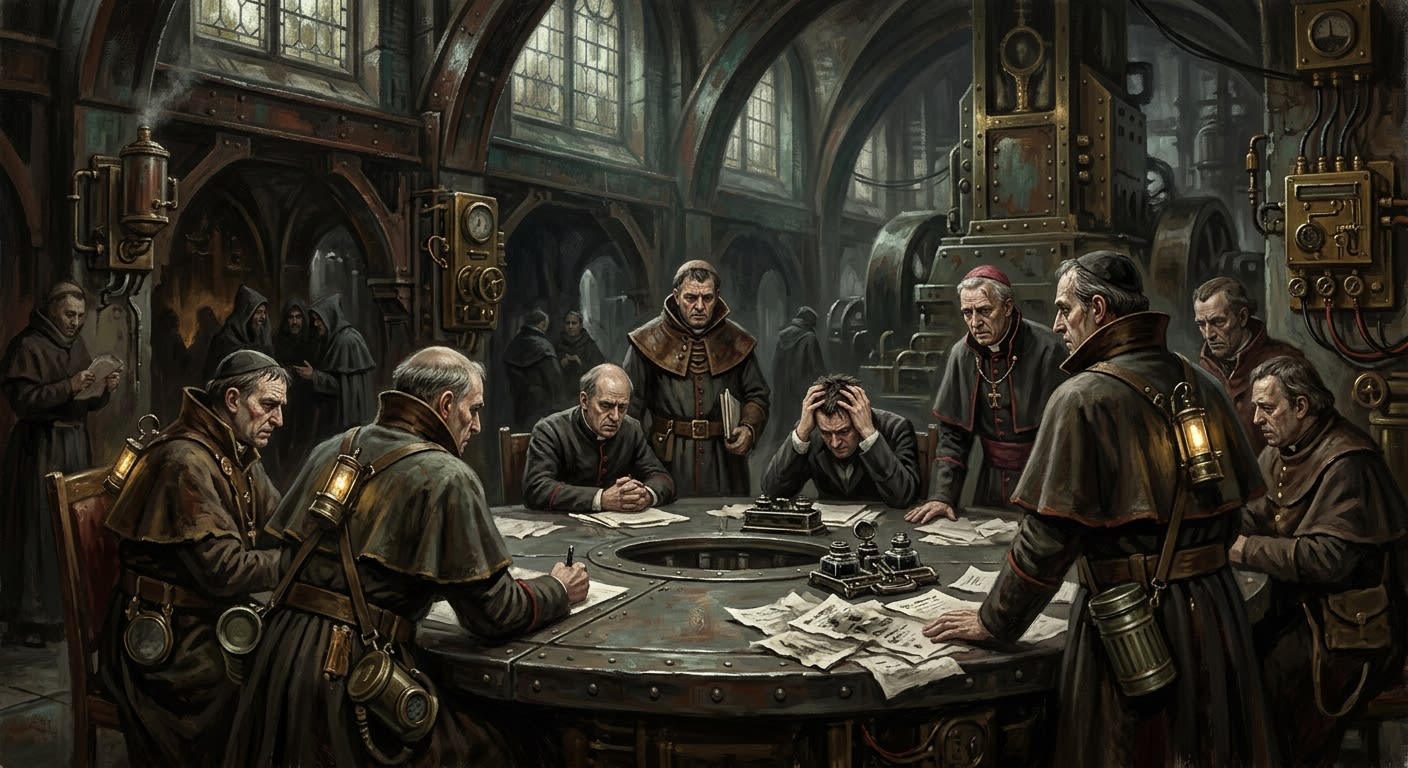
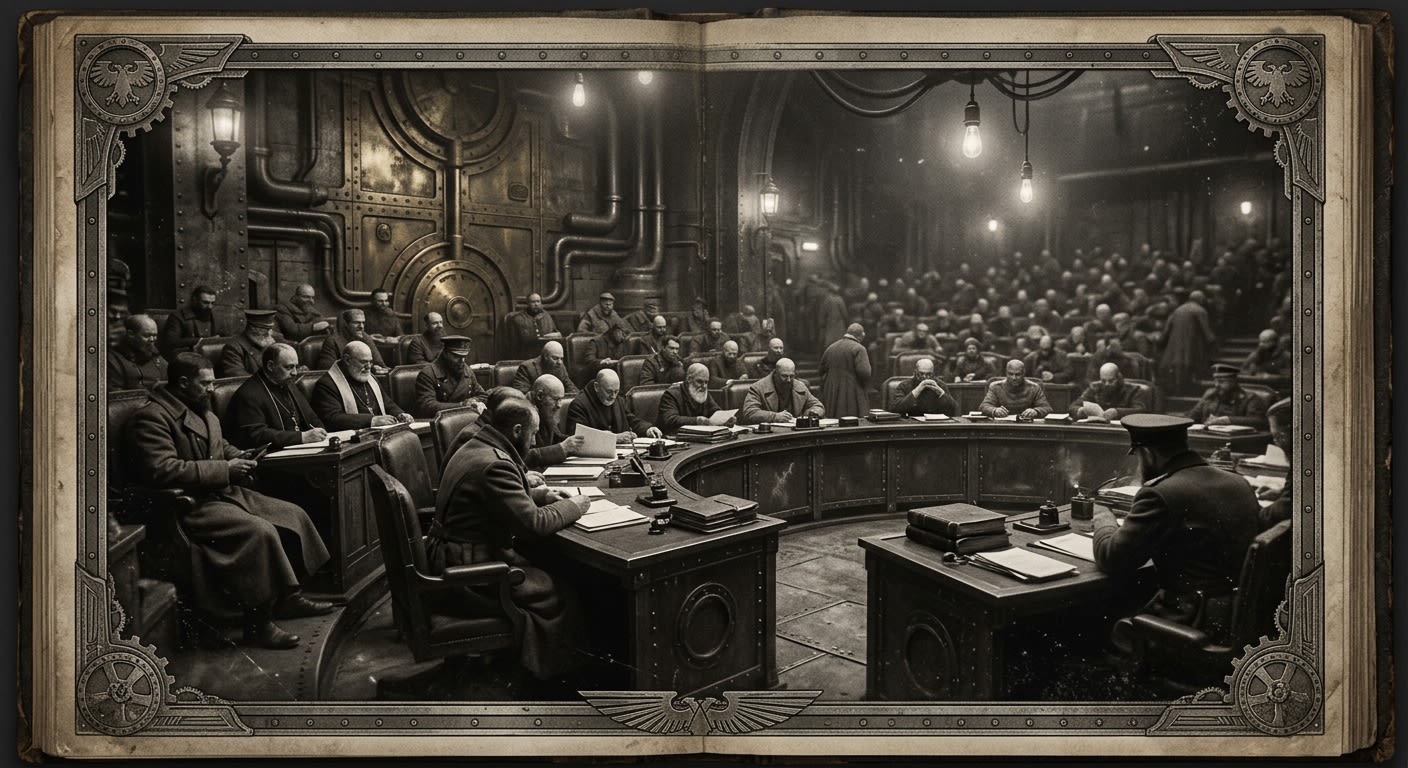
The Convocation met in the western chapter chamber of Cologne's old cathedral precinct, since the principal nave remained under repair after Rationalist artillery had tested the theological endurance of stone. The room smelled of limewash, wet wool, singed vellum, and those ecclesiastical anxieties that no incense has ever fully conquered. Thirty-seven delegates attended by the official count. Forty-one chairs appear in the seating diagram. Thirty-nine names survive in the hospitality ledger. The discrepancy is, according to Records, minor.
I adore minor discrepancies. They breed.
The delegates included bishops, abbots, cathedral canons, and an ordinary auxiliary from Mainz named Augustinus. He was nineteen, not yet ordained; his priestly ordination belongs to A.S. 33. Kratz, also nineteen, worked among the copying staff beneath Bishop Adelmar's secretary Breitner. Neither held a vote or a chair of rank.
He watched and copied from a side desk.
Breitner supervised the minutes. Kratz copied proceedings and drafts under his direction. Later inventories have enlarged the copyist into the architect of every concession. They are records of later institutional appetite, not evidence that the nineteen-year-old controlled the chamber.
Accounts of Augustinus's interventions emphasize unity, penitence, the scattered faithful, and common prayer. The detailed address and measured pause repeated in later school texts have no secure standing as a verbatim record.
#On the Articles That Failed
The First Council proposed seven articles. None passed in binding form. That sentence has comforted generations of localists, separatists, and diocesan nostalgics who fancy that failure means defeat. Children think this way. So do cathedral chapters.
Later catalogues offer detailed versions of the seven articles, including proposals on fasts, shared funds, relic custody, censured texts, couriers, and episcopal consent. Their exact numbering and wording remain disputed. None of the seven was adopted as binding law. The useful surviving decision was much narrower: voluntary contacts could be maintained, and separate custodians had to consent before property or relics passed into another's keeping.
A nineteenth-century catechism described the First Council's seven articles as "ratified in spirit."
This phrase is sentimental rot. Articles are ratified in ink, wax, oath, blood, or fear. Spirit may inspire ratification; it does not replace it. The catechism was corrected after a child in Rheims asked whether taxes could also be paid in spirit.
The Cellar Saints had not yet acquired their name, but their methods of shelter and evacuation were already forming. A later article-by-article reconstruction may be useful as evidence of what the Synod came to believe about Cologne; it must not be mistaken for seven authenticated resolutions.
One later catalogue describes a sealed seventh article on episcopal consent. Its title and chemical recovery narrative lack a secure contemporary witness. The article remains unadopted whatever that later catalogue preserves.
No article passed. Later writers dressed these drafts as ancestors of laws enacted decades afterward.
#On Kratz's First Experiment
The first experiment was small enough to be deniable, which is the proper size for beginnings.
Copies of the minutes did differ. The discrepancies were raised and corrected before the delegates relied on them. Later Bureau instruction turned that failed alteration into a parable of successful manufacture. The distinction matters: the delegates' limited contacts rested on corrected minutes and voluntary consent, not a concealed vote.
The later Bureau of Records filed the discrepancy under Proto-Synodic Concord. Its instructional uses reveal more about Records than about the delegates' intentions.
Kratz did not forge signatures at the First Council. The copying discrepancy was corrected; his later document methods should not be projected back as a successful constitutional act in A.S. 27.
Augustinus noticed the disputed copies, as did others. A sentence later attributed to his letter to Abbess Marta has not been verified against a contemporary original and cannot establish the council's outcome. Nor does this archive establish that the future bishop spoke as a priest or held the secretary's office.
#On the Failure That Took Root
The Council dissolved after nine days. No proclamation rang from the cathedral tower. Delegates departed with corrected copies and unadopted articles, and with permission for narrow voluntary contact subject to separate custodial consent.
The world did not change that morning. This is how one recognizes a true beginning. False beginnings announce themselves with trumpets. True beginnings enter the archive under a modest heading and wait.
Later histories trace routes of shelter and warning through these contacts. They do not prove that the seven proposals took effect on a fixed schedule. By A.S. 38, accounts of eastern silence were travelling west; by the Sundering in A.S. 45, dioceses had learned some of one another's roads.
Earlier local histories claim the First Council "achieved nothing."
Corrected: the First Council adopted no enforceable articles. It permitted limited voluntary contacts, corrected its minutes, and left drafts that later institutions repeatedly invoked. I have built monuments on less.
The later machinery found a usable ancestor here. The Black Decrees of A.S. 58, the Council of Worms in A.S. 87, and the Concordat in A.S. 90 each claimed more than Cologne had actually enacted. The later Council of Cologne in A.S. 100 was another event altogether.
#On the Sealed Minutes
The sealed minutes of the First Council occupy one narrow bundle in the Basilica of the Ledgered Saints, Shelf C-27, wrapped in grey cloth, bound with cord that predates the current knot standard and offends three branches of the Bureau of Masks and Seals. The outside label reads: COLOGNE — PRELIMINARY — NO FORCE. Someone, very late and very careful, added beneath it: FORCE PENDING.
I have read the bundle. Naturally.
The handwriting changes in the surviving copies. Attribution of individual lines to Breitner, Kratz, or Augustinus requires more than a later paleographic guess. Docketing after A.S. 58 shows how the Black Decrees made earlier hesitation look like prophecy.
Later catalogues list missing seating and draft material. Their exact inventory and claimed A.S. 92 relocation cannot settle what was adopted in September A.S. 27.
The First Council remains officially non-binding. This is correct. Later Synodal rhetoric made its contact procedures into a prophecy of compulsory unity. The surviving result was narrower: some dioceses could speak and move aid voluntarily, and a custodian's consent could not be silently presumed.