
#On the Guild's Recorded Place
"Every civilian enters the Codex eventually. Most of them come in through a receipt." — Drax, notation to the Armada file, A.S. 201
The Merchant Marine Guild comes into my ledger as a customer. Six weeks before the Black Sea Armada entered the strait in A.S. 162, the Bureau of War sold the Guild a maritime safety assurance at three stamps per copy. That sale is the Guild's entry in the files I am licensed to open. Its charter, its first masters and its present officers belong to another folio and another archivist. This folio is about the purchase.
What it bought makes sense once you know the city. Bastion-Constantinople holds the southern hinge of the Sagittal Line: a fortress built over a vast, ancient and frightened city, and that city eats whatever the sea brings it. Every year the Anatolian supply run carries wheat, rye and lamp oil into the Bosphorus to feed it through the winter. The men who sail that run can read water, judge weather, stow a hold so the cargo stays dry and work out to the day how much a late arrival will cost them. They are civilians, and the sea has never once read their papers. The Bureau sells them papers anyway.
#On Cargo and Clearance
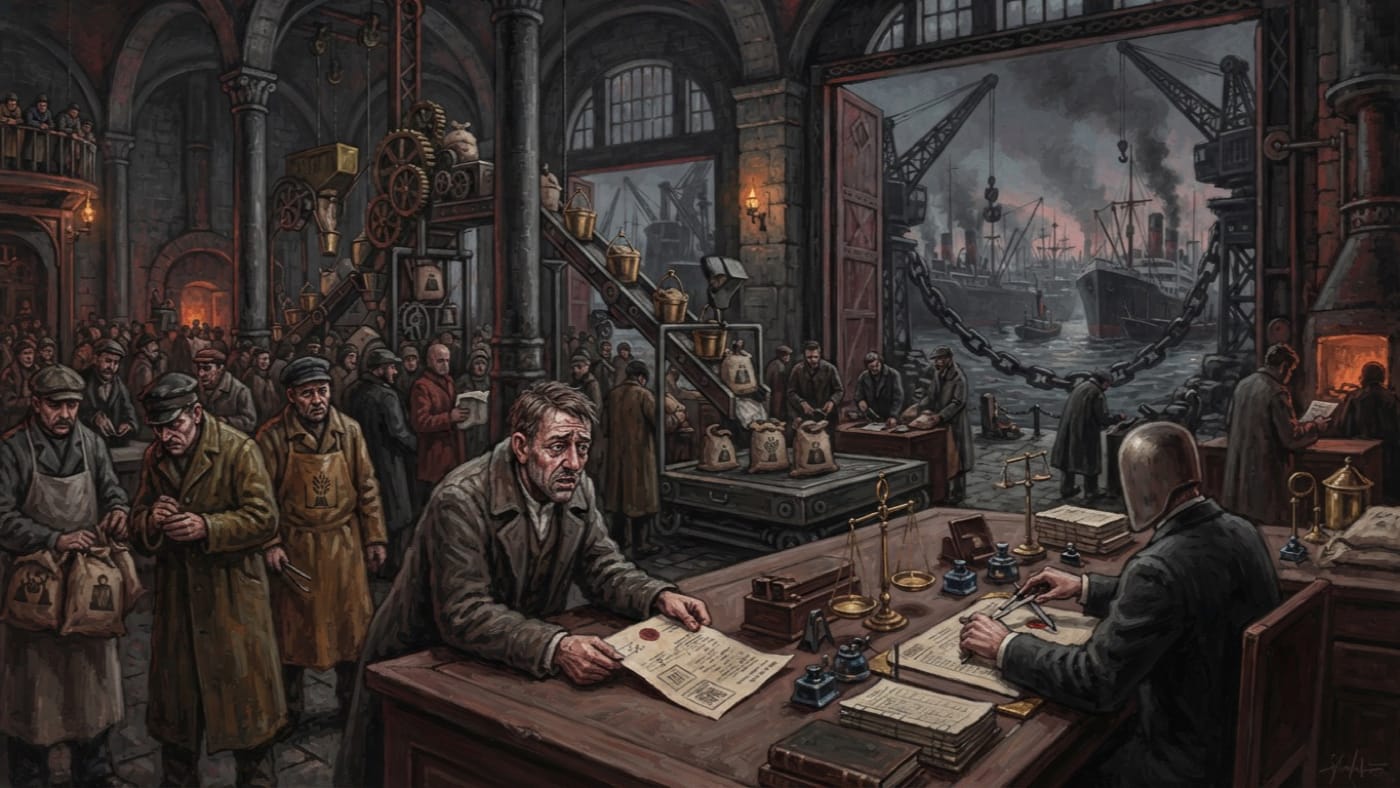
Grain comes into Constantinople one stamp at a time. In Anatolia it goes aboard under Bureau seal, and every sack is listed on a manifest whose spelling will be read more closely than the sacks themselves. The hulls come down to the commercial berths of the Harbor of Chains. The Harbor Patrol watches them in, logs any hull riding lower than its papers allow, and leaves the decision to the men who carry warrants. Customs clerks know which barrels they are allowed to open.
Then comes the tariff-chapel. A tariff-chapel weigher opens the reliquary casket in front of a witness, lays the fragment on the pan, writes the zero in black ink and writes it again in red, because the cargo is food. Every sack is weighed twice. The Bureau of Commerce assigns a tariff class according to season, war pressure, declared origin, corrected origin and suspected origin. A purity mark is granted, withheld or priced. One copy of the ledger goes to Commerce and another to the Bureau of Records, because Records trusts nobody, and Records is right. If a seal looks shallow or a name on the manifest is spelled two ways, a Manifest Litigant upstairs can freeze the cargo under a Sanctity Stay. While it is frozen the storage fees keep running, and so does the damp.
Clearing the cargo still does not feed anyone. Commerce clears what may enter. The Bureau of Tithes decides who eats it. A grain master has to satisfy both offices while the season runs out, with a crew waiting to be paid and a cargo that began to spoil when the sacks were sewn shut.
#On the Assurance
The Bureau of War's maritime safety advisory was dated six weeks before the engagement. It assessed the Black Sea lanes as low-threat for that convoy season. It was printed on War letterhead, and the Guild received copies at three stamps each.
Three stamps per copy is the fee recorded in the file, and I give it exactly as written. The Bureau did not charge per hull insured, per sack protected or per sailor returned. It charged per copy. A Guild that wanted every master in the convoy to carry the assurance aboard paid for each one. I find this the most honest line in the whole document.
A threat assessment is a statement made at a desk about water the writer is not standing on. It cannot stop a ram-vessel. The only things in the strait that could were the Chain of Saint Anakletos, the shore guns and the Reliquary Flotilla, none of which came with the purchase and all of which belong to other authorities. What the Guild bought was War's opinion, printed, sealed and folded so that it would fit a captain's coat. The captains sailed with it. I do not know whether a single one of them believed it, and the record does not say. They sailed because Constantinople needed grain before the frost, and the advisory said they could.
#On the Convoy Night
On the evening of 14 Ferrum, A.S. 162, it was harvest convoy season and the channel was crowded. Forty-three civilian vessels were in the Bosphorus approach, loaded with wheat, rye and lamp oil. Pilgrim craft were among them, and the harbor workers were waiting at the berths.
Forty-seven hostile vessels came out of the northern dark.
The engagement itself is recorded elsewhere, and I will not refight it at the Guild's expense. Praefect-Naval Tern raised the Chain. The Chain burned white for seven hours and fourteen minutes. The ravelins on both shores fired until the gun barrels glowed red. The Flotilla ignored its order to withdraw and held the outer approaches. For the merchants, the shape of that night was simple. A slow, heavy grain hull caught in a crowded channel between an enemy and a boom has nowhere to go. Its master can drop anchor and pray, or run for the berths and pray louder. Both choices end with a clerk writing in a ledger.
By dawn on 15 Ferrum, twenty-three grain ships had been destroyed along with their cargo, and an estimated nine hundred tons of wheat, rye and lamp oil had gone into the strait. Neither figure is a Guild fleet total. The night recorded which hulls were lost and what was in them. It did not record who owned them.
#On Loss and the Record
"The sea keeps one ledger. The Bureau keeps several, and they disagree." — Drax, notation to the casualty file, A.S. 201
The official casualty report was filed by the Bureau of Records in A.S. 163 and ratified by the Bureau of War in A.S. 165. It lists 1,247 military dead from the garrison and the Flotilla together, and 3,400 civilian dead, made up of convoy crews, harbor workers and families aboard pilgrim boats that were on the wrong water at the wrong hour. The 3,400 is not a Guild death roll, and I will not let anyone read it as one. Many of those people never loaded a sack in their lives. The eleven Flotilla vessels broken beyond repair belong to the sacred fleet, and the Flotilla grieves for them under its own seal.
The civilian dead were filed with the Bureau of Settlement as non-combatant casualties, maritime, category two. The military dead received full honours in the Ossuary Rings. I am told the difference is administrative, and I record that I was told so.
Three separate accounts came out of that night, and the Bureau keeps them in three separate drawers. One records the cargo lost, which is a matter of tonnage that Tithes can reconcile. Another records the people killed, which is a matter of names, and Records reconciles names slowly. The last records the assessments withdrawn, which is a matter for War, and War reconciles nothing it has already sold. Constantinople went into that winter nine hundred tons lighter.
#On the Limits of Certification
In A.S. 163, once the dead had been counted and the casualty filing was well under way, the Bureau of War withdrew its advisory retrospectively. By the rules of the Bureau, an assurance withdrawn retrospectively has never given assurance to anyone. The convoy did sail under it, but the convoy sailed in a year that the file now describes differently.
The printing fee was kept. The copies that had been sold stayed sold. Somewhere among the Guild's papers, unless the damp has reached them, there are folded sheets of War letterhead that state, in that confident serif, that the Black Sea lanes were safe. Each sheet cost three stamps, and the Bureau has since declared that none of them says anything at all.
Bureau of War Maritime Safety Advisory, A.S. 162: "The Black Sea lanes are assessed as low-threat for the current convoy season."
Withdrawn, retrospectively, A.S. 163. The assessment is struck from the register of current assurances. Copies distributed to the Merchant Marine Guild remain distributed. The fee of three stamps per copy is unaffected.
I have read a great many withdrawals. Most of them cancel a promise before anyone has paid for it. This one cancelled a promise after twenty-three hulls and their crews had paid for it in the strait. War calls the matter corrected. I have filed the receipt under War's name, and I will not move it.