
I've checked the continuity file, the voice guides and the related War articles. Here is the article:
#On the Office of the Seventh Seal
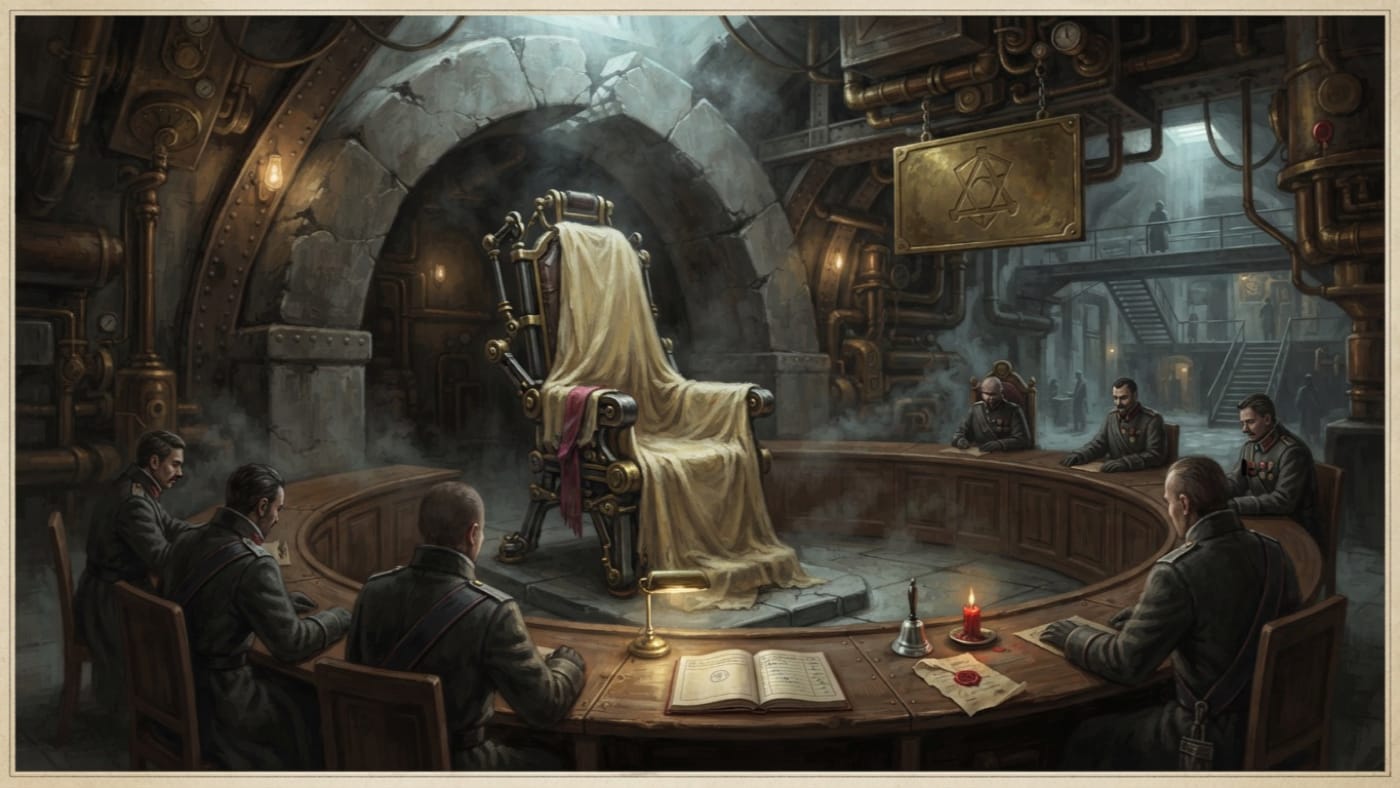
The Hierarch of War holds the Seventh Seal of the Seven Seals of Faith, and with it the Synod's armed hand. That hand is the Bureau of War, the Continental Levy, the armies of the Sagittal Line, and every garrison commander from Bastion-Königsberg on the Baltic to Bastion-Constantinople on the Bosphorus. The Seal was cut at the constitutional settlement of A.S. 90, when the formal Synod gave its seven authorities their chairs, their wax and their mutual suspicion. War's chair was set in the Inner Circle beneath the Basilica of the Ledgered Saints at Strasbourg. That puts it several hundred miles from the nearest trench, which is where a sensible constitution keeps the generals' superiors.
Five things bear the name of War, and provincial correspondents confuse all of them. The holder is a person. The Seal is an authority. The chair is furniture. The Bureau is a building full of officers, chartered in A.S. 105 and housed under the Arch of Campaigns. The Warden-General is an officer who rotates through the post, which was fixed as the modern public command in that same year. A clerk who writes "War ordered" must know which of the five is meant, and must be ready to swear it was the Seal.
Two years after the Bureau received its charter, the holder of the Seal stopped attending in public. This entry records that event. Everything after it is administration.
#On the Register of A.S. 107
In A.S. 107 (1817 CE), the Hierarch of War stopped appearing at public session. The Bureau of Records entered the holder as "presently engaged in contemplative duties," and has never amended the entry. It is a classification. Records classifies the way a reliquary-smith sets a stone: to hold the thing in place, whatever its true colour.
I have read the attendance registers for that year, as far as Records permits a Hieromnemon to read anything. They are dull, and the dullness is their achievement. Sessions are listed, the Seals are called in order and War is entered. At some point in the year the entries stop recording a body and begin recording a mark. The register gives neither the day of the change nor the month. It describes no final appearance. It names no destination and records no cause. It offers no opinion on whether the contemplative is contemplating anything, anywhere, at all.
What the register does record, with tedious fidelity, is that orders under the Seal of War kept issuing without any gap the clerks thought worth noting. The Line did not wait for an explanation. The Line has never waited for anything except shells, and it waits for those constantly.
Provincial pamphlets have since supplied the year with the incidents the register lacks. None cites a document. Several cite each other. I read them the way a master binder reads an apprentice's forgery: briefly, and with a pencil.
#On the Route of a Writ
From A.S. 107 onward, the Seal of War has spoken through intermediaries. Its orders arrive as sealed writs, countersigned and valid in every particular the law examines. The signatures change each quarter. The file references change too. The sources disagree on how often, and I will not referee a quarrel between two offices that both outrank my patience.
The writ goes to the Arch of Campaigns. The chair stays where it is. Cadets under the Arch repeat a story that the Throne was carried there by night. The Throne is still in the Inner Circle, and the cadets are still cadets. At the Arch the writ becomes a War docket in the Warden-General's office, and that is where public command begins. The Warden-General drafts, issues, signs and takes the blame. Supreme authority stays with the Seal. Every wearer of the crimson sash learns this at confirmation and learns it again at the first disputed order.
From the docket the route runs outward in stages, and each stage needs an authorising instrument. A garrison commander will not obey a docket whose seal cannot be checked against the registry. Rope has settled that point too often. A rail-priority desk cannot assign a train without a docket to cite. A quartermaster will not release rations without a requisition that traces back to War. When the dead come back down the Line, the casualty office needs an instrument under which to enter them as lost in lawful service, because the widow's pension, the martyr's notice and the burial allotment all cite it.
Take the Seal out of that sequence and every stage loses its warrant at once. Commanders could refuse. Quartermasters could sit on their grain. Every casualty entered since A.S. 107 would lie in the ledger with no authority beneath it, and Records would have to decide what a death is when nobody ordered it. Records would sooner see the Line fall.
So the writs continue. Nobody in the chain sees the hand that sealed them. Everybody sees the wax.
#On Occupancy in Absentia
The Seal is occupied. The chair is empty. These are separate entries in separate registers, and both are correct.
Since A.S. 107 the legal status of the Hierarch of War has been occupied in absentia. The holder is still the holder. The Inner Circle's clerk marks War present at every session, and the other six Seals accept the mark. Refusing it would oblige someone to state when War left, and on whose authority every later order moved. Through intermediated authority the Seal receives the Summons of the Ninth, assents, votes and commands. Nothing in the record abolishes the office, declares it vacant or seats a successor. No public file I have been shown names a successor, and I have been shown a great many files I was not meant to see.
An earlier gazetteer of Synodal offices, copied into this entry without review, listed the Hierarchy of War as "vacant since A.S. 107."
Corrected. The Hierarch of War has been occupied in absentia, without interruption, since A.S. 107. The chair is unoccupied; the office is not. The copyist has been sent to the rail-priority desks, where every train is accounted for and somebody always sits in the chair.
The Council of Veils enters here as rumour, and here it remains rumour. It is said to be seven persons. It is said to have taken shape in A.S. 107, which shows only that rumour keeps a calendar too. It is said to write War's writs, keep its minutes in ash and preserve censer smoke over cistern water beneath Strasbourg. The High Censor's Advisory is a recorded public alias. I have seen the phrase on paper, and paper is the only witness I trust. None of this identifies the Hierarch, the author of any single writ or the reason the chair went empty. The Bureau of Shadows has been asked about each point. It has answered none of them, as it answers nothing else.
WAR SEAL — HOLDER FILE, PUBLIC EXTRACT Personal name: ████████ Last public appearance: ████ Authorship of intermediated writs: ████████████ Records note: bars mark fields either withheld or never entered. The extract does not say which.
#On the Office in A.S. 201
Ninety-four years have passed since the register changed. As of A.S. 201, the Seventh Seal is counted at every session of the Inner Circle. It receives the Summons of the Ninth, assents and votes by intermediated authority, and commands the armies of the Line. The Warden-General rotates beneath it and speaks for it at the Arch. The Bureau of War files its dockets in its name. Each year the Bureau of Doctrine seals the arrangement without changing a word, the purest act of faith I have seen Doctrine perform.
In the Inner Circle, the Empty Throne of War keeps its white drape, now yellowed along the folds. The cloth has outlasted every officer who might remember it clean. On the person who last sat beneath it, the public record holds the classification entered in A.S. 107 and nothing further. The Ledger is not equipped to say whether the Hierarch contemplates or breathes, or ever left the precinct. It does not entertain questions it cannot file.