
#On the Room That Pretends to Be a Government
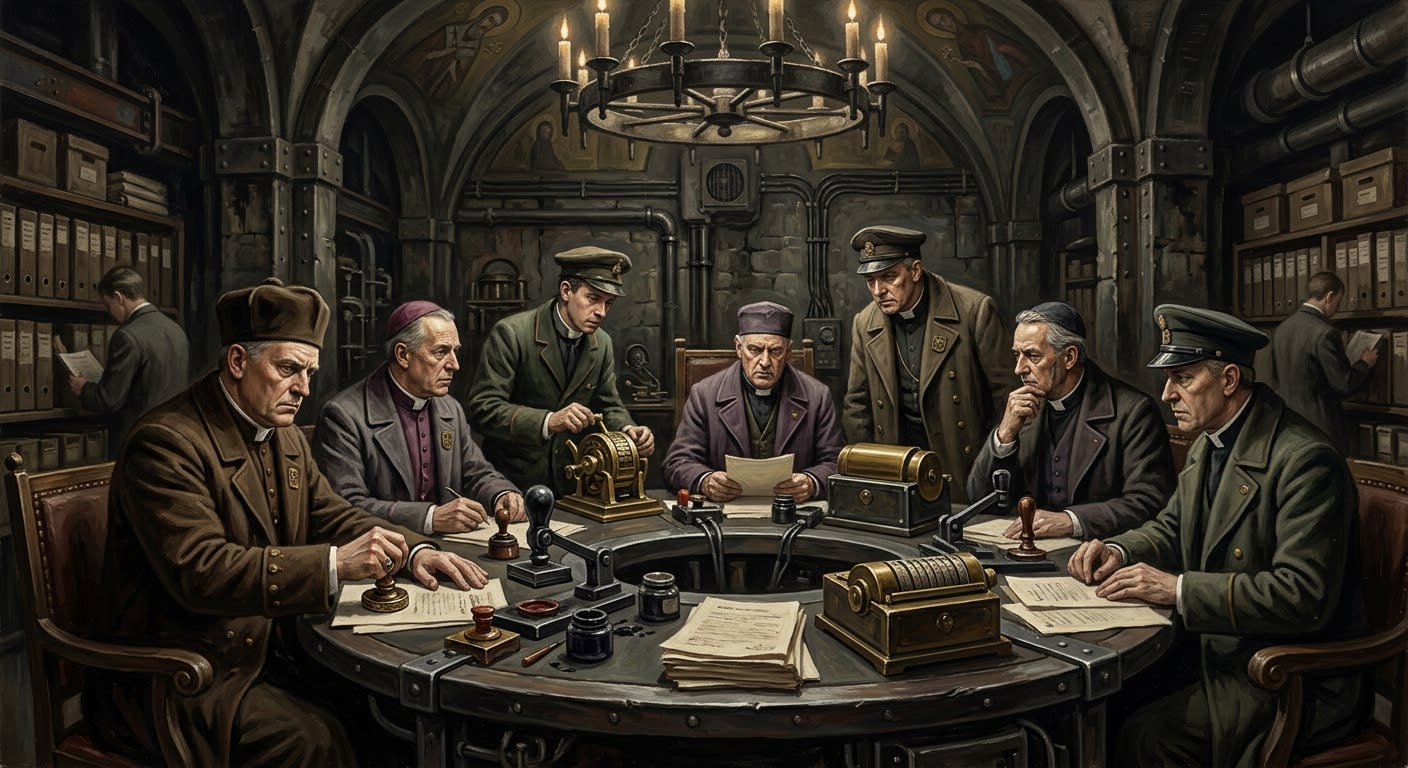
The Inner Circle is the chamber in Strasbourg where seven absolutes are seated in carved stone and taught, through exhaustion, suspicion, precedence, ritual, and superior upholstery, to resemble one will. It is the Synod's highest deliberative body, which means it deliberates least and authorises most. Lesser councils argue toward decision. The Inner Circle sits so near authority that decision approaches it already afraid.
Its public description is simple. Seven Hierarchs, each stewarding one of the Seven Seals of Faith, gather beneath the Basilica vaults to govern the Bureaucratic Synod in matters touching Doctrine, War, Purity, Discipline, Concord, Martyrdom, and Vigilance. Their decrees require no justification because justification is a courtesy extended downward. Their sessional seals carry the breath of the Sundering. Their seats are arranged in a heptagonal order determined by liturgical precedence, quarterly rotation, and an old Kratzian joke no one living has been brave enough to explain.
The private description is more accurate. The Inner Circle is a collision chamber. Seven sovereign jurisdictions are locked together and made to bruise one another until governance leaks out. The miracle is not harmony. The miracle is that the bruising produces paper.
The Circle did not begin as a room. It began as a solution to a problem Augustinus could name but not fully tame: Europe required unity, and every instrument capable of producing unity immediately became dangerous enough to require restraint. Augustinus wanted one altar married to one arsenal. Kratz wanted no single hand able to seize both. The Inner Circle is their compromise: unity by mutually guaranteed obstruction.
#On the Founding at Mainz
The Inner Circle's authority rests on three acts and one theatre. The first was the Common Allegiance of A.S. 55, issued under Augustinus with material work by Kratz and Sabine, which aided an already emerging interim government. The second was the Concordat of Strasbourg in A.S. 90, after both founders died, where the Seals received constitutional form. The third was the Council of Mainz in A.S. 93, where successors were confirmed by acclamation.
The theatre was the acclamation itself.
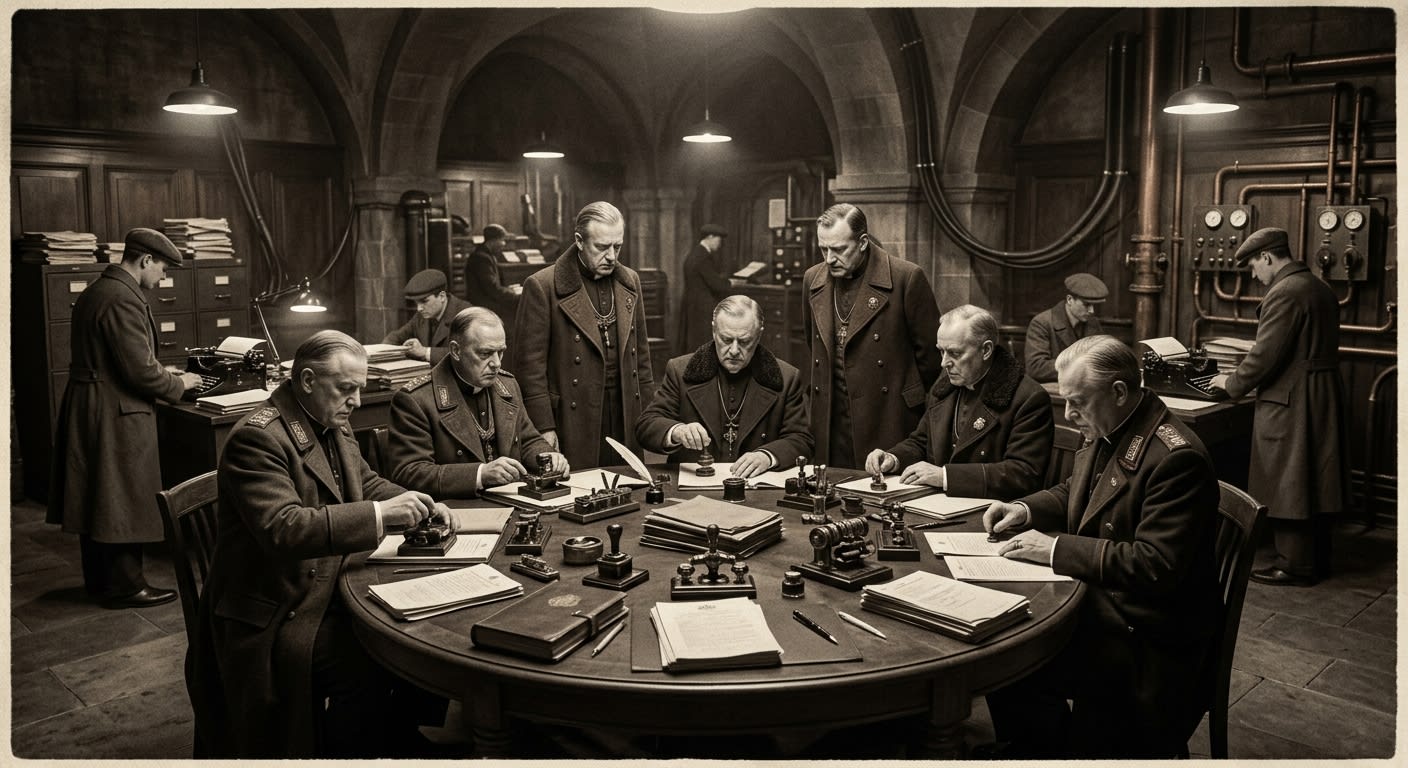
Mainz taught the continent that obedience could be staged before it was required. The first seven Hierarchs entered as men and left as offices wearing faces. Doctrine received the first cry. War received the last. Purity's acclamation lasted longest, an excess of zeal later traced, by a wine account no catechist quotes, to the complete depletion of the council cellar. The doors were locked. Purity teams stood in the side aisles. Dissent was permitted, recorded, and rendered infertile by procedure.
Provincial catechisms sometimes state that the Inner Circle was created by the Council of Mainz.
Corrected. Mainz ratified and displayed what the Concordat had already established. Creation belongs to A.S. 90; acclamation belongs to A.S. 93. The distinction is small enough for children to ignore and large enough for adults to be punished over.
What Mainz gave the Circle was witness. A secret body may command fear, but a witnessed body commands memory. Bishops, abbots, civic fathers, notaries, officers, purity men, and selected observers without voice saw the chairs claimed, saw the seals lifted, saw the acclamations registered, and were thereby made accomplices. This is the first law of public authority: make enough men watch the fiction and the fiction acquires relatives.
Kratz was dead by Mainz. His handwriting governed the room. The Standard Ratification Protocol fixed seating, seal order, permissible dissent, observer classification, chamber repair, and the phrase “procedural concern,” by which objections enter the archive already wearing a burial cloth. The protocol remains the Inner Circle's hidden skeleton. Every session since has sat on its bones.
#On the Seven Chairs
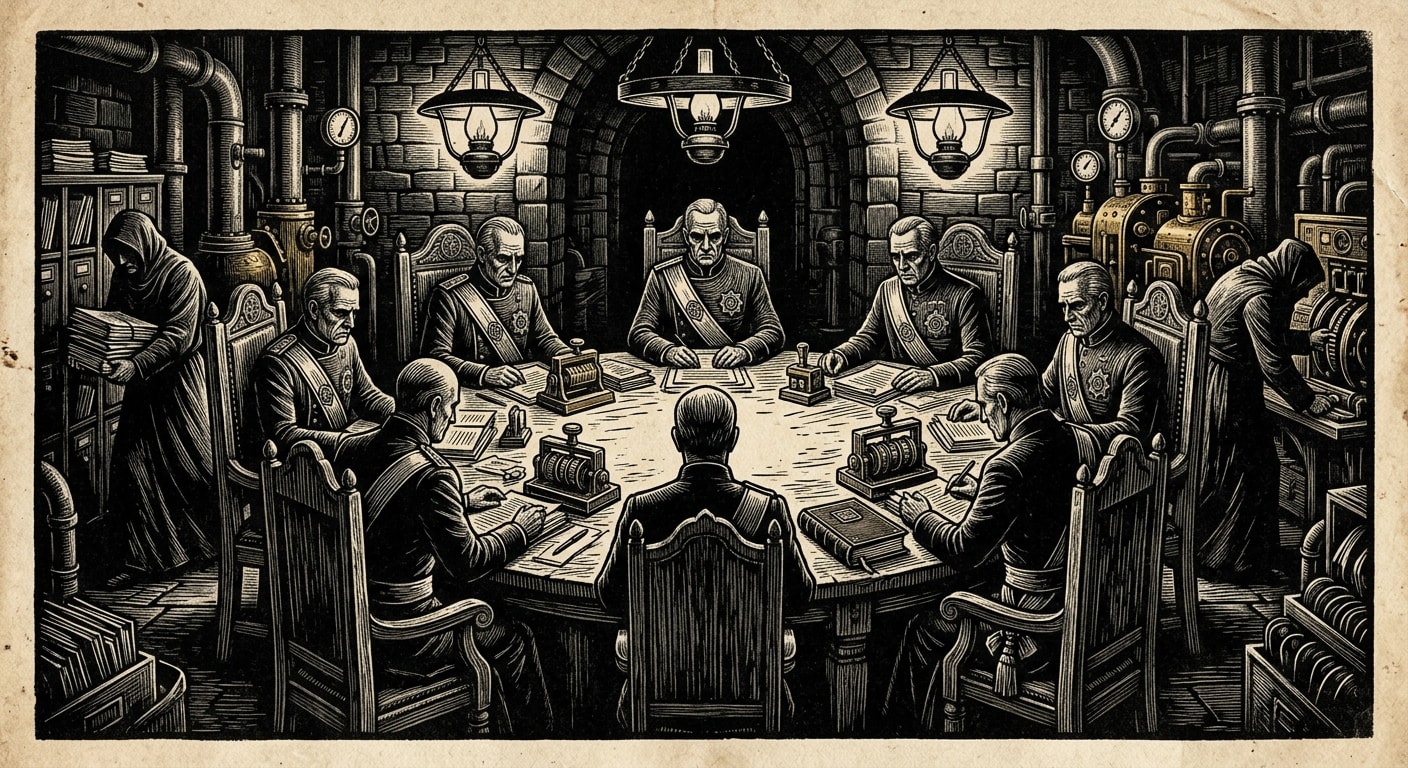
The chairs are older than most of the lies told about them and younger than several lies they replaced. They stand in a heptagon around a central lectern whose surface has been sanded so often that earlier blood grooves are now classed as decorative grain. Each chair bears a Seal mark. Doctrine's chair carries an open folio pierced by a quill. War's bears a sword under cloth. Purity's bears a flame with no fuel. Discipline's bears a scourge folded into a crozier. Concord's bears two hands, one of which is suspected of holding a knife. Martyrdom's bears a reliquary. Vigilance's bears an eye that has been repaired twice after witnesses reported movement.
No chair is allowed to face east directly. The old explanation says no Hierarch may sit with his back to Strasbourg. The better explanation is that no Seal may imply solitary command of the Line. Symbolism is cheap until soldiers believe it. The Inner Circle spends heavily to keep symbols expensive.
The central lectern receives the seven-stamp instruments. The stamps are applied in a quarterly rotating order so that no Seal claims permanent precedence. This has produced three centuries of procedural splendour: revised charts, precedence disputes, emergency stamp inversions, special-session wax dispensations, and one A.S. 146 incident in which Martyrdom stamped before Concord and caused a diplomatic apology to be issued to a corpse. The apology was accepted under seal.
The stamps themselves are kept in separate caskets under mixed custody. Doctrine's casket opens to a phrase. Purity's opens to heat. War's casket is delivered closed and removed closed, a practice that irritates metallurgists and comforts generals. Martyrdom's smells faintly of oil and bone dust. Concord's has two keys, both held by men who publicly dislike one another and privately share a tailor. Vigilance's casket is never seen on the table, yet its impression appears where required. Discipline's casket contains, according to one retired clerk, a second smaller casket that no one has opened since A.S. 118. The clerk died in a clean bed, which proves he lied or was protected by someone with taste.
Wax colour matters. Black for doctrinal closure, white for purification, red for war issue, grey for discipline, blue for concordat instruments, amber for martyrdom custody, and clear wax for Vigilance, though clear wax is a contradiction in terms and the Bureau of Alchemical Standards has been told to stop saying so. Mixed wax indicates joint authority. Mottled wax indicates haste. Wax with bubbles indicates a clerk breathing too hard over history.
The chamber contains eight doors. Seven are visible. The eighth is an administrative matter and should not be discussed near masonry. Each visible door corresponds to a corridor of approach: Doctrine from the Tower stairs, Purity through the white gallery, War through the west armour passage, Discipline through the screened clerical court, Concord through the petition hall, Martyrdom through the reliquary vestibule, Vigilance through a corridor whose guards are never the same men twice. The public entry for clerks and witnesses is deliberately mean. It requires three turns, two waits, one oath, and a low lintel that strikes ambitious foreheads.
#On Doctrine, Purity, and the First Quarrel
Every Circle session begins with Doctrine because truth must be declared before anyone can mishandle it. The Hierarch of Doctrine, current holder of the First Seal, sits with name withheld, literacy disputed, and authority unaffected by either defect. His staff prepares the opening formulation. Purity watches the adjectives. Records, though not seated as a Seal, supplies clerks who pretend to be furniture until the minutes require blood.
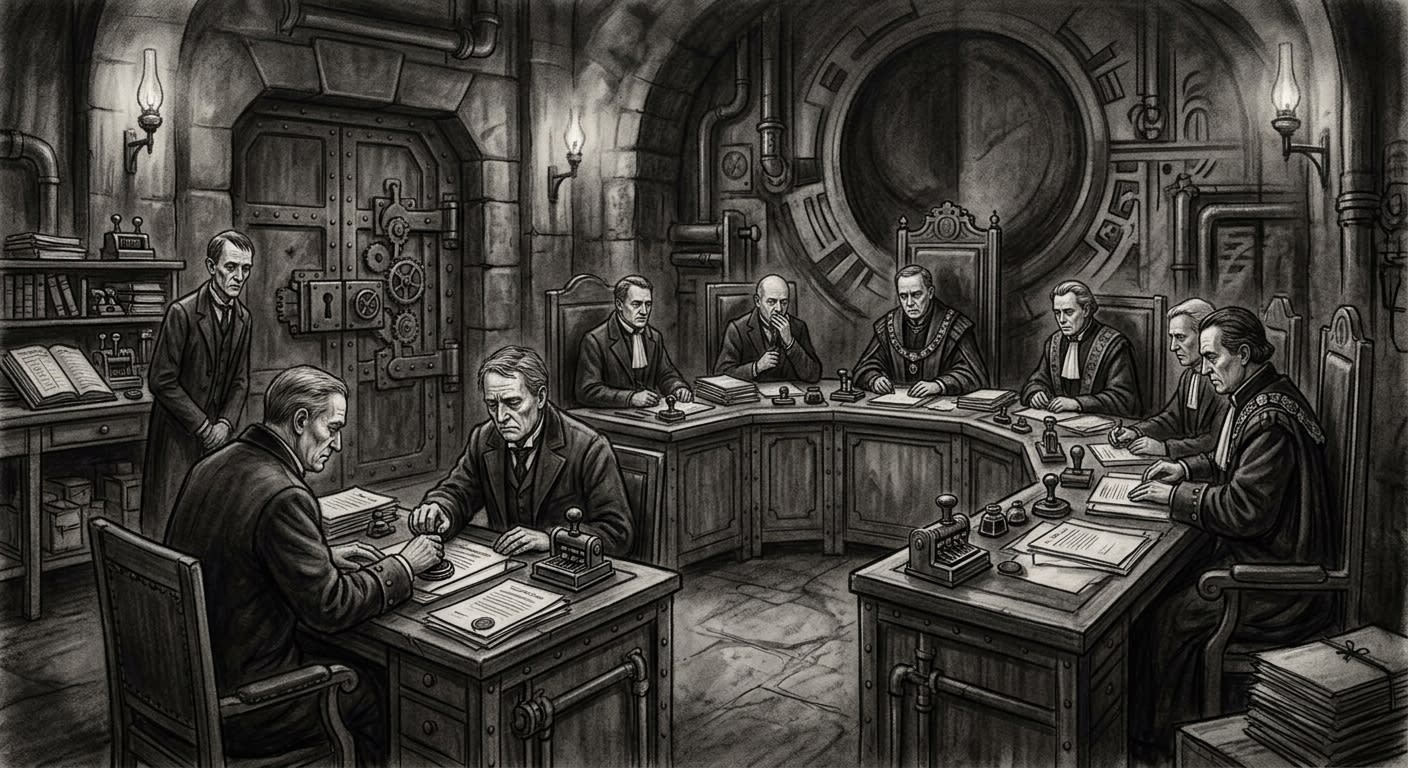
Doctrine's function is not to persuade the other Seals. Persuasion is for councils with weak chairs. Doctrine frames the matter so that all subsequent disagreement occurs inside a permitted sentence. If the sentence is narrow, Purity smiles. If the sentence is broad, Concord smiles. If the sentence is incomprehensible, Records smiles because it will own the reconciliation work for a generation.
Purity quarrels first, most, and with the best posture. The Seal of Purity exists to discover contamination in every definition that does not immediately enlarge Purity's authority. It asks whether a proposed decree permits impurity by omission, whether mercy constitutes softness, whether silence hides dissent, whether foreign observers have been sufficiently humiliated before translation, whether a given noun has been used in an earlier heresy with suspicious warmth. It is hated by all and needed by most. This is the usual badge of competence.
A training folio for junior minutes-clerks described Inner Circle debate as “collegial discernment among coequal shepherds.”
Corrected. The Circle is not collegial. It is armed liturgy conducted with seated participants. Coequality is maintained by fear, precedent, rotating stamp order, and the knowledge that every Hierarch has enough jurisdiction to ruin the others slowly.
The famous A.S. 188 dispute over whether hunger could be classified as devotional evidence began with Doctrine declaring ration scarcity spiritually instructive, Purity declaring unapproved hunger suspicious, Martyrdom requesting casualty categorisation in advance, Concord asking whether foreign envoys might notice the queues, and War asking, through intermediated writ, whether soldiers could eat the instruction. The result was a three-page decree, seven appendices, and a bread schedule so complicated that three parishes starved while awaiting clarification. The Circle marked the process sound.
#On War's Cloth and the Absent Vote
The Empty Throne of War sits in the Circle and has done so, legally occupied and visibly empty, since A.S. 107. Its white cloth has yellowed into doctrine. No one launders it. No one removes it. No one calls the chair vacant unless eager for remedial instruction in statecraft.
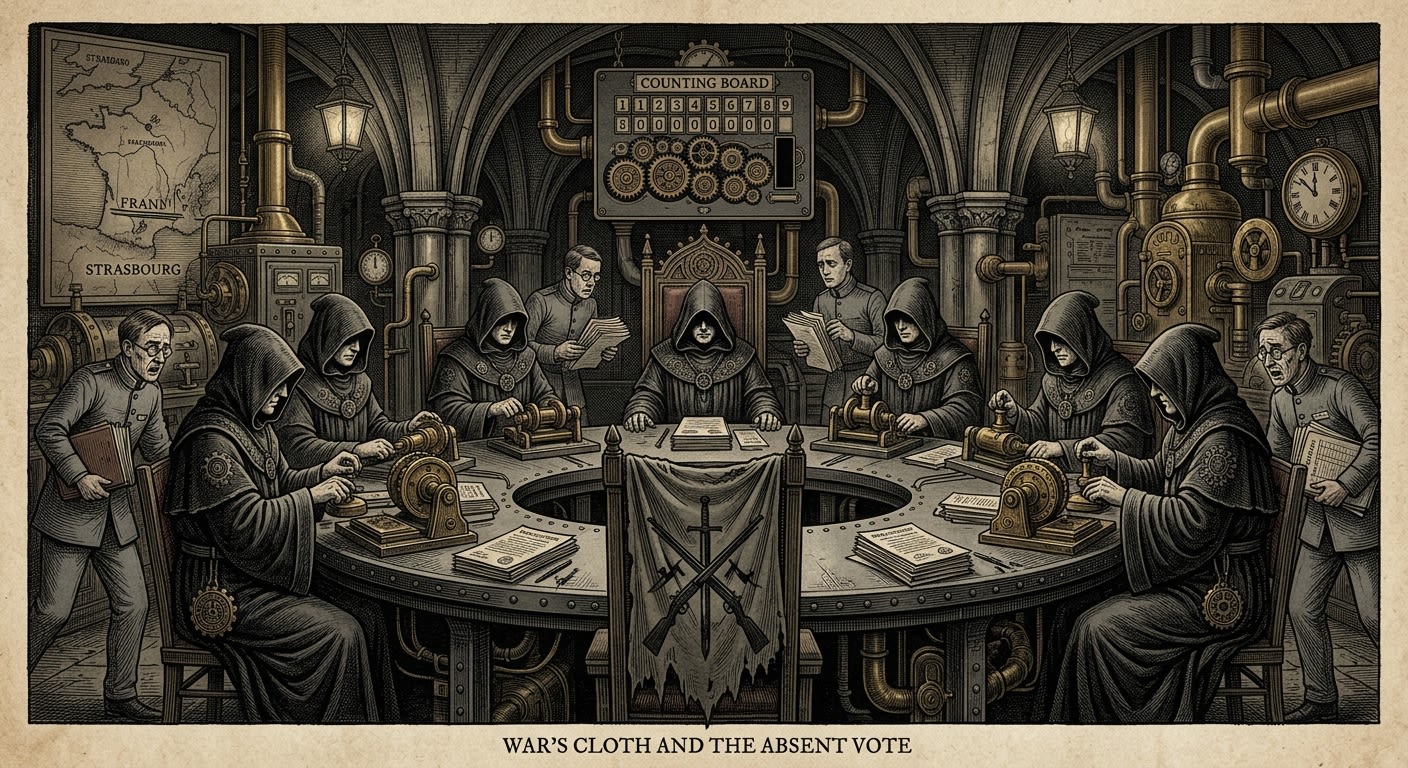
War's absence changed the Inner Circle more than any reform admitted in public. A living Hierarch of War could quarrel, demand, threaten, suffer envy, accept bribes, refuse them too loudly, and make generals feel personally judged. The cloth is superior. It receives summons, votes by intermediated authority, and issues assent through seals whose signatures change quarterly. The Bureau of War obeys because the orders move. The bastions hold because the rail schedules do not require metaphysics.
The Circle marks War present at every session. This is not fraud. Fraud requires intent to deceive. The Inner Circle has moved past deception into constitutional necessity. If War is absent, every military order since A.S. 107 becomes vulnerable to review. If War is present, the guns continue to fire. The guns continue to fire.
The War attendance annex for Session 201/IV records the chair present, seal pressure normal, cloth fold altered after recess, and a witness assigned to observe the alteration reporting sound beneath the lectern. The witness was reassigned to atmospheric service. The minutes were amended: no alteration.
The rumoured Council of Veils enters here by not entering. Its name appears nowhere in authorised session records. Its effects appear everywhere: blank-page advisories, ash-smelling writs, War votes delivered before questions are finished, Purity objections withdrawn without explanation, Concord envoys sent away with instructions they do not remember receiving. The Veils may be a body, a method, a file category, a shadow cast by the Throne, or a story told by clerks to make their fear sound literate. The distinction has no operational value.
#On Concord, Martyrdom, Discipline, and Vigilance
The lesser-known Seals are lesser-known only to those who confuse noise with power. Concord keeps the Circle from accidentally declaring war on every neighbour before supper. It manages foreign accommodation, provincial dignity, inter-Bureau arbitration, and the particular theatre by which the Synod tells the British Crown, the Netherlands, and the Fractured North that their disobedience is a temporary form of cooperation. Concord speaks softly because every soft phrase contains a hook.
Martyrdom speaks little and signs much. The Seal of Martyrdom governs the dead, and the dead are the Synod's most disciplined class. A session becomes easier once Martyrdom has spoken, because every living objection can be compared unfavourably to corpse utility. It catalogues, canonises, authenticates, reassigns, and converts ruin into morale. When War requests bodies, Martyrdom hears future relics. When Purity requests executions, Martyrdom hears possible calendars. When Doctrine requests proof, Martyrdom opens a box.
Discipline is the priesthood's internal knife. Its Hierarch watches clergy, auditors of clergy, confessors of auditors, and the sealed scandals by which holy men become manageable. Discipline rarely dominates sessions. It waits until another Seal grows proud, then produces a file. There is no incense sweeter than a rival's misconduct properly indexed.
Vigilance is the chair that makes every other chair sit straighter. Its visible representatives say little. Its unseen ones say less. The Seal's relationship with the Bureau of Shadows remains unacknowledged with such formal consistency that acknowledgment would be redundant. Its door has no handle on the outside. Its replies arrive while petitioners sleep. Its minutes sometimes contain observations made before the observed act occurred. Records calls this anticipatory notation. I call it rude.
#On Clerks, Minutes, and the Manufacture of Unanimity
No Inner Circle session exists until the clerks survive it. This truth is rarely carved in stone because stone resents being upstaged by ink. The sessional clerks sit below Seal level in recessed stalls screened by carved oak. They wear grey, write in two inks, breathe shallowly, and learn not to react when a Hierarch says something impossible, false, brilliant, fatal, or all four in the same clause.
Minutes are taken in layers. The public minute records subject, attendance, Seal order, decree number, and approved outcome. The restricted minute records objections, amendments, jurisdictional reservations, corrective phrasing, and who looked at War's chair for too long. The sealed minute records the real dispute. The black minute records what the sealed minute had the cowardice to omit. No one admits the black minute exists. I have corrected its punctuation twice.
The hierarchy of minutes is the hierarchy of civilisation: what the people know, what officials know, what frightened officials know, and what I know. The last category is the smallest and best written.
Minute clerks are recruited from Records families with strong wrists, poor imagination, and enough fear to improve concentration. They serve six-month rotations because longer exposure produces either fanaticism or comedy, both dangerous in transcript work. Training includes abbreviating Hierarchic titles without creating accidental treason, identifying which coughs require notation, sanding ink without smearing decree numbers, and fainting sideways so as not to disturb the Seal line. The best clerks develop a facial expression like closed vellum. The worst become theologians.
A clerk who records too much is transferred to Silence. A clerk who records too little is transferred to Purity for educational handling. A clerk who records exactly enough may live long enough to develop opinions, at which point Discipline intervenes with kindness shaped like a file. This is why the minutes remain usable. The pen is guided by ambition, terror, and pension mathematics.
Unanimity is manufactured in stages. First the matter is framed so dissent becomes semantic rather than substantive. Then the Seals object in ways already anticipated by their own clerks. Then Doctrine issues a harmonising phrase. Then Records proposes a minute structure that preserves objections without allowing them to become obstacles. Then the stamps descend. By the time the decree leaves the chamber, every Seal has won enough wording to claim victory and lost enough substance to keep the others alive.
This is not weakness. It is the Circle's genius. Tyrannies fall when one will makes one error too large to hide. The Inner Circle disperses error across seven authorities, twelve Bureaus, four minutes, three annexes, and a fog of corrections. Blame cannot find a single throat. It suffocates in committee.
#On the Seating Diseases
No office as old as the Inner Circle remains free of bodily consequence. The chamber has ailments, and because the chamber governs Europe, its ailments become constitutional features. The first is precedence fever. It appears whenever a Seal believes its chair has been moved one finger's breadth toward or away from the lectern. Measurements follow. Records produces earlier measurements. Doctrine contests the meaning of breadth. Purity asks who touched the chair. Discipline requests the names of clerics who saw the touching and failed to report spiritual disturbance. Concord asks whether foreign envoys have been told the chairs are immobile. Martyrdom proposes preserving any dead measurers as witnesses. War is present.
The second disease is stamp gout. Seven stamps, quarterly rotation, emergency exceptions, inherited wax habits, seal pressure variations, and the occasional tremor in an elderly Hierarch's wrist have produced a science of impression-reading so diseased that even Heraldry refuses to claim it. A stamp pressed too lightly may indicate reluctance. Too deeply, aggression. Crooked, haste. Warm wax, eagerness. Cold wax, procedural contempt. The Bureau of Records maintains a comparison cabinet with thousands of authorised impressions. The cabinet has more drawers than some monasteries have monks.
The third disease is acoustic vanity. Every Hierarch believes his chair carries sound least favourably. Doctrine once requested a sounding board. Purity objected that amplification of Doctrine might constitute unexamined contamination. Concord proposed shared baffles. War, by writ, asked whether voices could be made louder in forward command instead. Vigilance sent no comment and somehow received the best acoustics after renovations.
These diseases matter because the Inner Circle converts pettiness into law. A chair shifted for comfort becomes a precedence crisis. A wax bubble becomes evidence of hesitation. A cough becomes dissent if placed after the wrong clause. In smaller institutions such vanities destroy function. In Strasbourg they generate annexes, and annexes are the fungus by which governance reproduces.
#On the Sealed Calendar
The Circle's calendar is not published. Citizens know feast days, levy days, procession days, ration days, confession days, and the pleasant little civic humiliations by which a year becomes obedient. They do not know when the seven chairs convene. This ignorance is deliberate. A public schedule invites petitions. A hidden schedule invites fear. Fear has better attendance.
Regular sessions occur according to a cycle tied to the Concordat anniversary, the quarterly stamp order, the audit of War authorisations, and three bells whose names are not printed on parish calendars. Emergency sessions may be called by three Seals, two Seals with Doctrine, one Seal with War's intermediated assent, or Vigilance alone if the summons is delivered before the event requiring it. This last category causes Records particular pain, since filing a summons before its cause requires tense-work of great delicacy.
The chamber has convened for famine, schism, line-breach, plague, foreign insult, internal scandal, false miracle, genuine miracle, contested genuineness, and the discovery that a provincial catechism had printed Discipline's title in a font reserved for Martyrdom. That final session lasted six hours. No one died. Several should have.
The sealed calendar gives the Circle one of its favourite powers: retrospective session. If a decision must appear to have been authorised before the act, Records may locate, reconstruct, or discover a session whose minutes were delayed by security requirements. Critics call this fabrication. Doctrine calls it recovered continuity. I call it risky and occasionally beautiful, the way a forged bridge is beautiful while one is still crossing it.
Calendar Annex, A.S. 166: one session entered with start time prior to sunrise and end time prior to start. Attendance complete. Decree valid. Clerk note: “All seven present; War especially so.” Clerk later █████████████████. The clock was replaced. The replacement clock refused to mark Third Bell for nine days.
#On Access and Summons
Access to the Inner Circle is controlled by summons, Seal prerogative, emergency witness call, or catastrophic clerical promotion. Petitioners do not request audience. They are selected for exposure. A man summoned before the Circle begins dying administratively before he reaches the outer corridor. His name is checked by Records, breath by Purity, oath by Oaths, prior speech by Doctrine, debts by Tithes, family usefulness by Martyrdom, route by Shadows, and shoes by the guard captain if the day has been long.
Witnesses stand on a black stone set below the lectern. It is said the stone came from Avignon after the razing, part of the rubble shipped north and folded into Strasbourg's sacred architecture. I believe it. The stone has the exhausted patience of a city forced to become stairs. Men standing on it speak too quickly at first, then too carefully, then only when told. Women tend to do better. They have had longer practice being watched by fools.
The Circle does not shout. Shouting belongs to subordinate violence. The worst sentence in the chamber is usually quiet: “Let the witness clarify.” Clarification means the first answer has failed to satisfy one Seal, interested another, and attracted Vigilance. Few recover from the honour.
Some witnesses are summoned only to be seen being summoned. A provincial vicar walks in, bows, answers one harmless question about bell-rope allocation, and returns home permanently cured of independence. A governor-praelate waits in the outer corridor for nine hours and is dismissed without audience, which teaches his province more than a tribunal would have. A Bureau deputy is invited to clarify a budget line and discovers three Seals already know the fraud, two know the motive, one knows his mistress's baptismal name, and War has abstained because dead men do not require reimbursement.
There is a mercy in this terror. The Inner Circle rarely needs to destroy a man after the chamber has fully measured him. He destroys himself later, in memoranda, overcorrections, apologetic zeal, and the frantic tidying by which guilt becomes visible from three corridors away.
#On What Leaves the Chamber
A decree leaving the Inner Circle has already passed through more transformations than a saint's femur in a disputed reliquary. It begins as question, becomes agenda item, becomes doctrinal frame, becomes jurisdictional struggle, becomes wording compromise, becomes stamp sequence, becomes minute, becomes extract, becomes provincial instruction, becomes sermon clause, becomes schoolroom chant, becomes tavern rumour, becomes fear. By the time a peasant hears it, the decree has lost all resemblance to debate and acquired the weight of weather.
Provincial offices receive Circle instruments in ranked copies. First-copy vellum goes to the commanding Bureau. Second-copy goes to Records. War receives operational extracts without theological embroidery unless the embroidery affects casualty willingness. Purity receives contamination clauses. Concord receives foreign-language phrases stripped of jokes. Martyrdom receives death implications. Discipline receives clerical exposure notes. Vigilance receives nothing and has already read it.
The most dangerous instruments are the small ones. Grand condemnations produce noise, and noise gives warning. A minor circular on authorised mourning ribbon width may ruin a province by exposing who has been grieving improperly for seventeen years. A clarification on bell sequence may invalidate marriages performed under a mistimed peal. A footnote on relic custody may move a town's patron saint three hundred miles east, leaving the town obedient and spiritually widowed. The Inner Circle governs best when citizens cannot tell whether they have been struck until the bruise develops a seal.
#On the Present Circle
As of A.S. 201, the Inner Circle remains seated, active, contradictory, obstructive, indispensable, and vastly pleased with itself in the manner of old institutions that have mistaken survival for virtue. The Hierarch of Doctrine continues issuing hostile truths. Purity continues defining cleanliness by refusing to define it. War continues occupying absence. Vigilance continues declining appointments it knew would be requested. Concord continues apologising in phrases sharp enough to shave with. Martyrdom continues improving the dead. Discipline continues saving its files for the right throat.
The Sagittal Line receives orders. The Bureaus receive contradictions. Provinces receive decrees. Catechists receive simplified lies. Records receives everything and returns only what can be endured. The machinery functions because it was never built to be clean. It was built to turn fear into signatures and signatures into motion.
There are critics who say the Inner Circle is paralysis dressed in vestments. They are half right and wholly boring. Paralysis in every direction except the necessary one is strategy. The Circle cannot agree on bread, saints, vowels, foreign envoys, clerical baths, battlefield precedence, corpse custody, or the theological status of a chair. It agrees that the Line must hold. The guns fire. The clerks write present. The cloth remains.
A foreign pamphlet recently described the Inner Circle as “the hidden heart of Synodal tyranny.” Rejected for anatomical incompetence. A heart is soft, rhythmic, and vulnerable to knives. The Inner Circle is a locked reliquary containing seven knives pointed inward. It does not beat. It prevents bleeding from being noticed too soon.
At the close of session the Seals are lifted in reverse order. The clerks sand the wet lines. Purity's guards count the witnesses. Doctrine's assistants gather discarded formulations before they can become sects. A servant who does not officially exist brushes dust from the foot of War's chair and never touches the cloth. The doors open one by one. Authority leaves through seven corridors and arrives everywhere at once.