
#On the Man Who Commands Beneath an Empty Chair
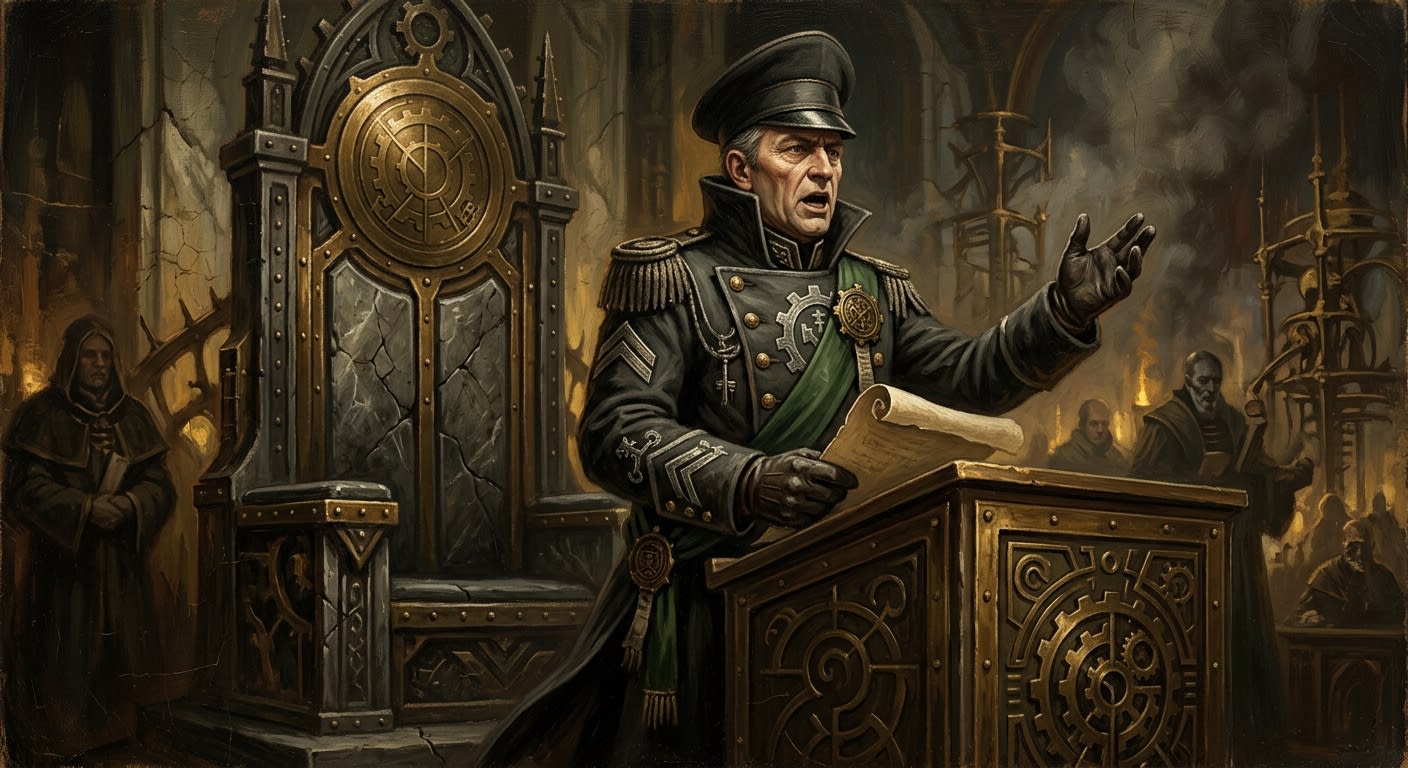
The Warden-General is the living throat through which the Empty Throne of War speaks when artillery requires grammar. He commands the Bureau of War in public, signs levy allocations in crimson, receives dispatches from Bastion-Königsberg to Bastion-Constantinople, and bows before a chair whose occupant has not appeared in public since A.S. 107. Call it humiliation if you require a small word for a large mechanism. I call it architecture.
The Synod has never liked generals. Generals love maps, horses, medals, shouting, and the intoxicating little fiction that armies move because a man in a sash desires it. The Synod corrected this defect by placing every Warden-General beneath a superior who cannot be flattered, threatened, assassinated, contradicted at dinner, or discovered with a mistress in a supply chapel. A chair is the perfect commander. The Warden-General is merely its weather.
His title is older than the current office. Wardens once guarded gates, relic houses, refugee columns, and other things men claimed were sacred immediately before misplacing them. The modern Warden-General was fixed after the founding of War's Bureau in A.S. 105, when the Synod required a military head visible enough to frighten provinces and disposable enough to satisfy the Seven Seals. Two years later the Seal of War vanished into draped cloth, and the office became what it remains: command with a ceiling made of absence.
#On the Rotating Appointment
The appointment rotates by design, though Records dislikes the word rotation because it implies a wheel and wheels imply axle maintenance, which belongs to Engineering and leads to correspondence. The Warden-General is selected from among senior War officers whose victories remain printable, whose catechism scores can survive Doctrine review, and whose enemies are numerous enough to prove consequence without being numerous enough to make succession amusing.
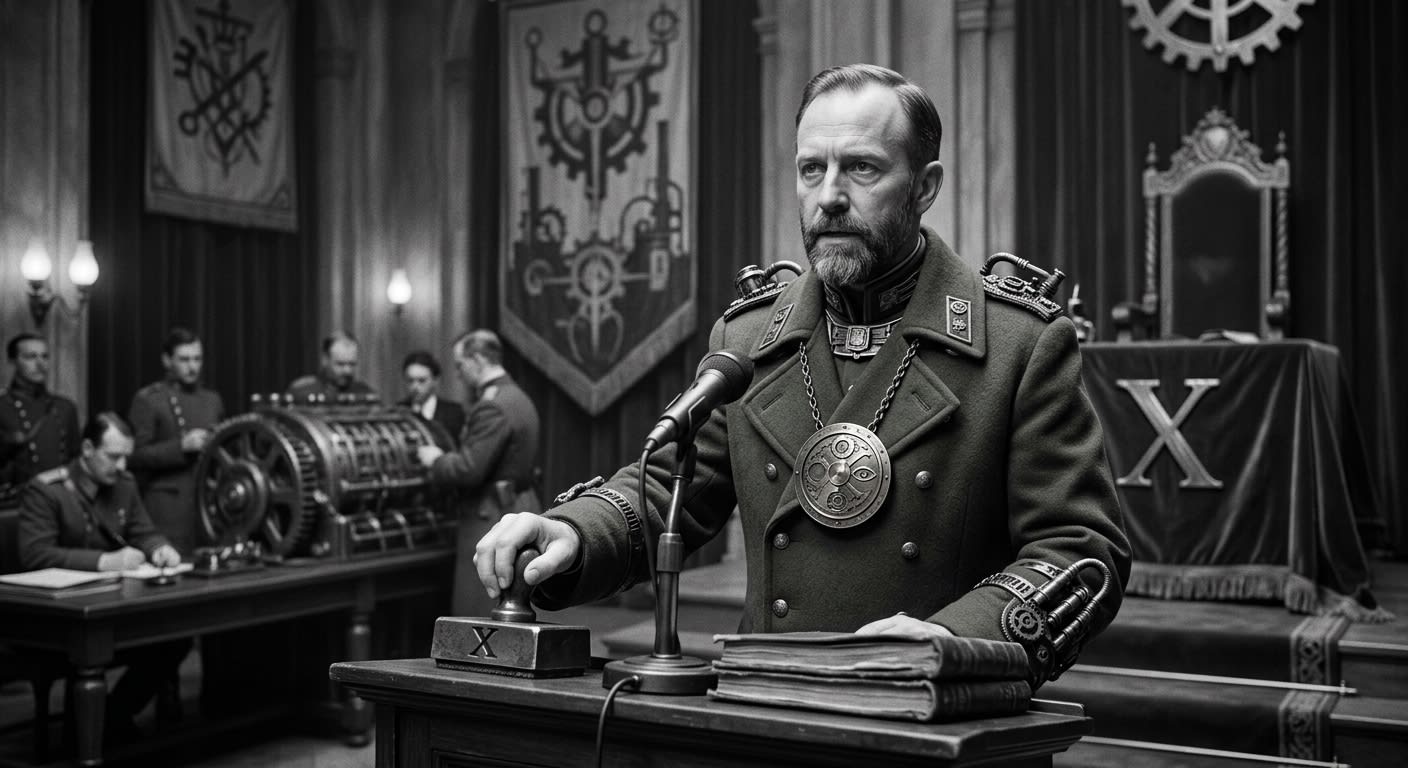
A candidate must be confirmed by War docket, Doctrine certification, Purity clearance, and a Seventh Seal writ transmitted through intermediated authority. The writ bears no stable hand. Its file number changes by quarter. The wax formula varies. Its legitimacy is total. Officers have objected to this arrangement exactly once in the formal record and several times immediately before reassignment in the informal one.
The rotation solves a problem familiar to any state that has fed sons to trenches: a successful commander becomes a province's favourite heresy. Let a man win three campaigns and villagers begin naming children after him, priests begin mentioning him in homilies, widows begin forgiving him for coffins, and quartermasters begin protecting his supply lies out of sentiment. This cannot be permitted. The Warden-General must be large enough to command obedience and small enough to fit through a disciplinary aperture.
Several officer primers describe the Warden-General as “supreme commander of the Synod's armies.”
Corrected. The Warden-General commands under the Seal of War, which is occupied in absentia. Supreme command belongs to the Seal, the chair, the cloth, and the writ no living officer may audit. The primer author has been reassigned to bayonet catechism, where supremacy has a point and fewer clauses.
#On His Instruments
The Warden-General's visible instruments are ordinary enough to deceive civilians: the crimson sash, the campaign baton, the grand docket, the levy tallies, the rail-priority seals, the right to summon Vexillators and Tribune-Chaplains into a room and make them leave with worse news than they brought. The sash is interwoven with pilgrim-banner fragments. The baton contains a splinter from Vienna's altar, certified twice and doubted by everyone with taste. The docket is heavier than the baton and has killed more men.
Beneath him sit the Vexillators, standard-bearers of the grand campaigns; the Tribune-Chaplains, who lead both prayer and assault; and the Litany-Engineers, those peculiar sappers who detonate charges in hymn rhythm and then insist the timing improved morale. Every subordinate rank requires theological certification from Doctrine. A man may win engagements, hold a breach, save a convoy, and still fail promotion because he misquoted the Fourth Antiphon under examination. War promotes the doctrinally certified capable. The capable alone are merely dangerous.
His invisible instruments are better. Delayed rations. Advanced rail priority. Funeral reclassification. Medal schedules. The right to turn a casualty into a martyr and a blunder into a miracle if the after-action prose climbs high enough. No campaign plan circulates without seals from Doctrine and Purity, yet the Warden-General's office prepares the first draft, and the first draft is where truth goes to be given boots.
#On the Empty Throne Above Him
A living Hierarch of War would ruin the office by competing with it. The Warden-General would have to please a superior with habits, illnesses, favourites, debts, jealousies, and possibly a face. The Empty Throne is kinder. It issues through intermediaries. It commands without appetite. It receives blame as a reliquary receives dust: visibly, uselessly, and without complaint.
The Warden-General knows this and hates it in proportion to his intelligence. A stupid one believes himself the master of armies. A clever one understands that every order he signs is a local pronunciation of a sentence whose author he will never meet. The clever ones live longer, though not always better.
The Council of Veils stains the edge of the matter. Orders arrive bearing War authority through channels that do not admit channelhood. Blank pages return from sealed rooms with pinpricks, ash residue, or nothing at all, and a rail convoy moves by morning. The Warden-General may suspect the Veils. He may curse them privately. He may not refuse them unless he wishes to become an instructional example in the next officer primer.
WAR SEAL INTERMEDIATION — COMMAND RECEIPT FRAGMENT Recipient office: Warden-General, Arch of Campaigns Directive: redeploy two levy cohorts from █████████ to █████████ Signature series: quarterly rotation invalid under prior registry / valid under current registry Marginal note in unknown hand: “The chair has voted.” Action: completed before dawn
#On His Relations with the Other Bureaus
The Warden-General spends half his office fighting the Enemy and the other half fighting the Synod's friends, which is to say he enjoys no leisure. Records demands exact corpses. War supplies useful ones. Purity demands clean language. War supplies victory language. Doctrine demands theological fit. War supplies outcomes and asks Doctrine to tailor the cassock around the wound.
Medicine troubles him most because Medicine measures before it kneels. Doctor Trenn can place field ledgers, distance charts, and autopsy ratios on his desk and say his men are dying from a phenomenon War can name only after someone else has cut it open. The Warden-General may dislike her. He still reads her reports. Casualty law has a way of defeating rank when the patient is leaking onto the map.
The Bureau of Tithes troubles him in a more familiar fashion. Tithes counts sons before War spends them, then complains when expenditure outruns forecast. This is like weighing candle wax and objecting to flame. The Continental Levy is a tithe of flesh; a tenth from every household in the older formulations, adjusted by province, census, exemption, and political cowardice. The Warden-General receives the flesh after Records names it and before Martyrdom improves it.
A fiscal memorandum from the Bureau of Tithes referred to levied soldiers as “recoverable strategic assets.”
Amended after War objection. Soldiers are “consecrated expendable assets.” The difference is pastoral, budgetary, and insulting in a more accurate direction.
#On Relief, Disgrace, and Canonisation
The office is rotating because the office is radioactive. Three Warden-Generals were relieved after the sealed southern campaign whose graves official records classify as geological features. Two were canonised. The third was entered into the Index Damnatus and struck from every muster roll. The Bureau's position is that the campaign did not occur, which makes the canonisations especially efficient: saints produced by an event that never happened possess a purity of utility the common martyr cannot match.
Relief of command follows liturgy. First comes the medical leave offered with too many witnesses. Then the doctrinal review framed as gratitude. Then the temporary retreat to a shrine-house where windows are small and visitors bring no pens. If the officer has friends, he emerges as adviser. If he has enemies, he emerges as penitent. If he has secrets, he may emerge as saint.
The Warden-General is expected to understand this from his first day. He wears crimson across the chest because someone else bled before him and because he is expected, in time, to provide material for future ribbon. Such economy should be admired. I admire it. I also keep my distance from men whose uniforms have already chosen their colour of obituary.
#On the Present Holder
As of A.S. 201, the current Warden-General remains unnamed in public codices by courtesy, security, and the Bureau's reluctance to provide assassins with decent stationery. His office sits beneath the Arch of Campaigns in Strasbourg, where maps of the Sagittal Line are pinned under reliquary glass and updated with red chalk, black pins, and little ivory tokens representing units that have often ceased to exist before the token is moved.
His morning begins with casualty tables. His noon belongs to seal disputes. His evening belongs to orders from a chair. He receives petitions from Brest concerning ammunition and confession-lane safety salvos, from Shipka concerning rotations shortened by sleep-fog, from Przemyśl concerning gaze discipline before Pride's vanguard, from Irongate concerning gasket failures and Envy's counter-signals, and from Constantinople concerning every species of fire, hunger, lust, rot, and administrative denial available to the southern hinge.
He signs. That is his sacrament.
The signature is watched. Records watches for continuity of hand. Doctrine watches for phrasing that mistakes victory for mere success. Purity watches for officers who write of necessity with too much appetite. Shadows watches because Shadows was watching before the ink arrived. The Warden-General knows the scrutiny and writes through it, each order a small confession disguised as command. Move the guns. Release the levy. Delay the coffins. Reclassify the loss. Dispatch condolence form six, the one with the warmer saint-quotation and the colder accounting column.
Some offices ennoble their holders. This one consumes them politely. A Warden-General enters as a man with campaigns behind him and leaves as a seal impression in red wax, kept in a drawer for comparison against future obedience.