
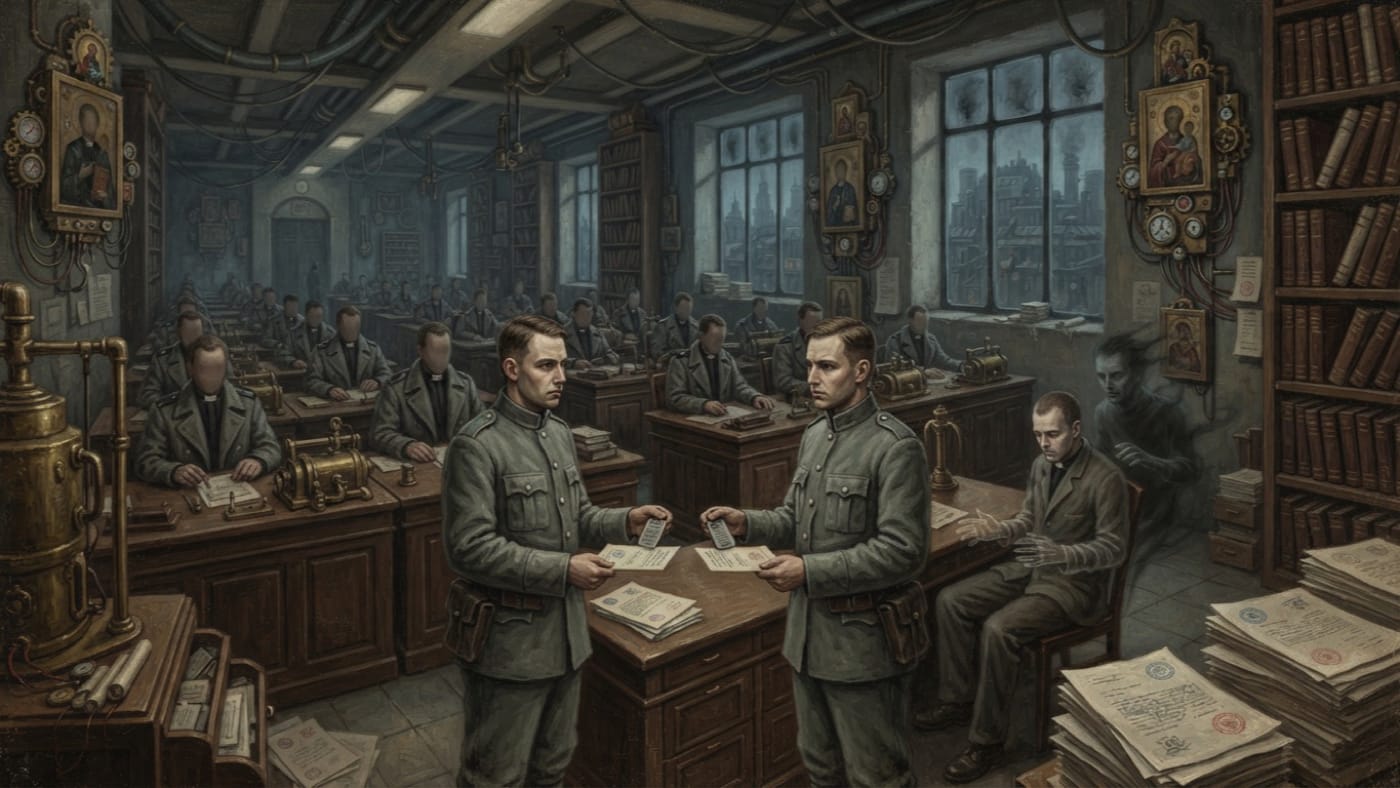
A survey of present condition, A.S. 201, concerning the school of sorcery that takes nothing from the purse and everything from the name.
#On the Theft of Self
The archive records that a bishop at the Hollow Vale was preaching when his voice was taken from him. It says the voice went on preaching after he stopped, in his tone and with his pauses, and that what it preached was blasphemy. The archive does not name the bishop or date the sermon. It does not say whether he stood at the rail with his mouth open while his own cadence taught his flock filth, whether he fled, or what became of him. I have looked. The folio ends at the point where the horror is complete. Archives rarely do a reader that kindness.
This is Mimetic Theft, the school of sorcery practised by the servants of Morwen, the Weeping Host. The catalogue of the Schools of the Lie calls it the foulest of them, because it steals no coin. It steals the self. Parish envy, coveting the neighbour's ox or his better pew, is a small sin with its own column in the ledger. The envy Morwen deals in wants to be the neighbour. It wants the ox to come when it calls.
The principle is simple, and I dislike it. Everything by which we know one another can be detached from the person who carries it: voice, face, gait, handwriting, the way a sergeant clears his throat before an order. It can be worn. It can outlast the wearer. It can turn round and give evidence against him.
The Bureau of Doctrine teaches that sorcery is paid for out of Creation and not out of the sorcerer's pocket. The payment comes from soil, borders, and the meaning that holds a name to the man who answers to it. Mimetic Theft draws almost entirely on that last account. No source gives its rate, its range or the time it takes. I will not invent a tariff for an outrage the archive has not priced.
#On the Borrowed Voice and Face
The voice costs least and is taken first. The lesser practitioners do little else. Echo-Kin are minor demons that imitate rather than replace. They attach themselves to a man and repeat him: his step, his oaths, his habit of touching his greatcoat collar before a barrage. Up close they convince no one. At thirty yards, in smoke, they convince enough. The worse effect comes slowly. A man who is copied long enough begins to doubt that he came first. Then he begins to copy his copy, until the two of them stand in a trench trading the same gesture like clerks passing back and forth a form neither will sign.
Face-Thieves work at the other end of the scale. They choose a single person and study that person, for months in the fuller accounts, until the replacement convinces the records as well as the wife. Documents come to show the thief. Memories rearrange themselves to include him. The original is left an anomaly in his own life, an imposter by majority vote. Some thieves, the sources say, have lived their borrowed lives so long that they no longer know they are copies. A copy may hold the original's memories, know his secrets and love his children, and believe sincerely, without malice, that it is the man himself.
Then there are the faces of the holy. Mimetic Theft counterfeits blessings, and keeps counterfeiting them until the original saint is forgotten and only the forgery is remembered. The Stolen Saints (Unregistered) carry this into the field. They are effigies of holy men whose blessings look correct and wither the people who receive them. The vestment is right and the gesture is right, so the faithful kneel to the shape they were trained to recognise. Doctrine holds that a counterfeit blessing does not become grace through long service. For once I am glad Doctrine is firm.
At the largest scale there is the Choral Maw, Morwen's organ of bone and sinew, which sounds with a thousand stolen voices. I give it one sentence, which is as many as a reader should carry before supper.
#On the Prayer Returned
The Palace of Echoes stands in the middle of the Hollow Vale, among hollow trees and mirror-lakes. The lakes do not return your reflection. They offer you an improved one, with a better face, a stronger stride and a more commanding voice. The Lore records that many have gone into those waters willingly, and that one figure always comes back out. It does not say whether he is the man who went in.
The school's second defining account comes from the Palace. Soldiers there found themselves praying to a copy of their own prayer. The archive gives no number, regiment or officer. They spoke their devotions and the devotions came back to them, until they could not tell which prayers had been theirs and which had been the enemy's.
The garrison set itself on fire. That is the whole entry. It records no supernatural command. Demons may copy a man's prayer, but they do not hold his hand to the match. The men chose. They chose in a fog of borrowed piety, unable to tell their own petitions from the forgery, and the choosing was the last thing left that was certainly theirs.
#On Those Who Ask to Be Taken
Some victims are robbed. Others apply.
Morwen's influence-demons do not hunt the ambitious. They hunt the self-rejecting: the man who hates the face in his shaving-glass, the clerk convinced his life belongs to someone more deserving, the widow who would give anything to be anyone else. The offer comes in a voice very like the listener's own: You could be better. No one would notice if you changed. I am obliged to record that the gifts are real. The timid man wakes up confident. The outsider is taken in by the family she envied and treated as if she had always been there.
The price is collected afterward, in instalments, because the becoming does not stop. The recipient picks up the phrases and habits of everyone near him and wants whatever they want. He thins, until the mirror shows a composite of everyone except the man who made the bargain. In the late stages a new copy appears, of the identity he stole, and it wears that identity better than he did.
This road must be kept apart from the bishop's. Nothing in the archive says the bishop envied anyone or asked for anything. He was preaching. The Synod's tribunals have long read misfortune as confession. In this school the habit is especially wicked, because the victim's own voice can be produced in evidence against him.
#On Authentication
Against all this the Bureau of Orison and Song brings its dust. Its broadcasts are laced with saint-dust and harmonic salts. The Orison Signal Engineers adopted the practice when they found that certain relic residues reduced what they call parasitic inversion, the enemy's mimicry of a carrier. Protected transmissions carry coded cadences, and the Bureau states that a copy cannot reproduce them without the saint-dust resonance key. A broadcast that passes its tests receives a Clean Carrier certificate, filed with the archives. Here, at least, is certainty.
For "Here, at least, is certainty," read "Here, at least, is the Bureau of Orison and Song's assurance concerning its own broadcasts." The coded cadence protects a transmission. It identifies no person, and it will not go into a dugout and tell a lieutenant which of two identical corporals is his. No method in this survey reliably identifies a copied man. A reader who thinks he has been handed one should reread the paragraph on Confession.
For persons, the Synod has a cabinet of lesser instruments. Recognition phrases and challenge codes rest on the theory that a copy cannot know what the original knew. In practice the copy often knows everything, and the codes catch only bad copies. The Confession of Identity requires a man to recite his history and his particular sins. A good copy recites them more fluently than a frightened original, and confessors have accepted the better performance. The Ledgers of Self, kept by the Bureau of Records, record appearance, habit, history and secrets against the day of dispute. But ledgers can be altered, and the Face-Thief's particular talent is that documents come to agree with him. Under mirror discipline, some installations cover or dull every reflective surface. The garrisons so protected slowly forget what they look like.
When two claimants appear and none of this can decide between them, the Synod executes both. It defends the policy as the only safe course. It is also an admission that the Synod cannot tell them apart, and the fuller accounts note the obvious consequence. An agent of Morwen who wants an honest man destroyed need only arrange to be seen beside him. Neither body, after the sentence, proves which man was real. The register records two deaths and one name.
Over the whole apparatus hangs the Singleton Doctrine: the assertion that each person is unique and irreplaceable, and that identity cannot truly be stolen or copied. I record it as asserted. What a copy is before the Creator, whether it carries anything that may be called a soul, and what is left to the original when his face walks off without him: Doctrine answers these questions in the catechism and declines to answer them in the field.
#On the Present Application
The Synod holds its line against Morwen at Bastion-Irongate, above the Iron Gates gorge on the Danube. Irongate runs on recognised voices. Its chant shifts must be sung. After the second bell only licensed choirs may sing. Its workers carry voice-licences, and a rite of passage there holds that a man's first licence is his first true name. Every one of these measures assumes that the voice presenting the licence belongs to the throat named on it.
Morwen did not have to design a weapon against Irongate. Irongate keeps one on file for her.