
#On the Song at the Empty Table
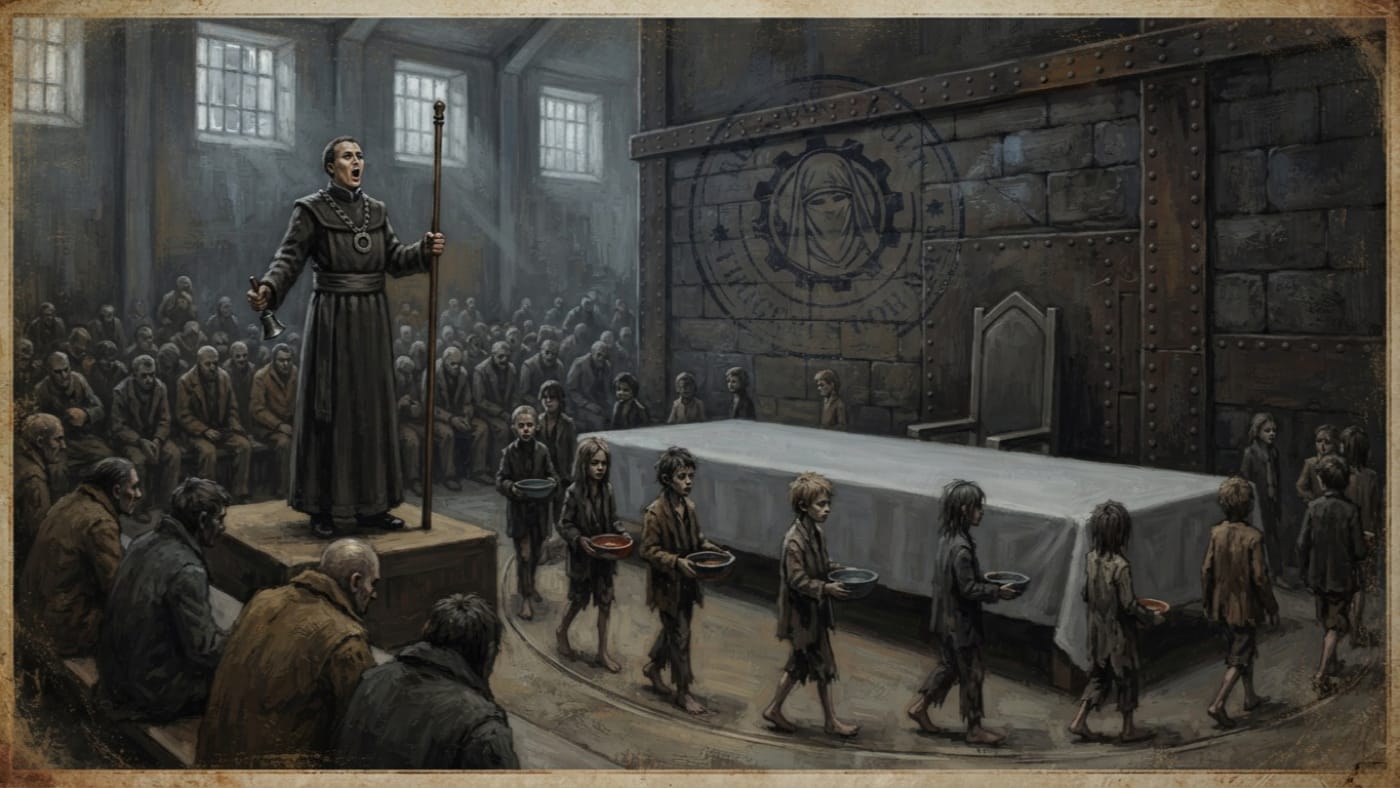
Every year, in selected wards, the Bureau of Festivals lays a table with clean cloth and puts no food on it. Children walk around it carrying painted bowls. While they walk, a Festival Chorus-Master sings the Hunger Antiphon in a key chosen to flatter thin voices. Then a performer licensed as Agnes of the Empty Table enters with three sacks, opens them, and hands out bread that no millet ever harvested could have produced. The audience may applaud for fourteen seconds at most. Then it goes home.
That is the entire public life of the Hunger Antiphon. It is the music sung over an empty table, filling the time between the bowls going round and the sacks coming open.
The record is small and I intend to keep it that way. It names the singer, the feast and the purpose of the key. It names no composer. It supplies no notation and quotes no verse. The Codex holds no score, and to my knowledge Records holds none either. I have been asked more than once to supply the words for this entry, as if a Hieromnemon kept antiphons up his sleeve like a conjurer's doves. I could invent a text in an afternoon. The Bureau of Festivals would then have to vet my invention, seal it and license a throat to sing it, and I have no wish to give them the work.
The procession matters more than the tune. Painted bowls cost less than full ones and read better from the back rows. Clean cloth shows every crumb, which is the point, because there are none. The Antiphon accompanies the walk. By the time Agnes arrives the audience has had a full song's length to look at nothing.
#On the Licensed Voice
A Chorus-Master doesn't sing whatever they like. The profession works from sealed scripts that have passed a doctrine reading before any singer sees them. Ranges are tuned to sanctioned limits, and any interval the Harmonic Jurists dislike is cut. Rehearsal punishes improvisation and rewards precision. On the night itself the master wears the permit sash with its Synod seal, and the throat-chain token at the collar proves that the voice is licensed. One hand holds the chorus rod. The other holds the cue bell that tells a crowd when to hush and when to kneel. Afterwards come the attendance ledger, the locked prop chest and the burned drafts.
Those are the habits of the trade. The Antiphon's file doesn't say which of them this song requires. I assume all of them, since a Chorus-Master who dropped one at a feast built around hunger would not keep the permit long. The assumption is mine, and I sign it.
The key is the only musical fact we have, so it gets a paragraph. "Thin voices" can be read two ways, and the Bureau would accept either reading with pleasure. The thin voice may belong to the singer: a chorus on festival rations is still a chorus in a rationed ward, and a hungry throat cracks on a high note. Or the thin voice may be hunger itself, made pleasant enough to perform on a public platform. Either way, a key that flatters thin voices makes the weak sound sweet. I have never read a better description of the Bureau of Festivals, and nobody there will thank me for it.
The trade has a saying: never feed the chorus. It means that a crowd must never be allowed to start singing on its own. At the Empty Table the saying is more literal than whoever coined it intended.
#On the Charity the Script Permits
The Bureau's staging order for the feast lists five requirements: three sacks, clean cloth, painted bowls, false millet, and a cue for the Mercy bell. In the approved story, the bell of Mercy tolled with no hand on the rope while Agnes died smiling before the altar. In the production, somebody has a cue. I don't object to stage machinery. My objection is to the pretence that the bell never needed any.
The forbidden list is shorter and more honest: walls, masonry tools, cellar inspection, tribunal language, and any direct reference to the Grain Keepers. Read side by side, the two lists reconstruct the woman by subtracting her.
The restricted file states that Agnes hid three sacks of millet intended for unlawful distribution and was convicted in a Purity ration proceeding. Her surname, parish, family and year of sentence are all unproved. She was sentenced to immurement in a wall beside a parish store. The masons who build such walls appear in no Festival script. Her full dossier is filed under Saint Silo-Agnes. This entry needs only the outline of what the song is sung over.
The Antiphon fills the place where the wall would stand. During the procession the audience is primed to see hunger. When the sacks open, it sees the hunger ended. The music sits in between, and the music is licensed. The staging order gives the approved moral as charity flows through obedience and the audience risk as unauthorised identification with the defendant. A performance succeeds, by the Bureau's measure, when the audience loves Agnes and does not recognise her.
A.S. 192 Festival circular: "No evidence connects Agnes of the Empty Table to Grain Keeper superstition."
Corrected internally; public denial remains authorised. The correction concerns the cult. It adds nothing to the Antiphon's text, which remains as unrecorded after the circular as before it.
#On the Ears Beyond the Chorus
Everyone in a selected ward hears the same Antiphon, and each listener comes away with a different feast.
Mothers hear the song that comes before a woman feeds children when the ration line has failed. Grain Keepers hear the song that comes before a woman who hid grain and kept quiet about it. Festival officers hear controlled grief, and Attendance Auditors count the weeping. Tithes hears receipts: commemorative ration cards sold in three grades, along with ticketed seating, programmes and stall fees. Purity hears a useful warning that generosity outside authority ends up safely inside theatre. Five ledgers are kept on one song, and they don't agree.
The Keepers' Agnes is the one the script works hardest to exclude. Folk usage gave her the name Silo-Agnes long after the sentence. Mercy Keepers chalk three dots inside the left sleeve and leave her a crust on the highest shelf. Quota Men write AG. beside tolerated discrepancies in their ledgers. The Keepers assign the three sacks to Mercy, Prudence and Sin, which gives Relics three objects of devotion it pretends not to have noticed.
It is tempting to number the Antiphon to match, with a verse, a movement or a chorus for each sack. The Codex holds no such division. Anyone who supplies one should expect the Bureau of Festivals to ask where they learned it.
The corrected circular admits that the cult is sung in kitchens after curfew. What those kitchens sing has never reached this desk. The Antiphon belongs to the platform, the permit and the rod. I will not credit it with the kitchens' music, or credit the kitchens with its.
The feast should not be confused with its harsher cousin. The Triumph of the Gaunt holds up the empty bowl as a virtue and crowns ribs in iron wire. The Empty Table at least lets the sacks come open. The Gaunt teaches that hunger is holy. The Empty Table teaches that food is holy when it arrives on cue, and the Antiphon is sung while the audience waits for the cue.
#On the Present Permission
As of A.S. 201 the pageant remains licensed, and the Antiphon is still sung each year in the wards selected to receive the feast. The private cult remains watched. A joint Purity and Tithes memorandum of A.S. 199 directs that domestic Silo-Agnes tokens be ignored unless tied to measurable diversion. So the grandmother may keep her waxed millet charm, the Chorus-Master may keep the key, and both are tolerated as long as neither one moves a sack.
Doctrine seals this entry with the particulars it has and no others. The Creator can supply the missing verses if they matter. The Bureau of Festivals has decided they don't.