
#On the Paper Left Behind
The Crossed Keys Roll is the single name the Church gives to what the Bureau of Records pulled out of Milan after the Coalition of the Crossed Keys went under in A.S. 150. The name is singular and the thing is not. It covers a mass of recovered paper and two registers copied from it, and it has been handled by more hands than anyone counted. No honest clerk would call it a roll unless the only other word on offer was swamp.
The Coalition earned its paperwork. Lombardy did not rise with pitchforks. It rose with seals. Sixty years after the Concordat of Strasbourg, Father Ambrosius of Como, principal preacher and key-bearer, led a congregation of parish fathers, silk treasurers and ward captains in declaring for the so-called True Successor of Rome. They held Como, Milan and a third city whose name is still under black wax. Then they made the worst mistake a schismatic can make: they started governing. They issued road warrants, collected grain, appointed receivers and oath-clerks, and printed catechisms. A rebellion that sings can be dispersed. A rebellion that keeps minutes can be prosecuted for generations.
The Bureau of War answered with hydrological pacification, which the vulgar call the Drowning of Lombardy. Canals were turned, embankments seized and barricaded premises flooded. Tithes froze the accounts. Purity went from font to font with its questions. Here the campaign interests me only as plumbing. Water went into the cellars of Milan, and the Coalition's papers were in the cellars of Milan.
When the sealed city fell, the Bureau of Doctrine chose not to erase. Erasure flatters weak administrators: a blank page looks like peace and costs nothing to store. Doctrine wanted the names, every participant the Bureau could identify. The work of keeping them went to Records, as heavy work always does.
#On the Twenty-Seven Crates
Twenty-seven crates came up from Milan's municipal undercroft. I give the number because it is the only number that is certain. It counts crates. It does not count volumes, pages, persons or sins. Any reader who multiplies it by anything will be corrected.
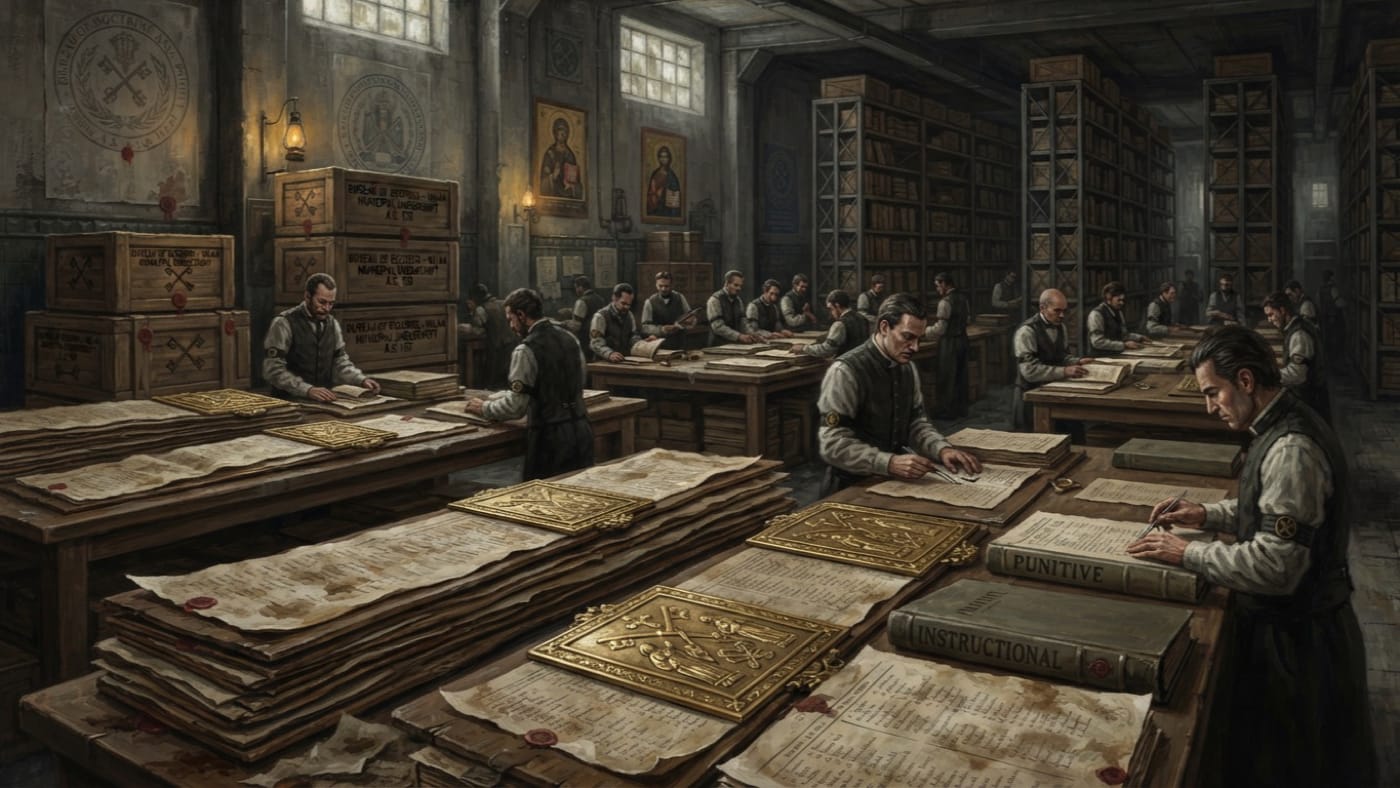
The clerks went down into water as deep as a man's belt. River filth filled the vaults to the waist, and the War officers on the stairs complained of the smell with the tender nostrils of men who had caused it. Records does not choose its clerks for courage. It chooses them for their hands. Those hands went into black water and came up holding ledgers that sagged like soaked bread and shed ink like a wound sheds blood.
Note, for the romantic, that the Coalition wrote on paper. Vellum survives a flood with some dignity. Paper comes out as pulp with ideas above its station. The rebels wrote on whatever the Lombard mills sold them, and the mills sold cheap, as mills do when the customer is in a hurry to overthrow something.
The drying was improvised from what a pacified city could supply. Sermon boards are the broad planks on which homilies are pinned for public reading. The clerks laid them flat and spread the pages between them. For weights they used confiscated reliquary plates, taken from the churches that had flown crossed-key cloths. Gilded saints pressed down on rebel rosters for days on end. The rosters flattened. I am assured the saints did not object.
Copying came after drying. Every name that could be read off the drying pages was written out twice, once into the punitive register and once into the instructional register. The clerks worked at the speed of fear, and a careful reader can see their cramp in the later entries, where the downstrokes grow shorter and the hand leans forward as if trying to get out of the room.
So the Roll is three bodies under one title: the recovered papers, dried, stained and still faintly smelling of canal, and the two registers made from them. An inquisitor who sends for "the Roll" will be asked by any competent clerk which of the three is meant. An inquisitor who cannot answer should not be trusted with any of them.
#On the Two Registers
Punishment produces a short document. The punitive register lists persons, and whatever the Church does to a person, it is finite. A man may be fined, stripped of office, exiled or given to the rope. When he is finished, his entry is finished. That register empties at the pace of its subjects' deaths, and it has been emptying since the waters went down.
The instructional register does not empty. It holds the same names for a longer purpose: to teach the Church what Lombardy is, and to teach Lombardy what the Church remembers. A rebel's son comes into his father's line there as surely as he comes into the house, minus whatever furniture Tithes carried off. His granddaughter is added with her baptism. The rope finishes with a man in one morning. The register keeps working on his grandchildren for as long as they live.
The labour is divided by competence. Records copies; Doctrine reads. A Records scribe can tell you which hand entered a name, whether the ink was Lombard gall or Strasbourg issue, and whether the page dried flat or cockled under a badly placed reliquary plate. The scribe cannot tell you what the name means. Meaning belongs to Doctrine, which is to say to me and to my superiors, ranked by competence and not by seniority.
A tension remains in the record, and I will not tidy it away. Doctrine's mandate was every participant the Bureau could identify. War's notice from the same season says the rolls seized were "complete enough" and the names preserved were "all useful names." The two statements do not contradict each other. They happen in sequence. Doctrine resolved to keep everyone it could identify. War decided which identifications were worth the trouble. Records copied whatever reached its table. In the Bureau's mouth, completeness describes an attitude of the will. It has never been an actual count, and the reader who asks for one will find the Bureau's door shut.
#On the Classifications That Followed
Seized names produce categories. Every Lombard offence still on the books traces its legal ancestry to A.S. 150 and to the registers drawn from those crates: Ambrosian sympathy, Crossed-Key nostalgia, papalist ornament, local-privilege doctrine, unauthorized Roman devotions, suspicious key imagery and excessive enthusiasm for lake processions. None of these charges requires that the accused stood behind a barricade fifty-one years ago. The categories descend from the revolt. The accused need only descend from Lombardy.
Mark the distinction. A grandmother who carries a candle a little too gladly along the shore at Como has not rebelled. She has shown enthusiasm of a classified kind. That classification has an origin, and the origin is in the Roll. Her inspector receives a precedent from the instructional register and, if her family name appears there, a pedigree as well. Paper does not need her to have done anything. It only needs her to be the kind of woman it already describes.
The circular of A.S. 151 announced that every symbol of the Coalition had been destroyed.
Clarified. Surrendered symbols were destroyed. Recovered symbols were destroyed. Any symbol whose existence a household denied went onto a separate schedule, and denial has kept it more lively than any key ever hammered onto a gate. The Roll records what Lombardy handed over. The schedule records what Lombardy would not hand over. I leave it to the reader to guess which one Purity opens first.
The Roll is not the Index Damnatus, and anyone who confuses them should be moved to a smaller desk. The Index belongs to Purity and lists what may not be read, sung, carved or spoken anywhere in the Church. The Roll lists who, in one province and in one bad year, actually did those things. A white-mantled inquisitor working the Lombard lakes will want both on the table. The Index tells the inquisitor what to look for. The Roll says which households to start with.
#On the Present Application
It is now A.S. 201, fifty-one years after the crates came up the undercroft stairs, and the registers are still in use. Milan's children learn the Triune Alphabet with particular severity, and the severity is not handed out at random. Como's lake churches file their bell schedules in duplicate, a habit any Records clerk will take as a compliment and any Como sacristan as an insult. Guild keys are inspected every year for devotional geometry, so that no two keys in one strongbox may lean toward each other at the forbidden angle. A crossed key found on a private seal can still ruin a dinner, a career and a family line, roughly in that order and over roughly that span of years.