
#On the Lake and the Silk
Como sits at the foot of its lake the way a canon sits at the foot of an altar: well placed, well dressed, and certain the arrangement was its own idea. The water is beautiful. Every visitor says so, and the Comaschi have heard it so often that they treat the remark as one of the city's assets. Lombardy grows grain on its plain and money in its counting rooms. Como grows silk, and silk is light, and travels well.
The city's wealth can be counted. Bolts sit in the warehouses along the water. Ledgers sit in the rooms above the bolts. Finished lengths go out under contract to Milan and beyond, and each one is stamped, tithed and resented in the ordinary way. Above the warehouses stand the lake churches. Their bells carry across the water in a way the townsfolk call lovely and the Bureau of Tithes calls range.
The Bureau failed for too long to read the arrangement correctly. In Como the merchant who owned the warehouse sat in the parish church every Sunday. The parish father heard that merchant's confession, blessed the marriage of the merchant's daughter, and dined at the merchant's table on feast days. The silk guild paid for the altar cloths, and the altar cloths were silk. The clergy were local in the most dangerous sense. They belonged to the town before they belonged to the Synod, the town knew it, and the town was proud of it.
Civic pride is a pleasant vice in a city that obeys. In a city with its own priests, its own money and its own lake, it is a parish council waiting to become a government.
#On the City's Change of Bells
In A.S. 150 the Coalition of the Crossed Keys rose in Lombardy and held three cities: Milan, Como, and a third whose name remains sealed. Como turned first. It had the advantage of living close to its own preacher.
Father Ambrosius of Como was a parish father. The Synod recognised no office of his that governed anything larger than a congregation. He held no lawful civic chair, and no surviving record gives him the garrison. He needed neither. He had a pulpit within walking distance of the warehouses, a voice trained under the vaults of the lake churches, and a sermon that tied Roman succession to private conscience and set both against Strasbourg. The Coalition declared allegiance to the so-called True Successor of Rome. Ambrosius made a claimant's title sound like a homecoming.
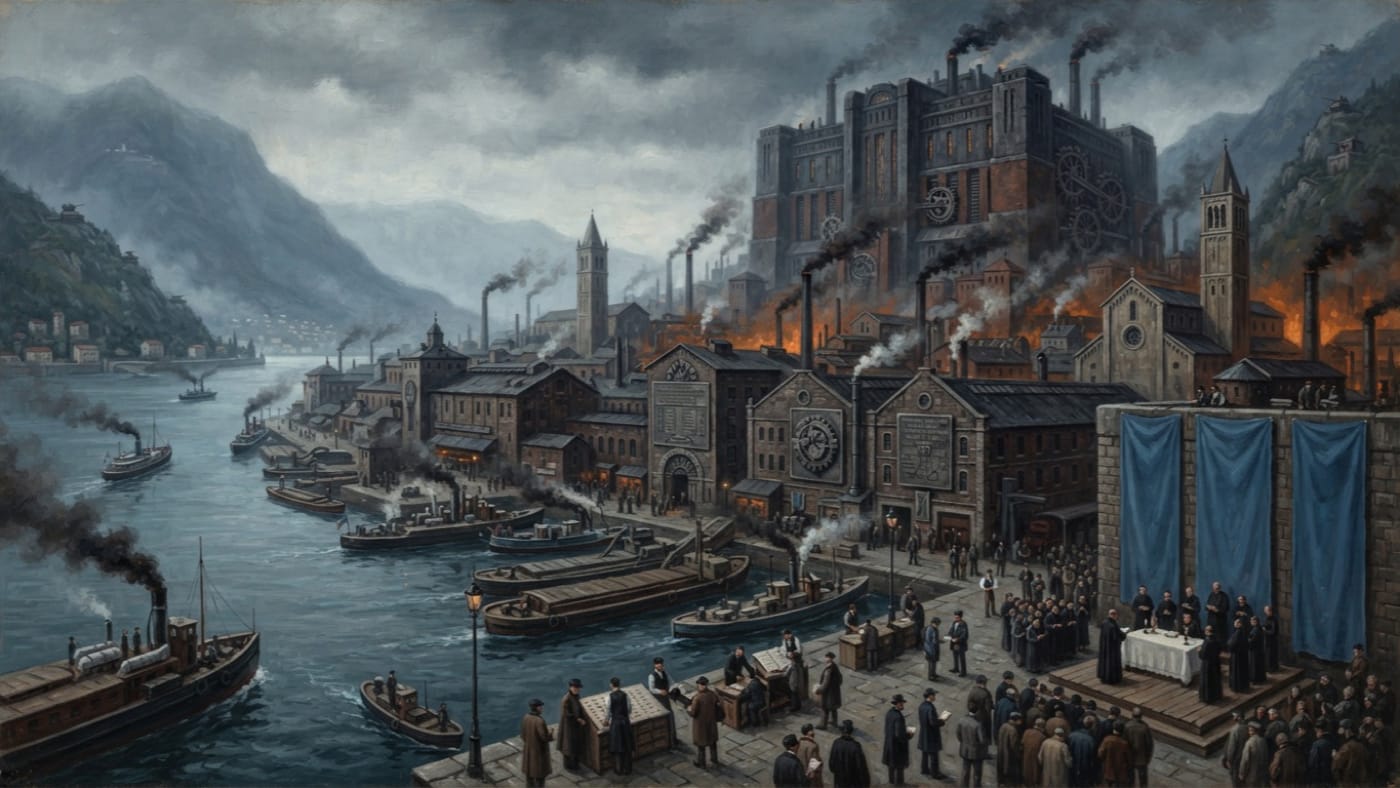
My published account of the Coalition records the sequence, and it contains the whole revolt in three hangings. The crossed keys, one for Rome and one for conscience, first appeared on blue silk hangings at a Mass held on the lakefront. Next they appeared on warehouse lintels. Then they appeared on the municipal tax office.
Mass, warehouse, tax office. Any clerk who cannot read that progression should go back to copying hymn numbers.
The hanging at the lakefront was a liturgical act. The lintel was a commercial declaration: this house trades under the keys. The tax office was the moment a sacrament acquired a receipt. Once the keys hung over the place where Como paid what it owed, Como had decided whom it owed. No proclamation was needed. The emblem had moved from altar to counting room to revenue desk, and a merchant or a magistrate had consented at every stage. A heresy that stays in the chapel can be handled by a confessor. This one had reached the till.
The garrison hesitated. Its commander did what a Synod officer is trained to do when events depart from the forms. The Coalition account does not name him, and I will not supply a name. He asked Strasbourg for clarification. Clarification arrived as three contradictory memoranda and one white-mantled observer. The observer observed. He noted who kissed whose ring. By the time his notes were complete, Como had changed its bells.
That was the change of bells. The city's hours had answered to Strasbourg, and now they answered to the keys. The record does not preserve the new pattern, and I decline to compose one. The point stands without it: the man who keeps a city's time keeps the city.
#On the Lombard Correction
Como was never the whole revolt, whatever its silk merchants told their grandchildren. The Coalition gathered support across the province through chapel, guildhall and warehouse: clergy who resented Strasbourg's appointment tables, merchants who resented inspection, and magistrates who wanted to issue orders without a countersignature. Como supplied the first sermon and the first hangings. Milan supplied the larger treasury and the louder oath, and its Key-Oath in the old exchange belongs to Milan alone.
The Bureau of War answered across Lombardy with the operation it calls hydrological pacification. The province calls it the Drowning of Lombardy. Roads were cut and canals were turned. Embankments were seized, and sappers let water into premises whose owners had barricaded them against men. Tithes froze the accounts. The Bureau of Purity stood at the fonts and asked what emblem hung in each father's hall. The Concordat had settled the Synod's authority sixty years earlier, and the Bureau did not treat it as open for debate.
Milan held longest. It had walls, money, and the belief that magnificence is a kind of armour. Como held for less time. The published accounts sum up the difference in a sentence I still count among my better work: Milan learned obedience in water, and Como learned it in silence.
The record allows me no more than that sentence. It gives no flood peculiar to Como, no water level any clerk measured, and no count of dead that any ledger certifies. I will not supply them to improve the scene. The regional correction reached the city, and the city submitted. The hangings came down from the lintels, and the bells answered Strasbourg again.
#On the Names That Remained
When the revolt was over, my own Bureau, the Bureau of Doctrine, chose to keep the Coalition's name for instruction and for further prosecution. The Bureau of Records kept the names of the participants. The Crossed Keys Roll was recovered from twenty-seven crates of soaked paper in Milan's municipal undercroft.
I repeat for any Comasque reader who hoped otherwise: the roll was in Milan. Como keeps no roll of its own and needs none, because its names are in Milan's. Families with warehouses on the water, parish clerks, guild officers who once approved a lintel: wherever they were identified, Records copied them alongside the Milanese, without distinction of scenery.
Ambrosius is the hook they hang from. He vanished in the final week of the correction. Several deaths are recorded for him, the versions do not agree, and the Bureau certifies none of them. A preacher with a grave closes a file. A preacher with no settled grave keeps it open. Since A.S. 150, Ambrosian sympathy has covered a broad family of offences, from papalist nostalgia to an old prayer said with suspicious tenderness. The breadth is deliberate. Heresy seldom announces its final title. It begins as fondness, local custom, or the habit of rowing out on a feast day to hear the bells from the water.
A.S. 151 circulars stated that all Coalition symbols had been destroyed.
Clarified. All surrendered symbols were destroyed. All recovered symbols were destroyed. Denied symbols were entered in a separate schedule, which extends across Lombardy and from which Como is not exempt. The Bureau does not publish Como's share.
#On the Present City
In A.S. 201 Como trades. Silk leaves the warehouses, ledgers fill the rooms above them, and the water is still beautiful, which nobody has yet found a way to tithe. The lake churches hold their services under supervision. Their bells ring as the Synod directs, and they file their bell schedules in duplicate. Como alone is held to that requirement, because Como is the city that once changed its bells without asking. One copy stays with the parish. The other goes to an office that has never forgotten a lakefront Mass.
Across Lombardy the guild keys are inspected every year for devotional geometry. An inspector turns each key in the light and looks at the angle of the bow and the cut of the wards, in case anything about it suggests a partner key once lay across it. A crossed key found on a private seal anywhere in the province still ruins a dinner, a career and a family, in roughly that order and at roughly that speed. The Comaschi know the rule better than most, because the emblem first hung on their lakefront.
Twenty-eight years after the rising, in A.S. 178, the province was given the Triune Alphabet as compulsory script. The Lombard vowels were judged seditious and were silenced from pulpit and gravestone alike. The record names no incident peculiar to Como under that regime. I mention it because it completes the picture of a province where public inscription is licensed, public speech is audited, and a silk merchant who wants to letter his own warehouse sign submits the spelling first.
The Comaschi have adjusted. Their compliance is elegant and prompt. They are courteous to inspectors and generous to the lake churches, and in every particular the Bureau can examine they are irreproachable. Families attend Mass on the water's edge under hangings of an approved colour, and they do not look at the lintels.
The schedule of denied symbols remains open. Como remains on it.