
#On the Salt That Eats the Rifle
At the Sister Trenches the sea attacks the Line twice a day and attacks its iron every hour in between. Spray comes over the seawall in fine grey sheets. It settles in the weave of the sandbags and in the wool of every coat, and it gets into the rifle through every seam the manufactory was too proud to close. A bolt put away wet at second watch is freckled brown by stand-to. The sea has never needed a breach to get at a weapon. A damp sleeve does the job.
Sea-salt corrodes the rifles faster than the smiths can replace them. Every replacement that reaches Elder or Younger has already passed under the Harbor-Chain of Thessaloniki, one to two days up the coast road. On the way it has been counted, stamped, carted, delayed, and waited for. The sea does no waiting. It starts on the new rifle as soon as the oilcloth comes off.
So the men clean. Every army that has carried iron near salt water has cleaned or died, and the soldiers of the southern flank of the Sagittal Line are no exception. What sets the coastal works apart is that their cleaning is done in unison, sung aloud, and counted toward the survival of the Line. The Church calls this the Hymn of Rust. The companies call it the last job before dark.
#On the Evening Office
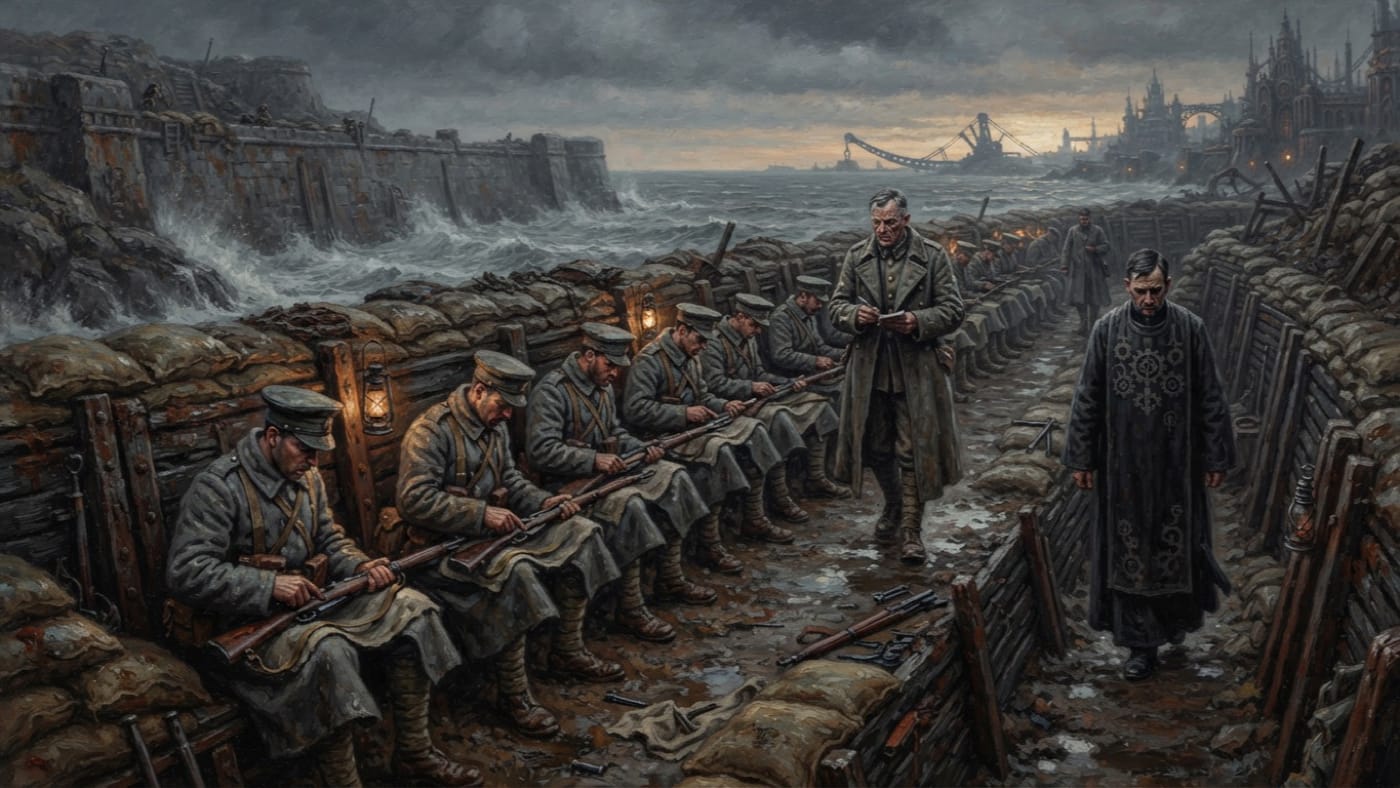
Every evening, in both trenches, the companies strip their rifles under supervision. The men sit along the firing steps with their knees in wet sandbag and the pieces of their rifles laid out on cloth. Lamps are kept low because the Grave-Tide watches the parapet. A sergeant walks the step. On many evenings a chaplain walks behind him. They are not always looking at the same things.
The chant begins once the metal is open. It is sung low and together, at the pace of a hand drawing a rag along a barrel, so that the cloth and the voice keep the same time. Rust comes away from the bolt in red-brown scale and drops onto the cloth, the boards, and the boots. Oil goes on after. The work and the singing finish together. A company that started late finishes late, and the sergeant can hear it.
The local account of its origin is short and believable because it does nobody any credit. The rite began as maintenance. It became a superstition, picked up a cadence, attracted chaplains, offended engineers, survived inspection, and was taken into official tolerance under the phrase "morale-adjacent care of materiel." No one in the account is named and none of its stages carries a date. One man scraped his bolt because his life depended on it. Another man hummed while he did it. A third noticed that the humming made the scraping happen on time.
None of the files I have been shown names a composer, and no hymnal edition prints the words. The words exist in the mouths of the companies. That is the least secure archive the Church keeps and the one it consults most often. Whether the hymn holds a licence is a question for the Bureau of Orison and Song, which has not asked me.
#On the Hour Claimed for Each Flake
The soldiers believe that each flake of rust that falls from a rifle lengthens the life of the Line by an hour.
Do the sum. Take a company of sixty men on a bad evening, when the spray has been in the bolts since noon, and allow each man a hundred flakes. That is six thousand hours added to the Line before the lamps go out. That comes to more than eight months, every evening, from one company, in one trench. The total lasts until the next morning, when the sea starts taking it back.
No ledger anywhere in the Church records these hours. I have looked, which is more than the soldiers have done. None of them asks to see the account, because the account is not the point. The point is that a man who believes his scraping buys an hour of the Line will scrape thoroughly, and a man who scrapes thoroughly will have a rifle that fires when the surf starts moving at low tide.
What can actually be shown is smaller. The rust is gone from the bolt, there is oil on the metal, and the rifle still works. The hour belongs to faith. The rifle belongs to the quartermaster.
#On the Objections of the Bureaus
The Bureau of Engines and Furnaces has recorded that the Hymn of Rust is a waste of time. The Bureau of Doctrine has recorded that it is discipline. Both findings are on file, and neither bureau has asked for the other's to be withdrawn.
It would be easy to cast Engines and Furnaces as the cold unbeliever at the trench lip, pocket watch in hand. That reading is lazy. This is the bureau that treats every cog as a relic and every piston as a psalm. It has no quarrel with sacred labour. Its quarrel is over which part of the labour gets the credit. When a furnace roars, Engines and Furnaces says the fuel did it, Doctrine says Heaven did, and the two have kept that argument going longer than most marriages survive. By that bureau's measure, the hymn spends minutes that the oil has already earned. Doctrine's answer is that the oil would never have been applied in time without the hymn. Neither has conceded the point, and the rifles stay clean while they argue.
"Engines & Furnaces claims it is a waste of time. Doctrine calls it discipline." — this Ledger, earlier entry on the Sister Trenches.
Amended. The earlier entry gave Engines and Furnaces a "claim" and Doctrine a "call." Both are findings, and both remain on file. The time is spent and the discipline is obtained. The Ledger takes no side on which of the two was wasted.
The Bureau of Engineering objects separately and should not be confused with its louder cousin. Its engineers look at the trenches through chain and level, and to them corrosion is attrition of stock, to be tallied as such. They were offended by the hymn at its birth and have stayed offended ever since, with a consistency I would admire if it were put to use.
The Bureau of War has no theory to offer. It has noticed that obedient soldiers with maintained rifles hold ground better than despairing soldiers with rusted ones, and it would prefer that nobody disturb whatever produces the first kind. In matters of liturgy, War is the most devout bureau of all, because it asks for nothing beyond results.
No single act has ever settled the jurisdiction. There is the phrase "morale-adjacent care of materiel," and there is the evening. Between the two, the rifles get cleaned.
#On Its Present Application
As of A.S. 201 the spray still comes over the seawall and the iron still gives way to it. The sandbags slump and are refilled, and the trenches collapse and are rebuilt. Wrathforged raiders still come out of the surf when the tide draws back, and the reports still file them under Maldrake's pressure. At low tide a rifle that will not chamber a round turns the man holding it into an entry in the casualty ledger. The Hymn of Rust is sung every evening because the next assault does not keep to a schedule.
Other songs are sung in the same trenches, and the reader should not confuse them. The Hymn of Salt is chanted at dusk over remains the tide has returned, as part of collecting and reburying them. Soldiers report that the Hymn of Saint Edras is heard in the waves themselves, sung by a voice no throat could produce. At second watch the Drowned Choir sings beneath the surf and pulls sleeping men toward it. The local defences against it are filthy singing, rifle oil under the nostrils, and a comrade with permission to strike first. The Hymn of Rust is none of these. No file I have read claims it wards off the choir, and I make no such claim here. It is a work song about iron. It ends before the dangerous hours begin.
The men on the coast age by corrosion. Their hands crack along the knuckles, and the salt goes into the cracks and stays there. They learn to strip a rifle by touch, in the dark, still singing. When a rifle is brought in from a dead man's grip, his company cleans it that same evening, sings it through like any other, and hands it to the next man. To the soldiers, his hours count the same as anyone's.
The Grave-Tide of No Man's Land keeps its own count of the dead. The companies keep theirs in flakes. Both totals change daily.