

#On the Present Compilation
Occupational survey, compiled for the Codex in A.S. 201 / 1911 CE. That year belongs to this compilation alone. It does not date the founding, inspection or edition of anything described below.
Purity employs many servants, and the Index Scribe holds the most theologically indecent post among them. A Lictor at least knows the clause he burns into a wrist. A White-Mantled Inquisitor may read the warrant before she serves it. The Index Scribe is ordered to guard what the scribe may not read and to read what the scribe may not remember, and is then expected at service again with clean gloves and an unclouded face.
That order is the whole occupation as the public record gives it. I have tried to improve on it in three drafts and one sermon. The order survived all four.
#On the House and the Glove
The scribes serve the Bureau of Purity at the Ashen Cloister, its seat in Strasbourg, Zone 2, three streets east of the Basilica of the Ledgered Saints. The master Index Damnatus is held there in chains and in Purity custody. The Codex gives the precise location in two voices. The Cloister account sets the master Index in a chamber adjacent to the Vault of Silences, under the Cloister's sealed floors. The Vault entry and the Index Chamber entry put the Vault beneath the Basilica, with the chamber inside it. I record both accounts and reconcile neither. A survey that settled the floor plan would be a map, and Cloister policy burns unauthorized maps unread.
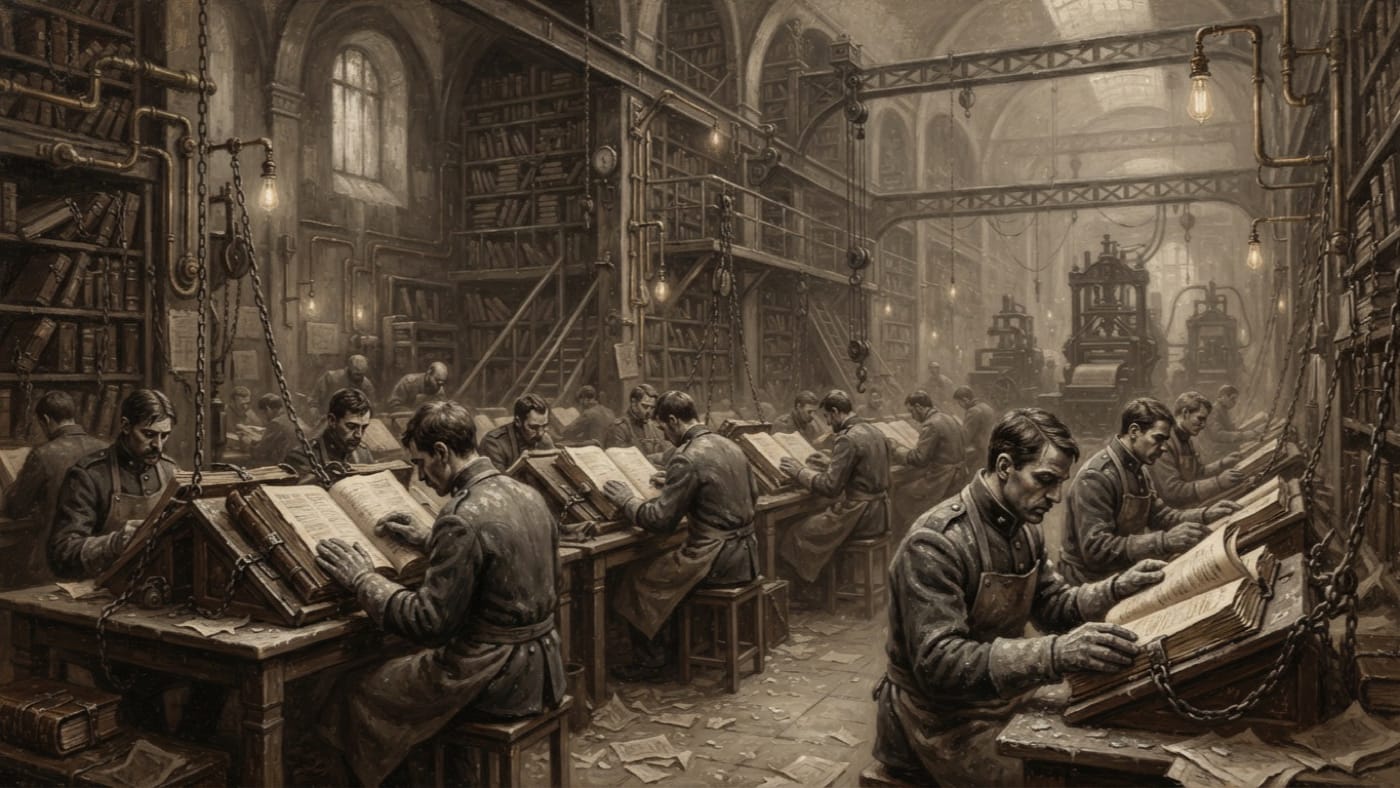
Every account agrees on the glove. The Index Scribe turns pages in gloves dusted with ash. It is the same sacramental grey that whitens the Cloister's outer wall and binds its mortar: the residue of burned contraband, brought back into service between the living finger and the condemned leaf. No document I have seen says the ash protects anyone. The documents say only that it is worn. Purity does not explain its powders to me. It issues them.
The Cloister account names one other figure close to this work: the low Index copyist. Before dawn the copyists come through the small service gate on Ash Cart Lane with the novices, wax clerks, ash sweepers and mantle washers. They are searched on arrival and leave by doors assigned according to rank. That is the copyists' entire public description. The scribes turn pages and keep guard, and the copyists copy. No document within my reach says whether every copyist touches the master pages, whether every scribe also copies, or whether one becomes the other through promotion, examination or simple attrition. I have watched pious clerks build a career ladder for both from that single sentence. The sentence contains no ladder.
"Index Scribe: a mid-rank of the scribal grades, between Register-Clerk and Seal-Operator."
Corrected. That line describes administrative scribal rolls kept under a different office. A Records grade with the same name does not make a rung in Purity's custody, and it does not prove a shared hierarchy, a common examination or a single guild. Two offices may own one noun. The Synod does this constantly and calls it economy.
#On the Categories Kept
The scribe guards a catalogue of proscription, which is a stranger thing to guard than a treasury. Gold does not grow while the ledger is shut, and the Index does. The Lore Book counts forbidden names, books, emblems, texts, relics, songs and kinds of incense among its concerns. My Cloister account adds tones, substances, recipes, colours, gestures and questions. It also adds the prohibitions that wait for nothing but the courtesy of being noticed. The Index entry divides the whole into Registers, each kept and sealed under its own wax and amended only by the ratification its Register requires.
None of the entries is reproduced here. The categories can be printed safely. The contents would make this survey a contaminated object and its reader a suspect.
A list that grows has to be kept current, so the custodian of a living proscription has to handle it constantly. The Lore Book records new names, words and phrases proscribed each week, with copies nailed at street corners, and it requires the faithful to memorize the updates or be judged negligent. The citizen is told to remember the Index. The scribe is told to forget it. Both orders come from the same Bureau, and both are obeyed under the same threat. The lettering on the corner slips is not attributed to the Cloister's copyists in any record I have seen, and I will not attribute it for them. Someone copies those slips. Purity knows who. I know only that the ink is cheap.
#On Custody, Courier and Command
Clerks in a hurry, and some Inquisitors who should know better, confuse three things: the hand that turns the page, the foot that carries the amendment, and the seal that authorizes either.
The Index Damnatus Runners are a separate profession. They work in the field, carrying amendment strips and sealed packets to gatehouses, ferry crossings, orphanage registries and the other places where a condemned name might try to cross faster than its condemnation. Runners travel. Scribes stay in the custody they were assigned. The record gives no account of what passes from one to the other, in which room, at what hour, or under whose countersign. A future clerk who writes a tidy handoff ceremony into this gap will be writing fiction with Purity's stationery.
Authority sits above both. Purity enforces what the Bureau of Doctrine defines. The Hierarch of Purity, whom I do not name, governs the Bureau whose chains the scribes tend. White-Mantled Inquisitors watch, investigate, arrest and attend the Vault. None of these offices is the Index Scribe, and the Index Scribe holds none of their warrants. Nothing on file shows a scribe defining a heresy, amending a Register or ordering a name struck. As far as the documents show, the scribe's hand works under every one of those powers and governs none of them.
"At the Ashen Cloister, the master Index is turned by Index Scribes in ash-dusted gloves."
Clarified, and not retracted. The Cloister account says so. The Vault and Index Chamber accounts describe a senior Inquisitor in bleached linen lifting the leaf at Matins with an ivory tongue while two watchers look away. Both accounts remain on file and neither has been retired. Until the Bureau says otherwise, no reader may merge them into a single rotation, a single room, a fixed hour or one shared rule of access. The Bureau has not said otherwise, and it rarely volunteers.
The same caution covers reading. The Index entry reserves reading for high authority. The Cloister account orders the scribe to read and then not remember. These may describe different pages, different chambers or different years of practice. They may also be one more case of two offices describing a single door from opposite sides. I set the two statements side by side and leave the gap between them open.
#On What the Hand Keeps
An occupation built on reading without remembering asks the human skull for something it was never made to give. The skull files everything. Tell it to forget a shape and it keeps the shape and drops the instruction. Purity understands this better than anyone, because Purity interrogates the faithful on exactly that principle.
I once wrote that many Index Scribes develop the calm of saints or furniture. I stand by the sentence as observation. It is not a diagnosis. I have seen scribes I would have taken for chapel fittings if they had not blinked. I have not examined them, and Purity publishes no roll of how its scribes fare: no count of breakdowns, no list of retirements, no tally of mothers whose nicknames went missing. That last phrase is mine. It comes from my own Cloister account, where I said the Index tightens its chains and makes clerks forget. That is a Hieromnemon's testimony about a frightening book. It does not prove the book acts, and a careful reader will keep the two apart even when I do not.
The nearest documented case belongs to a different office entirely. In A.S. 187 / 1897 CE, an Inquisitor, Breel, sat watch too long beside the master Index and was found to have transcribed part of a Register into her duty log with no memory of doing so. Attendance restrictions followed in A.S. 188 / 1898 CE. Breel was a watcher in the Vault, not an Index Scribe, and her case establishes nothing about the scribes' gloves, shifts or minds. I cite it because it is the one case on record of what happens when someone reads and remembers, and the work has no Index Scribe case to set beside it.
The scribe's instruction looks impossible, and Purity answers that it is obedience. The Amber desks two floors above would call it something else in a citizen. A citizen who reads forbidden matter and claims to remember none of it is under watch. A scribe who does the same is doing the job.
#On the Close of This Survey
This occupational survey closes in A.S. 201 / 1911 CE, the year of its compilation and of nothing it describes.
Before dawn at the small gate on Ash Cart Lane, the low Index copyists will be searched on arrival. The ash will be issued. The leaves will be turned under glove, by whichever hand the reader's preferred account names. What the hand touched will appear in no survey of mine.