
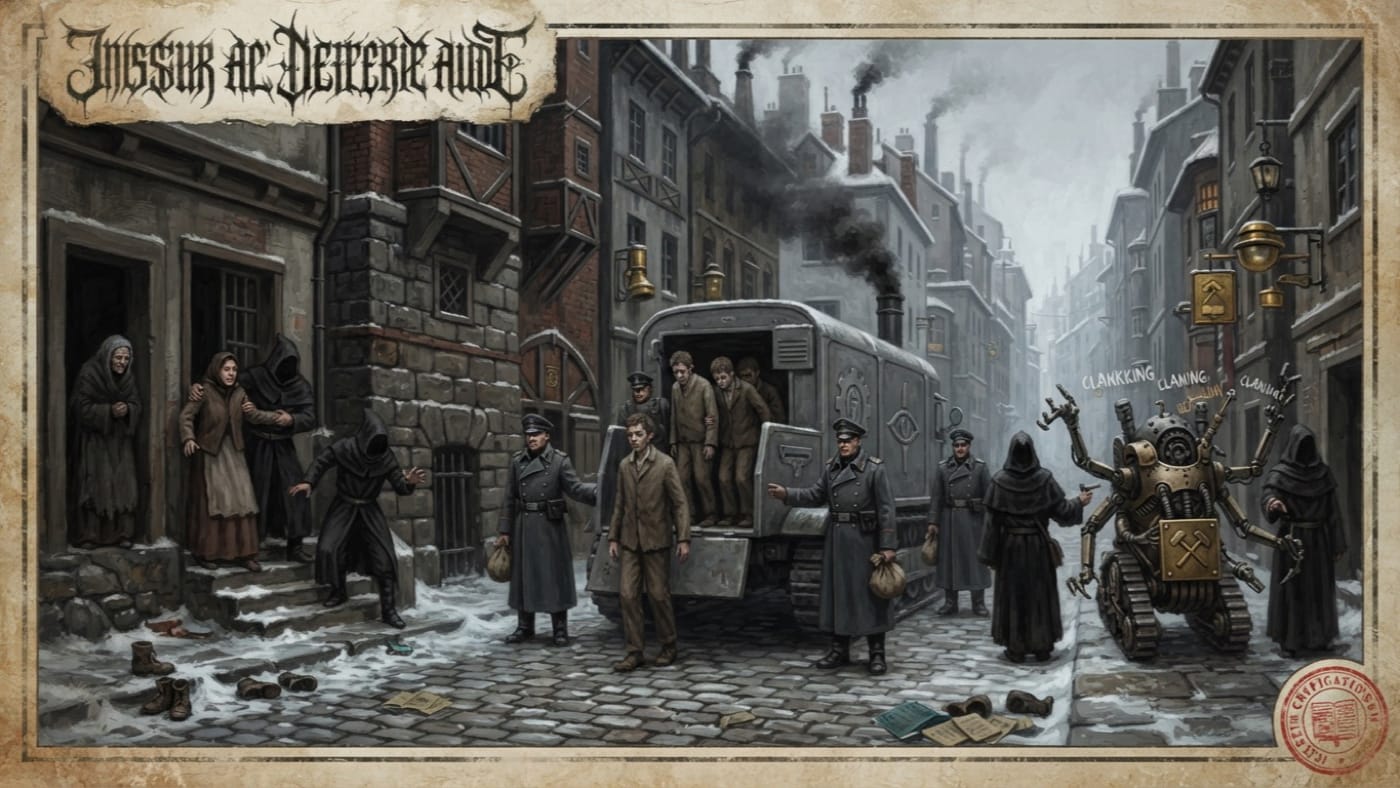
#On the Account Returned in A.S. 178
In A.S. 178 an audit at Innsbruck found a household that had kept three sons off the rolls for fourteen years. That sentence is the backbone of the public record, and every Bureau that has touched it since has tried to hang its own robes on it.
The Bureau of Conscription files the case as precedent: three stolen soldiers recovered, a concealment broken, the law proved right by arithmetic. I have read the precedent summaries. They are handsome documents, ruled in red, and they leave out the only number that matters to an honest clerk. Fourteen. For fourteen years three male lives ate, coughed, outgrew boots and slept in a city of the Inn valley, and the Ledger knew nothing of them.
An audit that ends in capture is a victory. An audit that arrives fourteen years late is a confession, and the Church has never been comfortable with confessions it did not extract.
#On the Law Behind the Audit
The audit rested on the Nursery Levy Decrees of A.S. 152. Before them, full infant registration was due within a month. After them, a preliminary birth notice was due within twelve hours of emergence, and full natal registration within seventy-two. Registrars gained the right to enter parish homes. Failure to register stopped being a slovenly omission and became concealment, which is to say heresy with a levy value.
Official theology supplied the varnish. A soul missing from the Great Ledger of Souls, the homilies taught, was missing from the Creator's sight, and what the Creator could not see, the Great Deceiver might claim. Doctrine asserts this. The Bureau of Conscription needed something plainer: a projected body for the Sagittal Line, entered at birth and collected when the table said it was ripe.
The Decrees were twenty-six years old when Innsbruck tested them. By then the cradle laws had produced their natural enemy, the Pale Kin Runner, a trade that grew up within two years of the seventy-two-hour clock. The Decrees did not invent the hidden child. They invented the trade.
#On Fourteen Years of Concealment
The record establishes the duration. It does not establish the method. I have no informer's name, no forged certificate, no hiding chamber and no investigator's report that I am permitted to treat as the account of how the household was found. Those who supply such details are writing romances, and romance in a Codex is a form of perjury.
What I can describe is the labour any concealment of that length demands. The Bureau of Records has spent a century learning exactly what a life leaves behind on paper. A child eats against a ration card. A child grows, and the growth has to be explained to neighbours, cobblers and the parish weigh-scale. A child falls ill, and someone must decide whether the fever is worth a physician's eyes.
Registry enforcement has its standing weapons: baptism checks, comparisons of weight against age, milk-ration audits and confession traps at parish lines. Against them the Runner trade fields false entries, swapped papers, borrowed ration support, and placements cut into compartments so that no single mouth knows the whole route.
Multiply one such defence by three sons. Multiply it again by fourteen winters of bread, linen, boots and silence. What you get is a household running its own counter-administration every day without a single clerk on salary.
I do not know which of those general methods this family used, or which of them failed at the end. The record says nothing about how the audit worked, and I say nothing with it.
#On the Disposal of the Household
There are three dispositions, and they must be kept apart, because the Bureaus prefer to blur them into one satisfying verdict.
The sons were conscripted. The levy that had waited fourteen years collected what it was owed. The record does not say where they were sent or what became of them, and I will not march them into a trench to improve the cadence of this paragraph.
The parents entered the Index Damnatus. That is the fact. The record gives nothing of their fate beyond the entry, and a reader who supplies a scaffold has built it himself.
The midwife associated with the case died in an iron choir. I hold her death and nothing else: not her name, not her exact offence, not the particular apparatus of her end. The Iron Choir's protocols are set out in the Bureau's own manuals in enough detail to spoil any appetite. I decline to borrow them for a woman whose file I have not seen.
Observe how the spoils were shared. Conscription received three bodies. Purity received two names for its book and one death for its instruction. Records received nothing but embarrassment, which it filed under corrected entries and sanded smooth.
The Innsbruck Audit proves that the Ledger sees every soul in the end.
Corrected: the Innsbruck Audit proves that the Ledger saw one household, fourteen years late. Claims of universal sight are withdrawn from this entry and returned to Doctrine, which may keep them.
#On the Strangers Who Had Already Lied
The audit counted guilt as well as sons, and some of the guilty never lived in the household at all.
During the Innsbruck Audit a washerwoman hid ration cards. That is all of her in the record I trust: a woman, a trade of lye and wet linen, and cards kept out of sight while the auditors worked. She is not named. Nothing shows that she knew the three sons, sheltered them or tried to save them. The Ward-Builders cite her as the kind of receiver they prefer, and I cite her for the same reason, with less affection.
A Ward-Builder places a hidden child with a stranger whose earlier, punishable mercy has already put her at the law's disposal. Shared exposure is the mortar. A woman who once hid cards from an audit has proved two things the faction values above blood. She will lie to the state, and she cannot easily betray the people who know she did.
Their rivals answer the question differently. Blood-Kin Purists send a child to an aunt or a grandmother first, keeping the name and the family table at the cost of a family tree any Purity examiner can climb. Ash Registrars care first for the empty space in the paperwork, holding that no escape in the flesh survives an obedient file. I cannot assign the Innsbruck household to any of these schools. The record does not, and I will not enlist a damned family in a faction to tidy a chapter.
The Ward-Builders profit from the audit whatever it finds. Every inspection that fails to catch the washerwoman certifies her for the next placement. Every family that falls shows the network which of its own joints will bear weight.
#On the Priority That Survived
Purity raised the Pale Kin's priority classification after the case. The Nursery Levy account puts the upgrade on the following morning. I accept the timing on that authority and add nothing to it: no calendar day, no numbered instrument, no tier.
The speed is instructive. Fourteen years of failure needed one night's reflection to become a doctrine of increased vigilance. Purity read the household as proof of the enemy's competence. Conscription read it as a recovery. Records declined to read it aloud.
Readers sometimes confuse this case with the bones of Mother Sava. Keep them apart. Sava burned her parish registry in A.S. 154 and vanished with eleven infants. Purity found her remains in an Innsbruck wall-cavity in A.S. 163, with eleven pairs of children's shoes, worn and outgrown, lying around them. That was a separate discovery, fifteen years earlier, with a different midwife and no family of three sons. The city simply has the misfortune of appearing twice in the same chapter of my office's shame.
In A.S. 201, twenty-three years after the audit, the Decrees are still in force, the priority is still raised, and the Pale Kin are still here. A household survives by staying illegible, and the registry lives by making it legible. Both parties have read the Innsbruck file. Both found it encouraging.