
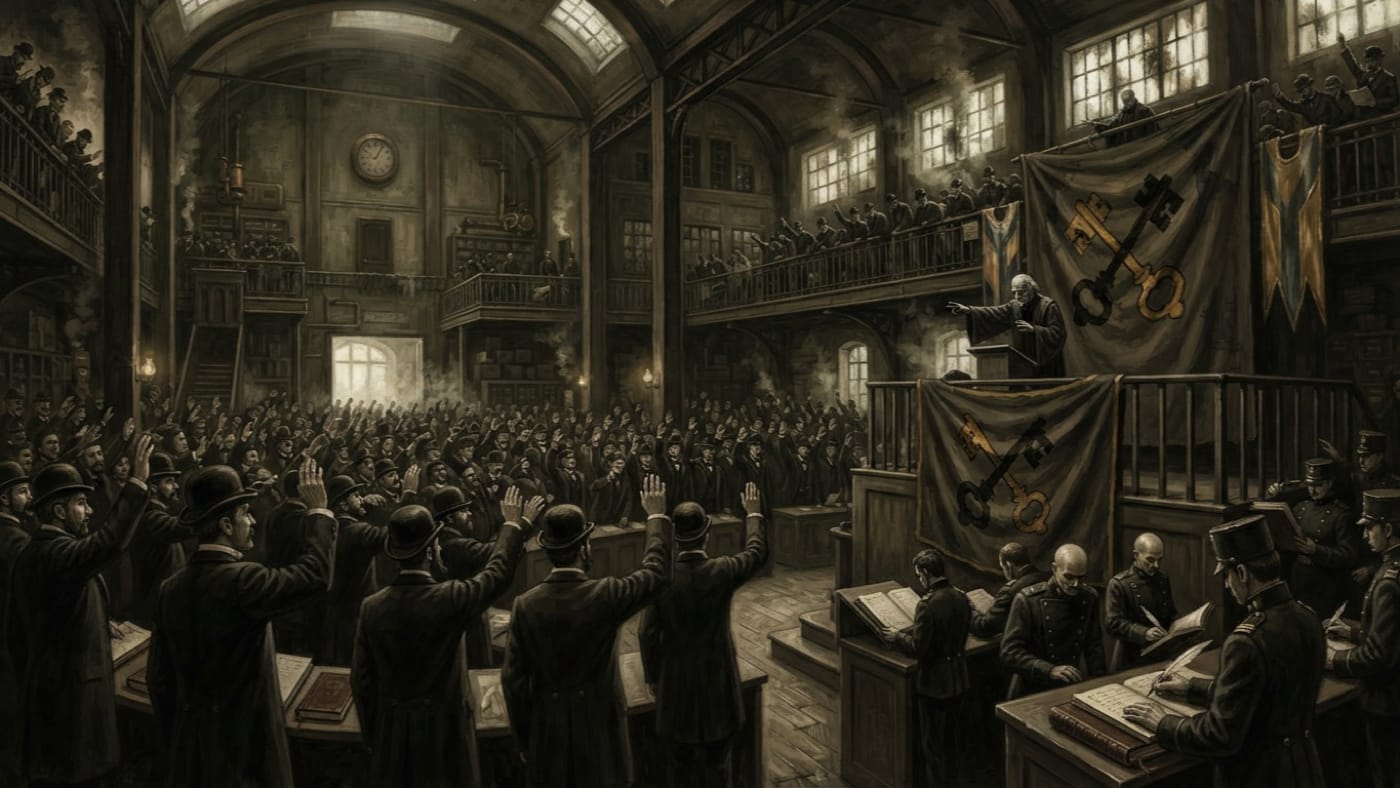
#On the Oath in the Old Exchange
The Key-Oath is the name the Church gives to what Milan's city councils swore in the old exchange in A.S. 150, with the guild banners hanging from the galleries above them. That is all of the sworn record the Bureau will sign. It took place in a hall built for trading bills, with the councils seated where brokers had shouted, and silk and steel hung over the rail like laundry with ambitions.
It matters that the place was an exchange. A cathedral would have made the business a heresy of the altar, which is a familiar disease with familiar cures. Milan chose the room where it priced grain, discounted paper and settled its debts. In that room it swore the city's civic allegiance to the Coalition of the Crossed Keys and to the man the Coalition called the True Successor of Rome. The Milanese have always believed that anything done among ledgers has been done properly. They took a commercial venue for a valid one.
The Bureau holds no certified day for the oath, no count of the councillors present, no list of names in the order they spoke and no rubric for the ceremony. Provincial pamphlets have since supplied all four with great energy. The Bureau of Doctrine supplies none of them. Invention is the schismatic's privilege. Precision is mine.
#On Rome and Conscience
The Coalition's emblem was two crossed keys, one for Rome and one for conscience. The oath took its name from that emblem. It does not follow that any councillor held a key, kissed one or laid one on a table, and the Bureau will fine the next engraver who draws it so. The name is heraldry. The rest is fancy.
The keys put the whole argument into a picture. Father Ambrosius of Como was the movement's principal preacher and chief key-bearer. He taught that Strasbourg had seized Rome's inheritance and put administration where apostolic succession ought to stand. In his account the Hierarchy governed by seal and register where it should have governed by the laying on of hands. The record does not place Ambrosius in the old exchange, and I will not put him there for a painter's convenience. His sermons travelled farther than he did. That is what sermons are for.
The claim needs careful handling. "True Successor of Rome" was a title asserted by partisans. No court of the Church certified the person, the lineage or the succession, and the Bureau of Doctrine does not certify them now. A man may call himself heir to Rome in a tavern, a pulpit or an exchange. Only the fine changes with the venue.
Against all this stood the Concordat of Strasbourg of A.S. 90, the constitutional settlement from which the formal Synod dates. Sixty years later, Milan's councils proposed to swear their city to an authority the Concordat did not recognise. Of the two keys, conscience was the more dangerous. Rome is a claim that can be examined, refused and filed. Crossed with Rome, conscience tells every alderman that he may examine the examiner.
#On What the Councils Committed
Milan does not swear empty-handed. The silk houses pledged cloth for uniforms, the armorers pledged steel and the bakers pledged loaves. The poor were promised bread after victory. The surviving account does not say whether these pledges were clauses of the oath, riders to it or simply the trading that filled the same week. The Bureau keeps the question open with some pleasure, because each answer convicts somebody different.
This much can be said: the oath gathered all three classes the Coalition rested on. The clergy brought the theology, the merchants brought the credit, and the civic notables brought the councils, the seals of office and the habit of being obeyed in their own wards. In Lombardy a guild commitment is never a private matter. It decides who is clothed, who is armed and who eats. When the guilds hung their banners over the councillors' heads, they placed the city's supply under the oath's seal.
That is where the Synod was injured. The Bureau of Oaths has jurisdiction over sworn words of every grade, from guild charters to peasant marriages, and enters them in its Ledgers of Fidelity under Strasbourg's seal. The countryside has a saying for it: no promise binds unless Strasbourg hears it. Milan's councillors were already sworn, through their charters and their offices, to obligations entered in those ledgers. The Key-Oath asked the same men to swear the same offices to another master. Two oaths on one office amount to a forged allegiance, whatever the parties believe.
The Coalition understood this well enough to build its own machinery. Across the movement it issued road warrants under crossed-key seals, collected grain in the claimant's name, appointed receivers and oath-clerks, and printed catechisms. I do not charge all of that to one afternoon in the exchange. I charge it to the principle that afternoon announced: that a city might govern itself with a second set of keys.
The record does not say whether a Witnesser of the Bureau stood in the gallery with his lead tablet. I note only that the Bureau has never needed an invitation.
Earlier provincial annals, and every Milanese pamphlet that copied them, treated the oath in the exchange as evidence of "three cities unanimously restored to Roman allegiance."
Corrected. Como turned by sermon, Milan by guild calculation, and the sealed city by a bargain the Bureau of Purity has not released. Only one of the three swore in its exchange. The annalists borrowed the word "unanimously" from the rebels' printers and never returned it.
#On the Answer and the Record
The Bureaus answered the oath together. The Bureau of War cut the roads into Lombardy and turned the branches of the Po against the barricades. The War Office files this operation as hydrological pacification. The parishes call it the Drowning of Lombardy. Milan held out longest, as an oath sworn among bankers was always going to. Tithes froze the accounts that had pledged the cloth and the steel. Purity questioned the households through their children at the baptismal fonts. The Bureau of Records copied what the children said, and my own Bureau supplied the meaning.
A frozen account is the proper reply to a sworn guild. The silk houses had promised cloth, and the cloth sat in warehouses whose ledgers no longer cleared. The bakers had promised loaves. The bread promised to the poor after victory never fell due, the victory having been cancelled.
Doctrine preserved the Coalition's name, along with the name of every participant it could identify, for punishment and for instruction. Records recovered twenty-seven crates of soaked paper from Milan's municipal undercroft. Its clerks dried the pages between sermon boards, weighted with confiscated reliquary plates, and copied the names into the punitive and instructional registers. That is how the Crossed Keys Roll began.
Mark the difference. The Roll is administrative paper recovered from a flooded cellar. It is not a signed original of the Key-Oath, and it is not a complete register of everyone who swore. Anyone who claims to have found the oath's text in the Roll has found a list of Milanese and wished very hard.
#On the Continuing Classification
Fifty-one years later, in A.S. 201, the Key-Oath binds nobody and governs a great deal. Ambrosian sympathy remains a classification. A key on a private seal still draws an inspector. The guild keys of Milan are examined every year for devotional geometry. Two of them left crossed on a counting-house table can ruin a dinner, a career and a family's standing with a single report. Milan's children learn their letters under a discipline sterner than any other in the province.
The councillors' heirs still sit in council. They swear their offices before the proper witnesses and under the proper seal. Their banners are registered. Their oaths are short.