
#On the Annual Ledger
"A name printed once is a rumour. A name printed every year is a government."
The Ledger of Succession is published once a year, and each year five names appear in it. They belong to five of the Hierarchs now seated in the Inner Circle of Strasbourg. They are printed so that every bishop, procurator and parish clerk in the Theocracy may know whose authority his orders came down from. My survey of the Hierarchy of the Synod mentioned this publication in a single clause. I am Warden of the Sacred Ledger, and I do not leave a sister instrument to live on one clause.
The Ledger has one purpose. Every decree, levy and dispensation the Synod issues claims to come down from the Seven Seals through an unbroken line of lawful holders. A levy is lawful because the Hierarch who sealed it was lawful. He was lawful because his predecessor was, and so on back, wax to wax, to the first entry. If a link breaks, the levy becomes extortion in a fine hand. The Ledger's work is to make sure that no link is ever found broken. It answers a question the faithful may not ask, and it answers every year so that they never need to.
#On the First Entry
"Every line must begin somewhere. The Synod prefers that it begin with a saint who cannot object."
Later registers put Augustinus at the head of the Doctrine succession. Any clerk who has handled them knows that entry was made afterward. Any clerk who says so in the refectory soon learns what contemplative duties are.
The order of events is plain enough. After the Sundering of A.S. 45, Augustinus held episcopal authority and then interim authority. In those years the Church governed whatever it could hold, and from about A.S. 50 a provisional council sat that did not yet call itself a Synod. The Common Allegiance of A.S. 55 was issued under his authority, and Kratz and Sabine shared in the work. The Council of Worms ratified it in A.S. 87. The Worms register holds 314 names, 289 clean seals and 25 seals with mixed defects. A list of names is no count of mitres in the room, and a defective seal is no proven forgery. I set both cautions down here because the provincial seminaries keep forgetting them. Augustinus was dead by the first weeks of A.S. 88, and Kratz died later that year.
The Seven Seals became constituted offices under the Concordat of Strasbourg in A.S. 90, when both men were in the ground. The Bureaus received their charters in A.S. 92, and more successors were confirmed in A.S. 93. Augustinus attended none of these proceedings. He signed nothing and appointed no one. The chair of Doctrine was finished after the man the registers seat in it had been buried.
So the first entry records an authority the Concordat later recognised, placed at the root of an office its holder never saw completed. The Synod did not invent that authority. It reclassified it, which takes more nerve and leaves fewer witnesses.
#On the Count and Its Custodians
"Forty-one is a fact. Forty-three is a doctrine. The remainder is classified."
There are seven offices, and nobody disputes that. The quarrel is over how many people have held them.
The Bureau of Records counts forty-one Hierarchs. The Bureau of Doctrine counts forty-three. The two extra are men whom Records classifies as administratively non-existent and whom Doctrine still cites because it finds them theologically convenient. The Bureau of Purity gives no number. Its position is that the count is correct and that the correct count is classified. The provincial almanacs give forty-seven. The Bureau confiscated them and did not quite manage to destroy them, so a few still circulate in the cellars of rural deans.
Each figure measures something different. Records counts the persons it acknowledges. Doctrine counts the persons whose rulings it still needs: a dissolved Hierarch's pronouncements remain in the commentaries, and Doctrine will not let a usable sentence go just because its author has been removed from existence. Purity counts in private, which is the only kind of counting that never has to be defended. The almanacs counted with the enthusiasm of men who were never going to be audited, and they turned out to be wrong about the audit.
None of this troubles the Ledger. It prints five names, and the legitimacy of a levy has never waited for anyone to finish the sum. A succession has to be continuous. Nobody has ever required it to be arithmetic.
#On Corrections to the Succession
"The Synod has never lost a Hierarch. It has occasionally mislaid one."
The Ledger's continuity is kept by correction, and the correction depends on the condition of the man being corrected. I recognise three conditions and do not let my clerks mix them up. A man may be missing from the evidence, condemned after his death, or dissolved out of existence.
The Third Hierarch of the Seal of Discipline is missing from the evidence. Records says moths destroyed his file in the sub-vaults of the Basilica of the Ledgered Saints during the damp winter of A.S. 112. Purity says no file ever existed. Doctrine says his record is complete in the sight of the Almighty, if not in the sight of the filing clerk. His portrait in the Hall of Succession has been painted over in ecclesiastical black, and its nameplate is blank. Three investigators looked into the matter, and all three were reassigned to contemplative duties. In the taverns they say the moths ate the man. That story mistakes a loss of paper for a miracle, and no Bureau has certified any miracle. The name is gone. What happened to him has not been established. His ordinal survives, and a succession can bear the loss of a name far more easily than the loss of a number.
The Seventh Hierarch of the Seal of Martyrdom was previously listed as Hierarch Delmatius of Cologne (A.S. 98–117).
This entry is retracted. In A.S. 147 the Fourteenth Doctrinal Congress declared Delmatius retrospectively heretical, after finding that his canonisation proceedings for the Twelve Martyrs of Brest rested on testimony extracted from a dead man. The extraction method is not specified. His name has been removed from the Hall of Succession and replaced with the notation SEAT OCCUPIED — OCCUPANT CLASSIFIED. His portrait has been turned to face the wall.
Delmatius was condemned after his death, which is a different instrument from the black canvas. The Congress did not dispute that he held the seat. It disputed his orthodoxy while he held it. The notation keeps the seat filled and withholds the man, so Martyrdom keeps an unbroken count and also a clean conscience. What becomes of the dispensations he sealed while the Church still thought him sound is a question the Congress did not answer. Nobody has asked me to answer it, and I will not volunteer.
Dissolution is the harshest of the three. A heretic stops having been orthodox. A dissolved man stops having existed. Records has dissolved two men whom Doctrine still quotes, so the Synod cites authorities it officially never had.
A fourth case is sometimes brought into this discussion and does not belong in it. The Twenty-Second Hierarch of Vigilance vanished from his chambers in A.S. 172. Records filed this as voluntary contemplative withdrawal. That is a disappearance with a plaque, and nobody has condemned him for it.
#On the Present Application
"Five names in print. One number in a drawer. One chair in a dust-sheet."
In A.S. 201 six of the seven chairs in the Inner Circle are occupied. The Ledger publishes the names of five of those holders. The Bureau of Shadows identifies the sixth only by a file number that changes every quarter. Nobody has told me which Seal that person holds, so I do not say. That person should not be confused with Delmatius, whose classification is a matter of history, or with the absent Hierarch of War. The file-numbered Hierarch sits in a chair. The Hierarch of War does not.
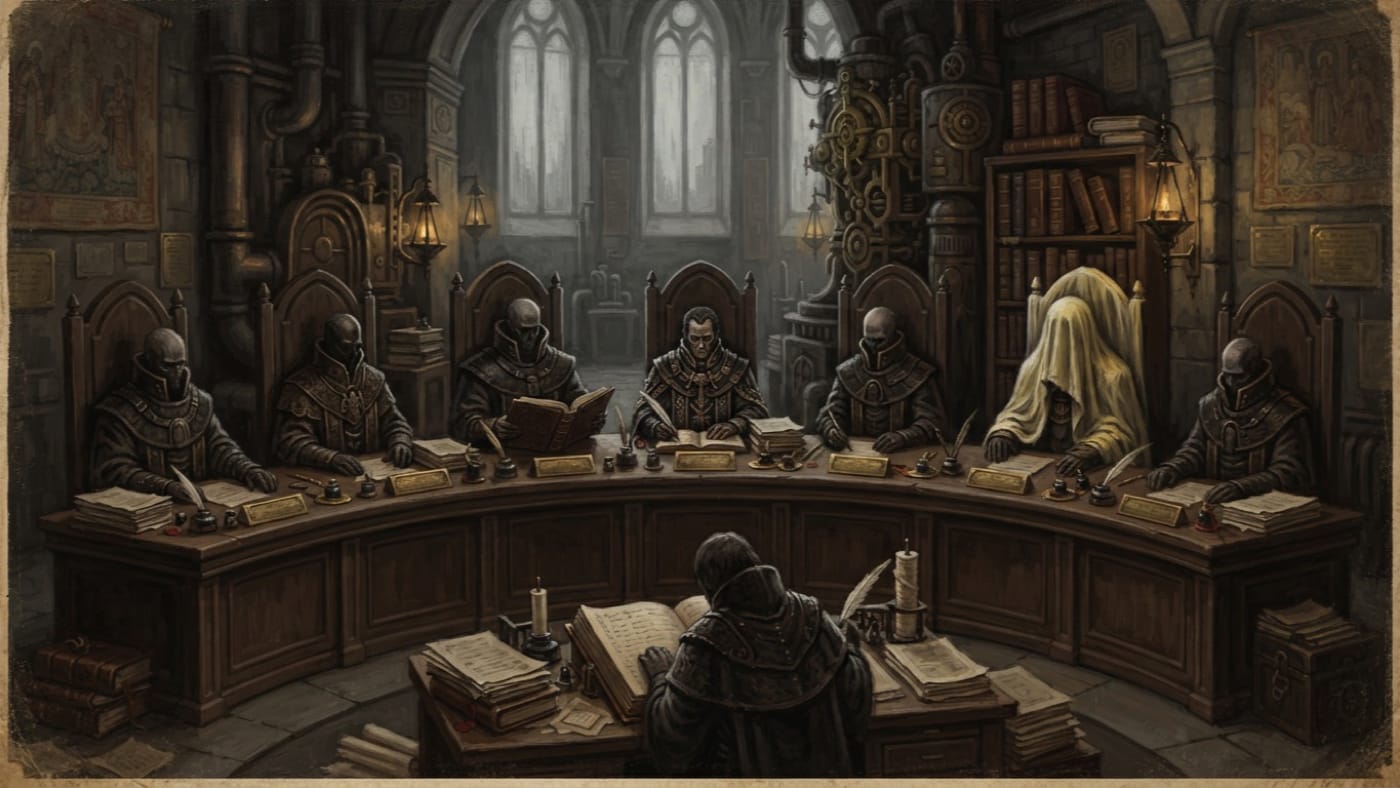
The seventh chair is War's. It has been draped in white cloth since A.S. 107, and the cloth has since yellowed. Records lists its holder as presently engaged in contemplative duties. He has been engaged in them for ninety-four years.
The Council of Veils is said to operate in the space left by that absence. I record only that it is said. My authorisation does not extend to whether it exists, who would sit on it, or whom it would answer to.
The recording clerk at the low desk in the centre of the Circle has two practices that bear on this. When a Hierarch fails to appear, the clerk counts his vote by faith and marks it with a red check. When a Hierarch dies during a session, his name is read into the minutes until the session ends. Both are rules for sessions. Nothing I am permitted to read says the annual Ledger follows either one. I note only that the clerk and the Ledger seem to share an instinct. An office is entitled to a voice whether or not anyone is in the chair, and someone in the Church can always be found to keep writing it down.