
#On the Writing That Must Be Warmed
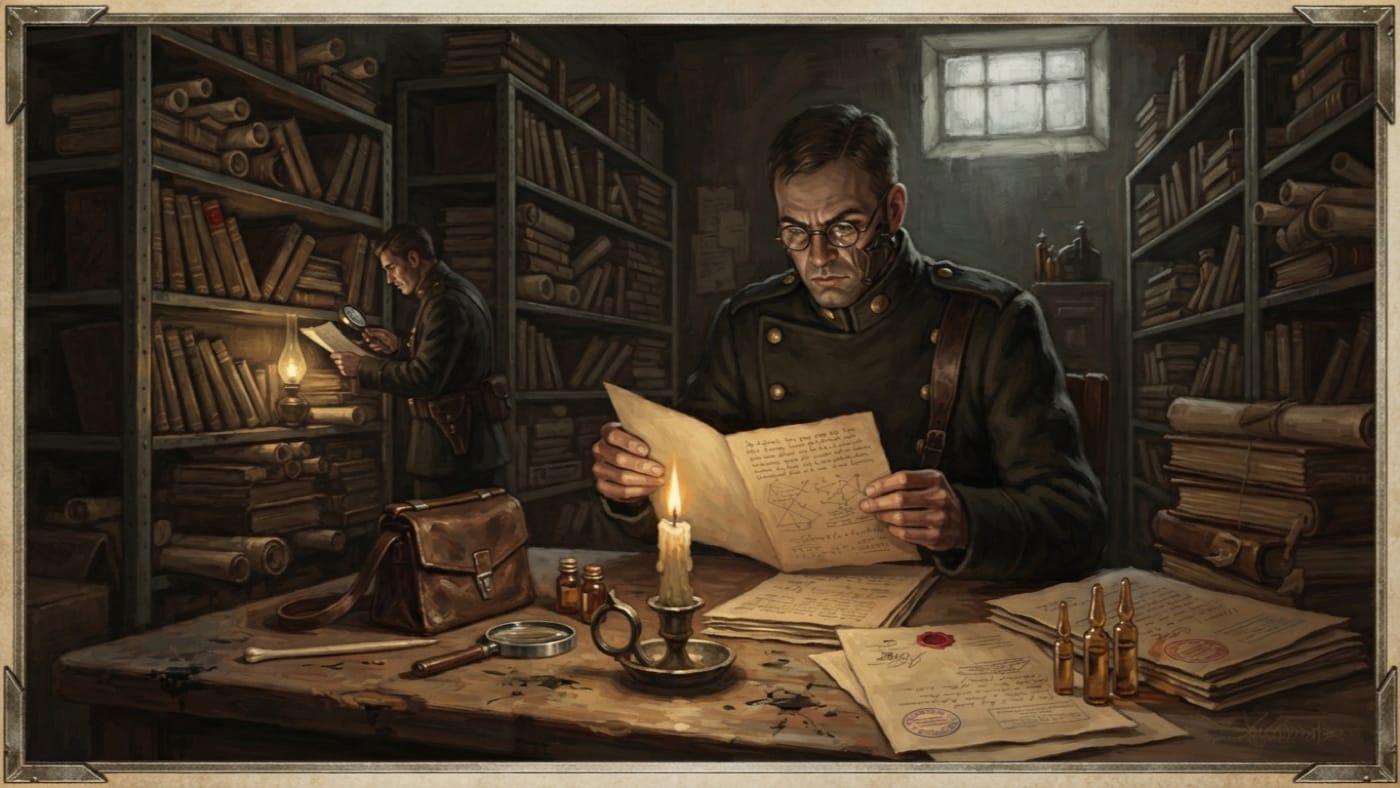
A page of lemon-ink looks like an ordinary page, and its whole usefulness lies there. At arm's length it gives you a psalm, a feast table, a dull commentary on fasting. Between the lines and down the white margins it carries a second text in a pale hand, which the eye skips the way it skips a water-stain. Hold the sheet near a candle and the second text browns into view, line by line, as the warmed paper gives up what it was told to keep.
The candle is the scandal. A copyist lights a tallow stub to read by, and an inspector lights the same stub to search by. Lemon-ink has no other defence. It belongs to the contraband of the Ashen Circle Scholar, who carries it in a small ampoule beside an ash stick, between the decoy prayer-book and the seal-scraper ring. It does one thing. It lets a forbidden sentence sit inside a permitted book until somebody applies heat.
The name says plainly enough where the fluid comes from. I will not print the method. The Codex is a register of the Church's enemies, and I will not have some seminarian learning cellar chemistry from my prose.
#On the Purge and Its Successors
The ink enters the official record through the Great Purge of Margins of A.S. 56–58 (1766–1768 CE). In those years the censorial offices of the young authority swept the Rhineland scriptoria for unlicensed annotation. Those offices were later gathered and constituted as the Bureau of Silence, and I give them that name after the fact, as one gives a foundling the family surname. The campaign began outside Trier and reached Mainz, Cologne, Ghent and Strasbourg. It ended with forty-seven scribes executed and twelve libraries confiscated. Those figures belong to that campaign and are set down in full in its own article. I do not repeat them here for pleasure.
Note the order of events. The Redactors of the first sweep were already warming pages over candles to test for lemon-ink. The ink therefore existed before the Purge, at least in some cellars, and no ledger records whose hand first brushed it onto paper. Its spread is documented. Its invention is not.
What the Purge did was make visible annotation a hanging matter. One scribe had written fever intervals in brown ink beside an antiphon. The scaffold in the courtyard taught that scribe that the brown had been the mistake.
After A.S. 56 the pale hand multiplied through cellars and rented rooms. Its users were not yet called anything. The Ashen Circle received its name in A.S. 103 / 1813 CE, decades after the first candle tests. The writers of the fifties were scattered clandestine scholars whom the later Circle has adopted as predecessors. The Church does much the same with martyrs it would have arrested.
#On What the Ink Carries
Doctrine, in my experience, does not bother to hide. The pale hand carries working matter: fever intervals, bridge ratios, bell corrections, the timing of a sowing, the dose at which a remedy turns into a poison. A bridgewright needs a load figure more than a sermon, and the figure needs a container that a patrol will wave through. The approved prayer-book is that container. Approved bindings have shelf rights, and hidden commentary borrows them.
Here a distinction must be drawn, because inspectors routinely fail to draw it. Lemon-ink hides that a mark exists. It does nothing to what the mark says. A warmed page may show plain arithmetic. It may equally show a coded summary that means nothing without the cipher wheel kept in another room. Concealment and cipher are separate crafts, and the Circle layers one over the other.
Nor should the ink be confused with ash-paper, the charcloth sheet carried in the same kit. Lemon-ink hides writing on a sheet that looks innocent. Ash-paper is a sheet built to burn. The two share a satchel. That proves no common manufacture, whatever careless clerks have since written.
The ink is one part of a larger apparatus. A scholar copies in layers: the true text, the decoy text, and a clean citation trail that leads an auditor politely nowhere. Couriers carry the pieces. Bone needles swap bindings without fresh cuts along the spine. False provenance letters assign a dangerous page to a harmless source. Knowledge is split so that no one holds the whole. The originals are burned, or a burning is staged for witnesses. Within all this, lemon-ink performs one modest office: it lets the true layer travel inside the decoy layer on the same leaf.
Ember Copyists memorise and transcribe. Soot Annotators code and clean the language. The novice learns lemon-ink by candlelight: writing the invisible line, warming it, reading it back, and then burning the notes. The burning is the part that counts as graduation.
Patrons tolerate all of this for as long as the fever breaks on schedule. A Ledger Prefect with a failing aqueduct asks no questions about how the figure arrived. When the auditors come, the same Prefect has never heard of candles.
#On Inspection
Defeating lemon-ink requires no instrument that a sacristan does not already own. The Interdiction Squads warm pages over candles, leaf by leaf, as the Redactors did in the first sweep. They inspect bindings for swapped boards and new stitching. They split endpapers, scrape boards and examine the dust under reading desks. A page that stays white under the flame goes into the report as clean. A page that browns becomes evidence. So does its owner.
No page is secure. A white page has passed one candle and waits for the next. The real danger of lemon-ink is the confidence it gives the writer. A scholar who has written invisibly is tempted to keep the page, and keeping one private page is the habit every member of the trade admits to and none survives at the wrong moment. The one thing no scholar outlives is being caught with the original during an audit. So the ink never works alone. Behind every warmed leaf there must be a copy somewhere else, a sequence held in memory, and a fire already laid.
The Circle's own proverb holds that a clean book is a trap. It is meant as a warning about planted texts. It is just as true of their own.
Ink testing appears among the standard audit rituals. Lessons in beating it appear among the scholars' side trades. I have read neither syllabus and do not intend to.
Official result: doctrinal correction achieved.
Corrected against the inspection record. The Purge removed visible annotation from approved scriptoria. A correction that still needs candles in squad hands one hundred and forty-five years later is a removal waiting to be renewed. The doctrine did not change. The ink changed colour.
#On Present Use
As of A.S. 201 nothing has changed in principle. The squads still warm pages. The scholars still write in the pale hand, still lodge it in approved books, still burn their notes. The training lectures present the Purge as a successful containment and leave lemon-ink out. New inspectors therefore learn the candle test from their sergeants rather than their lecturers, which is how every useful thing in the Church has been learned.
Warmed pages that brown are seized and sealed. The worthier among them end up in the Forbidden Stacks, beside the sciences they were written to preserve, where officials consult them when a bridge or a fever requires it. No inspector has yet asked who writes the figures those officials then sign.
The ampoule costs little. The candle costs less. Neither side has found a better instrument, and the contest between them is now older than the Circle's name.