
#On the Sheet That Leaves No Witness
Ash-paper is charcloth: rag linen burned in a closed vessel until it is black through, then stiffened with a thin size so it will hold its shape for one handling and one reading. It is black before anyone writes on it. The writing goes on pale, in chalk-grit, a bone stylus scratch, or lemon-ink sweated up under a candle. When the reader is finished, the sheet goes to the flame. A good sheet takes a spark at the corner and burns without much flame, only a creeping orange edge. It leaves a grey curl that falls apart if an auditor breathes on it.
The Church writes on vellum because vellum outlives the calf, the scribe and usually the argument. The Paper Mines of Ulm press condemned scholars into archival stock and redaction-grade vellum, so that even a heretic may serve the permanent record once his opinions have been removed with the rest of him. Every seal in the Synod assumes that what is written will stay written, and that what stays can be found, and that what is found can be hanged.
Ash-paper was made by people who had watched that syllogism carried out in courtyards. It is built to outlast nothing.
#On the Margin That Died First
The sheet is younger than the crime it answers. In A.S. 56 an Audit-Cantor outside Trier opened a hymnal of the Third Revision and found correct acoustics equations beside an antiphon in a monk's small brown hand. Within six weeks the same disease had been diagnosed in Ghent, Mainz, Cologne, Strasbourg and seven houses of copying. The Great Purge of Margins followed. Forty-seven scribes were executed and twelve libraries confiscated, and the annotated originals went down to the Forbidden Stacks.
The files that record all this belong now to the Bureau of Silence, and they call the campaign theirs. Silence was constituted in A.S. 82. The auditors, Redactors and cart-men of A.S. 56 served the censorial offices of an emerging authority that had no formal Synod yet. Silence absorbed those offices, renamed them and inherited their triumph. A Bureau may claim its predecessors' victories the way an heir claims the silver. Nobody asks whether it also inherits the debts.
The debt is ash-paper. After A.S. 56 the scholars of the Rhineland stopped trusting any page with an edge. A margin had become a noose measured to the finger. The first sheets turned up in the aftermath years of A.S. 56–58, which also brought the Night of Black Decrees and the Synod's first proud declarations that the Purge had worked. No ledger names an inventor. No cellar has confessed to being first. Later Silence files enter the origin as Rhineland, cellar, unattributed. It is the only entry in the censorial record that the heretics would sign.
Nobody used the name Ashen Circle in those years. The phrase belongs to Purity Interdiction Report 103-7A, filed in A.S. 103, almost half a century after the first sheet burned. The people who first charred linen in Rhineland cellars were margin-workers, clandestine copyists and monks who had lost faith in shelves. The Circle took them as ancestors later, and so did its hunters, and each side has found the lineage convenient.
Dr. Marrow Vask did not invent ash-paper. He was identified and burned in A.S. 57, and his Index of Safe Lies survived eleven burnings through twelve copy lineages. Vask taught the Circle to hide usable truth in doctrinal language. Ash-paper taught it where to put the truth once the language had been memorised: nowhere, briefly.
A Silence training digest of the present century describes ash-paper as "an evidentiary medium first developed for Bureau field use and subsequently misappropriated by heretical cells."
Corrected against the Purge files, which predate the Bureau by a generation and record charred sheets in the possession of the accused rather than the accusers. The theft ran the other way. The digest's author has been reassigned to a department with no history.
#On Manufacture and Use
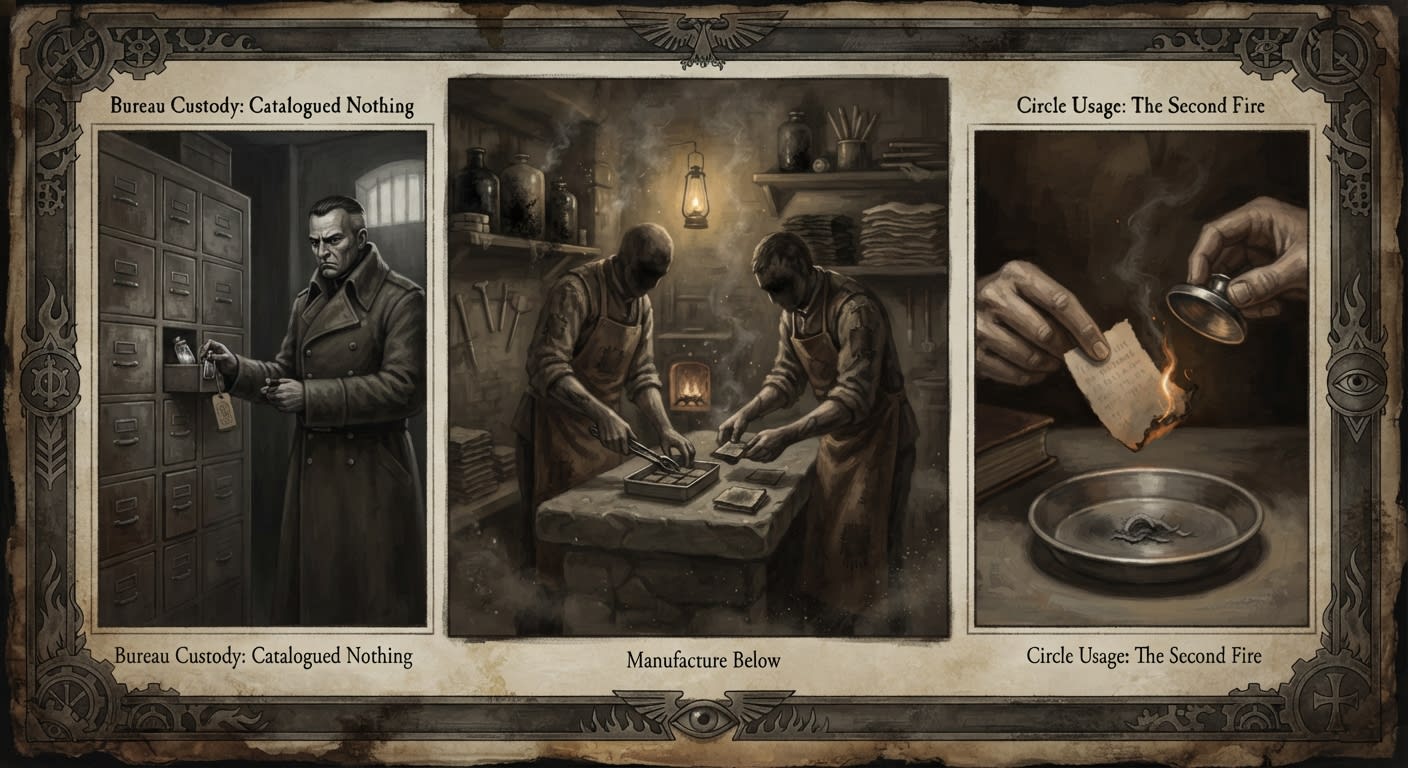
What can be said of its manufacture, I will say. Ash-paper is made below ground, in rooms with cold stone floors and poor drainage, by people with soot packed under their nails. They use whatever rag the laundry will not miss. The charring is done in a sealed tin at the back of an ordinary hearth, so the smoke that goes up the chimney is only supper. A cellar that makes ash-paper smells of burned cloth, tallow and damp. The Circle's apprentices call that smell dawn, and when a senior says ash is heavier at dawn, the apprentice knows a batch is cooling and the stair should be watched.
The sheets are small, rarely larger than a psalter leaf and often no larger than a playing card. They cannot be bound. They crack if folded twice. They take a single line well, a few lines badly and a paragraph not at all, and that suits their users, who have no intention of writing paragraphs. A sheet carries a fever interval, a bridge ratio, a bell correction, a countersign for a ferry, a dosage, or one line of a forbidden written Creed. The Eternal Creed article records ash-paper scraps among the illicit copies seized in the present day, along with lemon-ink and a tavern wall in Halle.
#On Burning, Division and Distrust
A sheet alone is merely suspicious. Ash-paper became a doctrine when the Circle married it to division. After the Purge, a formula that had once sat whole in a margin was split into six fragments and given to six custodians who disliked one another, on purpose. Each fragment crossed the city on ash-paper, inside a devotional case: an approved hymnal with its binding opened and re-sewn with bone needles so that no fresh cut showed on the spine. The receiver read the fragment, set it to memory against a cipher wheel and burned it. Then the receiver burned the ash.
Burn it twice is the Circle's name for this, and the second fire is the one that matters. The first destroys the writing. The second destroys the evidence that there was ever writing to destroy. A pinch of grey ash in a candle-dish is a question. A candle-dish scraped clean and rubbed with tallow gives an Interdiction officer nothing to ask about.
No complete text sits under one roof. No custodian can betray more than a sixth. The sheet is burned before the custodian can be sure the sheet was needed. The whole grim arrangement fits the idiom that a clean book is a trap: the approved hymnal on the shelf is spotless, the cellar desk beneath it is spotless, and the knowledge is held in six unfriendly heads.
#On Official Hatred and Official Theft
The Interdiction Squads still warm pages over candles and still split bindings. They carry shallow iron evidence dishes, because the only ash-paper they usually seize is already burning. Between A.S. 195 and 200 they took forty-seven Circle operatives across six provinces. The figure matches the Purge's forty-seven scribes, and nobody in the Squads' press office has noticed. The arrest reports list ash on the fingers as corroborating evidence. The acquittal reports, where any exist, note that half the Rhineland has ash on its fingers every winter.
INTERDICTION EVIDENCE NOTE — PROVINCE WITHHELD Item: single charcloth scrap, seized mid-burn from operative's hand Handling: transferred to evidence dish; flame extinguished under lid Observation: sheet consumed entirely. Dish floor retained a warm square matching sheet dimensions for approximately one hour. Officer [removed] reports the square "cooled from the edges inward, as though being read." Legible content: none Disposition: dish scoured; officer rotated to ledger duty
Hatred has never kept a Bureau from theft. The Bureau of Alchemical Standards issues ash-paper in its field kits with the silver tongs and the lead vials. Under the Alchemical Classification Ladder, assessors log Category One residue on it and seal it in white wax. Drawer 143-A holds forty-one ash-paper envelopes from the Thracian collection stations, A.S. 143–144. Envelope 17 was found resealed from the inside, and I decline to comment further on a drawer that has since been moved beneath a foundry floor. At Heldenplatz, commemorative ash-paper is sold to pilgrims for a separate fee.
Standards uses the sheet for the same reason the Circle does, although it will not say so. Some findings are safer written once, read by one assessor and allowed to fall apart before a committee can form an opinion. The Bureau of Doctrine applies that logic on a larger scale every day. It does not burn the page. It lets the page be forgotten, which takes longer and leaves fewer stains.
#On Present Custody
As of A.S. 201, ash-paper passes through Circle cellars from Strasbourg to the eastern bastion basements. Hospital orderlies use it for dosage intervals they are not licensed to know. Quartermasters use it for route countersigns that must not survive a captured satchel. The Forbidden Stacks beneath Strasbourg, which keep dangerous texts so that officials may consult them, hold no ash-paper that can be read. They hold boxes of labelled ash. Each box is catalogued by provenance, date and seizing officer, under Silence custody with the Records and Doctrine co-seal and Purity's right of inspection. It is the best-documented nothing in the Church.
Silence training lectures still present the Great Purge as a clean success. They do not mention ash-paper. Omission is Silence's native grammar, and it would be ungracious to expect the Bureau to speak about the one medium that has perfected Silence's own art.