
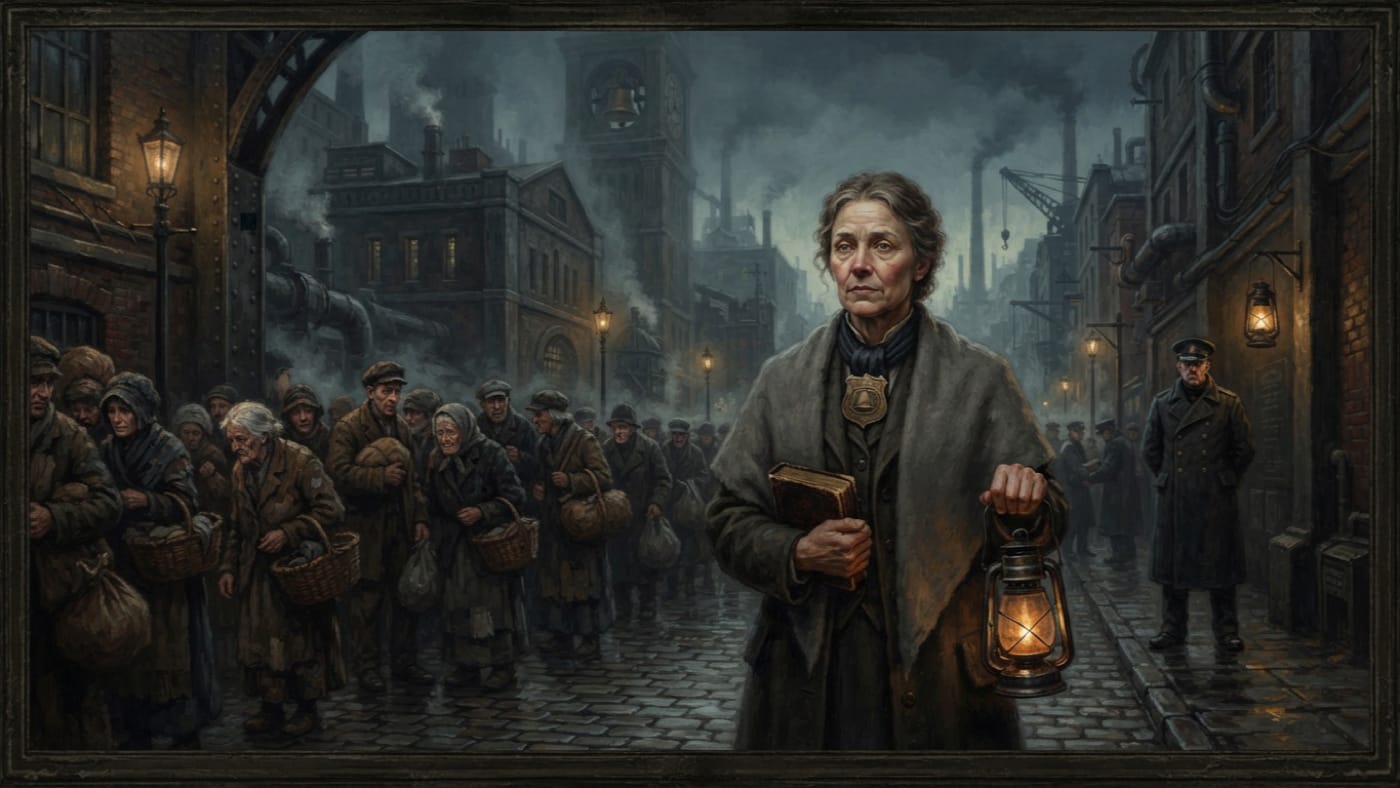
#On the Licensed Office
"Rest now, for the bell will call you to purpose." — Approved Comfort, Bureau of Rites issue.
A Licensed Consolator is a civic employee with a lantern. The office was ratified by the Curfew Ordinance of Quiet Hours in A.S. 94, four years after the Concordat of Strasbourg gave the Church its formal Synod and the Synod its taste for ordinances. Its purpose was disorder: the nightly disorder of exhausted people kept in the street by queues, burials and the curfew itself. A cudgel patrol at a Rhineland crossing produced broken heads, broken windows and a report. A soft voice produced quiet. The Bureaus can do arithmetic when the sum is cheap enough.
Three Bureaus divided the labour, as three Bureaus always will. The Bureau of Rites wrote the words, fourteen Approved Comforts to be memorised and recited. The Bureau of Purity vetted the people on the ground of temperament. The Bureau of Records stamped the lanterns. The grey-stoled Consolator went out to the curfew crossings with a light, a book and a schedule, and the crossings grew calmer.
The office worked. I record this first because everything after it is the Bureau finding out what working costs.
#On Admission and Authority
The first Consolators were volunteers, drawn from former almshouse staff and retired minor clergy. These were men and women who had already spent a working life telling the poor that soup was coming, and who had no other use for the voice once the almshouse shut or the parish replaced them with someone younger. The Synod took them because they were available, practised and cheap. Nobody asked what they felt.
Purity's word was temperament. I have found it written down often and defined nowhere, which is entirely in Purity's character. A Bureau that publishes its tests invites candidates to pass them.
The licence permits very little, which is why it is useful. A Consolator may reassure. A Consolator may counsel grief, sit beside the bereaved, and talk a quarrel at a ration desk down from fists to muttering. A Consolator may recite any of the fourteen Comforts in the accent of the district. A Consolator may not add to them. Supplemental exhortation requires canon approval, and the canon who approves it signs his name to whatever the sentence later does.
The licence explains presence. It answers the Warden who asks why this woman is standing at the bridge stair after the bell. It answers nothing else.
#On the Issued Lantern
A Consolator can be recognised at forty paces, and that is the intention. The stole is grey and unembroidered, visible to any ward and carrying nothing a vain parish might add. The lantern is civic issue, with amber glass where authorised. The brass badge is parish-stamped and worn at the throat, where an inspecting Warden need not ask to see it. Then come the parish token, a throat scarf against the fog and the approved prayerbook. Last is the authorised schedule, folded, which proves the bearer is exactly where he is being questioned. Chalk is carried only in districts that admit chalk.
Every one of these objects can be inspected, and every one is. The duty starts before dusk with the lantern and the papers: glass whole, seal intact, badge matching parish, schedule matching station. A smudged lantern earns a second look, and a schedule for the wrong crossing earns a third. A Consolator who passes takes station as the light fails and holds it through the curfew bell. By then the queue mouths, ossuary gates, tavern thresholds, infirmary corridors and bridge stairs are full of people the bell has caught outdoors. Rounds follow, and after them the parish report: station kept, Comforts delivered, disorder reduced.
Pronunciation is inspected as well. The standard permits local pronunciation, and that is the most dangerous permission in it. The Comforts belong to Rites, the vowels belong to the district, and the district does not report to Rites. A Consolator in a Rhineland ward who says rest the way her grandmother said it is acting lawfully. Whether she means anything by it is for someone else to transcribe.
#On the Fourteen Comforts
I will not print all fourteen. Rites holds the texts, and the Codex is not a prayerbook for the unlicensed. Three circulate freely enough to quote: The Creator sees your labour. The Synod shelters your obedience. Rest now, for the bell will call you to purpose.
They are good sentences: short, obedient, and impossible to argue with at midnight. Each names an authority and a consolation. None names an address. A widow at an ossuary gate hears that the Creator sees. A debtor at a ration desk hears that obedience is sheltered. A conscript's mother hears that the bell has a purpose, which is more than the levy notice told her. The street goes quiet. That is what the Consolator is for.
Then comes the trouble. The Fog Preachers carry the same lantern, wear the same stole and recite the same fourteen texts. They are the street-facing tier of the Lantern Mercy Preacher apparatus, and their whole method lives in the permissions I have just described. They pause inside a lawful sentence. They lean on the word sees. They add one phrase after the approved blessing, said low enough to pass for a sigh. Behind them are Candle-Runners carrying schedules, Mercy Architects planning routes, and Tongue-Smiths writing lines that pass audit on paper and mean something else aloud. None of these is a grade of the licensed office. They are the network's own names, and the Ordinance gave them nothing but a lantern to stand behind.
A licence proves employment and nothing about membership. Purity has learned, at some expense, that an honest Consolator and a Fog Preacher look identical until one of them speaks a sentence Rites did not write.
#On Pastoral Overreach
The office ran for forty years before Purity brought a charge against it. In A.S. 134 the Bureau detained seven Licensed Consolators across three Rhineland districts. The proceedings are entered as the Warden Sermon Trials. The offence was pastoral overreach, a classification the Bureau of Rites invented for the occasion. So Rites wrote the Comforts and then wrote the crime of adding to them. One admires the economy.
The seven were found by plainclothes Confessor-Booth Clerks, who stood at the crossings pretending to inspect the weather and wrote down what was said. Their transcripts showed approved Comfort language throughout, plus sentences the Bureau had not written. The clerk's work is simple. He lays the sermon beside the text, line by line, and marks where the text stops and the Consolator keeps talking. The margin of that page is the indictment.
The transcripts were read aloud in tribunal. The accused wept, and the tribunal noted that weeping is not a defence. Five were reassigned to trench chaplaincy at the forward bastions. Comfort is always short there, and an extra sentence is unlikely to be overheard by anyone who survives the week. Two were immured. The Bureau of Mercy sent flowers.
Parish manuals of the early office filed the Consolator's supplemental phrase as "pastoral colouring."
Corrected after the Warden Sermon Trials of A.S. 134. The supplemental phrase is pastoral overreach, a charge before Purity. A tribunal does not try colouring. It tried seven Consolators.
The office survived the trials. Its licences protected nobody in them. The later warning case is Lira Voss of Bastion-Brest, the bridge-fortress on the Bug, whose brass-ribbed trusses stand in river mist a long way from any Rhineland crossing. She was licensed, watched, cited and immured after telling a levy queue that their sons were cheaper than the mortar. Her lantern was in order, and her badge was at her throat. Neither was the problem.
#On Continued Employment
The office stays in service because the street stays exhausted. The ration queues have not shortened. The ossuary gates have not closed. The curfew bell still rings and catches people outdoors, and somebody must stand at the crossing and tell them to rest. An honest Consolator does this well. A skilled one does it so well that the riots stop.
That is when the auditor arrives. A crossing that is too quiet earns a clerk in plain clothes. A Consolator who is too loved earns a transcript. The Lantern Brotherhood watch on the same corner may shield her, ignore her or report her, depending on the Circle and the week, and she will rarely know which before the dawn report. Competence is the office's purpose and also its chief evidence.
A Consolator is commended on the evidence of a quiet street and detained on the same evidence when Purity reads it differently. I sign both kinds of form, in the same ink.
Disposition of the office: retained, and watched.